Around this time of year, the gringo and Canadian (they are adamant they are NOT gringos) population in Oaxaca begins to grow — an increase that will last for the duration of winter. Called “snowbirds” by the resident ex-pats, they are an eclectic and interesting crowd. Among them are a couple of talented people with whom I have become acquainted — San Francisco Bay Area based writer, Robert Adler (who, along with Jo Ann Wexler, publishes the invaluable, Viva Oaxaca) and Seattle photographer, Tom Feher.
Robert and Tom have embarked on an ambitious project interviewing and photographing undocumented immigrants on their arduous and dangerous journey from Mexico and Central America, en-route to El Norte. The result is to be a traveling exhibition of 24 to 30 of near life-size images on narrow aluminum sheets designed to be hung from the ceiling and accompanied by a booklet with the biography of each immigrant. The exhibition will be called, I Have a Name — the title coming from a neighbor of Tom’s, “who, having hired a Latino man to do some work, refused to call him by his right name and referred to him only as “the Mexican”, even though he was from Guatemala. ”
The decision to leave all that is known and loved for distant country and alien culture is not undertaken lightly. The creators of this project hope, in the words of Robert, that the exhibit, “will convey what we’ve been learning firsthand–that it’s one thing to have a concept such as ‘migrant,’ ‘migrant worker,’ ‘undocumented worker,’ or ‘illegal alien,’ and quite another to know people as individuals with their own names, faces, life stories and dreams.”
This is an expensive project and Robert and Tom need your help to bring I Have a Name to fruition. They have mounted a fundraising campaign on the crowd-finding site, Indiegogo. Please consider helping them raise $25,000 before their November 25, 2013 deadline.
Much like the Mark Twain line, “The report of my death was an exaggeration,” unfortunately, so too the news announcing the death of GMO corn in Mexico.
Contrary to reports, genetically modified (GMO) corn has not been banned in Mexico. On October 10, a Mexican judge from the Twelfth Federal District Court for Civil Matters in Mexico City issued an injunction suspending field trails of GMO corn, however, a complete ban was not ordered.
Federal Judge Jaime Eduardo Verdugo’s ruling does order the halting of “all activities involving the planting of transgenic corn in [Mexico] and ends the granting of permissions for experimental and pilot commercial plantings.” [Read full article, HERE]
Sometime around 8,000 years ago, corn was first domesticated in the valley where I have the privilege of living. Botanists have determined that the valley of Oaxaca was the “cradle” of maize evolution. Maíz became the lifeblood of the Mesoamerican diet and culture and it continues today.
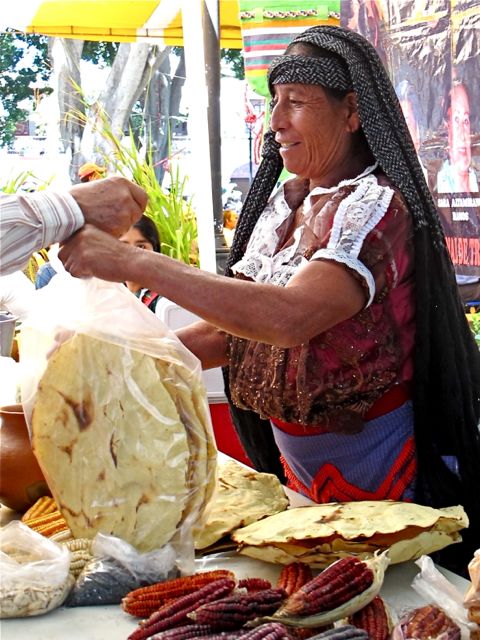
On September 29, Oaxaca celebrated el Día Nacional del Maíz Nativo (National Native Corn Day). On the zócalo, across from the Government Palace, there were displays showcasing the multiple hues of native corn…
There were tlayudas for sale…
However, there were also warnings about the dangers of genetically modified corn and the products containing them…
Genetically modified corn is a major issue in Oaxaca. There is a concern that native plants could become infected with GMOs, which would then contaminate and compromise the genetic diversity of native varieties. Speakers, at the event, discussed the importance of the community seed banks that have been established to safeguard native varieties and be used in the wake of economic and ecological crisis. Two weeks after the aforementioned event, there was good news, a Mexico judge has placed an indefinite ban on genetically engineered corn.
And so to celebrate, I am re-posting the Lila Downs video of her song “Palomo del Comalito,” paying homage to maíz, and its “granitos de cristal” (grains of crystal).
And to bring this post full circle, the video was filmed in Teotitlán del Valle, located here in the valley where corn was first cultivated.
There is a lot of work that goes into getting a marmota ready to go to the dance. Getting dressed takes a quite a crew and there is a lot of up close and personal last-minute cinching that must be done. Then there is squeezing (she does weigh over 70 kilos) through the church plaza portal, to make her grand entrance onto the street. However, once she emerges, she joins with her friends to dance through the streets of Tlacolula de Matamoros late into the night!
This slideshow requires JavaScript.
Calenda in honor of el Señor de Tlacolula, October 11, 2013. Living history from the valley where corn was first cultivated.
Expats and Mexicans alike, are watching in amazement at the nonsense (as in, making NO sense) taking place in the hallowed halls of Washington DC. And, since many of the expats are retired, we are holding our collective breath over the possibility social security checks will not be forthcoming in November and a tanking stock market that flushes our nest eggs away. Of course, Mexico is in the middle of its own mess, “educational reforms” and economic proposals that will hurt Mexico’s working class and rural populations the most.
Wall in Oaxaca city.
In a New York Times article two days ago, Carlos Puig explains the reality of the material conditions that have forced the teachers of Oaxaca to take the drastic action of abandoning their classrooms to lead massive and extremely disruptive protests in Mexico City against the “No Child Left Behind” style reforms that the Peña Nieto led government has proposed and passed. (Read a critique of the US education “reform” by Diane Ravitch, former “No Child Left Behind” proponent, here.)
Oaxaca is 500 kilometers from Mexico City, yet the real distance is much bigger. The state’s G.N.P. per capita is one-quarter the average for the country. Oaxaca ranks second-to-last among all states in infrastructure. More than half its population lives in towns of fewer than 2,500 people.
Being a teacher in Oaxaca means sometimes having to travel for an entire day to reach your school in a tiny community, teach for three days — to children of all grades — and travel back home for the weekend. It means having to deal with children who speak more than 20 different dialects.
Being a teacher in Oaxaca means operating in a different universe — and under different rules.
Banner hanging in front of a school in Oaxaca city
However, as in the USA, the incomprehensible words coming out of the mouths of the 1% and their elected representatives are mind-boggling in their obliviousness to the adverse consequences their behavior and policies cause. And, we scratch our heads in amazement… McClatchy journalist, Tim Johnson, has repeatedly blogged about the exceedingly “bad” behavior exhibited by Mexico City’s rich and powerful directed at those they consider “below” them — most recently, Las Ladies, episode 7. And, just last week in Oaxaca, most were aghast to read that an indigenous woman, in the advanced stage of labor, was turned away from a hospital and forced to give birth on the hospital lawn.
Daniel Goleman had a revealing piece in the New York Times a few days ago that helps explain where this lack of empathy the ruling elite exhibit, that results in callous social policy, comes from. He explains in Rich People Just Care Less that, by necessity, “the poor, compared with the wealthy, have keenly attuned interpersonal attention in all directions…” And that, “A growing body of recent research shows that people with the most social power pay scant attention to those with little such power” and, “In politics, readily dismissing inconvenient people can easily extend to dismissing inconvenient truths about them.”
Okay, now we know why the rich care less, so what are we going to do about it?
Before returning to honor al Señor de Tlacolula this Friday, I figured I’d better finish posting pics from last Friday’s la Virgen del Rosario calenda.
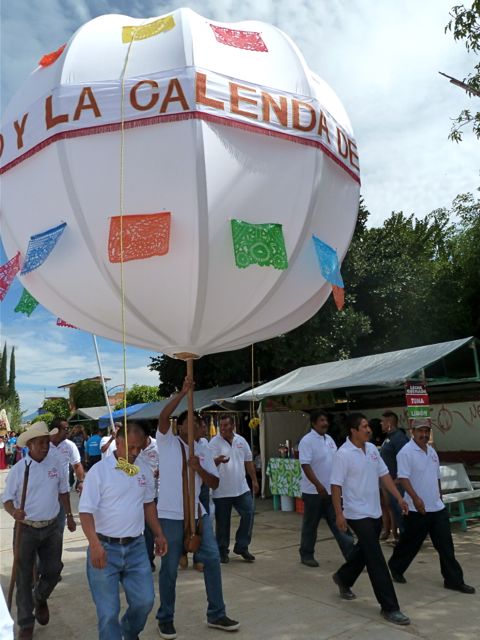
This annual procession slowly winds its way through the streets of Tlacolula de Matamoros. Participants stop at “stations” throughout the village, where religious ritual is performed, rest breaks are taken, and tamales, sweets, and beverages (yes, including mezcal) await. This goes on until after midnight. I don’t know how they do it!
Yesterday, we headed about 20 miles southeast of the city to Tlacolula de Matamoros for their calenda (parade) in honor of la Virgen del Rosario (the Virgin of the Rosary). While we go to Tlacolula often, especially for their Sunday market, and while we’ve been to countless calendas, this particular one was a first — and what fun it was!
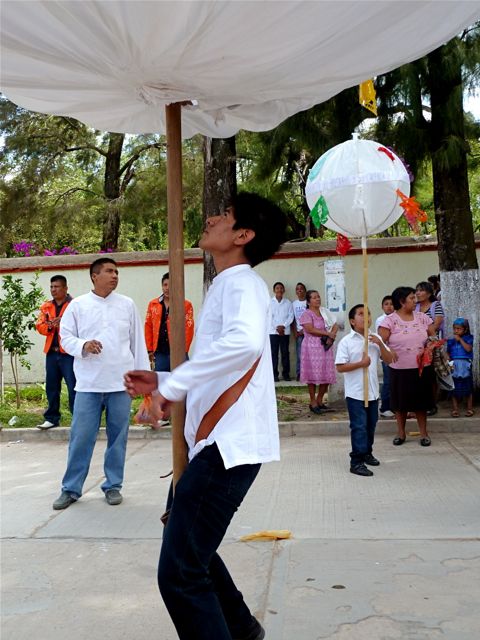
I’m always amazed at the variations from one village to another — even those only a few miles apart. I have to say, one of the most striking features of Tlacolula’s calenda was the masses of marmotas. No, I’m not talking the groundhog/woodchuck variety. These, at their most awesome, are ginormous cloth globes on a pole that are carried in every calenda I’ve ever seen down here.
Little boys start out with little marmotas — learning how to position it in the holster and becoming comfortable carrying it for several blocks.
The pre-teens graduate to bigger and heavier marmotas and the lesson here is one of balance — learning to find one’s center — and that you get by with a little help from your friends.
Teens refine their moves and their “look.” Look ma, no hands! After all, a central part of the calenda is a procession of the unmarried girls and young women of the village!
Young men eventually become good-natured and married journeymen…
I’m guessing it never ceases being a source of macho pride — enough to tempt one of Tlacolula’s senior citizens into showing, he’s still got it!
And then there was the gringo…
Check out Oaxaca–The Year After for this hilarious tale in his own words. (I’m still laughing!)
When you are caught in stop and go (mostly stopped) traffic and getting hungrier by the minute, the only thing to do is turn off onto a side street and find an Irish pub.
Hamburger and French fries = comfort food to soothe the traffic-challenged soul. But, in Oaxaca??? Yes, McCarthy’s Irish Pub in Reforma! Probably wasn’t the best dining decision we have ever made. French fries were pretty good, but hamburgers left a lot to be desired. However, by the time we left, the traffic had thinned and it was smooth sailing home!
Early Wednesday evening, I walked down to the Palacio de Gobierno to see Dreamer, one of the Oaxaca FilmFest4 offerings. It had been raining on and off all day and so, to lighten my load and make room for my umbrella, I left my camera at home. Why would I need it? I was just going to be sitting in a small dark theater. Sheesh, was I mistaken! It was twilight when I entered the Palace via the side door on Flores Magón, but we were directed to exit through the main front entrance — and I was blown away by the scene before me. The rain-soaked zócalo glistened and glittered, awash with El Mes de la Patria green, white, and red lights.
Needless to say, last night when I returned to watch, Twenty Million People, I took my camera!
Heroes of the independence movement, Hidalgo and Morelos in the spotlight as they gaze down from the Government Palace. I always forget how beautiful the zócalo is at night!















 Mexican Peso Converter

 View From Casita Colibrí
They ARE different
October 11, 2013 by spixl
Expats and Mexicans alike, are watching in amazement at the nonsense (as in, making NO sense) taking place in the hallowed halls of Washington DC. And, since many of the expats are retired, we are holding our collective breath over the possibility social security checks will not be forthcoming in November and a tanking stock market that flushes our nest eggs away. Of course, Mexico is in the middle of its own mess, “educational reforms” and economic proposals that will hurt Mexico’s working class and rural populations the most.
Wall in Oaxaca city.
In a New York Times article two days ago, Carlos Puig explains the reality of the material conditions that have forced the teachers of Oaxaca to take the drastic action of abandoning their classrooms to lead massive and extremely disruptive protests in Mexico City against the “No Child Left Behind” style reforms that the Peña Nieto led government has proposed and passed. (Read a critique of the US education “reform” by Diane Ravitch, former “No Child Left Behind” proponent, here.)
Oaxaca is 500 kilometers from Mexico City, yet the real distance is much bigger. The state’s G.N.P. per capita is one-quarter the average for the country. Oaxaca ranks second-to-last among all states in infrastructure. More than half its population lives in towns of fewer than 2,500 people.
Being a teacher in Oaxaca means sometimes having to travel for an entire day to reach your school in a tiny community, teach for three days — to children of all grades — and travel back home for the weekend. It means having to deal with children who speak more than 20 different dialects.
Being a teacher in Oaxaca means operating in a different universe — and under different rules.
Banner hanging in front of a school in Oaxaca city
However, as in the USA, the incomprehensible words coming out of the mouths of the 1% and their elected representatives are mind-boggling in their obliviousness to the adverse consequences their behavior and policies cause. And, we scratch our heads in amazement… McClatchy journalist, Tim Johnson, has repeatedly blogged about the exceedingly “bad” behavior exhibited by Mexico City’s rich and powerful directed at those they consider “below” them — most recently, Las Ladies, episode 7. And, just last week in Oaxaca, most were aghast to read that an indigenous woman, in the advanced stage of labor, was turned away from a hospital and forced to give birth on the hospital lawn.
Daniel Goleman had a revealing piece in the New York Times a few days ago that helps explain where this lack of empathy the ruling elite exhibit, that results in callous social policy, comes from. He explains in Rich People Just Care Less that, by necessity, “the poor, compared with the wealthy, have keenly attuned interpersonal attention in all directions…” And that, “A growing body of recent research shows that people with the most social power pay scant attention to those with little such power” and, “In politics, readily dismissing inconvenient people can easily extend to dismissing inconvenient truths about them.”
Okay, now we know why the rich care less, so what are we going to do about it?
Part of a mural on Niños Heroes in Oaxaca city.
Share this:
Posted in Culture, Economics, Education, Politics, Protests | Tagged education, educational reforms, graffiti, Mexico, Oaxaca, photographs, photos, political commentary, protests, street art, Teachers union, United States legislation, wall art | 13 Comments »