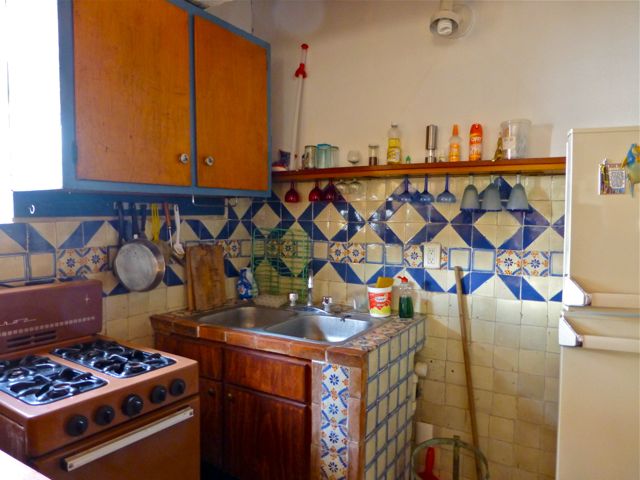
Initially, when I came face-to-face with the kitchen at the bigger and better Casita Colibrí, I was convinced there was NO way I could make it work and that IT should be numero uno on the make-over list. A double sink, but no counter space? A grungy ancient copper-colored stove that may or may not have been safe to light? A cabinet door that couldn’t be opened, because said stove was in the way?
With a little pleading (whining), management replaced the stove with a new one that had been hiding in the storage shed. I installed the shelf unit I’d gotten for my old apartment and I had the cabinetry painted white — making it more functional and easier on the eyes — and I was happy. Hey, a friend even wanted to practice using his new fisheye lens.
(photo by Alan Goodin)
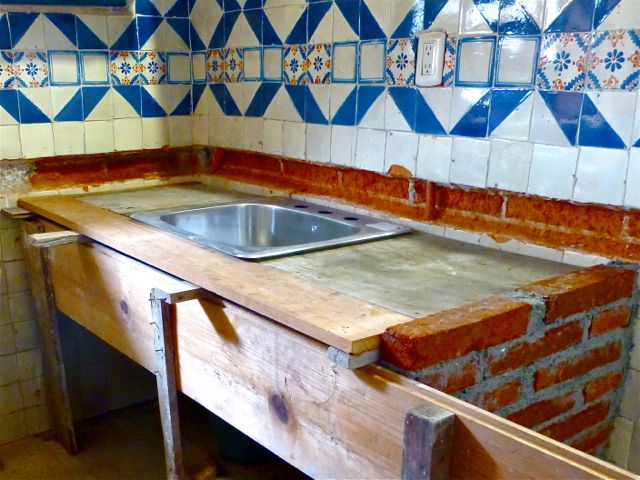
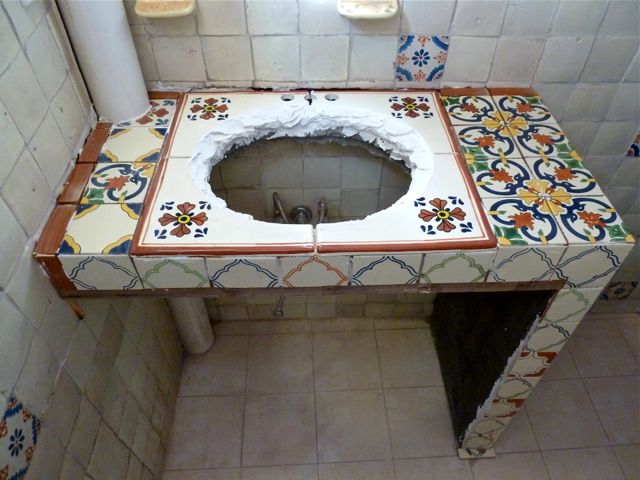
However, the talavera transformation in the bathroom turned out so well, I was inspired, plus the cement at the base of the kitchen sink unit kept falling out. Thus, talavera transformation, part 2 began two weeks ago.
The old cabinet was demolished (oh, the polvo!) and the new counter, with new sink, began to materialize from the dust and debris.
Again, I scavenged tile from the bodega. Luckily, there were several boxes of russet orange tiles, but they were slightly smaller than most of the other orphan tiles, making finding accent pieces a challenge. I didn’t want to introduce another color into the blue/cream/orange mix that already tiled the walls and so was hoping Nalo and crew could salvage some of the old tile, but it proved far too time consuming.
The result? I love the cleaner, less busy, look for the kitchen. And, the crew took about 6″ off the top of my old shelf unit, so it would fit under the new counter and I wouldn’t lose the storage space. It’s faintly visible on the right behind the blue plastic curtain.
One of my grandmother’s oft-repeated sayings was, “You can’t make a silk purse out of a sow’s ear” — but I’m trying!!!
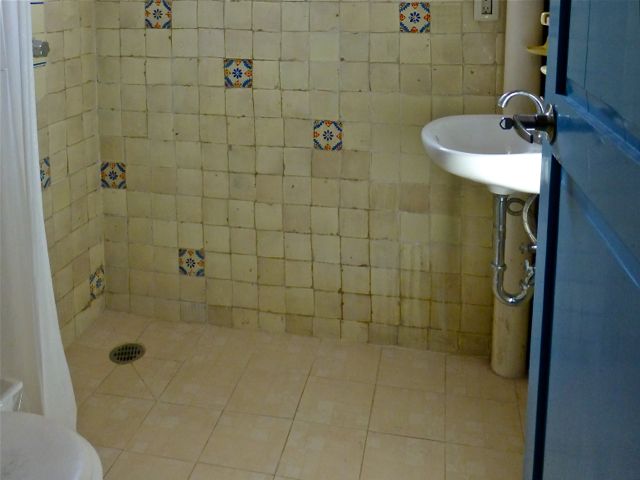
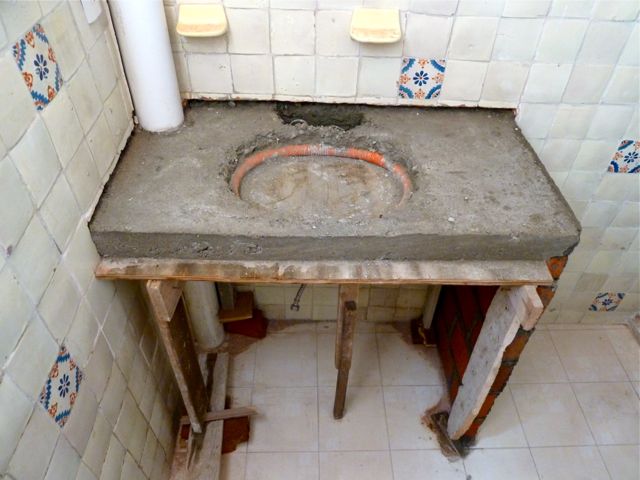
For those of you who may not be aware, most Mexican bedrooms and bathrooms are small. In the US, it’s what I grew up with and lived with most of my life, so I’m cool with that. However, what has driven me nuts is the lack of a bathroom counter. How does one handle toothbrush, tube of toothpaste, and water bottle, without at least one of the items ending up in the sink or on the floor? And, forget trying to apply makeup!
So, when I moved into my bigger and better, but also with the aforementioned deficiency, apartment a year and a half ago, it became number one on my “find a way to fix” list. Serendipity motivated me into action, when I happened upon a talavera sink and surround on sale AND discovered a treasure trove of leftover talavera tiles in the bodega (storage shed) here at my apartment complex. Project proposed and permission given by the property’s owner (thanks Doug), I hired a contractor, and work began.
Being completely ignorant of construction of this type, I was fascinated by the process.
Once I’d received the okay for the project, I began hauling up buckets of mismatched tiles from the bodega and laying them out on the floor of my main room — in an attempt to create some sort of unified design — it was exciting to see it materialize.
The finished project…
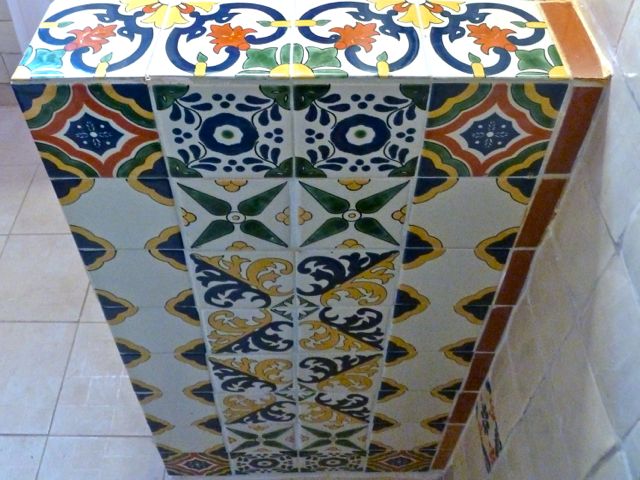
And, take a look at the side — it’s what one see’s when opening the bathroom door. I think Nalo and his crew did a super job!
What a difference a bathroom counter makes. Form and function!!!
I walked down to the zócalo today. Not exactly big news, I know, but the truth is, I’ve been avoiding it. However, I was out of dried cranberries and pecans and had to go to the Mercado Benito Juárez to restock the larder.
New posters have gone up on building walls, this one calling for justice for the victims of the previous governor (Ulises Ruiz Ortiz) and preparations for a general political strike against the structural reforms (education and the state-owned oil industry, of which I’ve previously written) recently passed by the federal government.
The zócalo and surrounding streets continue to be filled with teachers, tents, and al fresco kitchens. No surprise, this is causing a traffic nightmare and parking is at even more of a premium than usual. However, if you are in need of a pit stop for you or your car, this one is on Trujano at 20 de noviembre.
The restaurants under the portales on the zócalo have been especially impacted — some had patrons sipping their morning coffee and hot chocolate while looking out over the sea of tents, tarps, and banners and some were empty.
If you are tired of reading the newspaper accounts, D-II-218 of the Telesecundarias (rural distance education programs) from Miahuatlán has provided a poster so you can read up on the issues in dispute from the teachers’ point of view.
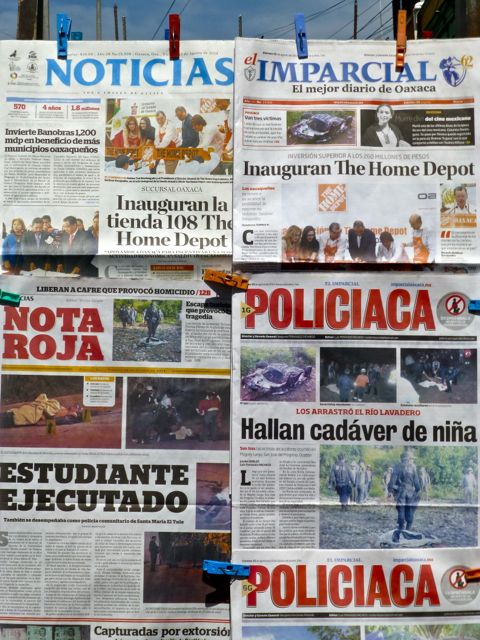
However, if you are tired of it all, you can always stop by the local newsstand to catch up on what’s really important — the opening of Home Depot (an OMG! OMG! OMG! event for some) or, if you are so inclined, graphic images of crime and violence. By the way, regarding the latter, I stumbled on a website that gives A Vague History of La Nota Roja.
What can I say? Good news is in short supply, no matter where one looks. The handwriting seems to be on the wall here, there, and everywhere…
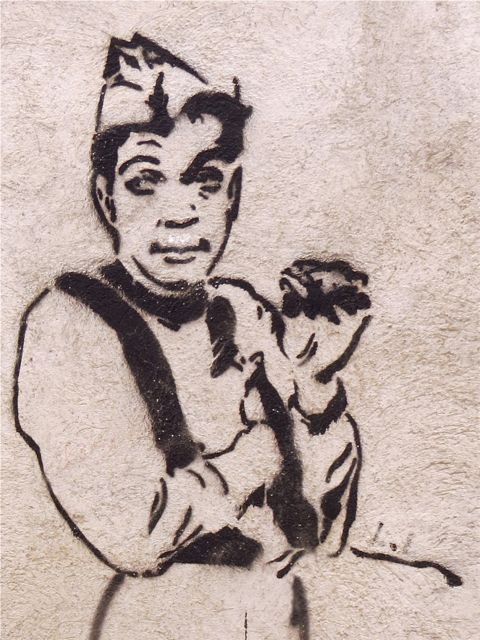
Feliz cumpleaños to Cantinflas. Today, the beloved Mexican actor, comedian, writer, and producer, born Fortino Mario Alfonso Moreno Reyes, would have turned 103. I’ll be waiting in line to the movie, Cantinflas, based on his life, when it opens in Mexico on September 19, 2014. For those in the USA, you get first crack, as it is scheduled to open on August 29, 2014.
Image of Cantinflas on a wall in Teotitlán del Valle — painted by the lovely and multi-talented, Luvia Lazo.
I would also like to say RIP, Robin Williams, another actor with the gift of combining humor and pathos. How blessed we are to have shared this planet with both and to continue to have the opportunity to experience their creative genius.
After five days of being confined to Casita Colibrí — eating, inhaling, and choking on concrete and brick-dust and enduring the throbbing sounds of drills, hammers, and chisels — due to demolition of the old and construction of a new kitchen counter (still not finished), market day in Tlacolula de Matamoros was just what the doctor ordered. Blogger buddy Chris offered and off we went.
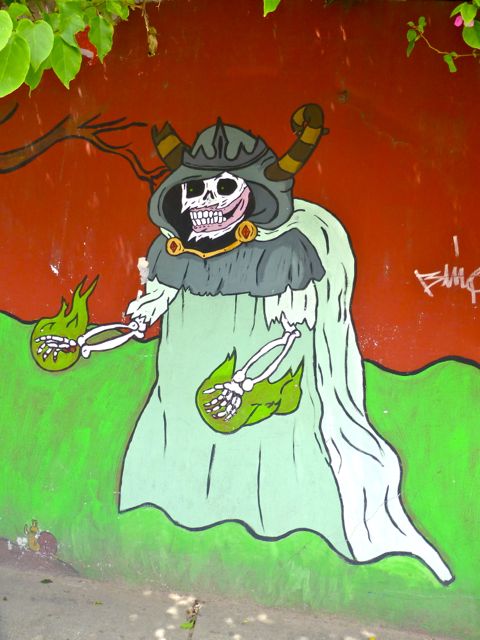
The enticing aroma of tacos and gorditas at our favorite street stall beckoned and we quickened our step, until we came to this unexpected and powerful mural…
The mural is the work of Tlacolulokos, a collective that originated in Tlacolula. According to this article, these self-taught artistsexplore the subjects of violence, the transformation of traditions, tourism, poverty, and social decay by referencing southern Mexican folk elements. They use a variety of media and techniques, rangingfrom graffiti, easel painting, graphicsand object, to videoand sound.
And, Tlacolula worked her magic… We ate, soaked in her color, stopped to listen to a youth band from Santa María Guelac (with a girl tuba player, no less!) play “New York, New York” and “Can-can,” and shopped a little (for me, a 5-liter plastic “gas” canister for our next mezcal run and red bananas). Tlacolula never dies and never gets old.
August 9th is International Day of the World’s Indigenous Peoples; so designated twenty years ago by the United Nations General Assembly in an attempt to guarantee the human rights of over five thousand indigenous groups that exist in 90 countries.
Zapotec woman at Oaxaca’s Feria del Tejate y del Tamal – July 23, 2014
However, to cruise around the online versions of CNN International and the New York Times, one would never know of the day’s significance. At least Día Internacional de los Pueblos Indígenas isn’t being ignored by CNN Mexico. In an article published today (in Spanish) they cite seven challenges faced by the indigenous of Mexico:
Justice – The CNDH reported on July 24 that there are 8,334 Indians in Mexican prisons. Of these, the majority “have not been assisted by a defender and interpreter or translator companion, and even often know why they are internal,” the commission said in a statement.
Health – 20% of the indigenous lack access to health services, a rate similar to the population as a whole, except, as the article notes, in recent months the issue has drawn public attention following cases of indigenous women who have had to give birth in hospital courtyards or bathrooms, as they were not given immediate attention by hospital authorities.
Education – 50% of Mexico’s indigenous are said to be educationally “backward.” And the article noted, the three states with the highest failure rates in primary and secondary school are Guerrero, Michoacan and Oaxaca, three of the states of the country with the largest indigenous populations.
Housing – 40% of the indigenous have inadequate housing.
Food – 42% of Mexico’s indigenous population receives insufficient nutrition.
Poverty – 72% of the indigenous in Mexico are living in poverty.
Discrimination – In August 2012, the National Council to Prevent Discrimination (Conapred) released a survey showing that 44.1% of Mexicans believe that the rights of indigenous people are not respected.
Pueblos Indígenas en México (Indigenous peoples in Mexico) — Infographic from NoticiasMVS
And, regarding discrimination, yesterday ADNPolítico.com published an article, 5 ‘retratos’ de la discriminación hacia indígenas mexicanos (in Spanish). Despite the fact that the first article of the Mexican Constitution declares, any discrimination on grounds of ethnic origin is prohibited, the story highlights five recent cases that have made national headlines:
The death of a 20-year-old pregnant Mixtec woman and the baby she was carrying, after she had spent 5 hours in the waiting room of a community hospital in Copala, Guerrero.
The case of a 13-year-old girl, with a gunshot wound to the abdomen, who was denied medical care in the Civil Hospital of Oaxaca.
A Tarahumara laborer from Guachochi, Chihuahua, died after spending five days outside a hospital in Guaymas, Sonora, without food and without shelter, having been denied admission to the hospital because he did not have enough money.
A 10-year Tzotzil boy originally from Chiapas who, while selling candy to buy his school supplies, was humiliated by an official of the municipality of Centro, Tabasco, who forced him to throw his merchandise on the ground. A video of this travesty went viral and sparked outrage.
A gas station in Zapopan, Jalisco, was closed last June after its owner was shown on video assaulting an Indian couple who was eating outside the station.
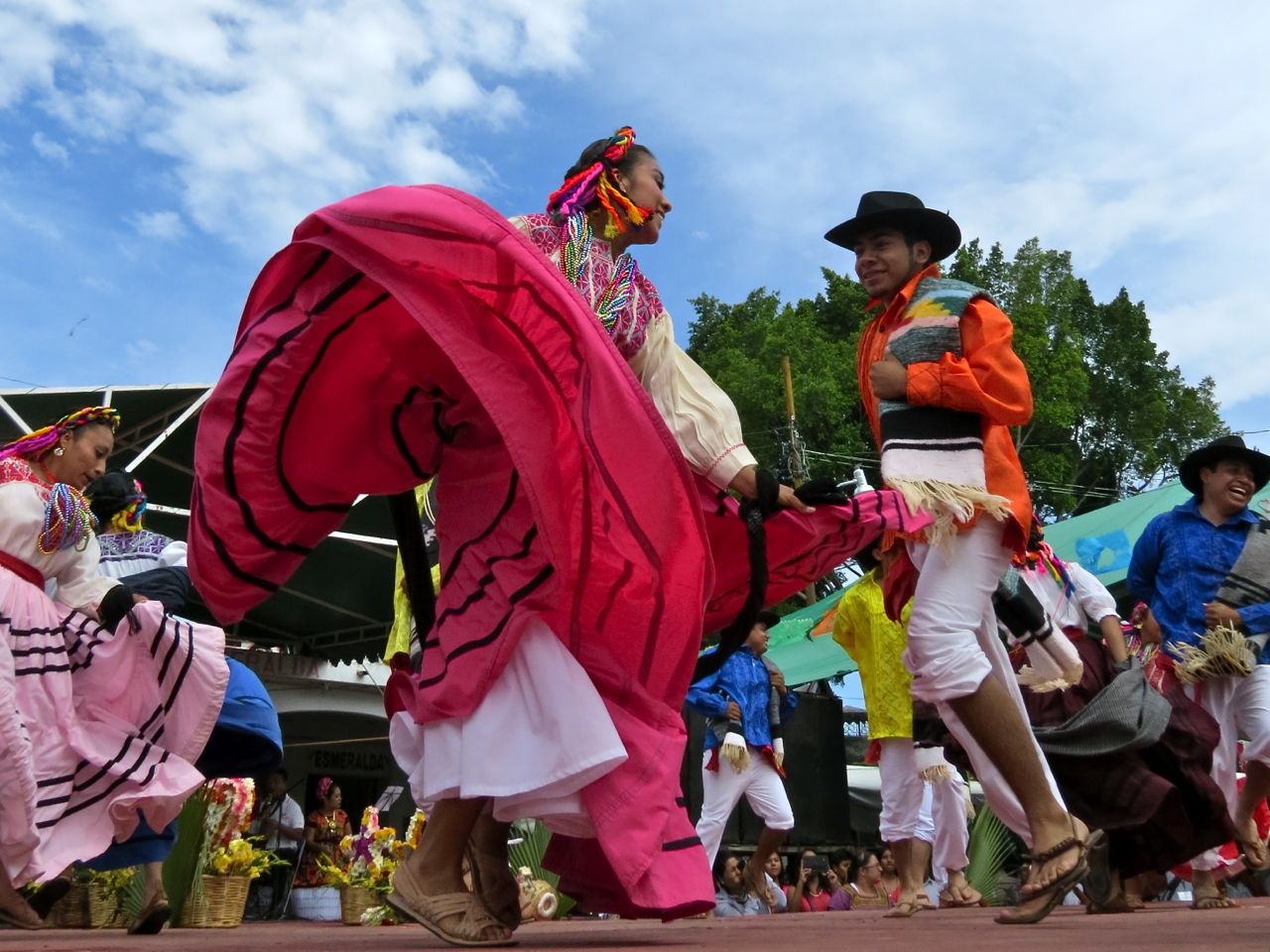
We, in Oaxaca, just experienced the spectacle of the Guelaguetza celebrating the indigenous cultures of Oaxaca. However, some say (in Spanish) it presents a static view of indigenous peoples, reinforces stereotypes, and sells exoticism — all to promote tourism.
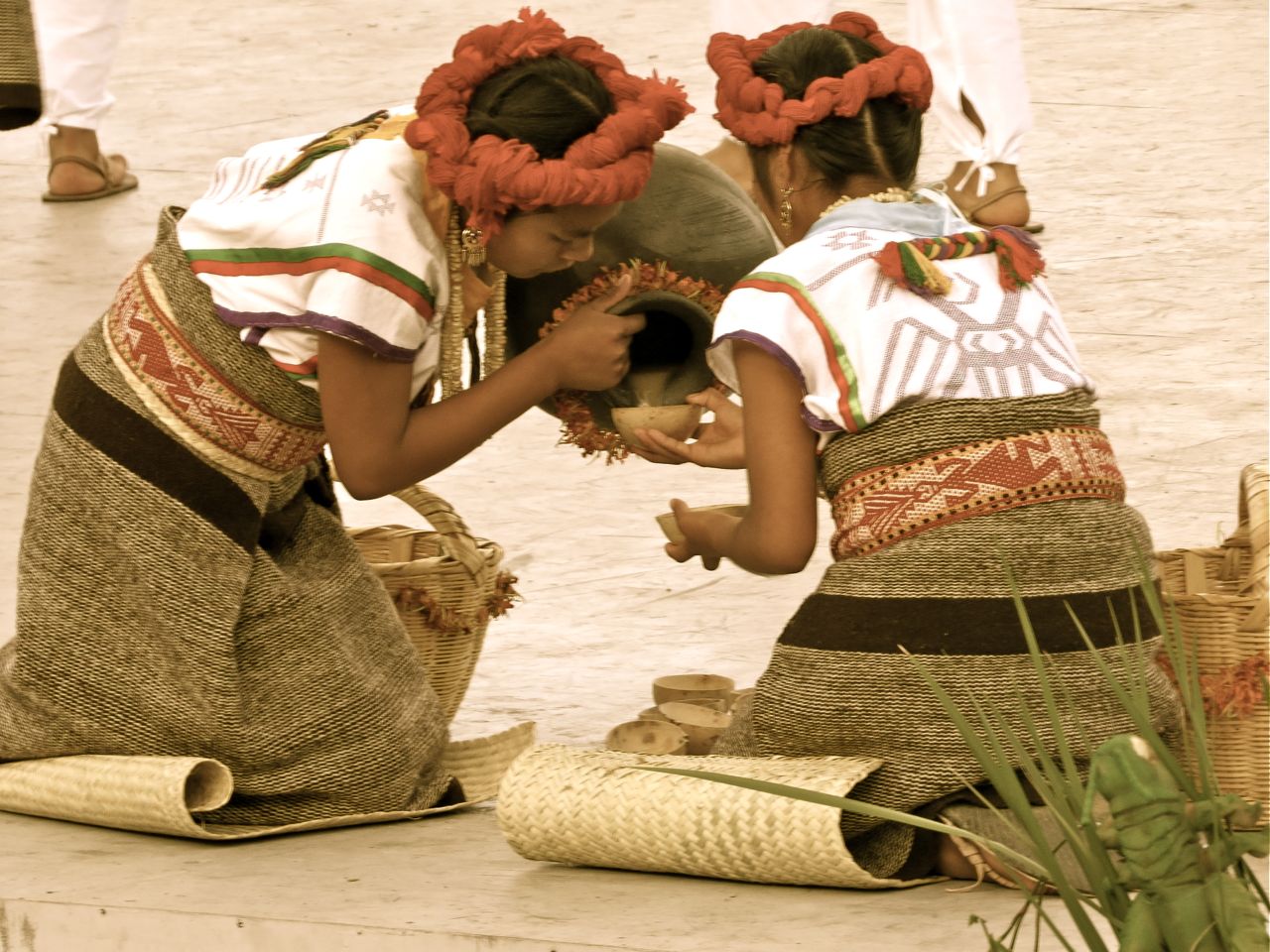
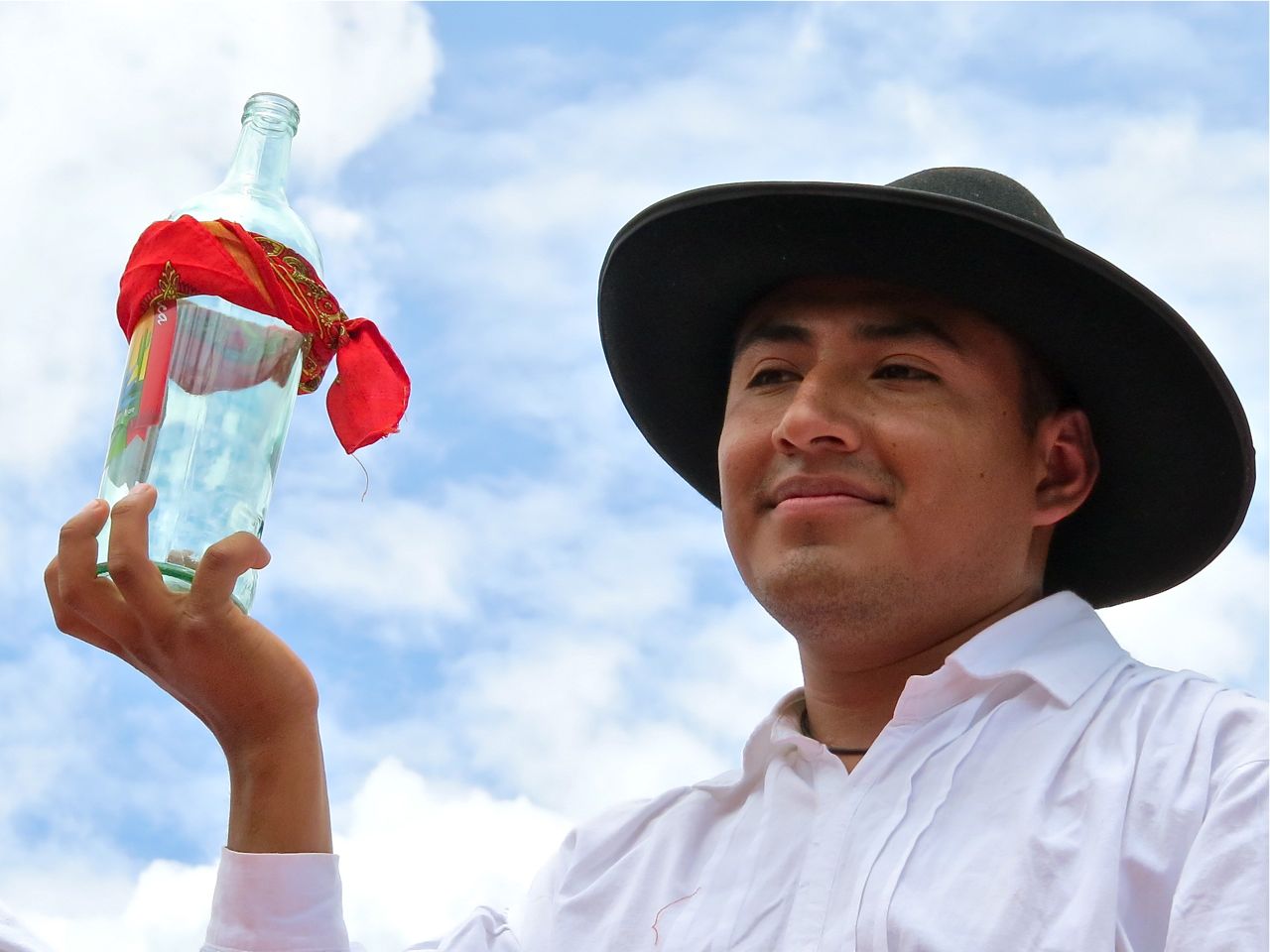
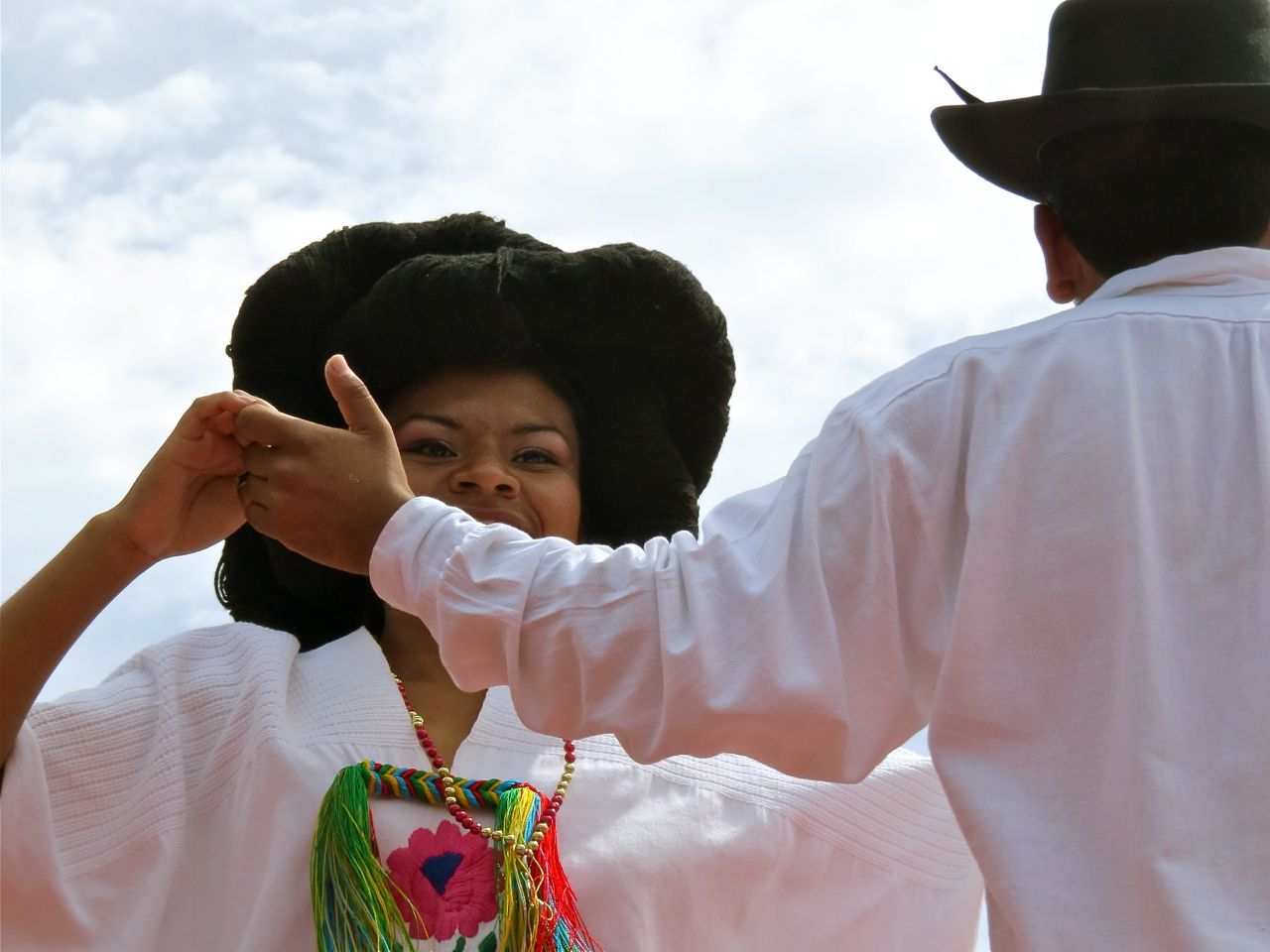
Mixtec dancers from San Antonio Huitepec at La Guelaguetza — July 21, 2014.
The focus of this year’s International Day is “Bridging the gap: implementing the rights of indigenous peoples.” Is it all talk, no action, and a lot of window dressing? I don’t know, but it sure seems like that to me… Sometimes, “poco a poco” isn’t good enough.
Last Sunday morning. What can I say? Sometimes the light…
Painting its own time zone… dawn summons us to a world alive and death-defying, when the deepest arcades of life and matter beckon. Then, as if a lamp were switched on in a dark room, nature grows crisply visible, including our own nature, ghostly hands, and fine sediment of days.
Diane Ackerman, Dawn Light: Dancing with Cranes and Other Ways to Start the Day.
(New York: W. W. Norton, 2009), xiv.
Last Monday, L and I had a leisurely hike up the hill from my apartment to the Guelaguetza Auditorium, sat in stadium seats almost 20 rows up, looking down on the enormous circular concrete stage with the city and mountains providing a picturesque backdrop.
Yesterday, I hopped on a bus, heading for another Guelaguetza performance, this time in Villa de Etla. However, a bloqueo (blockade) by Sección 22 of the teachers’ union had the bus turning around, doubling back, and taking a circuitous route that eventually wound its way through the narrow streets of Santa Rosa. Once we got back on the main road, I transferred to a colectivo and arrived in Etla just as the dancing was about to begin — this time on a small temporary wood-plank stage, that seemed to shake with every dance step. The setting wasn’t quite as spectacular, but, there I was, within an arm’s reach of the dancers!
Danza de la Pluma
Flor de Piña
With the exception of the Danza de la Pluma, these dancers are from a folkloric group that performs each of the traditional regional dances. As you can see from their faces, they dance with as much joy and pride as the delegations from the villages at the big Guelaguetza.
Returning home was its own adventure. Last week, L and I only had to navigate sidewalks, pathways, and stairs along with the other 11,000 attendees. Yesterday, Chris (see his Guelaguetza in Etla – 2014 post) gave me a ride to a bus stop where, after about 10 minutes, I caught the bus that would deposit me a half block from Casita Colibrí. Alas, the best laid plans… Just before the intersection up to Cerro Fortín, masked maestros (teachers) surrounded the bus, our driver shrugged, opened the doors, and off we passengers got. It was hot, I was tired, but what else was there to do? I hoofed it to halfway between the Museo del Ferrocarril (Railroad Museum) and Morelos Park, when another bus materialized, I climbed aboard, giving my feet a much-needed rest, and let the driver navigate the clogged streets that took me back to home sweet home.
It was a fun and frustrating AND exhilarating and exhausting kind of day.
One of the qualities that amazes me about most Oaxaqueños is their patience with waiting in interminable lines. On the one hand, I think those north of the border could take some much-needed lessons in civil and well-mannered behavior. However, on the other hand, I think Oaxaqueños deserve much better than having to stand in endless lines, be it the bank, a government agency, or to get tickets to a concert by their favorite daughter, Lila Downs.
Last year, unable to figure out the hows and wheres of getting a ticket to her free concert during the ten days of the Guelaguetza festivities, I was on the verge of giving up getting tickets to see Lila Downs, when friends coming in from out-of-town(!), offered a couple to me. Of course, I accepted!
This year, after several false leads, on Tuesday morning L and I climbed back up to the Guelaguetza Auditorium to try to score some tickets to this year’s free concert. The box office was scheduled to open at 9 AM, we got up there at 8:30 AM and found ourselves at the end of a line that stretch halfway to the planetarium AND that continued to grow as the hours ticked by. Abuelos, niños, moms, dads, and teens lined the pathway, talking on cell phones, eating, talking, and laughing — without a raised voice or harsh word spoken.
At almost 10 AM, when the line hadn’t moved an inch, I walked down the hill to the box office to see what was happening. Nothing, as it turned out!
However, good-natured patience finally succumbed to whistles and shouts by those who were in the line of sight of the ticket booth — after all, according to the newspaper they had begun lining up at 4:30 AM!!!
I wound my way back up the hill to report my findings to L. Alas, after another 45 minutes of no movement, impatient gringas that we are, we gave up. However, to borrow from the musical Sound of Music, “somewhere in [our] youth or childhood, [we] must have done something good,” because 48 hours later, my neighbor presented us with tickets! And so last night, we climbed back up Cerro Fortín to see Lila Downs. We were very happy campers.
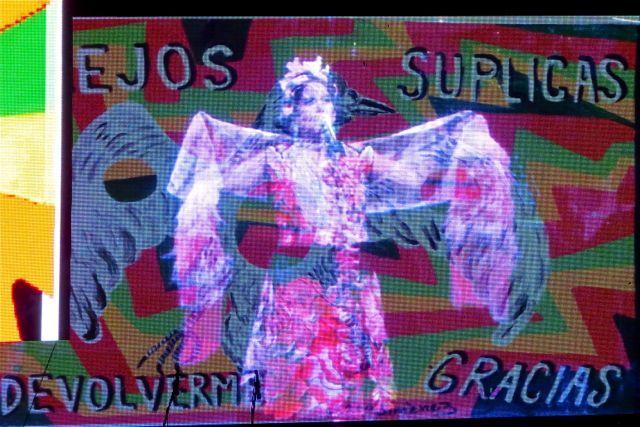
She put on another spectacular show — mixing new tunes with old, incorporating several of the Guelaguetza delegations into the production, and generally bringing cheers and sing-a-long voices from the hometown crowd. By the end, everyone was on their feet.
So much to see and do, so little time to process photos and post — should all our problems be so enjoyable! However, before tonight’s Lila Downs concert, tomorrow’s Desfile de Delagaciones (parade of delegations), and Monday’s Guelaguetza in Etla (and that’s only a few of the activities on the dance card), a glimpse from the beginning of Monday evening’s Guelaguetza performance.
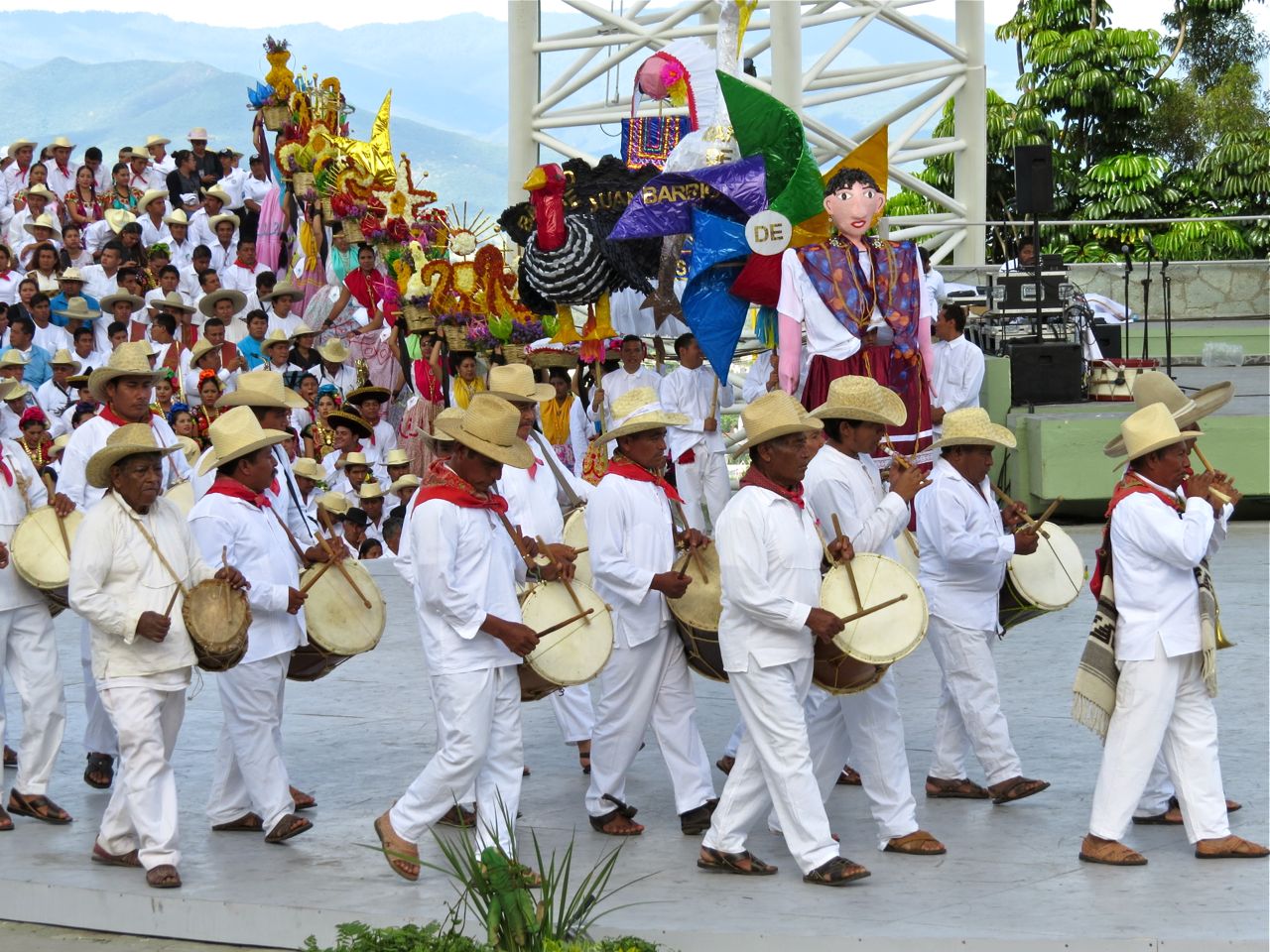
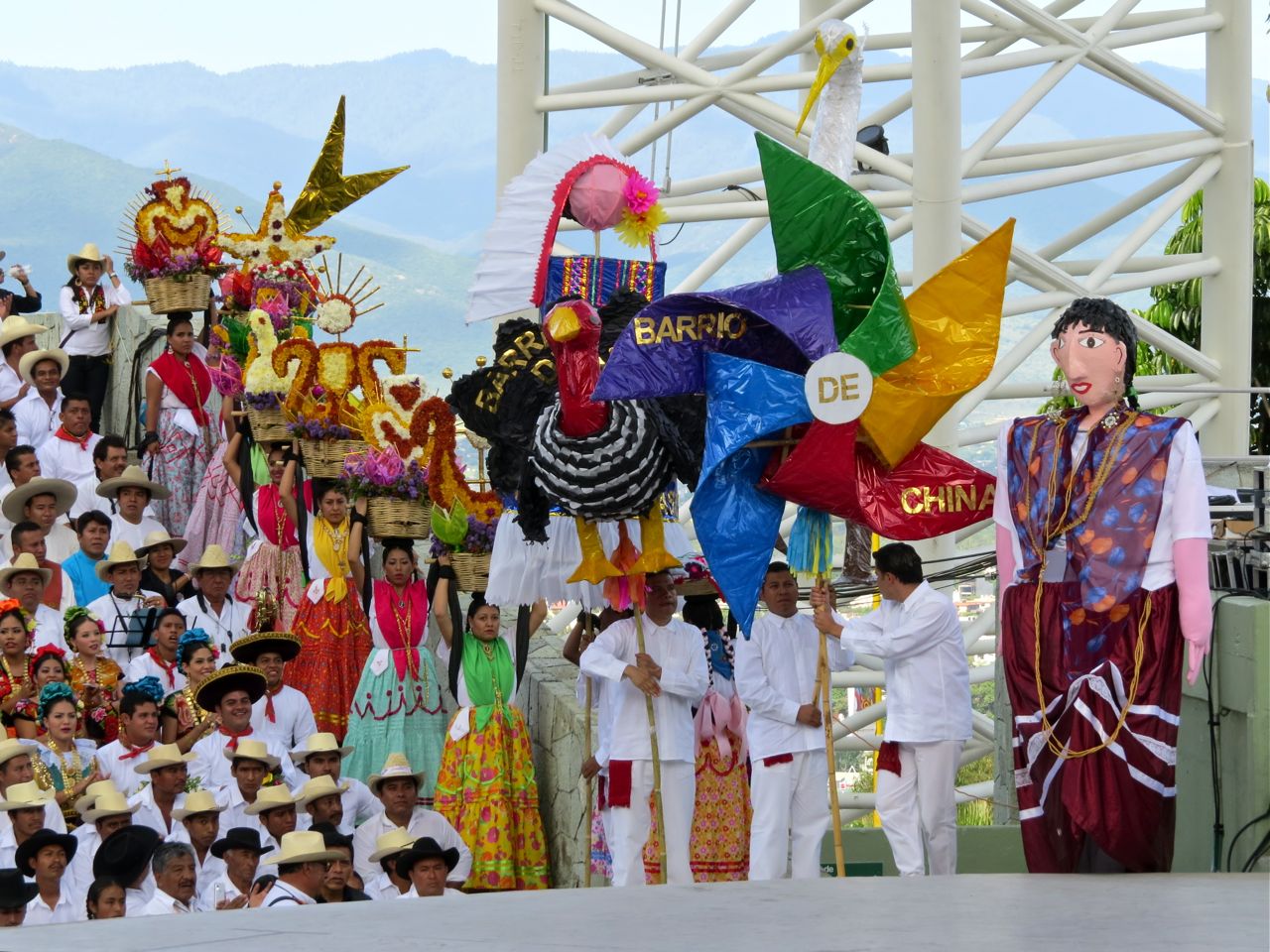
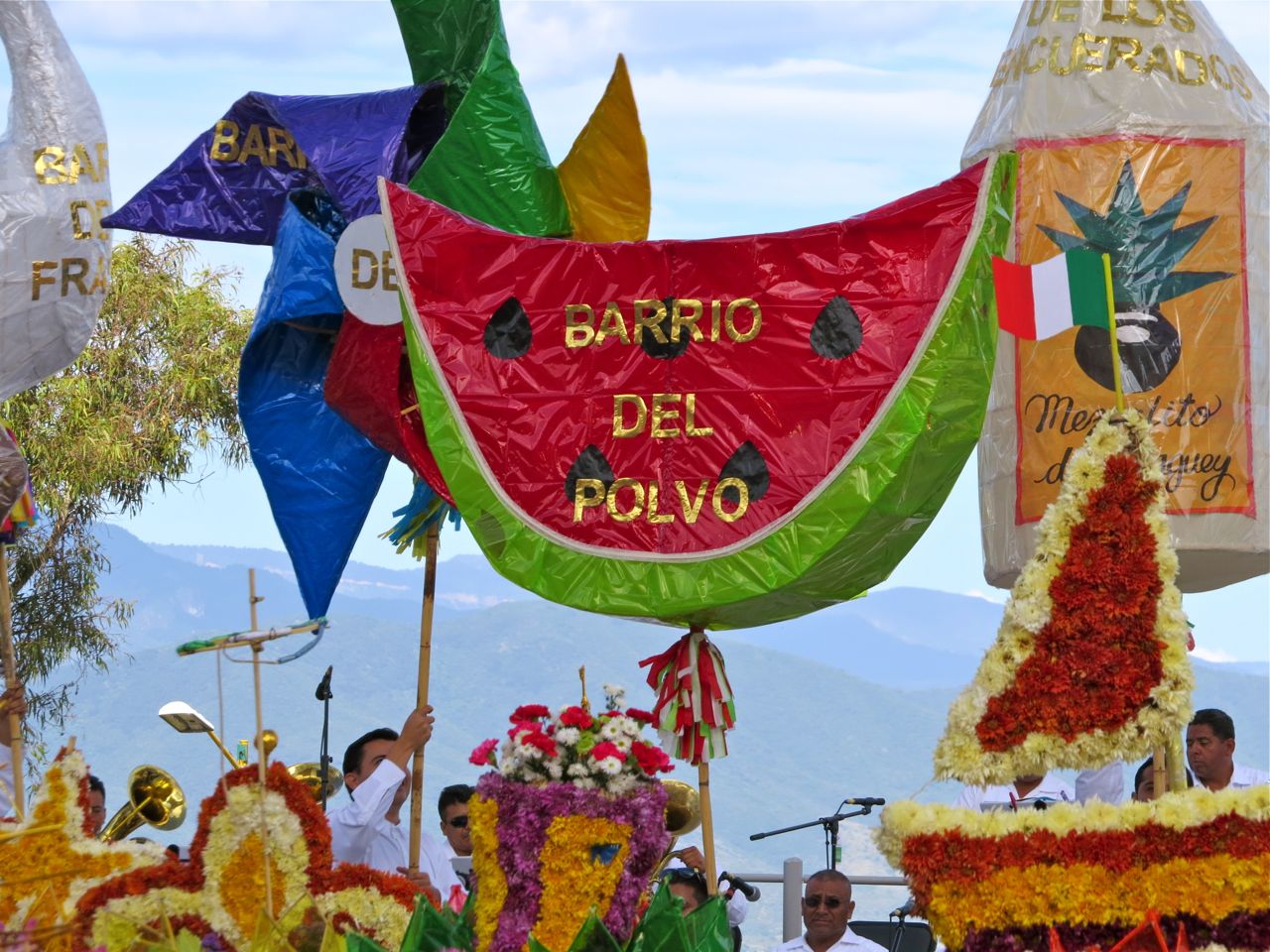
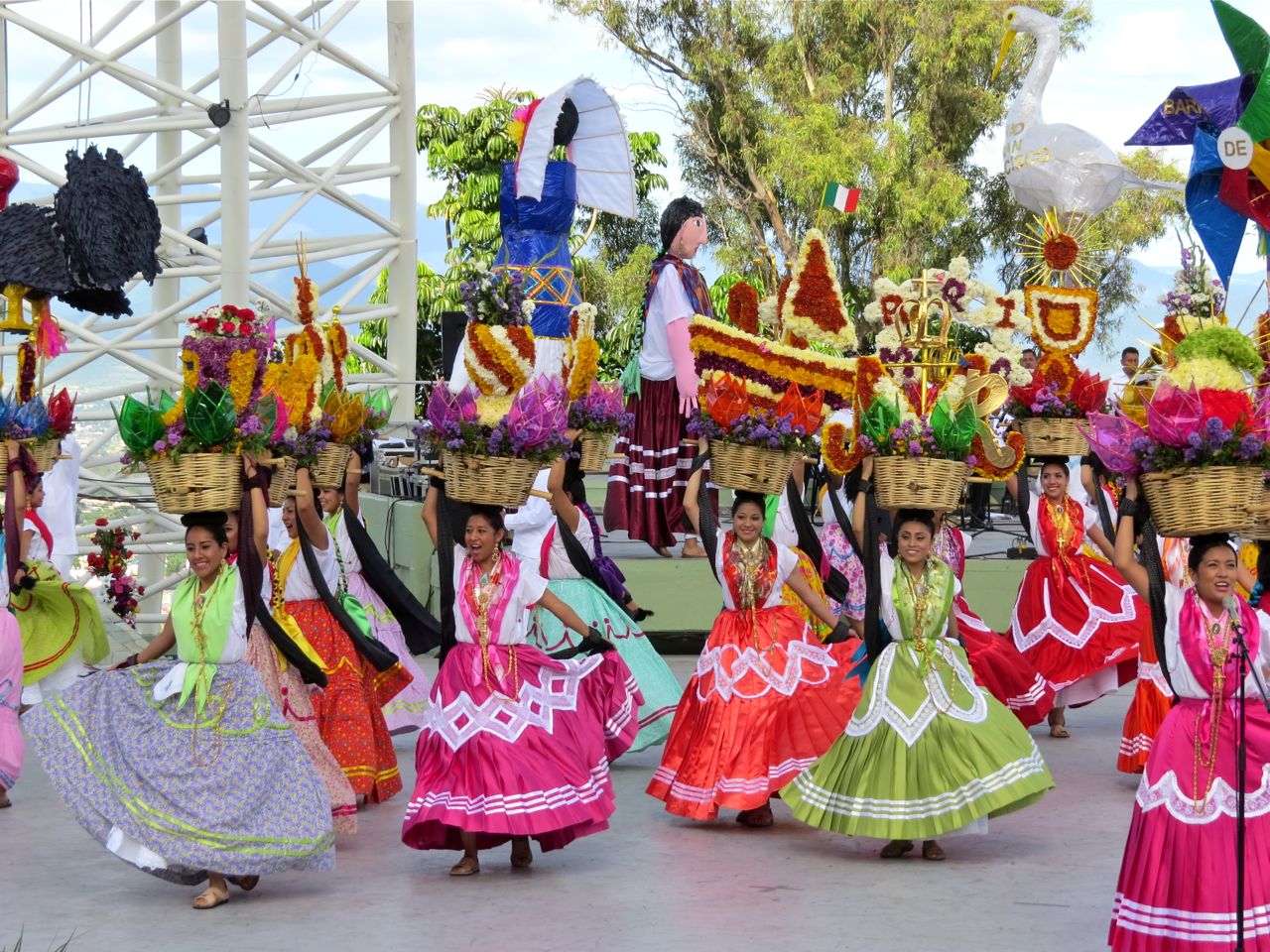
As tradition dictates, she was followed by the convite (procession) of Chinas Oaxaqueñas with their band, monos, and banners.
They filled the stage, dancing the Jarabe del Valle to the cheering crowd.
It was a balmy evening, the view was spectacular, fourteen more delegations danced their way into the night, and a dazzling display of fireworks exploded above the open-air auditorium to conclude the show.
And, they do it all again this coming Monday — hopefully, the kinks will be worked out for the live streaming, so no matter where you are, you can watch and enjoy the morning and/or evening performances.
This post is really just an excuse to post photos of two young women who are presiding over this year’s Guelaguetza activities. The first is the Reina (queen) of the 4th Expo Feria del Queso y Quesillo. She is a writer, loves books, and her eyes lit up (even more!) when I told her I was a librarian. She and her mother were so gracious and radiated joy and warmth. Alas, I didn’t catch her name; if anyone knows, please post in comments.
Friday evening, the Diosa Centéotl (corn goddess) was chosen to reign over this year’s Guelaguetza. JacquelineReyesRosarioSarabia, a native ofSanto DomingoTehuantepec, Oaxaca, was selected from 33 participants who represented the 8 regions of the state of Oaxaca in a 2-part competition. Each entrant was required to make a presentation,in both her nativelanguage and in Spanish, about thegastronomy,crafts,dances, legends, traditions, and customs of hervillage andonthe clothing ofher region. Even though we were way in the back, Jacqueline caught our attention with her impassioned speech. One of the first of her duties was to lead yesterday’s desfile (parade of the Guelaguetza delegations) through the streets of the city of Oaxaca.
I love Jacqueline’s reaction when her name was announced as Diosa Centéotl 2014.
Live streaming of the Guelaguetza performances at the Guelaguetza auditorium atop Cerro del Fortín, July 21 and 28 at 10 AM and 5 PM (Central Daylight Time).
 With a little pleading (whining), management replaced the stove with a new one that had been hiding in the storage shed. I installed the shelf unit I’d gotten for my old apartment and I had the cabinetry painted white — making it more functional and easier on the eyes — and I was happy. Hey, a friend even wanted to practice using his new fisheye lens.
































 Mexican Peso Converter

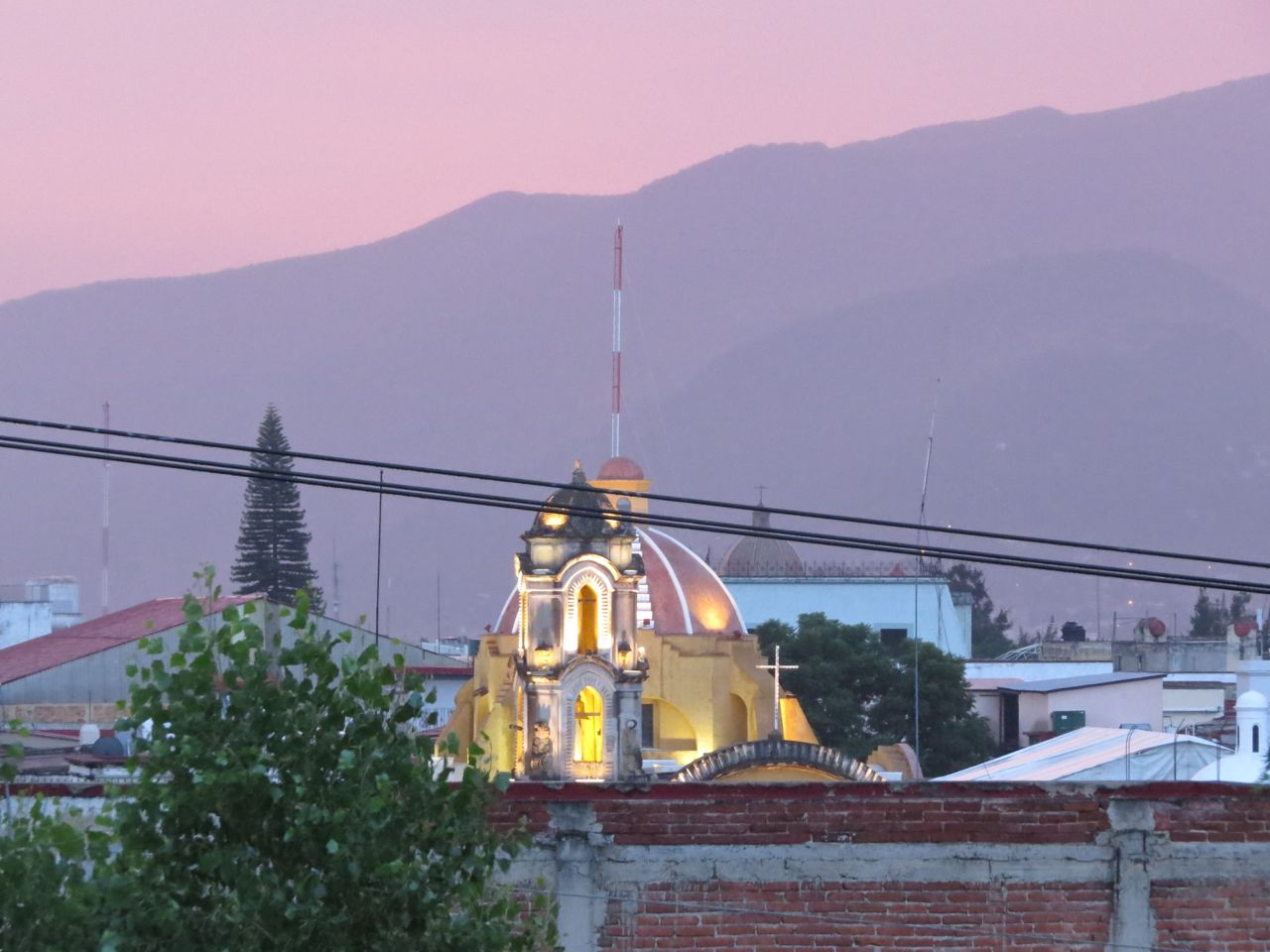
 View From Casita Colibrí