Feeds:
Posts
Comments

Locally grown

From today’s NYT…

Market Driven, Oaxaca-Style

By PETER CATAPANO

A vendor at Mercado de la Merced in Oaxaca, Mexico, where produce grown on small local farms is sold throughout the city.

OAXACA, Mexico — “The market is not for shopping,” Pilar Cabrera said.

¿Qué?

We were walking around Oaxaca’s Mercado de la Merced, a covered market where Cabrera, a well-known chef and owner of the popular La Olla Restaurant, does some of her food gathering for a class she teaches at La Casa de los Sabores, a cooking school she runs to which chefs on pilgrimages and food-curious tourists have been flocking for several years. Students who sign up and pay for the class (about $70) gather up the goods with her at one of the town’s markets in the morning, then bring them back to a big, bright, picture-perfect kitchen, where they proceed to cook and consume the meal, a five-course Oaxacan lunch based on Pilar’s recipes, including a taste of mezcal and dessert. (Coloradito, a red mole, was the main event at the class I attended.) They also get to pepper her with questions about the food, recipes and region.

Pilar knows her stuff: she was born and raised here and has a background in food science, as well as decades of cooking experience. La Olla serves a modern menu based on traditional Oaxacan recipes in a modest, clean setting that attracts both tourists and well-heeled locals. Apart from the restaurant and cooking school, she has gained some fame as a sort of ambassador for Oaxacan cuisine, traveling abroad to teach her classes, even making an appearance on “Iron Chef.”

In both the restaurant and the class, Pilar hammers home the main theme of Oaxacan food: an uncompromising devotion to fresh, unprocessed local ingredients (the squash blossoms she chose for the meal that day were still open when the vendor handed them to her). And she can switch from speaking Spanish to English with ease, making it easy for monolingual pilgrims like me to get what’s going on.  [Read full article]

h/t:  gg

Lush life update

Returned from the mercado this afternoon to find…

Garden pot breaking on top of the garden god

… a crack in the pot.  Garden god bursting with pride???

Lush life

Torrential rain by night; brilliant blue sky by day…

Garden god surrounded by succulents and cactus

This is the way the garden grows during the rainy season in Oaxaca.

Salud… to your health!

This afternoon, I headed to the Mercado Benito Juárez to stock up on my favorite coffee — 100% organic and grown in the highlands of Oaxaca — El Grano de Oro, Cafe Pluma.

As I entered the Alameda, it had been transformed into a parking lot — 42 new, spotless white, small Mitsubishi trucks, Dodge vans, and a couple of large Ford trucks.

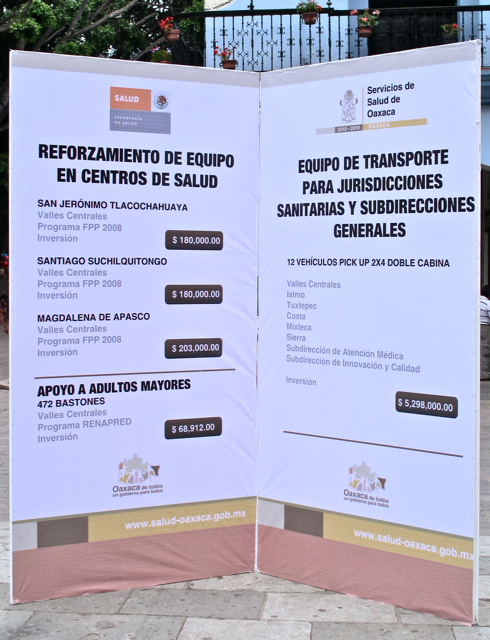
According to Noticias, this is part of a 24.6 million peso (approx. 2 million dollars US) project to improve the health of the people, including a major vaccination effort.  Governor Gabino Cue was present to unveil the program.

Poster showing program expenditures

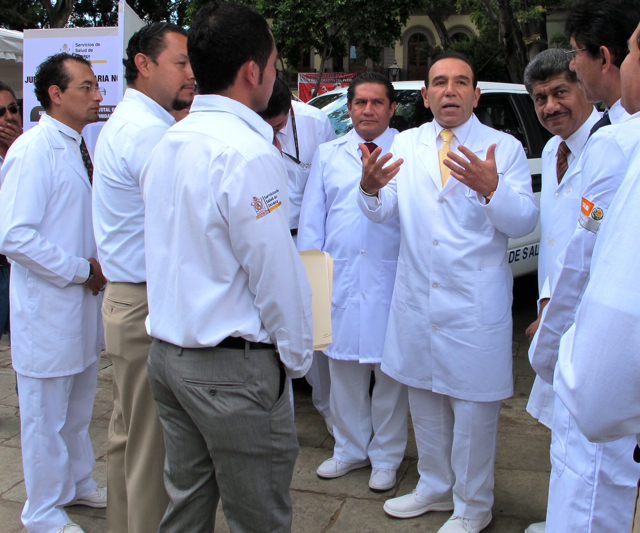
People in white coats milled around, posed for photos, and gave interviews after the governor’s speech.

Doctors gathered and discussing

And a new ambulance, earmarked for the municipality of Miguel Hidalgo, had a place of honor in front of the Cathedral.

Ambulance

Adios, mosquitos

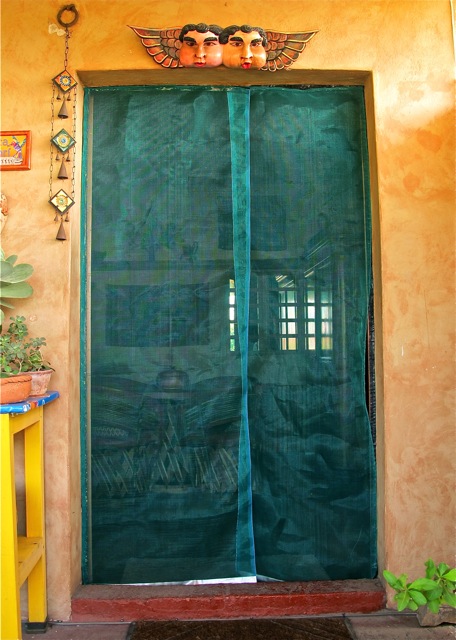
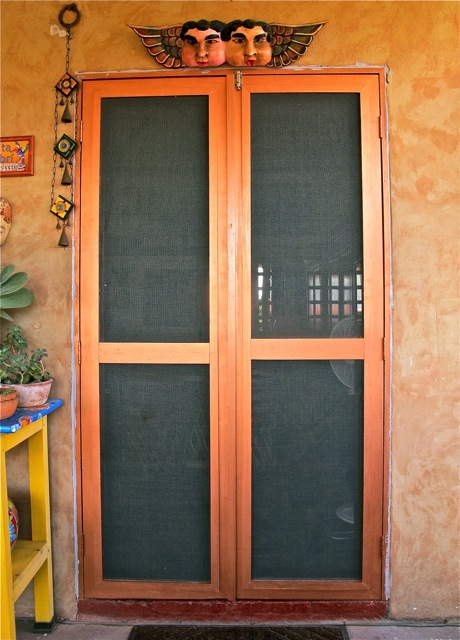
It’s the rainy season; that means it’s also mosquito season… and they love me and my ankles!  This year, I surrendered to the adage, the best offense is a good defense.  Using plastic mesh, duct tape, and velcro, I fabricated an ugly, and somewhat difficult to navigate through, screen for my door.

Green screen on door

Defense exhibit 1

It helped, I even got used to the green color, though the center opening was problematic.  However, heat and dry air followed by heat and humidity were not kind to the glue on the back of the velcro that secured the screen to the doorway nor to the duct tape holding the coins weighing down the screen.  After two months it began coming unglued, as did I!

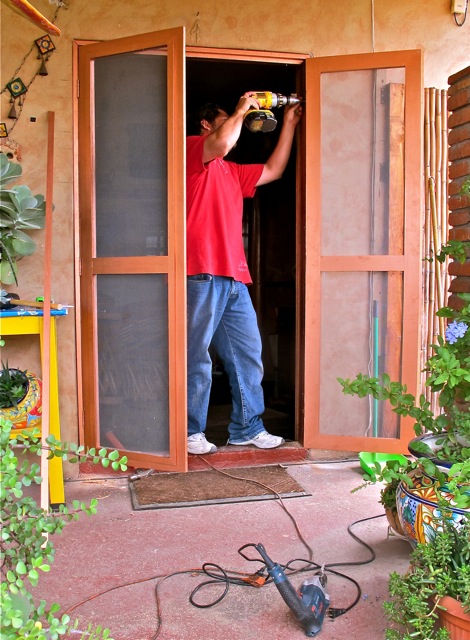
So, I relented, loosened my purse-strings, and called master carpenter Juan, who has so ably come to my rescue on previous occasions.  He took measurements last week, drew up a plan, built the doors, and arrived yesterday to install them.

Juan, with drill, installing the new screen door

My hero, Juan

What a difference a real screen door makes!  Looking in…

New wood frame screen door

Defense exhibit 2

And, looking out…

Screen door from inside apartment

Defense exhibit 3

With my new door, stash of citronella candles, and repelente natural, it’s adios mosquitos!

Currently at the Museo Nacional de Antropología

Spanish conquest still “open wound in Mexico,” curator says

Banner for La Conquista a sangre y fuego

Mexico City, Mexico (NTN24 Wires) – The Spanish conquest continues to be “an open wound in Mexico” five centuries later, the curator of the National Museum of Anthropology’s “La Conquista a sangre y fuego” (The Conquest by Fire and Blood) exhibition, Francisco Gonzalez-Hermosillo, said.

“There have been all kinds of reactions, but, especially, there are many who leave very hurt after seeing the bloody images that speak of the violence there was during that period in history,” the researcher told Efe.

The paintings, codices and arms that make up the exhibition show the cruel methods used by the Spanish to impose their rule on Mesoamerica, Gonzalez-Hermosillo said.

The exhibition was organized to mark the 490th anniversary of the conquest of the Aztec city of Tenochtitlan, where Mexico City is situated, by Spanish conquistador Hernan Cortes.

The goal of the exhibition is not to “change perceptions of history” but to give the Indians’ view of the conquest because it is “so seldom taken into account,” Gonzalez-Hermosillo said.  [Read full article]

Fifty-three percent of Mexico’s indigenous population lives in Oaxaca (Sipaz report).  One can only hope Oaxaca is on the itinerary for this traveling exhibit.


Madre-isms… Who knew?

My Spanish language abilities are progressing little by little (poco a poco).  However, one thing my wonderful and extremely patient Spanish teacher, Laura Olachea, has neglected to cover is Madre-isms; those too numerous to count and unique to Mexican Spanish, expressions that the mamas, hijas, and hermanas for the most part never use, at least not in mixed or polite company.

Of course, being that one doesn’t know what one doesn’t know, I was oblivious!  Oblivious, that is, until I read Norma Hawthorne’s review of the new book, Madre: Perilous Journeys With a Spanish Noun, by Liza Bakewell.  Intrigued, I purchased the book when I was in el norte in June and immediately plunged in.
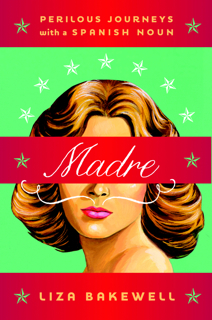
Cover of book, Madre: Perilous Journeys With a Spanish Noun, by Liza Bakewell

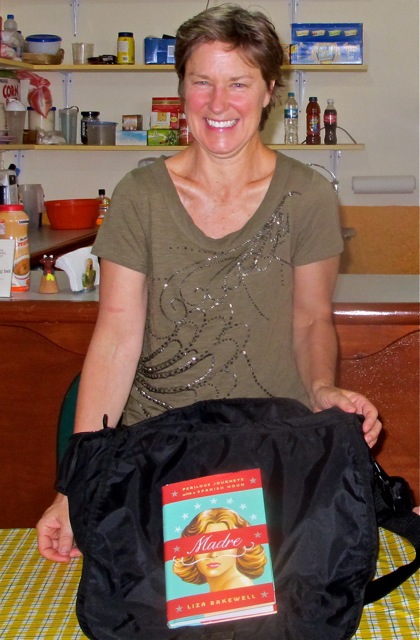
In July, while I was immersed in the “madre” minefield, Liza arrived in Oaxaca for some much-needed R & R, to write an article or two, and to promote her book.  I had the pleasure of getting to know her (she’s warm, smart, and funny), eat one of Aurora’s (you will meet her in the book) empanadas, and assist with setting up a couple of speaking engagements.  The first, in English, was at the Oaxaca Lending Library, where the audience was overwhelmingly women and, as expected, mostly gringas.  There was much surprise and laughter as Liza read excerpts from the book, expanded on points, and answered numerous questions.

Liza Bakewell at the Oaxaca Lending Library showing her book, Madre...

The second speaking engagement, the following evening, was at the Instituto de Artes Gráficas de Oaxaca (IAGO) and was conducted all in Spanish.  And here, surrounded by the Rini Templeton exhibit, I looked around and noticed the majority of people attending were Mexican men.  However, like Guillermo Fricke, Director of IAGO, people listened closely, occasionally chuckled knowingly, and stayed to ask questions and make respectful and thoughtful comments.
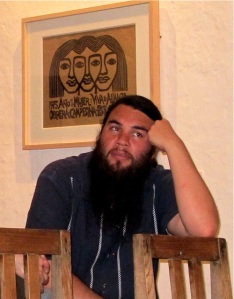
Guillermo Fricke listening to the talk by Liza Bakewell at IAGO

It was a much more reserved gathering than the day before, but no less attentive and appreciative.  And, reflecting on previous events and observations and now reading Labyrinth of Solitude, by Octavio Paz, I’m coming to understand, except for fiestas, that is the Mexican way.  Though, I wonder, if it had been all Mexican women in attendance, would it have been different?  I think so.  There is something about the bond women share that crosses boundaries and cultures….

However, thanks to Liza, at least while in Mexico, I may never utter the word, madre, again!

(ps)  If your local library doesn’t have Madre: Perilous Journeys With a Spanish Noun, ask them to order it!

(pps)  Another insightful review of Madre has just appeared on GlobetrotterGirls.com

Who is Camila?

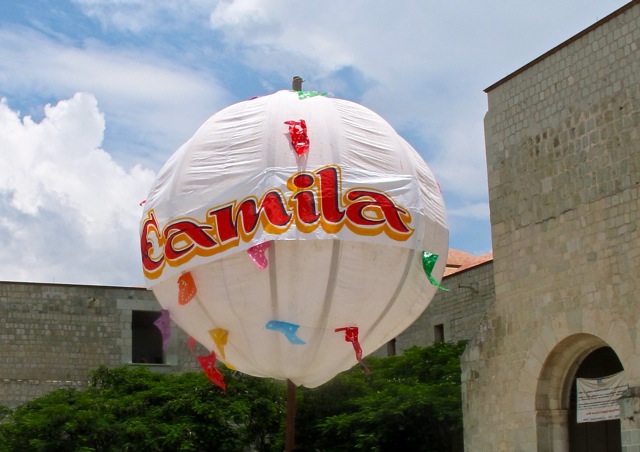
Also on Saturday, I stumbled on yet another parade.   And I wondered, who is Camila?

Giant cloth balloon (una marmota) with Camila written on it

Is this Camila (y amigo)?

Male and female giant puppets (monos)

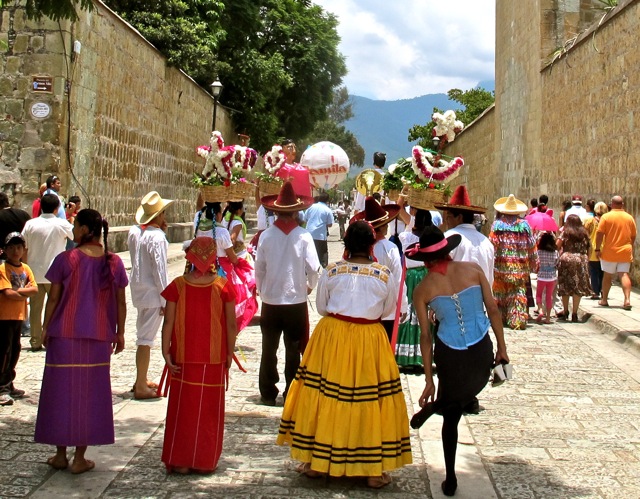
Whoever she is, she was a good excuse for music, fireworks, dancers, and a parade up Macedonio Alcalá…

Parade up Macedonio Alcalá

and, why it’s a good idea to take one’s camera… even when just going grocery shopping!

Spanish lesson:

  • Giant cloth balloon = Una marmota
  • Giant puppets = Los monos
  • Flower covered head pieces = Las canastas

¡Un milagro!

It’s a Saturday miracle; my favorite vendor is back!!!

She and her little crate-and-basket stand, usually positioned at the foot of the two stairs outside Pan y Co on García Vigil, have been missing in action for the past two weeks and I was worried.  I kept asking the clerks at Pan y Co if they knew what had happened to her, but they merely shrugged.  However, today there she was…

Vendor and her stand.

I came away with sliced mango, papaya, jicama, a bag of roasted peanuts with dried chiles, and, best of all, kisses and hugs!!!

(ps)  Apparently, she has been sick, but she assured me that she is okay now.

Tomorrow marks the 100th anniversary of the birth of comedian, actor, writer, and producer, Cantinflas.

Cantinflas head shot with hat on

Fortino Mario Alfonso Moreno Reyes was born in the Santa María la Redonda neighbourhood of Mexico City, and grew up in the tough neighborhood of Tepito. [4] He made it through difficult situations with the quick wit and street smarts that he would later apply in his films. After an unsuccessful attempt to enter the United States through California, he became a prizefighter in his teens as a source of income.[5] His comic personality led him to a circus tent show, and from there to legitimate theatre and film.  [Read full Wikipedia entry]

Reading the following article recalled fond memories of watching Cantinflas on the big screen in the films, Pepe and Around the World in Eighty Days and, on our black and white TV, in old Mexican-made movies.  Like Charlie Chaplin’s little tramp character, even as a child, I “got” and identified with the everyman characters Cantinflas portrayed and understood he was often the smartest character in the story.

Mexico Marks Century Of Comic Cantinflas’ Birth

MEXICO CITY August 11, 2011, 05:23 am ET
It is hard to think of a Mexican Everyman without turning to Cantinflas, the tattered, droopy-pants character created by comic Mario Moreno in the “tent theaters” of Mexico’s slums in the 1930s.

With the approach of Friday’s centenary of his birth, he has been celebrated as a touchstone of Mexican national identity, fondly remembered for his convoluted doublespeak and clever underdog persona he portrayed for nearly six decades until his death in 1993.

He is best known in the rest of the world for his turn as David Niven’s resourceful valet in “Around the World in Eighty Days,” but the pencil-mustached Cantinflas contributed something much deeper in Mexico… Cantinflas reflected the poorer side of Mexico that gets by on its wits… Wise behind his seeming illiteracy, able to snowball the pompous with a stream of clever but meaningless verbiage, Cantinflas was able to make the transition to movies, where he can still be seen winning out over snobs, bureaucrats and corrupt politicos….  [Read full article]

(ps)  Update:  from the NPR program, All Things ConsideredThe Chaos And Comedy Of Mexico’s Cantinflas.   h/t  gg

Tajín seasoning… yummm!!!

Tajín Clásico seasoning has become my absolute, cannot do without, favorite seasoning.  It’s a mix of dried chiles, salt, and lime juice and it can be used to flavor just about everything.  This morning’s breakfast…

Plate with scrambled eggs and bananas sprinkled with Tajin and bottle of Tajin seasoning

Scrambled eggs and bananas with Tajín sprinkled on top.

I use it to season chicken, veggies, egg dishes, sauces, salads, guacamole, and all kinds of fresh fruit.  You name it, Tajín will enhance it!  And, amazing discovery…  When I stopped by my local gelateria recently, the gal behind the counter offered me Tajín to sprinkle on my cucumber and lime gelato.  At first I declined, then thought, what the heck.  ¡¡¡Muy sabroso!!!

Enough is enough!

It’s a quiet Sunday in the city.  Traffic on the busy street beyond Casita Colibrí’s gates is light; church bells, for reasons mysterious to me, seem more restrained on Sundays; and even the usually chattering birds sound like they are taking a rest from their noisy territorial battles.

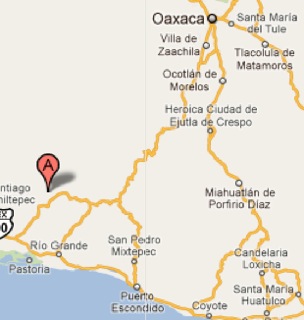
However, yesterday, all was not tranquil in the village of Santa Cruz Tepenixtlahuaca, 165 miles southwest of the city, where villagers, fed up with alleged cattle rustling, rapes, and murders, took matters into their own hands…

Map showing Santa Cruz Tepenixtlahuaca is southwest of Oaxaca city

Mexican villagers attack alleged crooks, killing 6

OAXACA, Mexico (AP) — Dozens of armed villagers surrounded the home of a suspected crime gang in southern Mexico, setting off a gunbattle that killed a child, a woman and four men, authorities said Saturday.

The confrontation took place after a town assembly decided to arm 90 villagers and send them to threaten the group allegedly behind cattle thefts, rapes and murders, Oaxaca state’s public security chief said in a statement.  [Read full article]

From tiny mountain villages in Southern Mexico to the streets of Tel Aviv,  ¡Basta ya! was a cry echoing around the world on Saturday.

Storm clouds over Oaxaca

Where did the mountains go???

Dark sky over Oaxaca

Currently, the Instituto de Artes Gráficas de Oaxaca is exhibiting the work of Rini Templeton; three rooms of her iconic work.  For those who may not be familiar with the name, there is a good reason…

For 20 years an extraordinary artist-activist named Rini Templeton drew struggles of grassroots people in the United States, Mexico and Central America. She made thousands of drawings, didn’t sign them and gave them away freely, so her name remains unknown while her work is widely known, used and loved.  [Read full biography at RiniArt.org]

As the former director of a labor library and archive, the exhibition kindled so many wonderful memories of this talented, committed, and inspiring woman’s work.

Guelaguetza in Etla

Yesterday, I opted for the smaller and more intimate Guelaguetza in the Villa de Etla, about 12 miles northwest of Oaxaca city.  As far as I could tell, seven of the eight regions of the state of Oaxaca were present; only the Sierra Sur was missing.  FYI:  In the photos below, I purposefully left out the Plume dancers, who represented the Valles Centrales, as you will find plenty of photos of the Danza de la Pluma in my postings from the Fiesta de Preciosa Sangre de Cristo in Teotitlán del Valle.  By the way, Chris at Oaxaca-The Year After posted a terrific Guelaguetza Guide to assist in identifying the regions of Oaxaca.  It’s in Spanish, but even a non-Spanish speaker can learn quite a bit.

On a more serious note… I was reminded today by a Oaxaqueña friend, Guelaguetza in the city of Oaxaca is controversial.  Tickets (available through TicketMaster, I might add) for reserved seating to the official performances on Cerro Fortín at the (newly renovated and hotly disputed) Guelaguetza Auditorium are beyond the reach of most Oaxaqueños, some events are sponsored by Coca Cola, hundreds of thousands of pesos of tax payer monies have been spent on the sound and light show (spectacular, as it is), nightly fireworks, bringing in celebrities, and slick, though often inaccurate, publicity.  All is geared (well, not the inaccuracies) toward tourists; a boon to the restaurants and hotels around the zócalo.  But…

Unfortunately, what is lost is that the Guelaguetza is supposed to be a celebration that brings together the extremely diverse indigenous communities, from the various regions of the state to share their crafts, food, dance.  It wasn’t supposed to be crass commercialism that caters to tourists and well-heeled locals, at the expense of peoples who originated the tradition.  And, my friend asked, along with admiring their costumes and colorful dances, wouldn’t a portion of the pesos be better spent attending to the real and extremely pressing needs of the poverty stricken indigenous communities, especially with regard to infrastructure and education?

However, yesterday in Etla, I caught, perhaps, a glimpse of the original meaning of Guelaguetza.  Admission was free and open to one and all.  Free tamales and beverages (alcoholic and non) were offered to the standing-room only crowd, along with the sombreros, baskets, fans, whisk brooms, tlayudas, and fruit that each of the delegations of dancers tossed to the audience at the end of their performances.  After it was over, fellow blogger Chris and I looked around and realized, we were probably the only gringo and gringa in attendance.  What an honor and privilege!