Feeds:
Posts
Comments

Archive for the ‘Holidays’ Category

Yesterday, having just posted Celebrating the Women of Oaxaca, I set off for my cataloging shift at the Oaxaca Lending Library.  As I turned up the Alcalá, I was greeted by bevy of beautiful and colorful women in all shapes, sizes, and lifestyles — Oaxaca’s tribute to women on International Women’s Day.  By the way, you can see in the distance in one of the photos, the Migrantes are still here.

This slideshow requires JavaScript.

Meanwhile, down at the Government Palace, the City Council recognized the history and contribution of 10 women conferring upon each a Distinguished Citizen award; Zapotec women demanded justice for the disappeared and prisoners; and several city workers dismissed over a year ago (according to them, without cause) held a protest demanding reinstatement.

Thus was International Women’s Day in Oaxaca!

Read Full Post »

Today is International Women’s Day, established by V. I. Lenin in 1922, revived by women in the USA in 1968, and recognized by the United Nations in 1975.  Here’s to the beautiful, strong, and all around amazing women of Oaxaca!

This slideshow requires JavaScript.

¡Feliz, Día de la mujer!

The librarian in me can’t help but include a few resources, I put together a few years ago, chronicling the history of International Women’s Day:


Read Full Post »

Valentine’s Day, known here as Day of Love and Friendship, is in full swing.  Hearts, flowers, and balloons are everywhere.  If you forgot to buy your lover or friend a little something, there are always vendors there to remind you.  And, don’t forget to be safe.

This slideshow requires JavaScript.

¡Feliz Día del Amor y la Amistad!

Read Full Post »

Today Día de la Constitución in Mexico is being observed.  It celebrates the promulgation of the Mexican Constitutions of February 5, 1857 and February 5, 1917.

According to the US Library of Congress website on the history of the Mexican Constitutions, the former “starts out by saying that all men are free and that by merely setting foot on Mexican soil one is set free” thus outlawing slavery many years before it was abolished in the U.S.  And, the latter “came with significant social reforms to labor laws, and provided for equality in treatment without discrimination on the basis of race, creed, social or political condition, among other reforms…. What is also more evident with the most recent Mexican constitutions is a deliberate movement toward secularism.”

Schools, banks, and some businesses are closed but, other than that, not much seems to be happening here in Oaxaca.  So, I will post photos I took a few days ago of the new color changing lights that now illuminate the palm trees along Calle Constitución in Oaxaca — the result of the previously mentioned massive decorative lighting project that began last October.

This slideshow requires JavaScript.

Does that put you, In the Mood?

Read Full Post »

Yesterday (February 2) was the Christian holy day, Día de la Candelaria (aka, Candlemas, Presentation of Jesus at the Temple, and Feast of the Purification of the Virgin).  In Mexico, tradition calls for families to bring their figurines of niño Dios (baby Jesus) to the church to be blessed.

Niño Dios comes in all sizes — the ones brought to the Church of Guadalupe (north end of Llano Park in Oaxaca) last night, ranged from four inches up to a foot and a half.   All were dressed with care, creativity, and attention to detail.  They were carried and displayed with obvious pride by both young and old and men and women — though, in truth, mostly women.  Several angelic young girls led the procession into the church, while the priest stood in the doorway sprinkling each niño Dios with holy water.

This slideshow requires JavaScript.

As mentioned in my Of kings and babies… post, the other (very yummy) aspect of Candelaria in Mexico is the tamale party that follows — tamales courtesy of the person who found a tiny baby Jesus figurine in their slice of Rosca de Reyes.  To protect all those who partied hardy after the mass, photos will not be posted of the fiesta I attended.  All I will say is the tamales were delicious and wine, mezcal, and hot chocolate flowed freely.  Muchisimas gracias to all who made it happen!

Read Full Post »

Yesterday, El Día de Reyes (aka, Three Kings Day and Epiphany) was celebrated all over Oaxaca (and the rest of the Hispanic world).  Letters having been written, children went to bed on January 5th in anticipation…

Young girl with face painted

of a visit by los Reyes Magos; though, something tells me they didn’t ask for gold, frankincense, and myrrh.  If these Three Kings are truly wise, they visited the toy department of a local store.

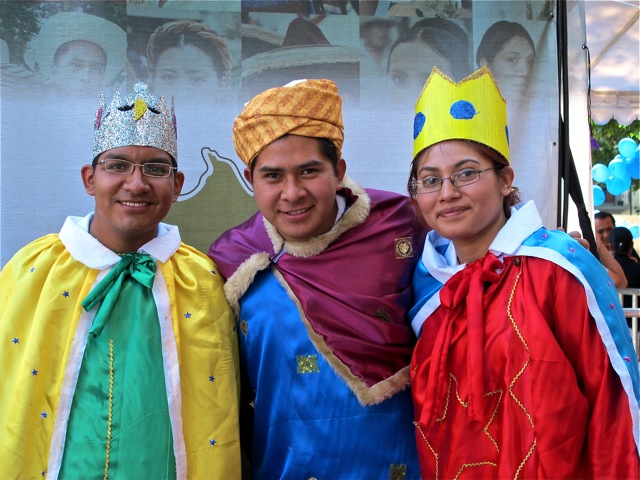
Three teenagers (2 boys and 1 girl) dressed as the Three King.

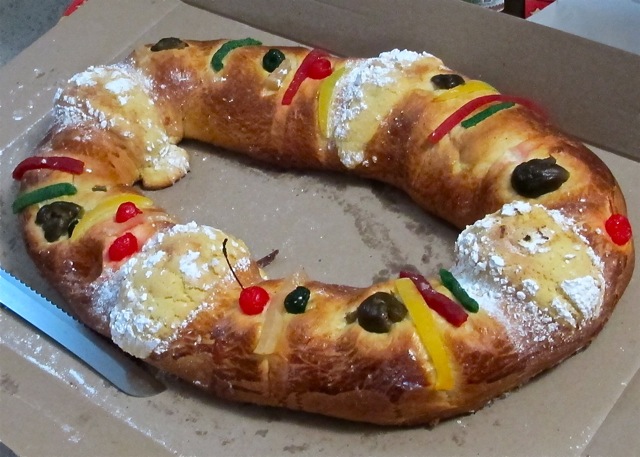
Yesterday morning, children awoke to find their very own gifts from the Magi.  However, the day’s excitement didn’t end there.  Rosca de Reyes, a wreath of sweet bread had been made or purchased.

Woman putting powdered sugar on top of a Rosca de Reyes

This innocent looking dessert has a secret; a tiny plastic “bebé Jesús.”  Family and friends take turns with a knife, each slicing their own piece, and the one who finds the figurine must host a tamale party on February 2, Día de la Candelaria (Candlemas), for all those gathered.

Rosca de Reyes

However, Laura (my Spanish teacher) and her friend Manuel, just couldn’t leave it at that.  Last night, one by one, guests cut into the above cake and, lo and behold, we all bit into a baby Jesus.  Needless to say, there was much joking about fertility drugs!  It should be some tamale fiesta on February 2nd.

Read Full Post »

A little craziness from the November 2, 2011 comparsa in Vista Hermosa…

Muchisimas gracias to all my readers.  Thank you for stopping by, your perceptive comments, and your encouragement.  Peace and joy in 2012, if not in the world, at least in your heart!

Read Full Post »

A few weeks ago, my neighbor gave me the following poem based on the Clement C. Moore classic, ‘Twas the Night Before Christmas.  The author, she said, was unknown.  The reference librarian in me couldn’t resist doing a little digging and found that this is Texas Public Radio DJ Ernie Villarreal’s version of the song, Pancho Claus, by Chicano music legend, Eduardo “Lalo” Guerrero.

~~~

‘Twas the night before Christmas and all through la casa
Not a creature was stirring, Caramba! ¿Que pasa?

Los ninos were all tucked away in their camas,
Some in vestidos and some in pajamas.
While Mama worked late in her little cocina,
El viejo was down at the corner cantina.

The stockings were hanging con mucho cuidado,
In hopes that St. Nicholas would feel obligado
To bring all the children, both buenos y malos,
A Nice batch of dulces and other regalos.

Outside in the yard, there arouse such a grito,
That I jumped to my feet, like a frightened cabrito.

I went to the window and looked out afuera,
And who in the world, do you think que era?

Saint Nick in a sleigh and a big red sombrero
Came dashing along like a crazy bombero!

And pulling his sleigh instead of venados,
Were eight little burros approaching volados.

I watched as they came, and this little hombre
Was shouting and whistling and calling by nombre.

¡Ay, Pancho! ¡Ay, Pepe! ¡Ay, Cuca! ¡Ay, Beto!
¡Ay, Chato! ¡¡Ay, Chopo! ¡Maruca
and ¡Nieto!

Then standing erect with his hand on his pecho
He flew to the top of our very own techo.
With his round little belly like a bowl of jalea,
He struggled to squeeze down our old chimenea.

Then huffing and puffing, at last in our sala,
With soot smeared all over his red suit de gala.

He filled the stockings with lovely regalos,
For none of the children had been very malos.

Then chuckling aloud and seeming contento,
He turned like a flash and was gone like the viento.

And I heard him exclaim and this is VERDAD,
Merry Christmas to all, And to All ¡Feliz Navidad!

~~~

Multicolor star-shaped piñata against blue sky.

Piñata at the southeast corner of the zócalo in Oaxaca.

Paz y alegría a todos  ~~  Peace and joy to all.

Read Full Post »

And the juxtapositions continue; the annual nativity scene set up on the zócalo in Oaxaca across from the Government Palace and the ongoing occupation by the women of San Juan Copala, not to mention the ubiquitous banners of  Section 22 of the Teachers’ Union.

This slideshow requires JavaScript.

Then there were the impossibly cute kids and a rapid request from them.  “Mas despacio, por favor,” sez I.  A slow motion reply followed, “To-ma nu-es-tra fo-to,” sez the older girl.  And, so I did!

Read Full Post »

On December 18, Oaxaqueños celebrated the feast day of the Queen of Oaxaca, La Santísima Virgen de La Soledad (Virgin of Solitude).  There are several minor variations to her story, but there is no doubt that in the State of Oaxaca, she is venerated in a manner similar to the Virgin of Guadalupe and is carried through the streets of the city during many religious celebrations.

Virgen de La Soledad being carried through the streets with plain purple cape

Virgen de La Soledad in her traveling clothes

According to one legend:  In 1620 a mule train bound for Guatemala camped outside the city of Oaxaca discovered an extra mule which did not belong to anyone in the group. The mule refused to move and when prodded rolled over and died. When the pack it carried was opened, it was found to contain the statue of the Virgin of Soledad. Taking this as a sign from heaven, the inhabitants built first a shrine, later a church and finally the imposing basilica which stands today on the spot where the statue first appeared.

Another story:  a muleteer from Veracruz in route to Guatemala noticed he had one too many mules in his pack upon his arrival in Oaxaca. Outside the San Sebastian hermitage, the mule collapsed under the burden it was carrying. All attempts by the muleteer to get it back on its feet were futile; so to avoid punishment he notified the authorities. When he lifted the load off the mule, it got up and died instantly. The burden was inspected, and they found an image of the Virgin accompanied by Christ on it, along with a sign that said, “The Virgin by the Cross.” Faced with this momentous event, Bishop Bartolome Bohorquez ordered a sanctuary built in honour of the divinity.

Still another legend:  a heavily laden burro of mysterious origin appeared outside of town in 1534, fell to the ground, spilling its load next to a rock (still onsite) containing the beautifully carved Virgin (thought to be carved in Guatemala or the Philippines) and a chapel was built on the spot. However, apparently there was an adobe shrine to the Virgin of Solitude atop Cerro Fortín as early as 1532 — and the rock may have even been moved from the mountain in 1617 to the current site (immediately to the right, along the wall as you enter).

She became the patron of not only the city but the entire state, as well as of the mariners who sailed to and from her ports. She wears a purple velvet cape, and her vestments are encrusted with pearls, 600 diamonds, and she wears a 4-lb gold crown.

Virgin of Solitude with purple cape encrusted with pearls and diamonds

Virgen de La Soledad her glass enclosed home at the Basilica

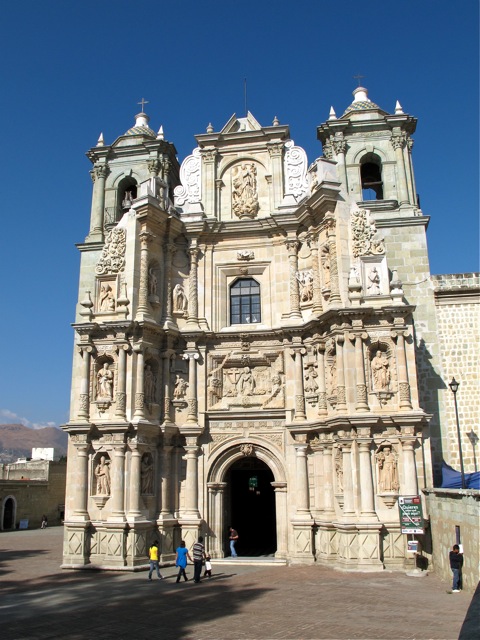
She resides in the church dedicated to her, the Basílica de Nuestra Señora de la Soledad.  Construction began in 1682, it was designed by Father Fernando Méndez, sanctioned by the Viceroy Tomas Aquino Manrique de la Cerda, and consecrated in 1690 by Bishop Isidro Siraña y Cuenca.  The current baroque style facade was built between 1717-1719 and is unusual because it faces east (Photos are best in the AM).  It was built with the green cantera and a pinkish stone, used in the facade.  If one looks carefully, several ways in which the indigenous masons and carpenters introduced their own “pagan” symbology and pantheon into the wood and stone are in evidence.

Facade of the Basílica de Nuestra Señora de la Soledad

East facing facade

It was intentionally built with low spires and towers, to better withstand earthquakes.  The atrial courtyard is enclosed and fitted with two simple access portals, one facing south, and the other east. The latter leads to the Socrates Garden (currently undergoing a major renovation) and the Plaza de la Danza.

References:

Read Full Post »

December seems to be quite a month for the Virgins of Oaxaca.

December 8, I was awakened by cohetes (rockets… all bang, no bling) at 4:45 AM.  They continued sporadically until about an hour later, when wildly clanging church bells heralded a non-stop barrage of more cohetes for several minutes… they eventually faded away, but a banda was heard in the distance.

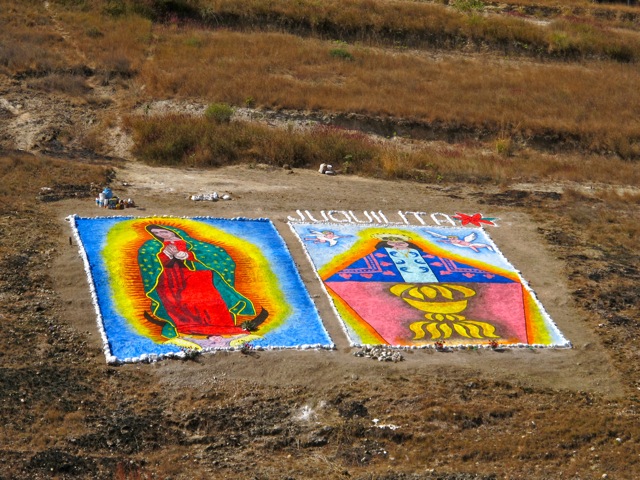
It was the feast day of the Virgin of Juquila (La Virgen de Juquila), one of Oaxaca’s own.  According to legend, in 1633, when a fire burned the small Chatino village of Amialtepec to the ground, a small statue of the Virgin Mary was rescued amidst the ashes. It was a miracle; she was undamaged, save for her light skin color, which was permanently darkened by the smoke… causing her to look more like the Chatino people, who revered her.

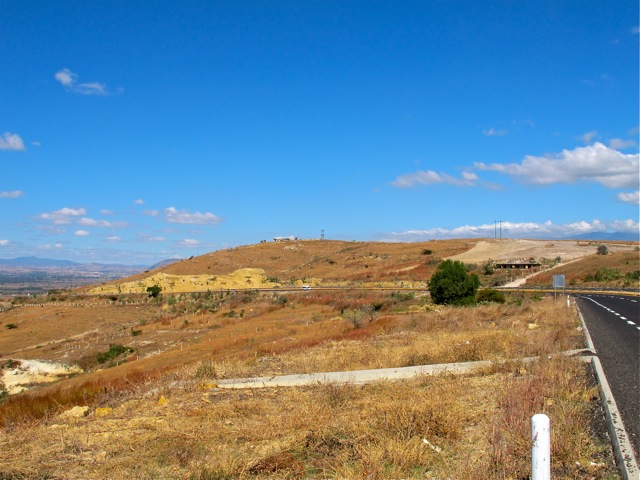
Here she is, in a field alongside La Virgen de Guadalupe, almost at the crest of the new carretera between Oaxaca and San Martín Tilcajete.

Brown fields next to highway at crest of hill

La Virgen de Guadalupe on the left and La Virgen de Juquila on the right.

Sand paintings of the Virgin of Guadalupe and the Virgin of Juquila on a mountainside.

The Virgin of Guadalupe had her day only four days later, on December 12.  La Virgen de Guadalupe is known as the Queen of Mexico and Empress of America, and is the patron saint of México.  Reports estimate that 5.8 million of the faithful made the pilgrimage this year to Basilica of Our Lady of Guadalupe in Mexico City to honor the dark-skinned virgin who appeared to Indian peasant Juan Diego on Dec. 12, 1531 near what is now Mexico City.

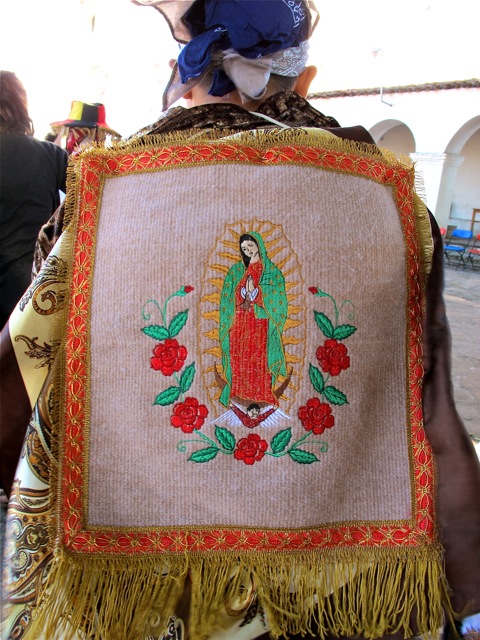
In Oaxaca, worshipers flocked to the Chapel of Guadalupe at the north end of Llano Park and a carnival filled the park for all the little Juan Diegos and girls in period costume to be entertained.  However, I headed out to Teotitlán del Valle to see this Zapotec village honor La Virgen de Guadalupe with their traditional Danza de la Pluma.  Several of the Danzantes (dancers) were wearing capes woven and embroidered especially for this day…

Virgin of Guadalupe embroidered on the back of the cape of a Danzante.

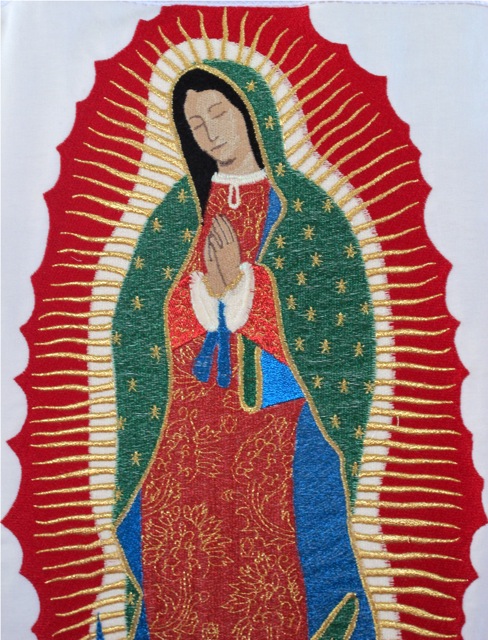
The weaving and embroidery were spectacular!

Closeup of the Virgin of Guadalupe on the back of Moctezuma's cape.

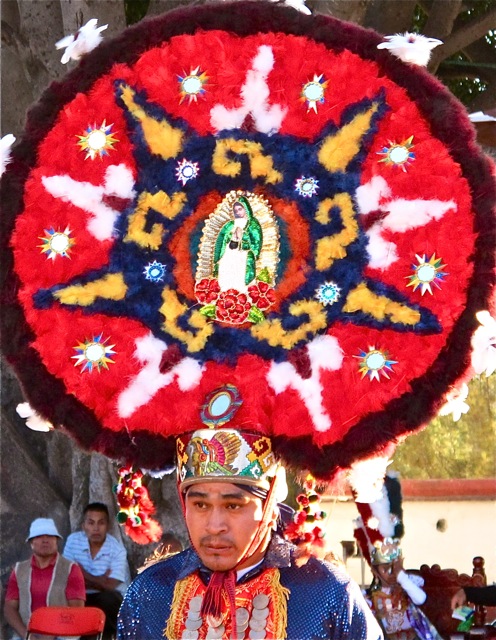
And, at least one of the Danzantes had an image of the Virgin of Guadalupe in the middle of his corona (feathered headdress).

Feathered headdress with image of the Virgin of Guadalupe  in the center.

Malinche and Doña Marina also had similar images on the skirts of their dresses.  To see those and several other photos of the dancers, you should take a look at what Chris has posted at, Oaxaca-The Year After.

Next on the “Virgin” calendar is December 18, the feast day of La Virgen de la Soledad (the Virgin of Solitude), Oaxaca’s patron saint.  Stay tuned…

Read Full Post »

…warms the night and the heart.

After a week (plus) of temps that dropped into the high 30s/low 40s during the night (Brrrr… central heating, what’s that?), sun, clear blue sky, and mild evening temperatures have returned.  It’s perfect weather for strolling around la ciudad, wandering in and out of artesania shops, doing a little stress-free Christmas shopping, and pausing every once in a while to absorb the scene.

This slideshow requires JavaScript.

You might have noticed, the angel from Friday’s post successfully ascended the ladder and now graces the top of the stable.  And, along with bells and Rudolph, a Star of David hangs on the side of a building.  Interesting… this is the first time I’ve seen it as part of holiday decorations.  By the way, there are no synagogues in Oaxaca.

Read Full Post »

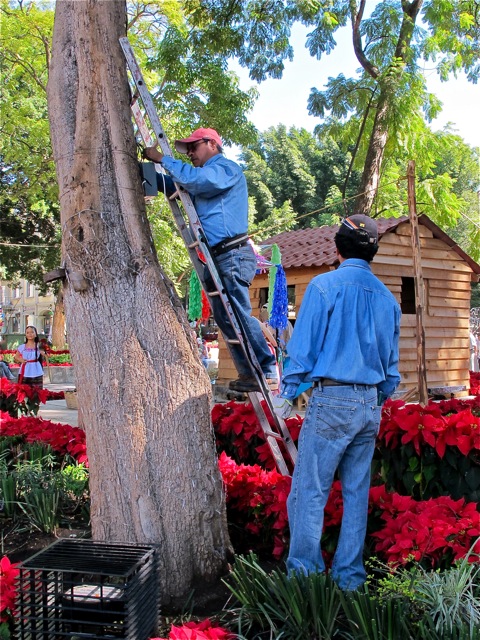
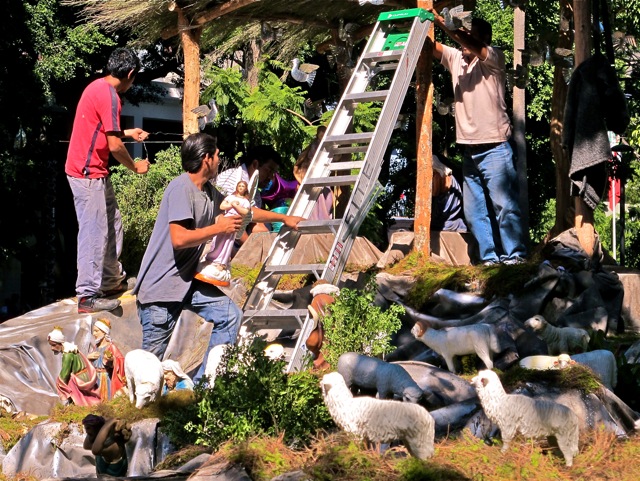
Oaxaca is gearing up for Christmas.  Thankfully, it is not (yet) as hectic and commercial as in el norte.  Though decorations have been been displayed, front and center, in my local Soriana super-mercado for at least a month, it is only in the last few days that the city’s electricians have been positioning lights on the trees around the zócalo…

Electrician positioning light on tree

to  illuminate the welcoming niño.

Mannequin of boy in sombrero and sarape

Lambs have begun appearing…

Long white-haired mannequin carrying lamb.

Angels are being elevated…

Workman about to carry an angel mannequin up a ladder.

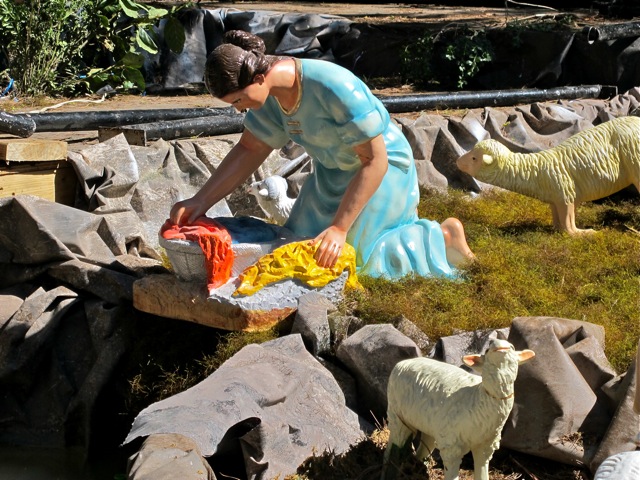
Clothing is laundered in preparation for Navidad…

Female mannequin washing clothes as mannequins of lambs watch.

And, thousands of poinsettias have been brought in to add splashes of color to the beds beneath the 130+ year old Indian laurels.

Flower bed of poinsettias under Indian laurel tree.

It’s beginning to look a lot like Christmas!

Read Full Post »
Today is Thanksgiving in los Estados Unidos de América… and besides my wonderful family and friends, I am so grateful to see and experience places like San Antonino Castillo Velasco during los Días de Muertos.

This slideshow requires JavaScript.

¡Feliz Acción de Gracias a todos!

Read Full Post »
San Antonino Castillo Velasco, a Zapotec community near Ocotlán, is a village known for its flowers.  They are, no doubt, the inspiration for beautifully embroidered linens and clothing sold in the mercados and found in museum collections.  And, a specialty is the “flor inmortal” (immortal flower), so named because, even when dried, it retains its brilliant colors.  They are used to create intricately designed figures on display December 23 in the city of Oaxaca, during Noche de Rábanos and to decorate the graves of  loved ones during Días de Muertos in San Antonino.

This slideshow requires JavaScript.

As I’ve previously mentioned, each village seems to have its own unique traditions for the Days of the Dead.  Villagers here mix the area’s very fine dirt with water, cover the graves, use a trowel to smooth it, outline designs and religious imagery into the dried coating, and then use flowers (fresh and dried), to paint the scene.  Entire families are involved, young and old, and the atmosphere is filled with joy, purpose, and most of all… Love.

For a very special moment, that is a metaphor the two days spent at San Antonino, see Chris’s post, Moments make a life..

Read Full Post »

« Newer Posts - Older Posts »