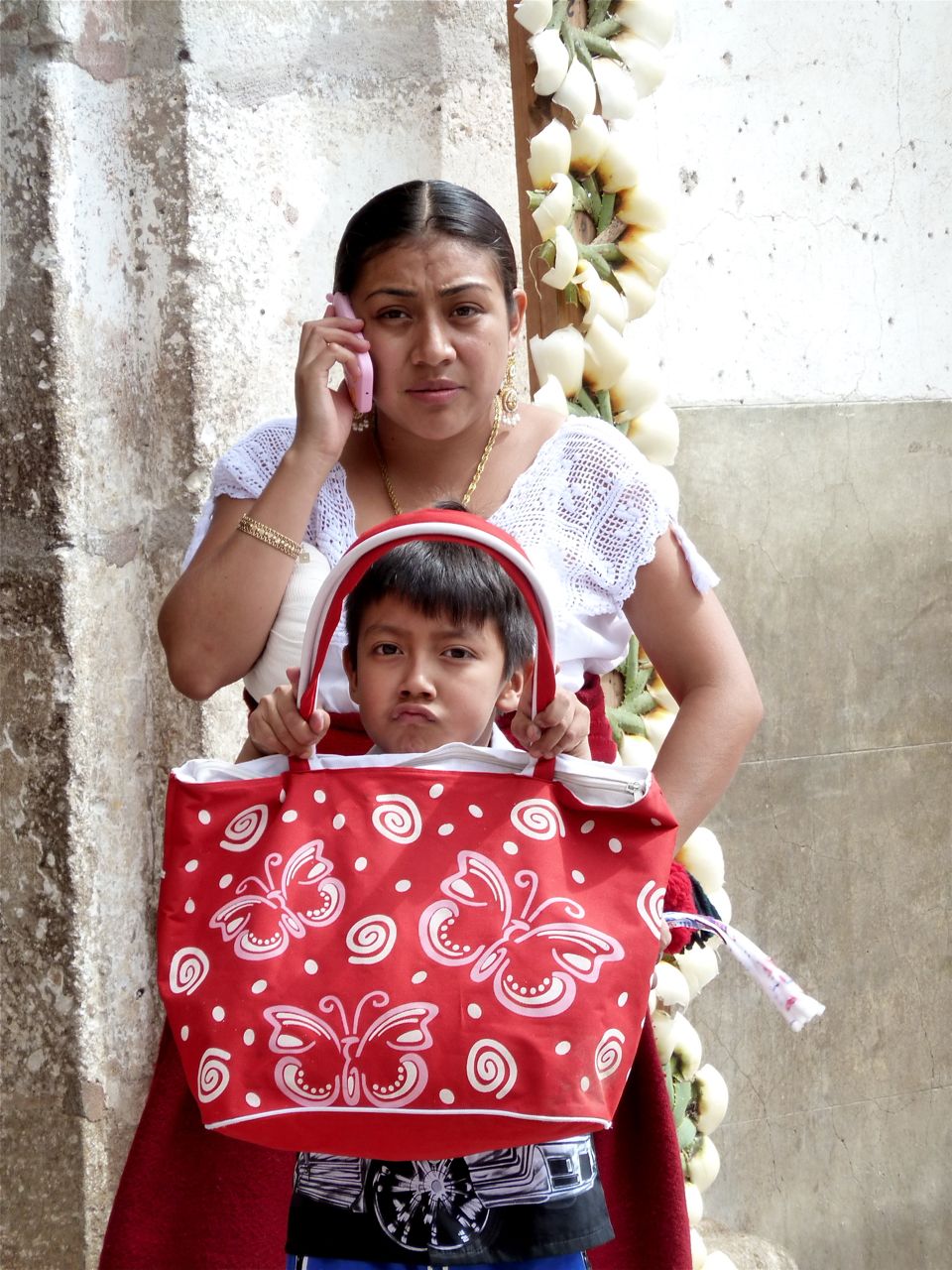
Outside Templo de Santa María de la Asunción, Tlacolula de Matamoros, on Friday, waiting for the calenda to begin.
Posted in Celebrations, Culture, Travel & Tourism, tagged calendas, cell phones, Mexico, Oaxaca, parades, photographs, photos, popular travel destinations, Señor de Tlacolula, Tlacolula de Matamoros on October 13, 2013| Leave a Comment »
Outside Templo de Santa María de la Asunción, Tlacolula de Matamoros, on Friday, waiting for the calenda to begin.
Posted in Celebrations, Culture, Religion, Travel & Tourism, tagged baskets, calendas, canastas, Fiesta de la Virgen del Rosario, Mexico, Oaxaca, parades, popular travel destinations, Tlacolula de Matamoros, Virgin of the Rosary on October 8, 2013| 2 Comments »
Before returning to honor al Señor de Tlacolula this Friday, I figured I’d better finish posting pics from last Friday’s la Virgen del Rosario calenda.


This annual procession slowly winds its way through the streets of Tlacolula de Matamoros. Participants stop at “stations” throughout the village, where religious ritual is performed, rest breaks are taken, and tamales, sweets, and beverages (yes, including mezcal) await. This goes on until after midnight. I don’t know how they do it!
Posted in Celebrations, Culture, Religion, Travel & Tourism, tagged calendas, Fiesta de la Virgen del Rosario, marmotas, Mexico, Oaxaca, parades, popular travel destinations, Tlacolula de Matamoros, Virgin of the Rosary on October 5, 2013| Leave a Comment »
Yesterday, we headed about 20 miles southeast of the city to Tlacolula de Matamoros for their calenda (parade) in honor of la Virgen del Rosario (the Virgin of the Rosary). While we go to Tlacolula often, especially for their Sunday market, and while we’ve been to countless calendas, this particular one was a first — and what fun it was!
I’m always amazed at the variations from one village to another — even those only a few miles apart. I have to say, one of the most striking features of Tlacolula’s calenda was the masses of marmotas. No, I’m not talking the groundhog/woodchuck variety. These, at their most awesome, are ginormous cloth globes on a pole that are carried in every calenda I’ve ever seen down here.

Little boys start out with little marmotas — learning how to position it in the holster and becoming comfortable carrying it for several blocks.


The pre-teens graduate to bigger and heavier marmotas and the lesson here is one of balance — learning to find one’s center — and that you get by with a little help from your friends.


Teens refine their moves and their “look.” Look ma, no hands! After all, a central part of the calenda is a procession of the unmarried girls and young women of the village!
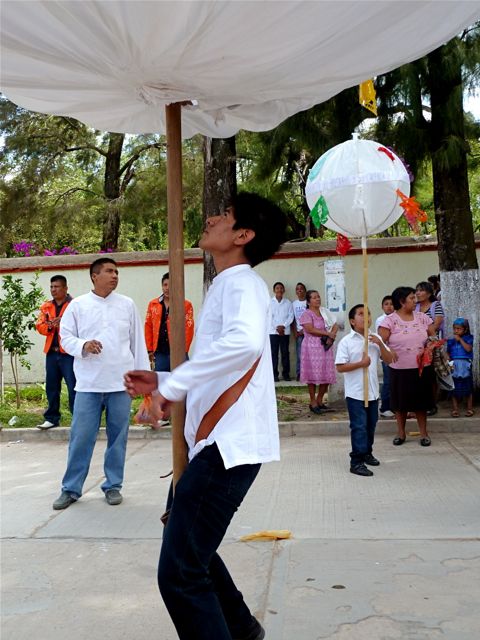
Young men eventually become good-natured and married journeymen…
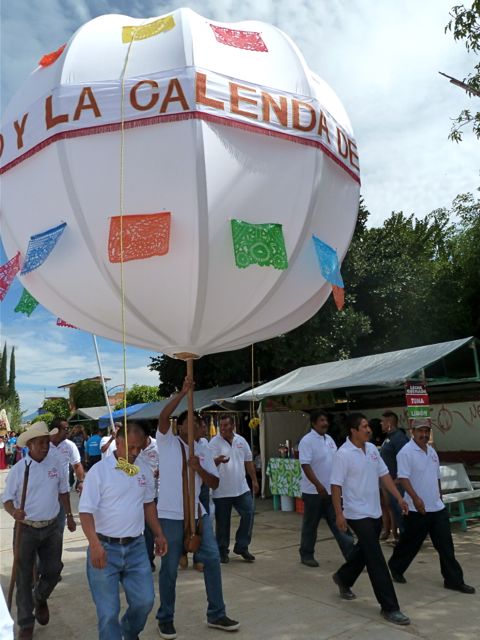
I’m guessing it never ceases being a source of macho pride — enough to tempt one of Tlacolula’s senior citizens into showing, he’s still got it!

And then there was the gringo…

Check out Oaxaca–The Year After for this hilarious tale in his own words. (I’m still laughing!)

Marmotas on parade — it was a spectacular sight!
Posted in Buildings, Celebrations, Culture, Travel & Tourism, tagged decorative lighting, Dreamer, El Mes de la Patria, Government Palace, José María Morelos y Pavón, Mexican Independence, Mexico, Miguel Hidalgo y Costilla, Oaxaca, Oaxaca Film Festival, Oaxaca FilmFest4, Palacio de Gobierno, photo, photographs, Twenty Million People on September 26, 2013| 3 Comments »
Early Wednesday evening, I walked down to the Palacio de Gobierno to see Dreamer, one of the Oaxaca FilmFest4 offerings. It had been raining on and off all day and so, to lighten my load and make room for my umbrella, I left my camera at home. Why would I need it? I was just going to be sitting in a small dark theater. Sheesh, was I mistaken! It was twilight when I entered the Palace via the side door on Flores Magón, but we were directed to exit through the main front entrance — and I was blown away by the scene before me. The rain-soaked zócalo glistened and glittered, awash with El Mes de la Patria green, white, and red lights.
Needless to say, last night when I returned to watch, Twenty Million People, I took my camera!

Heroes of the independence movement, Hidalgo and Morelos in the spotlight as they gaze down from the Government Palace. I always forget how beautiful the zócalo is at night!
Posted in Celebrations, Culture, Travel & Tourism, tagged Congreso Nacional de Danzón, dance, Danzón, festivals, Mexico, music, Oaxaca, photographs, photos on September 20, 2013| 2 Comments »
Not only is the previously mentioned Oaxaca FilmFest4 opening tomorrow night, but last night a calenda up Morelos heralded the arrival of the 8th Congreso Nacional de Danzón. Alas, it was raining, I’m a wimp, and so stayed home. However, the music coming from the Plaza de la Danza sounded wonderful. Sigh….
If you are walking around Oaxaca during the next few days, be on the lookout for the guapas y guapos (the guys are all duded up, too) of Danzón. They are adding a lot of glitz and glamour to the streets of the city.

For the uninitiated, Danzón is a very stately dance that originated in Cuba. However, it seems to be most beloved in Puerto Rico and Mexico. It has especially flourished in Oaxaca, where one can find dancers young and old dancing under the laurel trees in the Zócalo every Wednesday evening at 6:30. And, no wonder it has retained its popularity here, according to Wikipedia, “many famous danzones were composed by Oaxacan musicians such as the famous Nereidas and Teléfono de larga distancia, both works of Amador Pérez Dimas, from the town of Zaachila, near Oaxaca city.”
If you aren’t anywhere where Danzón is performed, you can check out the 1991 movie, Danzón:
Julia (Rojo) is a phone operator in Mexico City who divides her time between her job, her daughter and the danzon: a cuban dance very popular in Mexico and Central America. Every wednesday Julia does the danzon with Carmelo (Rergis) in the old “Salon Colonia”. They’ve danced for years but barely know each other. One night Carmelo disappears without a trace. Feeling lonely and sad, Julia takes a train to Veracruz, where she knows Carmelo has a brother. That sudden trip will change Julia’s life forever. — IMDB
I haven’t seen the movie, but according to one reviewer, the soundtrack is worth the rental price. I’m going to try to find it!
Posted in Celebrations, Culture, History, Holidays, Travel & Tourism, tagged desfile, holidays, Mexican Independence Day, Mexico, military, Oaxaca, parade, photographs, photos, popular travel destinations, women military on September 16, 2013| 6 Comments »
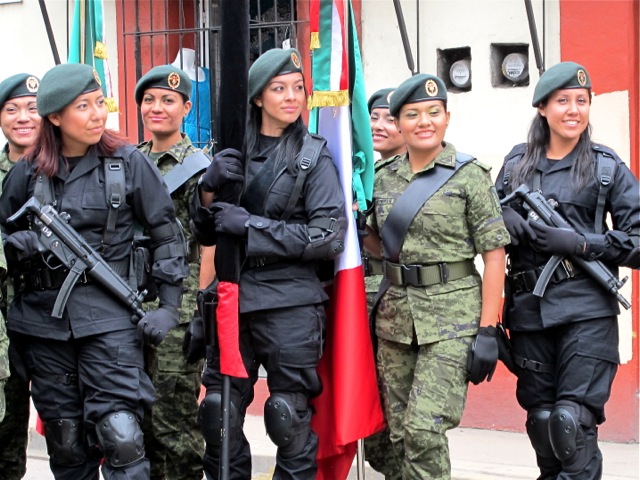
What do the guys do while waiting for an Independence Day parade to begin?
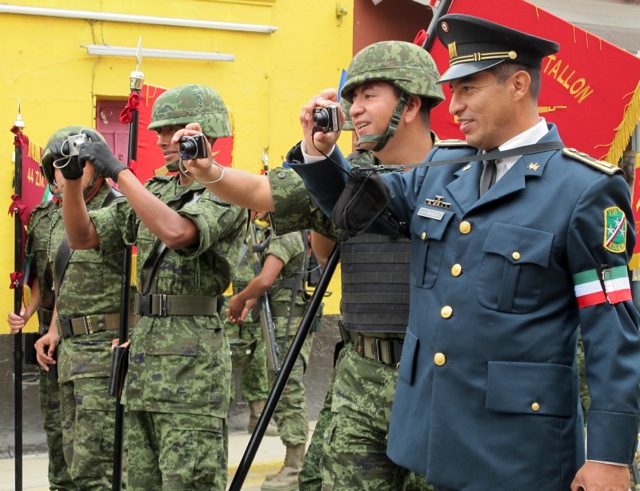
And, what do gals do? Pose for them!
A mother takes twenty years to make a man of her boy, and another woman makes a fool of him in twenty minutes. — Robert Frost
Posted in Celebrations, History, Holidays, Travel & Tourism, tagged El Grito, el grito de dolores, Grito de Dolores, Mexican flag, Mexican Independence Day, Mexico, Oaxaca, photographs, photos on September 15, 2013| 2 Comments »
At 11 PM tonight, with El Grito de Dolores, also known as El Grito de la Independencia (the Shout of Independence), echoing from government buildings throughout the country, Mexico begins celebrating her long and hard-fought independence from Spain. Despite the gathering of meteorological and political storm clouds, Oaxaca has gotten her green, white, and red on.
Doors are decorated, bunting is hung, and Mexico’s tricolor appears…


This proud yet faded flag with frayed edges seems a fitting symbol this year.

In the words of Che Guevara, “La lucha continua.”
Posted in Celebrations, Creativity, Culture, Travel & Tourism, tagged capes, Danza de la Pluma, feather art, Feather dance, Fiesta a la Natividad de la Virgen María, Fiesta de la Preciosa Sangre de Cristo, leggings, Mexico, Oaxaca, penachos, photographs, photos, Teotitlán del Valle on September 10, 2013| 5 Comments »
The Danza de la Pluma penachos (headdresses), capes, and leggings are spectacular and unique to Teotitlán del Valle. The feathered designs on the penachos are more intricate and varied than in other pueblos; and the capes and leggings are hand-woven in this village that is internationally known for its weaving. However, while the Danza de la Pluma is a crowd-pleaser during the annual July Guelaguetza on Cerro del Fortín in Oaxaca, folkloric groups from other villages are usually chosen to perform it, as Teotitlán’s costumes are not considered “authentic.”

However, performing for tourists is not why Teotitlán del Valle tells this story through music and dance several times a year. It is performed on the church plaza, not the municipal plaza, because it is an integral part of the annual major religious celebrations of the village: Fiesta titular a la Preciosa Sangre de Nuestro Señor Jesucristo in July, Fiesta a la Natividad de la Virgen María in September, Fiesta a el Rosario de la Virgen María in October, and Fiesta a la Virgen de Guadalupe in December.
Penachos from the Fiesta a la Natividad de la Virgen María on Sunday…


Capes from Sunday’s Fiesta a la Natividad de la Virgen María and July’s Preciosa Sangre de Nuestro Señor Jesucristo festival.


Leggings from both festivals…


The various elements of the costumes do not come cheap and dancers must appeal to their extended families to assist in commissioning each of the pieces. Thus, as annual festivals come and go during a dancer’s 3-year commitment, the costumes may evolve.
With their performances, the dancers honor the rituals of their church and community. And, with their magnificent costumes, they pay homage to the creativity, talent, and tradition of Teotitlán del Valle’s weavers and feather artists.
Posted in Celebrations, Culture, Travel & Tourism, tagged Danza de la Pluma, danzantes, Doña Marina, El Picacho, Fiesta a la Natividad de la Virgen María, fiestas, Malinche, Mexico, Oaxaca, penachos, photographs, photos, popular travel destinations, Teotitlán del Valle on September 8, 2013| 2 Comments »
Yippee, I’m back in Oaxaca! Last night’s flight was smooth, on-time, and mostly empty. I have to admit to always getting a goofy grin as the little Embraer comes in over the lights of the city and the smile continues through immigration and baggage claim. It usually falters and turns to a grimace when I have to hoist my 50 pound suitcase up onto the x-ray conveyor belt. However, last night the grin returned when I pressed the “to search or not to search” button, got the green light, and was able to proceed directly to the booth to buy my colectivo ticket — 60 pesos for door-to-door service to the historic district ‘hood. An easy return to home.
Unpacking done, late this morning I walked down to my local mercado to restock the larder with some basics: 2 perfect avocados, 1 pristine white onion, a bunch of unblemished small and sweet bananas, half kilo of quesillo (Oaxacan string cheese), and 6 freshly made tamales (mole, rajas, and verde). I’d actually asked for 4, but my regular tamale gal threw in 2 extras. How often does that happen in el norte? A welcoming return to home.
This afternoon, blogger buddy Chris and I drove out to Teotitlán del Valle for the Fiesta a la Natividad de la Virgen María performance of the Danza de la Pluma. We stepped up onto the plaza of Templo de la Preciosa Sangre de Cristo and it was like emerging into the middle of a technicolor movie. We’ve been there countless times, but today we were blown away by the scene. Mother Nature had conspired to use her enhance wand on the sky, clouds, sun, and costumes. A spectacular return to home!


The recent trip to California was to sign papers finalizing the sale of the house my grandparent’s built in 1957. Prior to relocating to Oaxaca, it had been my home for 30 years, where I’d raised my kids and made many wonderful memories. Needless to say, selling it was an emotionally challenging ordeal and it has engendered a lot of thinking about the notion of “home.”
However, these past 24 hours have reinforced my belief in bumper-sticker wisdom seen many years ago, “When you live in your heart, you are always home.” It’s good to be home!
Posted in Celebrations, Culture, Travel & Tourism, tagged Asunción Ixtaltepec, costumes, desfile, Edna St. Vincent Millay quote, El Espinal, Guelaguetza, Mexico, Oaxaca, Ocotlán de Morelos, parades, photographs, photos, San Agustín Loxicha, San Jerónimo Tecóatl, San Juan Bautista Tuxtepec, San Juan Cacahualtepec, San Pablo Villa de Mitla, San Pedro y San Pablo Ayutla, Santo Tomás Ocotepec, traje, Villa de Tututepec de Melchor on August 16, 2013| 6 Comments »
“Beauty is whatever gives joy.” — Edna St. Vincent Millay
Some of the beautiful women, young and old, of this year’s Guelaguetza desfiles.
Posted in Celebrations, Culture, Travel & Tourism, tagged Costa region, desfile, Desfile de Delegaciones, Guelaguetza, Jamiltepec, La Mayordomía de San Andrés Huaxpaltepec, Mexico, Oaxaca, parade, photographs, photos, San Andrés Huaxpaltepec, San Juan Colorado on August 4, 2013| Leave a Comment »
Wading through the 900+ Guelaguetza photos and wondering… Where do I start? Where do I stop? Today, it will be with two delegations from the Jamiltepec District in the Costa Region of the state of Oaxaca.
I begin with photos from last Saturday’s desfile of these fierce (and one not-so-fierce) looking guys from San Juan Colorado.


And, I will end this post with San Andrés Huaxpaltepec delegation.


With the crowds that line the parade route and the contingent of family, friends, and aides (providing props and costume repair, along with much-needed water) that accompany each delegation, it was hard to photograph, let alone video, the dancing along the way. However, click HERE to watch a video of the La Mayordomía de San Andrés Huaxpaltepec from last Monday’s performance at the Guelaguetza Auditorium. And, you can click HERE for a video I found of the Danza los Chareos of San Juan Colorado.
Posted in Celebrations, Culture, Travel & Tourism, tagged costumes, Desfile de Delegaciones, Guelaguetza, Mexico, Oaxaca, parades, photographs, photos, traje on August 2, 2013| 1 Comment »
I love arriving early at the assembly site for the Guelaguetza desfile. There is time to mingle with the delegations as parade participants gather. Tourists, bloggers, and professionals aren’t the only ones taking photos…


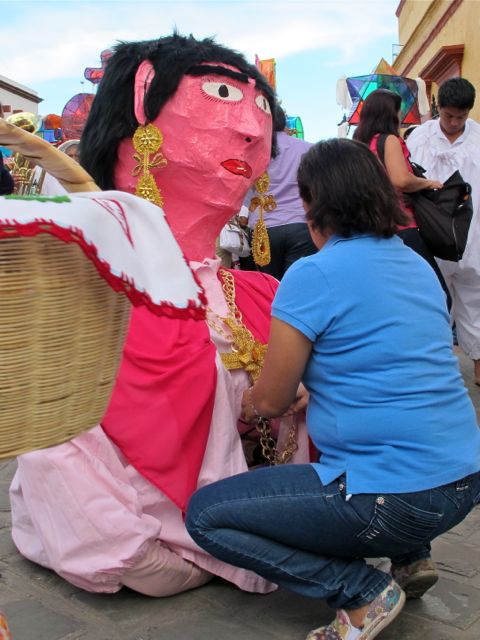
Finishing touches are put on costumes and canastas.


Adjustments are made to sandals and feet are rested before beginning the 3 hour procession through the streets of the city.


We won’t ask what alteration she is making!
More parade photos to come…
Posted in Casita Colibrí, Celebrations, Culture, Travel & Tourism, tagged fireworks, fuegos artificiales, Guelaguetza, Mexico, Oaxaca, photographs, photos, popular travel destinations on July 30, 2013| 6 Comments »
And so, Guelaguetza 2013 ended last night in an explosion of fireworks from Cerro del Fortín…


Not a bad view from Casita Colibrí!
Posted in Celebrations, Creativity, Culture, Music, People, Travel & Tourism, tagged Alejandra Robles, Desfile de Delegaciones, Guelaguetza, Lila Downs, Mexico, musicians, Oaxaca, parades, photographs, photos on July 28, 2013| Leave a Comment »
Some of my closest friends have been (and continue to be) musicians. And, one of the things I find so appealing about Oaxaca is that music is everywhere and all the time. Marimbas are set up on sidewalks, accordions are almost ubiquitous, and free concerts occur weekly in the zócalo. Music is honored and valued as an integral part of the culture — a birthright.
Each of the 8 regions of the state has its own distinctive “sones” and “jarabes” and they are tremendous source of pride. Within a bar or two of Pinotepa, Canción Mixteca, or any one of Oaxaca’s regional anthems, the clapping begins, tears may well up, and audiences of all ages begin singing the lyrics. Thus, a major feature of the modern “Mondays on the Hill” that is Guelaguetza, is the performance of the music and dance of each of the regions.
And, so I give you, some of the musicians who played almost non-stop for 3 hours, while their delegations danced their way through the streets of Oaxaca city during the last two Saturday evening Guelaguetza desfiles (parades).
Here’s to the musicians, long may they play!
Posted in Celebrations, Culture, Food, Travel & Tourism, tagged chichilo mole, Feria del Tejate y el Tamal, festivals, food, Mexico, Oaxaca, photographs, photos, popular travel destinations, San Andrés Huayapam, San Andrés Huayapan, tamales, tea towels, tejate, Unión de Mujeres Productoras del Tejate on July 24, 2013| 4 Comments »
There is SO much going on in Oaxaca right now that the doing isn’t leaving much time for the writing!
However, I’ll give it a try with today’s Feria del Tejate y el Tamal. The festival is part of an effort to preserve the food culture of the Zapotec.

What, you may ask, is tejate? It’s a frothy, refreshing, and nutritious non-alcoholic pre-Columbian beverage made from Nixtamal corn mixed with tree ash, toasted cacao beans, mamey seeds, and Rosita de Cacao flowers. The sale of tejate is the main economic activitity in San Andrés Huayapam, located about 7 miles north of the city, and it is prepared and served by the tejateras of the Unión de Mujeres Productoras del Tejate.


Then, of course, there were the tamales — in tin buckets and giant pots covered in layers of tea towels, many colorfully embroidered. So many vendors anxious to reach into the steaming buckets and so many varieties to choose from. Where does one start?


Blogger buddy Chris recommended the Rajas and Verde from the gal “down at that end,” a taste of a friend’s Flor de Calabaza added that to the list, Mole is a given, and I had to find Chichilo. The latter is one of the seven moles of Oaxaca, it is only served on special occasions, such as weddings and christenings, or when the crops have been harvested. Chilhuacle negro, mulatto, and pasilla chiles; blackened tortillas and seeds of the chiles; and avocado leaves (the latter imparting a subtle anise flavor) give it its distinctive flavor. After three unsuccessful attempts, eureka, I found it! And so I returned home with five mouth-watering tamales.

Speaking of ingredients like corn, cacao, chiles, and calabaza, for a graphic of foods Mexico gave to the world, click HERE.
¡Buen provecho!


 Mexican Peso Converter
 View From Casita Colibrí