Feeds:
Posts
Comments

Archive for the ‘Celebrations’ Category

And we thought last year’s Día de la Virgen de Guadalupe in Teotitlán del Valle was exceptional!  It was, but, for blogger buddy Chris and me, this year brought even more warmth, appreciation, and the intangible of being present in the richness of more layers of being in this special village.

p1230528

Edgar Daniel Ruiz Ruiz

We are patrons of two of the danzantes of the 2016-18 Grupo de Danza de Pluma Promesa in Teotitlán del Valle — and Edgar Daniel Ruiz Ruiz is one of them.  As such, we were invited to the home he shares with his parents, Mario Ruiz Bautista and Victoria Ruiz, to partake in the traditions and observe the responsibilities that accompany taking on the three year commitment to being a member of the Grupo.

img_2526-recovered

Mario Ruiz Bautista (on left) overseeing the offerings

From my albeit limited understanding, as part of the commitment the dancers make during their three years of service, each of their families is tasked with taking a turn hosting one of the four yearly festivals.
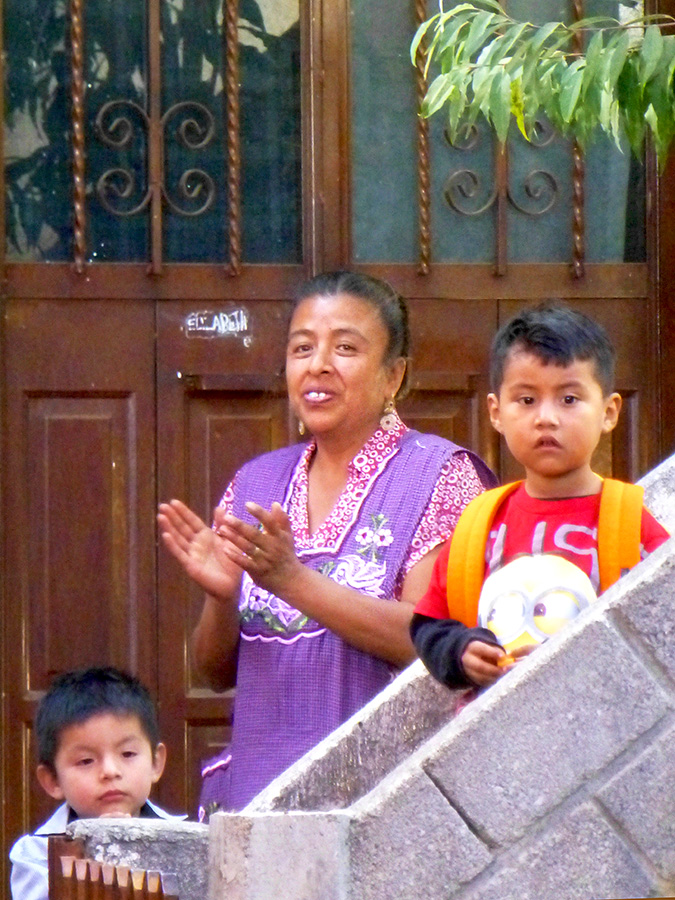
p1230570

Victoria Ruiz watching Edgar’s dance

The day began with a breakfast of traditional breads and hot chocolate and was followed by Mole de Castilla, a mole unique to Teotitlán and served during weddings and the most important festivals.  There must have been over 100 people, including Edgar’s extended family, padrinos, danzantes and their families, and band members.  They gathered and were served in the courtyard of the Ruiz home, with men seated at one long table, women on the other side of the courtyard at another, and the two gringos seated with the danzantes in the altar room opening onto the courtyard.

p1230504

Breakfast breads with hot chocolate

Following the meal, chairs and tables were folded and removed, the danzantes took the floor, the band began to play, and, as the sun streamed down on the courtyard, Edgar began his dance.  It was a touching moment to see this young man, whom I’ve known for almost six years, since he was a gangling teenager, and Chris has known since he was a small boy, dance with such confidence and pride.

Following dances by the whole group, with band leading the way, dancers, families, and guests processed down the steep and winding streets from the house to the church.
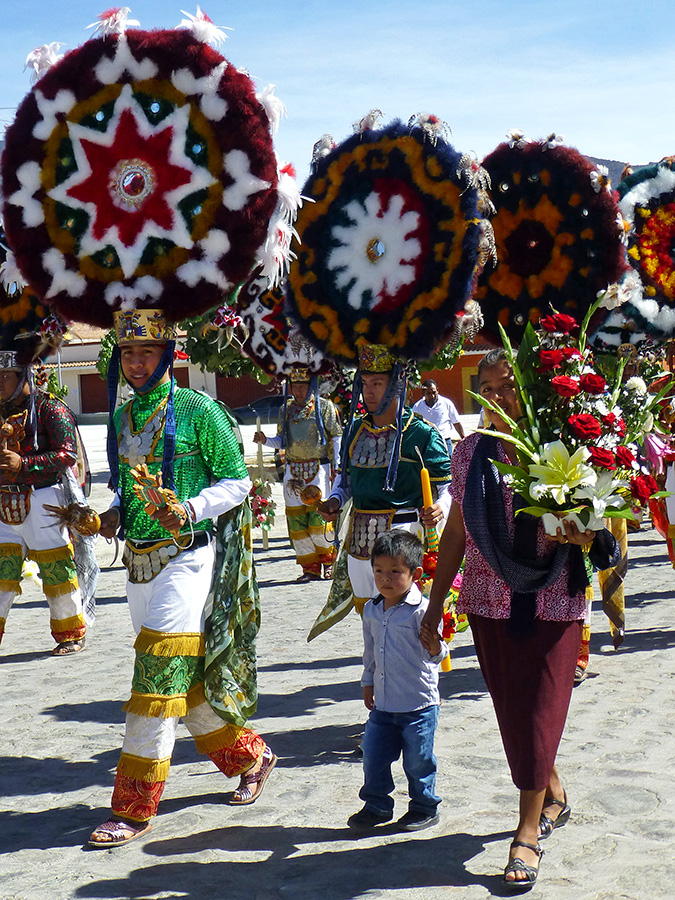
p1230610

Edgar Daniel Ruiz Ruiz en route to the church, accompanied by Victoria (his mother) and his nephew.

They filed into the church, where a special mass was celebrated, and then regrouped in the church courtyard to begin the seven hour (más o menos) Danza de la Pluma.  Early in the afternoon, while the dance continued, the families and invited guests returned to the Ruiz home, where the families of the other dancers each made formal presentations of baskets of fruit and mezcal or cervesa to Mario and Victoria.  This was followed by a comida (lunch) of caldo de pollo.  After all were fed, the offerings  were loaded into pickup trucks to be taken to the church plaza, to later be shared with the community.  At night, after the dance ended, we all again returned to Casa Ruiz for barbecoa de res (beef) in a rich and flavorful sauce, cervesas, mezcal, and soda pop.  I can’t even begin to imagine all the work that went into preparing all the food, orchestrating its serving, and then washing all the dishes — by hand in basins set up in the yard across the street.

p1230608

Edgar Daniel Ruiz Ruiz

It’s been over twenty four hours since Chris and I returned from Teotitlán del Valle and, though we talked continuously on the drive back to the city and have spoken several times since, we are still unable to put into words how meaningful and how honored we were to share this special day with Edgar, his family, and his community.  It was a precious gift. ¡Muchisimas gracias a todos!

For more, see Chris’s blog post, A very special Dia de Virgen de Guadalupe.

Save

Save

Save

Save

Save

Save

Read Full Post »

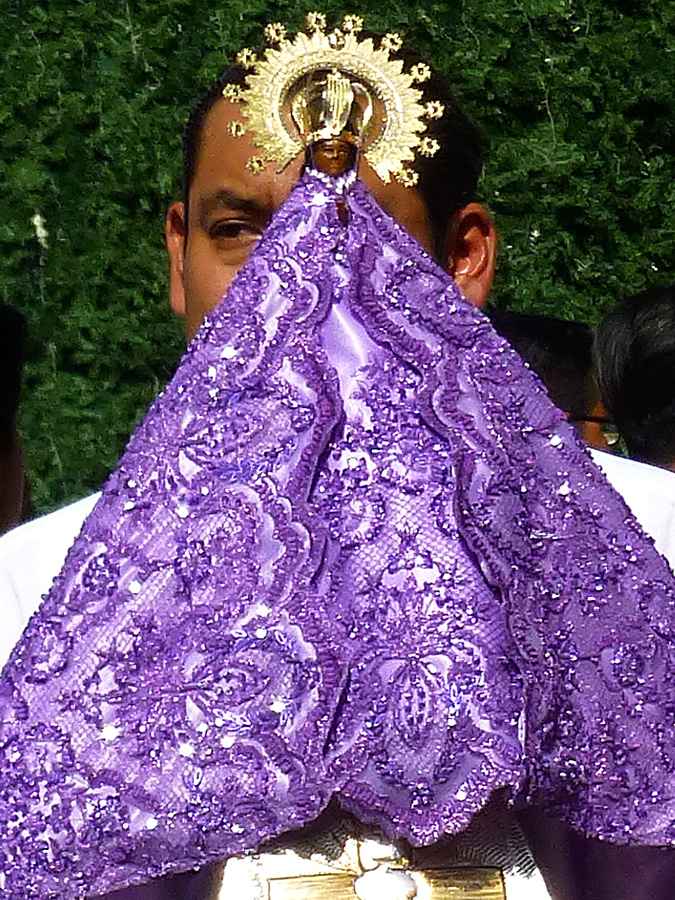
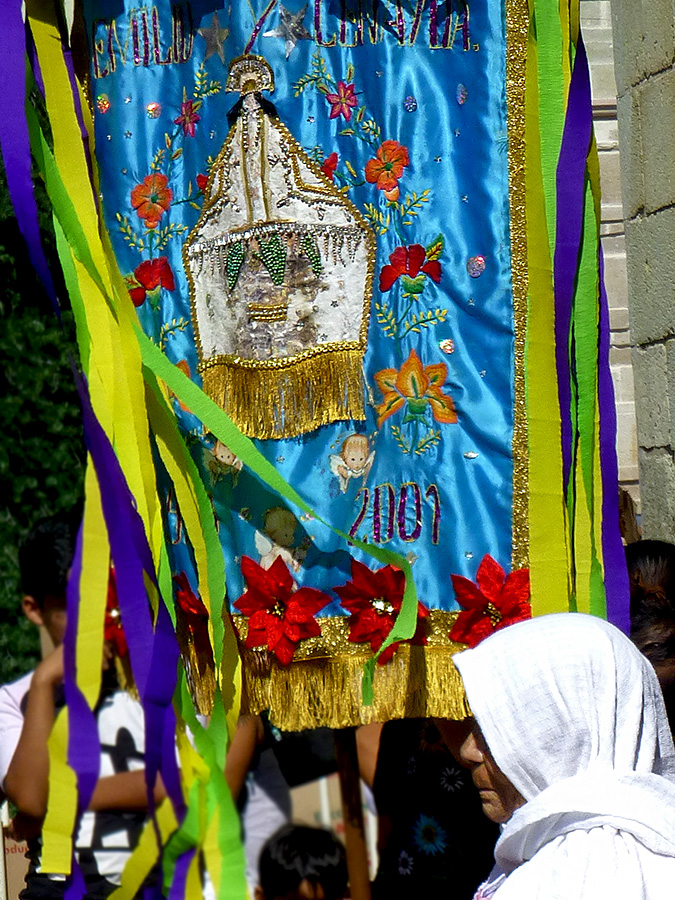
December seems to be el mes de las vírgenes (the month of the virgins) in Oaxaca.  Early this morning cohetes (rockets) and church bells announced the first of the month’s three virgin days; the feast day of la Virgen de Juquila.  And, this afternoon, on the Alameda in front of Oaxaca’s cathedral, a small procession gathered.

p1230437

According to legend, in 1633, when a fire burned the small Chatino village of Amialtepec to the ground, a small wooden statue of the Virgin Mary was rescued amidst the ashes.  She was undamaged, save for her light skin color, which was permanently darkened by the smoke, causing her to more closely resemble the Chatino people, who live in this remote mountainous region.  Local priests declared her survival a miracle and she has been venerated ever since.

p1230450

Alas, that wasn’t the end of the story; the priest in the village of Juquila convinced the “powers that be” that she should be moved to the bigger and better church in Juquila.  She, however, had other ideas and returned to Amialtepec.  This back and forth continued another three times.  Finally, in 1719, La Morenita (the dear dark one), as she had come to be known, gave up her traveling ways and agreed to call Santa Catrina Juquila her permanent home.

p1230442

The faithful make pilgrimages to both her old and new mountain homes (about four hours southeast of Oaxaca city).  They come year round on foot, on bicycle, and in all other manner of transport, to make offerings and pray for miracles, but especially during the days leading up to December 8.  October 8, 2014 marked her crowning achievement; in a grand ceremony, she received a papal coronation, joining her previously crowned (1909) Oaxaca sister, Nuestra Señora de la Soledad.

Read Full Post »

It was early evening last Monday, all my bags were packed and I was ready to go, when the the sounds of a parade began getting closer and closer.  I grabbed the little Lumix and headed into the streets.

img_2397

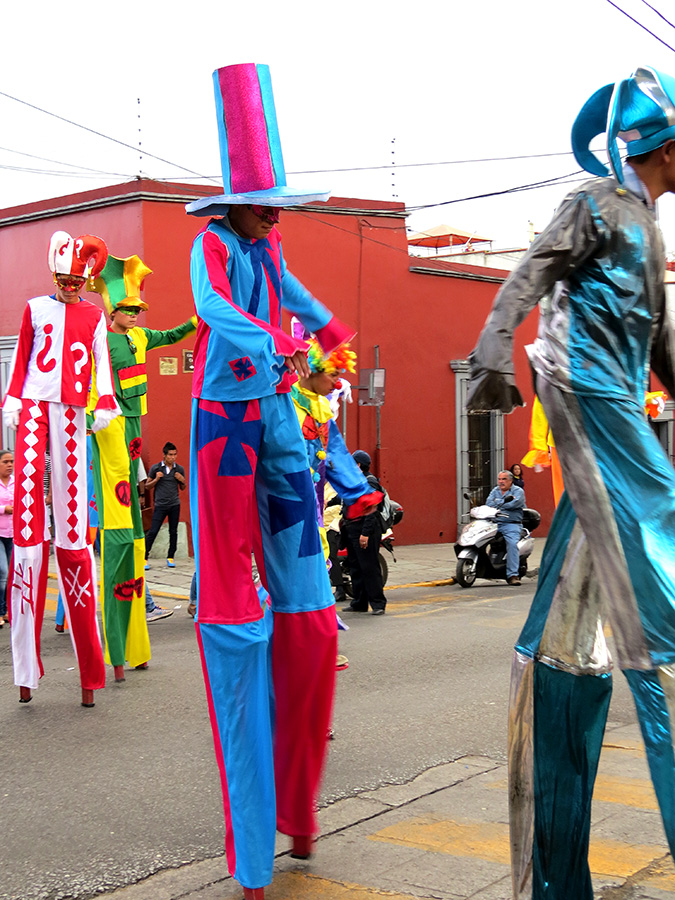
Zancudos, not autos, on Av. Morelos

Yikes, Zancudos had taken over the street.

img_2406

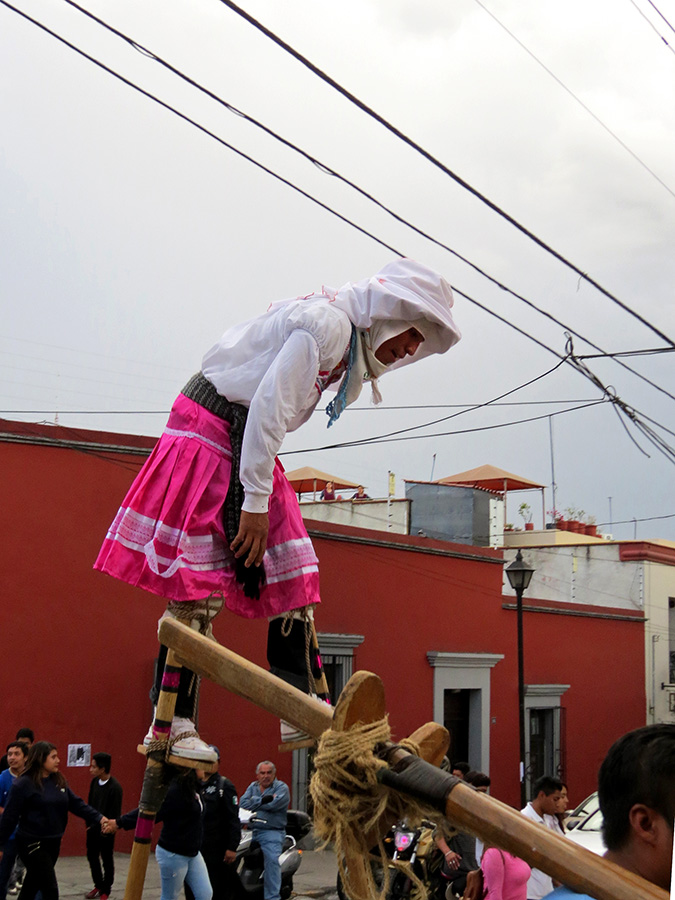
Low bridge!

As you can see, we are not talking about mosquitoes; these Zancudos are stilt walkers.

img_2414

Approaching the Plaza de la Danza

The two contingents of Zancudos were part of a calenda kicking off UABJO (Universidad Autónoma Benito Juárez de Oaxaca), Semana Cultural, Deportiva y Científica (Culture, Sport, and Science Week).

img_2418

About to tackle the stairs

The five-day program of events included competitions in singing, chess, oratory, and science experiments; film and theater presentations; along with zumba, self defense, and aerobics demonstrations.

img_2426

Dancing and prancing on the Plaza de la Danza

Reason #980 why I love Oaxaca:  You just never know when a calenda will break out!

img_2455

Rest time, after walking and dancing their way through the streets

It was a great memory to carry with me, as I boarded the plane the next morning en route to el norte.

Read Full Post »

After the wretched week that was (RIP Leonard Cohen and Leon Russell, not to mention the USA elections), reviewing my Día de Muerto photos from Teotitlán del Valle was the ideal tonic.

On November 1, as I previously mentioned, after strolling and sitting and contemplating and conversing our way through the panteón in Tlacolula de Matamoros, we drove to the home of friends, Zacarias Ruiz and Emilia Gonzalez, in Teotitlán.  Arriving at 3:00 PM, we were just in time to join the family and other guests, as Zac gave words of welcome to the difuntos, who had also just made their appearance.

p1230127

Our pan de muerto and mezcal joined the other offerings on the altar to provide nourishment to the departed while we, the living, sat down at the long table for a little cervesa, mezcal, and more than a few of the 500+ tamales Emilia had made.  After lots of eating and conversation, we walked across the courtyard to give our regards to Antonio Ruiz (weaver of one of my treasured rugs), wife Claudia, and their children (the beautiful Beatriz and her lively brothers, Diego and Antonito), and to see Antonio’s new showroom (Chris has a photo in his Familia blog post) and their altar.

p1230131

Invited to return to the Ruiz home the following day for Emilia’s famous mole negro, we also stopped at the village panteón to listen for the wind that signals the departure of the difuntos at 3:00 PM on November 2.

p1230161_copy

We also stopped to pay our respects at the grave of Arnulfo Mendoza, though it took a little searching to find it, as the large tree that stood next to it had fallen, leaving only a stump.

p1230157

Both days, the drive back to the city was filled with the warmth, peace, and joy that Teotitlán del Valle always seems to impart.

p1230164

Under the strong and comforting gaze of Picacho, who could ask for a better resting place.

Save

Read Full Post »

The dead don’t arrive in the valley of Oaxaca all at once.  The cosmic difunto air traffic controller has scheduled their arrival at different times on different days, from October 31 through November 3, to avoid celestial congestion.

Santa María Atzompa’s departed are among the first to return, arriving on the night of October 31.  Flower and food vendors line the walkway leading to the panteón as grandparents, parents, teens, and small children stream in with arms full of flowers, candles, buckets, and brooms.  Because is built on a slope and there are almost no paths, footing can be treacherous, especially in the dark when only candles on the graves light the way.  At one time, perhaps tombs were positioned on a grid, but no more and it seems to be filled to capacity.  I guess that’s why one side of the panteón has been opened up (one of the walls removed), the field beyond leveled, and a new wall around the field, connected to the old, constructed.  (You can click on images for a larger view.)

On November 1, in the early afternoon, it has become our custom to visit the cemetery in Tlacolula de Matamoros, before bringing pan de muerto and mezcal to the home of friends in Teotitlán del Valle.  In contrast to the higgledy-piggledy of Atzompa, the panteón in Tlacolula emanates a sense of order and serenity.  I wonder, could the tranquility come from the 500 year old ahuehuete trees (hijos of el Tule, we were told) that reign over the tombs of the departed and make for an amazing play of light and shadow throughout?

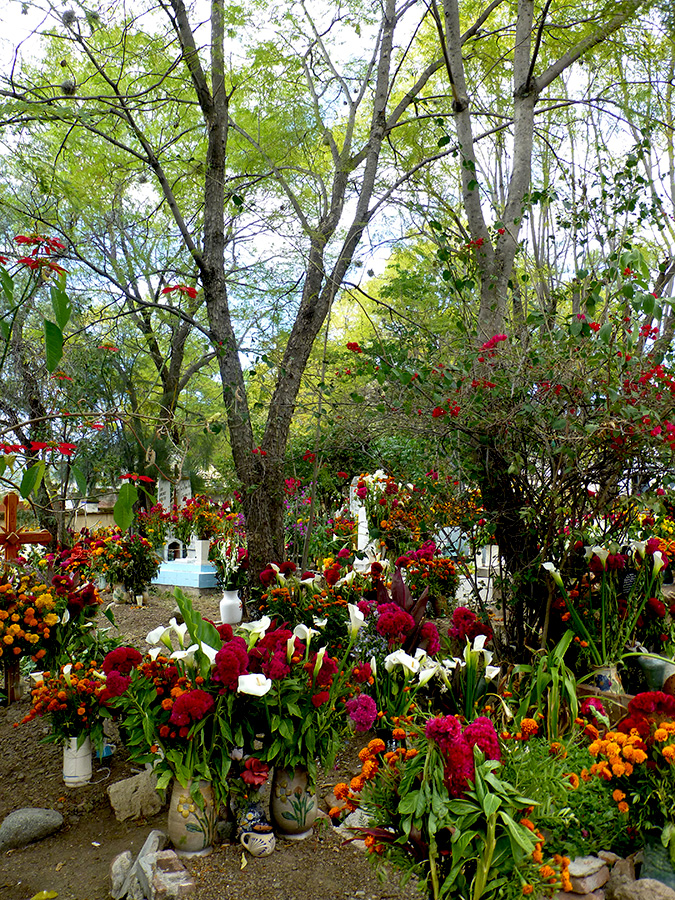
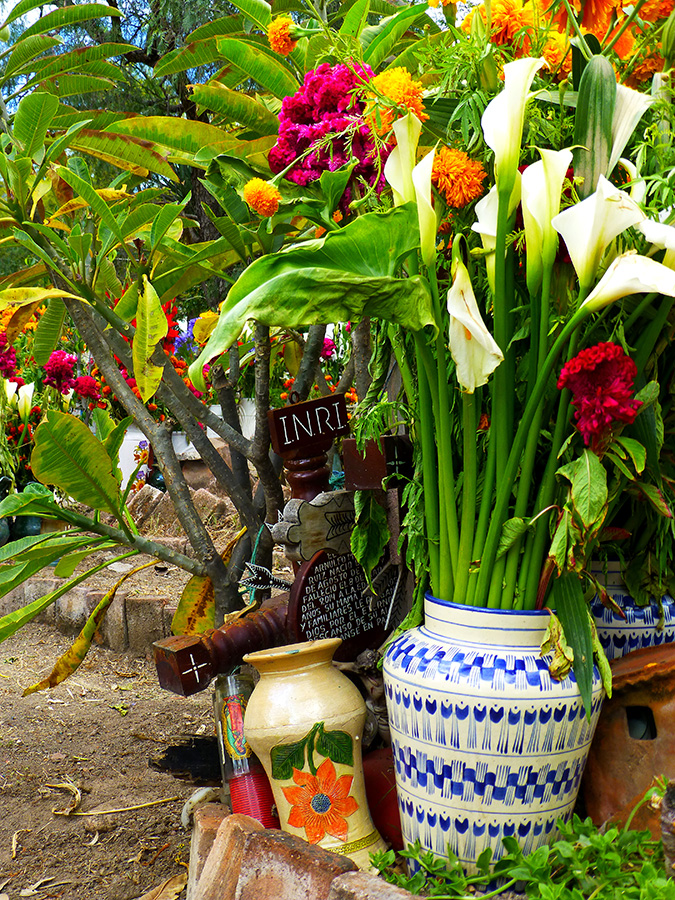
On November 2, we returned to Teotitlán, but I will save that for another blog post.  However, that was not the end of the road.  In the category of, no rest for the living, the following day we drove south to San Antonino Castillo Velasco.  This is the village known for their beautiful flowers and exquisite floral embroidery.  And, it is said that because the living are so busy providing flowers to other parts of the valley, the departed wait until November 3 to return. (See the book, Day of the Dead: When Two Worlds Meet in Oaxaca by Shawn D. Haley and Curt Fukuda.)  I’m sure, like we, the difuntos are dazzled by the intricacy of floral designs that family members have created to decorate their tombs in welcome.

Octavio Paz writes in The Labyrinth of Solitude, “Life extended into death, and vice-versa.  Death was not the natural end of life but one phase of an infinite cycle.”

Read Full Post »

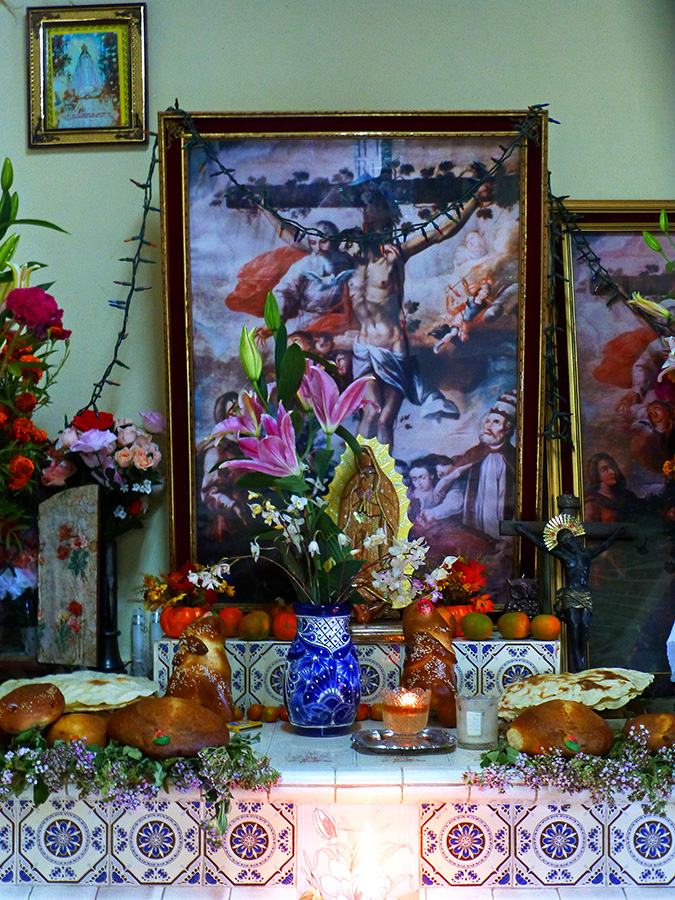
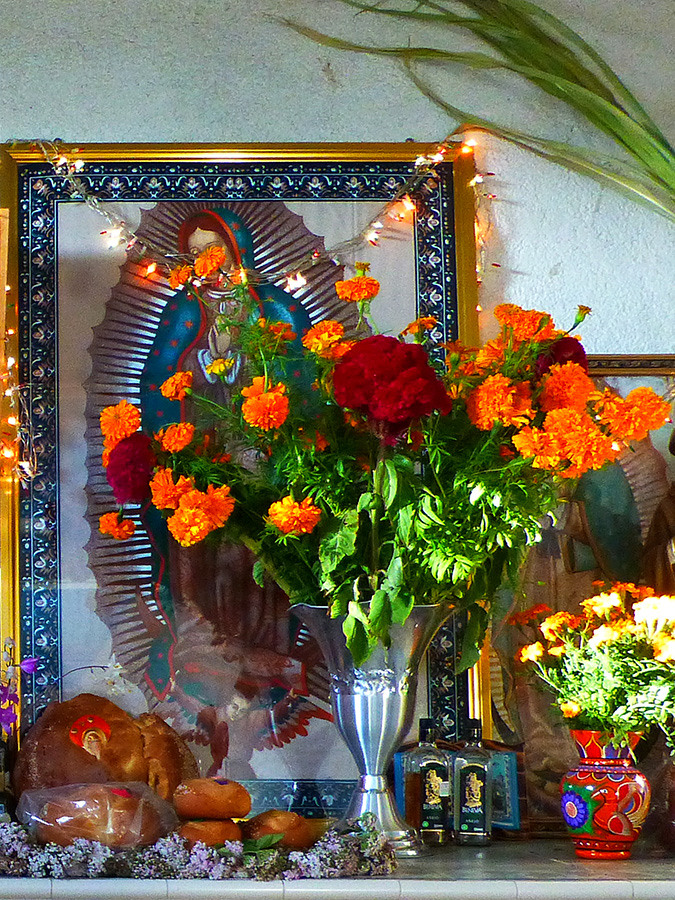
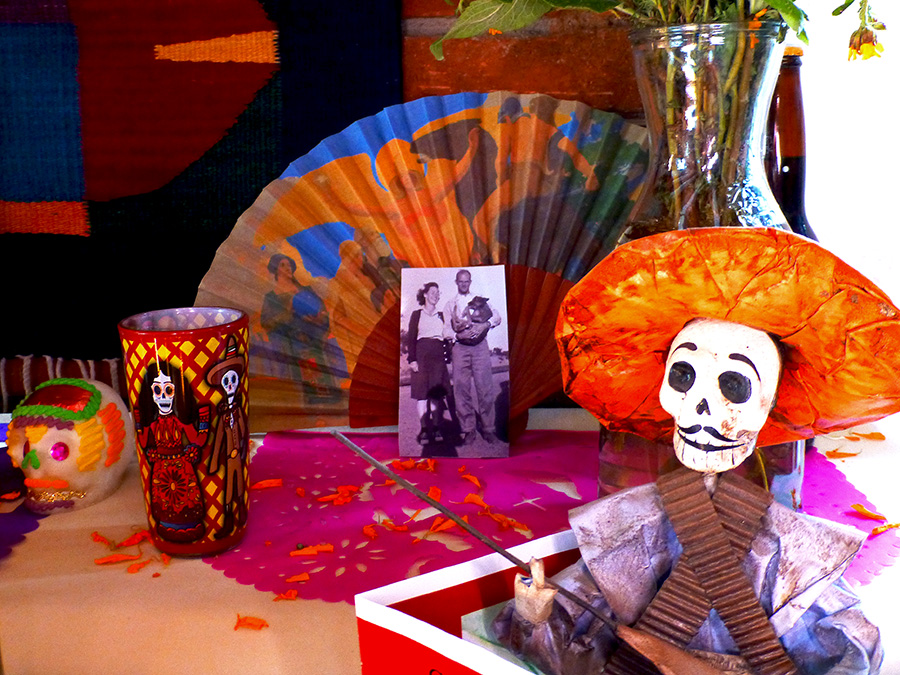
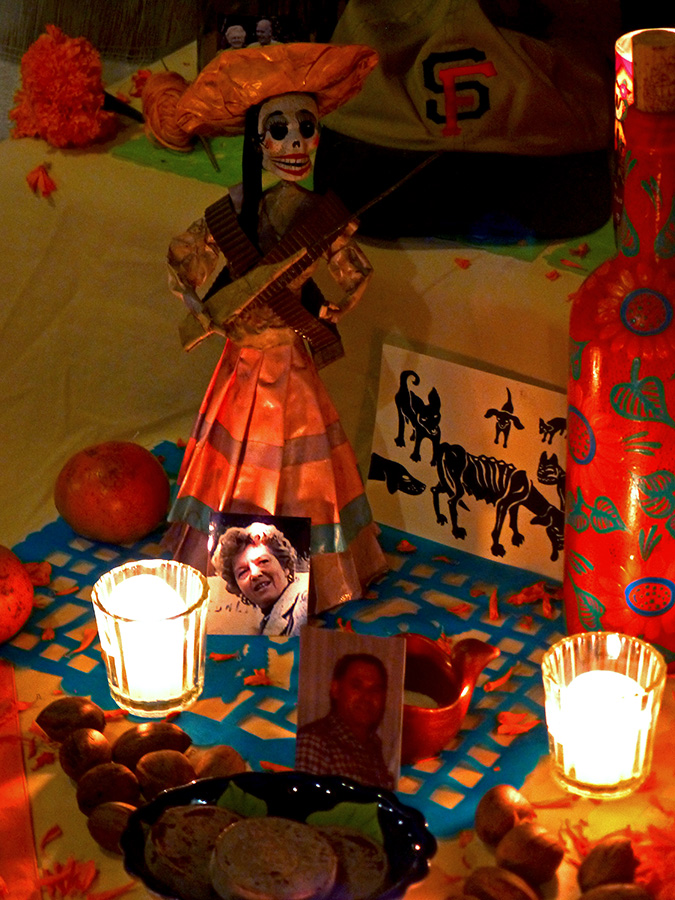
Poco a poco (little by little) my ofrenda has been constructed and composed.  A yellow (the color of death in prehispanic southern Mexico) cloth covers two chests and papel picado, signifying the union between life and death, has been added.

p1230011_crop

Photos of departed loved ones have been placed, along with apples, oranges, and nuts to nourish the difuntos, sal to make sure the souls stay pure, cempasúchitl and veruche (domesticated and wild marigolds) — their scent to guide the spirits, cockscomb to symbolize mourning, the previously mentioned flor de muerto from the mountains above Díaz Ordaz, and copal incense to draw the spirits home and ward off evil.

p1220899_crop

Sugar skulls, catrinas, and a few of the favorite things of my parents, grandparents, and in-laws have also been added.  Lest the spirits become thirsty, there is water, mezcal, cervesa, and a bottle of port (for my mom) to drink.

p1230015_crop

Last night, the candles and copal incense were lit to guide my loved ones to my Oaxaca home and, just to make sure, I sprinkled some cempasúchitl petals outside to help them find their way.

img_2246_crop

It may not be the house where they lived, but I’m hoping they too believe, When you live in your heart, you are always home.

Read Full Post »

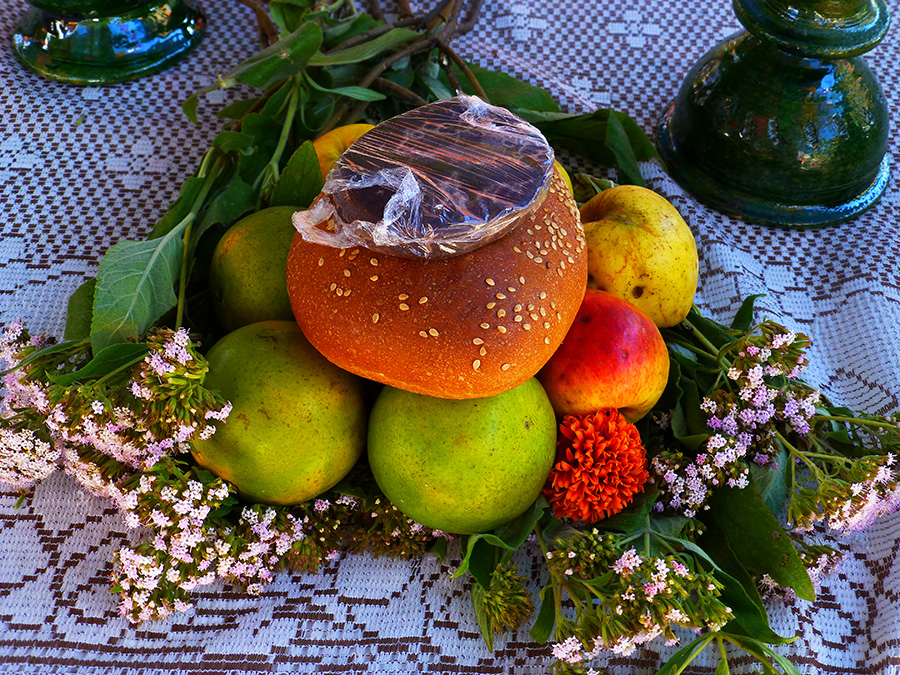
October 30, 2016, around and about the valley of Oaxaca, preparations were underway for Día de Muertos.  Bread, fruit, chocolate, nuts, and flowers for sale spilled from mercados into the streets; the difuntos must be fed… and only the best!

Our first stop was Villa Díaz Ordaz for their first Expo Festival del Pan de Muerto.  It was day two of the 3-day festival and, of course, we were there early (around noon), but everyone was so warm and welcoming.  Hopefully, it will continue to grow in future years, as this is a sweet village in a picturesque setting at the base of the mountains.

p1220852

In Díaz Ordaz, they call these tiny, spicy-scented, lavender flowers “flor de muerto” and we were informed that they are even more important than cempasuchil (marigolds).

p1220847

After buying some surprisingly flavorful (whole grain!) pan de muerto for my ofrenda, we headed off to San Pablo Villa de Mitla.  Mitla has the most beautiful pan de muerto and two years ago we stumbled on their Pan de Muertos festival and competition.  A dazzling display of intricately decorated breads lined the sidewalks under the portales.  Alas, the festival was not continued, as their bread is in such demand, the bakers were too busy to take time out for an expo and competition.  So, like last year, we just enjoyed the sights and aromas of their bustling mercado.

p1220868

Have you ever seen so many varieties of bananas???  And, now for the famous  pan de muertos…

p1220861

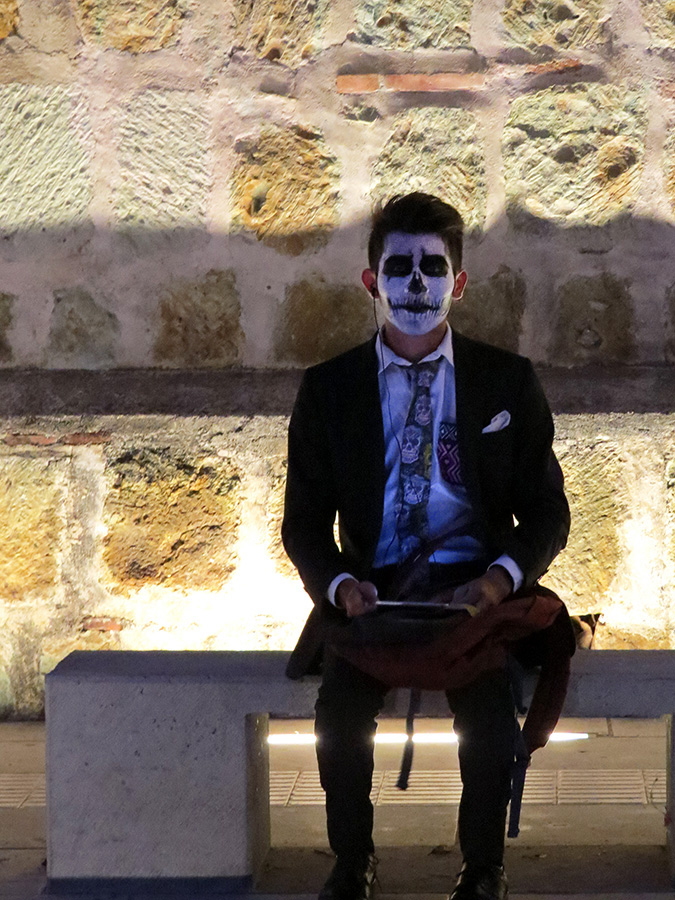
Returning home, I added the bread and flor de muerto to my ofrenda.  Following a siesta, I ventured out into the streets of the city in search of a comparsa.  I never found it, but, as you could see from my previous post, the city was teeming with people and activity.  However, amid the merriment and mayhem, there were scenes of tranquility.

img_2135

A catrin ejecutivo?

img_2172

The copal incense beckoned the difuntos…  They began arriving this morning, seconds after midnight.

Save

Save

Save

Read Full Post »

Beautiful Oaxaca tonight on Macedonio Alcalá…

img_2145

In the words of the song, “Oaxaca vives en mí” (Oaxaca, you live in me).

Read Full Post »

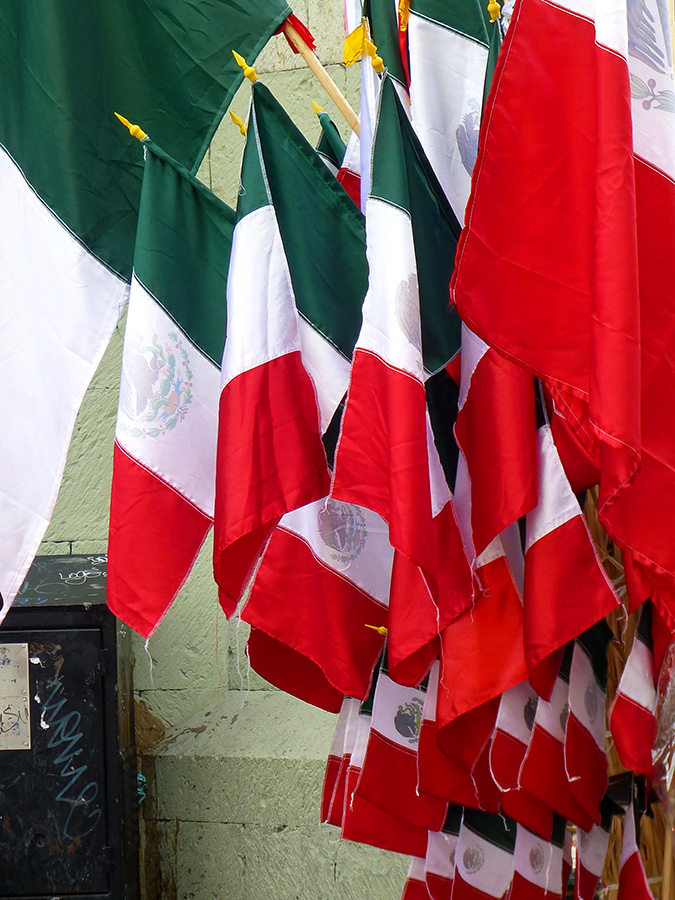
Mexico’s El Mes de la Patria (the month of the homeland) is upon us and overnight, as August turned to September, the streets erupted in green, white, and red.

p1210919

Mexico celebrates September 16, 1810 as the beginning of its fight for independence from Spain.

p1220023

Flags are flying everywhere and are for sale on every other street corner, along with all manner of patriotic tchotkes.

p1220025

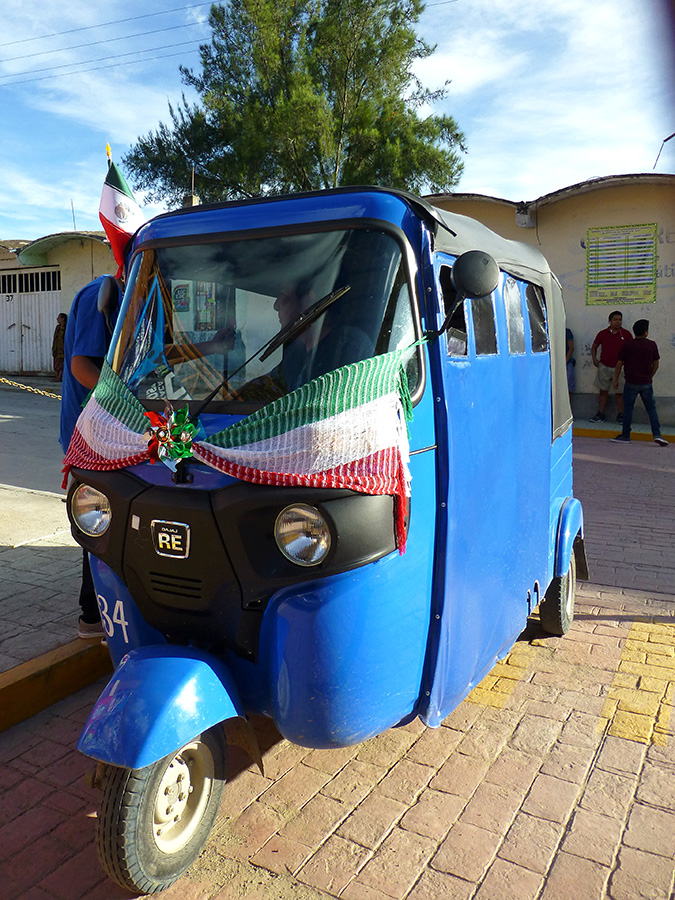
From buses in the city to moto-taxis in the villages, everything is decked out in the green, white, and red of the Mexican flag.

p1220066

As for Oaxaca?  The five-month renovation project at Mercado Benito Juárez has been completed and vendors have moved from their temporary stalls on the surrounding streets back into the market; Sección 22 teachers have returned to their classrooms and 80% of the encampment in the zócalo has been disassembled; the governor will give his final Grito de DoloresGrito de Dolores at 11:00 PM on September 15th; and the annual patriotic parade will fill the streets of the Historic District with participants and observers on the 16th.

Save

Read Full Post »

While waiting for yesterday’s convite to begin, the Danza de la Pluma subalternos, Florentino Martínez Ruiz and Juan Bautista Ruiz, knew how to keep young, old, all those in between, and the photographers entertained.

p1220053

A little “splendor in the grass” for Juan?

p1220055

And, the fun didn’t stop there, once the convite began, Florentino snatched a marmota from one of the little boys to give it a try.

img_2036

And, everyone laughed, especially the boy!  That’s entertainment, Teotitlán del Valle style!

Read Full Post »

Five days ago, Norma Schafer blogger at Oaxaca Cultural Navigator and moderator of the Facebook group, Mexico Travel Photography, issued a 5-day “Mexico Colors” photo challenge to the Facebook group — one photo a day for five consecutive days.  I think she was giving us a gentle prod, because up until then, most of us had been pretty lax about posting photos.  However, with her challenge, the floodgates opened.  Unsurprisingly, my five entries were all about the colors of Oaxaca.

P1210349_day1

Day 1:  Naturally dyed yarn hanging to dry at the family home of Porfirio Gutiérrez and his sister, Juana Gutiérrez Contreras.

P1090252_day2

Day 2:  My empty wine bottles hand painted by Isabel in San Antonio Arrazola, Oaxaca — waiting to be filled with mezcal!

IMG_1305_day3

Day 3:  Danza de la Pluma in Teotitlán del Valle, Oaxaca — during this year’s patronal festival honoring Preciosa Sangre de Cristo.

P1170253_day4

Day 4:  The “only in Oaxaca” celebration of Día de la Samaritana in Oaxaca city.

P1200734_day5

Day 5:  Flor de Piña dancers from San Juan Bautista Tuxtepec at this year’s second Guelaguetza desfile in Oaxaca city.

Norma has hinted that there may be more challenges to come.  We shall see!


Read Full Post »

The morning of August 12:  Almost continuous explosions of cohetes (rockets), shrill incessant traffic whistles, honking horns, and the distant sounds of a band (or two or three).  What in the world?  I had errands to run, so out into the cacophony to confront the unknown, I went.  It only took walking to the end of my block to realize what I’d forgotten.

IMG_2335

It’s Día del Taxista, the day when cab drivers and their families decorate their taxicabs and process en mass through the streets of the city, accompanied by bands, monos, and pirotecnicos (hence the booms and bangs).

IMG_2333

I not only forgot what day it was, but I also forgot my never-leave-home-without-it little Lumix, so the above were taken with my iPhone — something I almost never do and which explains the “creative” image below.

IMG_2326

I have NO idea how it happened, but I’ve got to say, it does illustrate what riding in a taxi in Oaxaca often feels like!

Save

Read Full Post »

Unlike last Saturday, there was no rain on yesterday’s Guelaguetza parade.  There was music, mezcal, and tepache. (Click on photos for full image.)

There were headdresses and bling.

There was awesome pride and joy.

And, there were kids to carry on the traditions.

Muchisimas gracias to the extended family of Hotel Casa Catrina who allowed me to seek shelter from last Monday’s rain and yesterday, saw me across the street and invited me for a shot of mezcal and to watch the desfile with them.  That’s Oaxaca — warm, welcoming, and wonderful!!!

Read Full Post »

As regular readers know, I have a huge soft spot in my heart for the people and cultural traditions of the Zapotec village, Teotitlán del Valle.  Blogger buddy Chris and I go out there often, especially for their major festivals where the Danza de la Pluma is performed.  Earlier this month, a new group of danzantes de promesa assumed the sacred 3-year commitment to perform the Danza de la Pluma and, for the first time in recent memory, they were selected to dance in this year’s official Guelaguetza.  As you can see from the Vive Oaxaca video below, their 17-minute performance Monday evening was spectacular!

¡Felicidades! to the band, Los Reformistas, led by Maestro Antonio Servando Bautista González; to the breathtaking dancing of Sergio Gutiérrez Bautista (Moctezuma), who was front and center and flawless during the entire performance; and to all the Danzantes, who impressively executed the complicated and visually stunning choreography of Maestro Javier Gutiérrez Hernandez.  While I may only be a (albeit, frequent) visitor to Teotitlán del Valle, I couldn’t help but feel incredibly proud of the dancers and the way they represented their strong, vibrant, and historic community.

Read Full Post »

Yesterday, two friends and I hailed a taxi and headed out of the city.  We disembarked at the Viguera crucero, where we crowded into blogger buddy Chris’s car enroute to the intimate Guelaguetza in Las Peñitas Reyes Etla.

The day was overcast and there were a few light sprinkles, but the welcome we received on this grey day warmed our hearts.

As they have in past years, for three and a half hours, the members of the folkloric dance group, Danza Balachi, danced, changed costumes, danced, changed costumes, and danced some more.

The sun eventually made an appearance and our day ended with very yummy estofado at our favorite restaurant, Comedor Colón in Villa de Etla.  It was a great day!

Read Full Post »

« Newer Posts - Older Posts »