Feeds:
Posts
Comments

Archive for June, 2012

One of the pleasures of living here, is grocery shopping at the traditional mercados.   As the map from my local Mercado IV Centenario shows, the variety of items sold rivals any US supermarket chain.

Color coded map of Mercado IV Centenario stalls painted on wall.

The freshness and quality far exceeds anything the chains have to offer and you can’t beat the personal attention.

Woman vendor in her produce stall.

There is something comforting about being recognized and greeted by favorite vendors and gratifying about purchasing tamales proudly sold by the loving hands that made them.

White-haired woman sitting behind two plastic buckets full of tamales

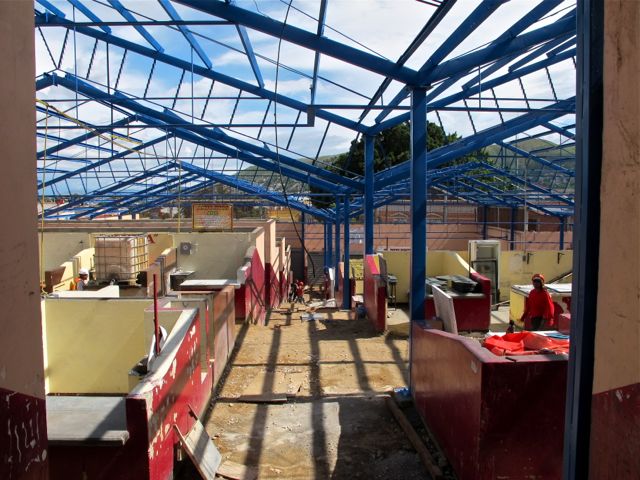
However, on May 14, 2012, Mercado IV Centenario, operated by the municipio of Oaxaca de Juárez, began a much-needed major renovation.  The doors have been locked…

Chains locking double doors.

and demolition has begun.

Construction workers demolishing interior of mercado

According to a May 25th article, the project includes a new roof and bathrooms, waterproofing, installing tile floors, interior and exterior painting, and rehabilitation of the water, sanitation, and electrical systems.  In addition, an access door on the busy avenida Independencia will be constructed.

For the duration of the renovation, the merchants and their stalls have been relocated under a big blue tent in Jardín Morelos on Independencia, across from the chain supermarket, Soriana.  Rather than hurting business, the vendors report sales have increased at the temporary site and are hoping to bring the new customers along when they move into the newly renovated Mercado IV Centenario.

Read Full Post »

… and I’m not talking weather!  Today, I headed down to Soriana for a major restocking of the empty larder.  As I was perusing the wine section, a new sign caught my eye.

Sign - "Estimada clientela: Anticipe sus compras de vinos, licores y cervezas ya que el fin de semana habra ley seca por disposicion oficial por motivo de las elecciones federales.

(Translation: Anticipate your purchases of wines, spirits and beer for the weekend. There will be an official prohibition on selling because of federal elections.)

In the event you were unaware, there is a big election in Mexico this weekend; on Sunday, July 1, Mexican voters elect their next president.  In anticipation, the above sign went up and Noticias reported that Oaxaca’s governor, Gabino Cue, announced on Monday that alcohol sales are forbidden from midnight June 30 through midnight  July 1 — the entire 24 hours of election day.  This, he said, was in compliance with the provisions of the Federal Code of Electoral Institutions and Procedures, “thus ensuring the safe and harmonious development of the Federal Election Day on Sunday 1 July.”

I’m confused!  According to an article in NOTIMEX and other sources, the 1915 federal law prohibiting the sale of alcohol 24 hours before the elections and throughout election day (Paragraph 2 of Article 239 of the Código Federal de Instituciones y Procedimientos Electorales (Cofipe) was repealed prior to the 2006 presidential election.  It was a nod to the states with a heavy-duty tourism industry.  No cervezas and no margaritas for 24 hours equals unhappy campers at Mexico’s popular resorts!  Regulation was left up to the individual states.

So I ask, is Oaxaca’s ban a state statute?  Or, has the federal law changed again?  Or, has word of the 2006 change not reached this far south?  Hmmm…

Read Full Post »

In the last month, several articles in the US press referencing Oaxaca have been called to my attention.  They aren’t the usual travel features enumerating the “10 must see sites,” “best places to stay,” and “local fare dining.”  Nor do they cater to the ever more popular fear mongering and demonization of Mexico and her citizens.  Instead, these articles provide a window on Oaxaca’s indigenous past and challenging present.
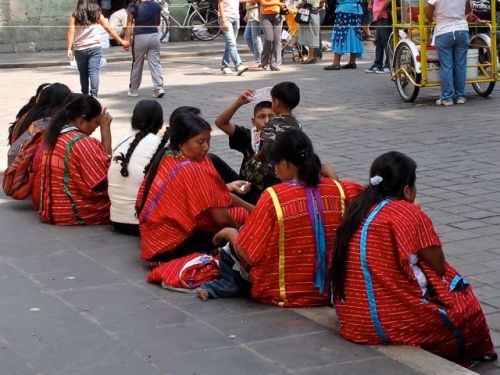
Triqui women sitting on a sidewalk

Triqui women and children in front of the Government Palace in Oaxaca de Juárez

From the June 15, 2012 New York TimesThe Past Has a Presence Here by Edward Rothstein.

OAXACA, Mexico — The past casts a sharp shadow here, wherever you look. You see it on mountaintop plateaus, where the ruins of ancient pyramidal staircases and capital-I-shaped ball fields hint at mysterious rituals that disappeared over a millennium ago.

<snip.

We are not dealing here with imagined reconstructions, but with the past’s palpable presence. And most of these ancient cities and monuments were abandoned some six centuries before the Spaniards plundered the region. After 80 years of archaeological research, their meanings are still unclear, though much has been written about Zapotec social hierarchies, gladiatorial-style games and stone carvings.

What is more clear is that remnants of those worlds also exist in the valley, where the slow-changing cultures of this buffeted but protected region still reflect Zapotec and Mixtec heritages. So here everything is plentiful that in the United States is rare: indigenous ruins, ancient languages, signs of direct lineage. And there is an edge to it all. Centers like Monte Albán are monuments to power and accumulated material wealth; they are also clearly evidence of a large-scale political organization, relics of perhaps the earliest state in the Americas.  [Read full article]

From California’s June 7, 2012 Monterey County Weekly, Native speakers and local missionaries work to save an indigenous Mexican language by Sara Rubin.

Gloria Moreno walks with a slight limp under the weight of the black messenger bag slung over her shoulder. It holds something of a botanical encyclopedia, petals and leaves gathered from the streets of Greenfield, which Moreno says help alleviate any number of ailments – pain, anxiety, weak bones.

Moreno says her collection is part of a medical tradition she began practicing as a teenager in Mexico. It was there, at 15, that she says she was instructed in a dream to take up herbal medicine.

Moreno dreamt her directive in Triqui de la baja, an indigenous language of the Copala region of Oaxaca in southern Mexico.

As native Triqui speakers disperse, leaving behind a notoriously violent region, there’s pressure both to preserve that language, and to leave it behind.

Of an estimated 40,000 Triqui speakers worldwide, about half of them are thought to have migrated away from Oaxaca, and as many as 10 percent live in the Salinas Valley.

<snip>

Moreno hopes for a generation of trilingual children, but many younger Triqui speakers are encouraged to trade their native tongue for English or Spanish, says a Salinas-based interpreter (who asked not to be named for fear of reprisal), because indigenous Mexicans are viewed as inferior. He trekked two hours to school from his childhood home in Oaxaca where he says he was bullied for being different.

“Because of the discrimination, parents don’t want their kids to learn [Triqui],” he says, “but then we lose tradition and culture.”

To reverse that, he hopes to get a grant or some cash to revive a bimonthly Triqui class piloted at the Greenfield Public Library two years ago. It drew about 35 students; of those, only a quarter were native speakers. The rest, mostly service providers, were there to learn Triqui.

“To speak Spanish, I used to think you had more value,” he says. “When I came here, I learned it is not that way. If you know three or four languages, you can explore and learn more.”

View Barbara Hollenbach’s Spanish-Triqui dictionary at www.sil.org/~hollenbachb/Posted.htm  [Read full article]

And finally from the May 28 Los Angeles Times, Epithet that divides Mexicans is banned by Oxnard school district, by Paloma Esquivel.

Rolando Zaragoza, 21, was 15 years old when he came to the United States, enrolled in an Oxnard school and first heard the term “Oaxaquita.” Little Oaxacan, it means — and it was not used kindly.

“Sometimes I didn’t want to go to school,” he said. “Sometimes I stayed to fight.”

“It kind of seemed that being from Oaxaca was something bad,” said Israel Vasquez, 23, who shared the same mocking, “just the way people use ‘Oaxaquita’ to refer to anyone who is short and has dark skin.”

Years later, indigenous leaders are fighting back against an epithet that lingers among immigrants from Mexico, directed at their own compatriots. Earlier this month the Mixteco/Indigena Community Organizing Project in Oxnard launched the “No me llames Oaxaquita” campaign. “Don’t call me little Oaxacan” aims to persuade local school districts to prohibit the words “Oaxaquita” and “indito” (little Indian) from being used on school property, to form committees to combat bullying and to encourage lessons about indigenous Mexican culture and history.

Indigenous Mexicans have come to the U.S. in increasing numbers in the last two decades. Some estimates now put them at 30% of California’s farmworkers. In Ventura County, there are about 20,000 indigenous Mexicans, most of whom are Mixtec from the states of Oaxaca and Guerrero who work in the strawberry industry, according to local organizers.

Many speak little or no Spanish and are frequently subjected to derision and ridicule from other Mexicans. The treatment follows a legacy of discrimination toward indigenous people in Mexico, said William Perez, a professor of education at Claremont Graduate University who has interviewed and surveyed numerous indigenous Mexican students.  [Read full article]

Read Full Post »

Last night, under starry skies, I returned to Casita Colibrí.  The streets were wet and potholed (more than usual) and even in the dark, my garden looked green and lush, all thanks to the rains Hurricane Carlotta brought and a storm track that continues to have Oaxaca in its sights.

After a verrry slow morning spent renewing my apartment’s acquaintance (remember, no TP in the toilet), gazing at the view, and unpacking, armed with two shopping bags, I headed down to Mercado IV Centenario (my local mercado) for some much-needed restocking, only to find doors locked.   Ooops!  I’d forgotten, as of mid May it was temporarily relocated to Jardín Morelos, due to a long overdue renovation project.  So, down the stairs and across Independencia to the new site, I went.  How nice it was to see the familiar faces of my favorite vendors and what warm greetings I received.   Ahhh… it’s good to be back!

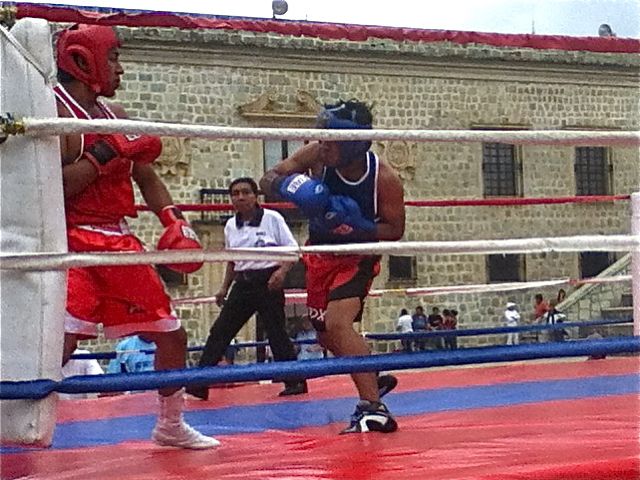
The route home took me up through the Plaza de la Danza.  And, what to my wondering eyes did appear?   A boxing ring, boxing fans, and a boxing match in progress.  Darn, I neglected to bring my camera.  Hey, it was just supposed to be a grocery shopping trip!  However, this from my iPod Touch camera.

2 boxers in boxing ring with referee in background.

Concerts, dance exhibitions, fireworks staging site, ferias and now boxing in the Plaza de la Danza.  As I’ve said, the public spaces in Oaxaca are well used!

Read Full Post »
Wanna see me pull a rabbit out of my hat?

Creature with long nose with rabbit in hat

Happy first day of summer.

Creatures painted on wall

From the walls of Oaxaca…

Creatures painted on wall

To the walls of Mill Valley…

Reclining bull painted on side of wall

by artist, Zio Zieler

Enjoy!!!

Save

Read Full Post »
The fathers of Oaxaca…

This slideshow requires JavaScript.

Read Full Post »

As hoped, I managed to make my way to the Mexican Consulate in San Francisco for .  It’s the exhibit (I mentioned a few days ago) that celebrates the Zapotec artists of Oaxaca from Rufino Tamayo and Francisco Toledo to those they encouraged and influenced.

On the consulate’s ground floor the scene was a familiar one — signage and conversations en español; the eagle, serpent and green, white, and red of the Mexican flag prominently displayed; waiting room filled with patiently waiting people — a sliver of Mexico in San Francisco.  Climbing the two flights of stairs (elevator was broken) up to the third floor, a friend and I found the exhibit…

This slideshow requires JavaScript.

According to the article, Oaxacan surrealism hits the SF Mexican consulate, the consulate’s cultural affairs attache, Marimar Suárez Peñalva, hopes the gallery and its exhibitions will offer Mexican expats an opportunity to connect with the creativity, not just the bureaucracy (my word), of their culture.  However, I don’t know how many of those waiting on the first floor make it up to the third floor; early in the afternoon, we had the gallery to ourselves.

And yes, works by Tamayo and Toledo are included, but I thought I’d feature some of the lesser known artists.  By the way, did you notice the name, Alejandro Santiago Ramírez?  This is the same Alejandro Santiago of the 2501 Migrantes sculptures that I’ve previously written about.

Read Full Post »

I’m again in the San Francisco Bay Area, visiting family and friends and taking care of the odds and ends of still maintaining a presence here, while living in Oaxaca.  We’ve had clear blue skies and sun and, except for the high-speed pace and exorbitant price of food, it “almost” feels like home.  Hey, I even bought some resin chairs for my son’s backyard and ate some of the best Mexican food ever (in the USA) at Doña Tomás in Oakland.  (FYI:  The Callos con Sopa de Elote — puréed corn soup with seared day boat scallops and fingerling potatoes, roasted poblano chiles and cilantro, served with arroz achiote — was divine.)

To also keep from getting too homesick for Oaxaca, there are a currently a couple of exhibits in San Francisco I plan to see while here.  I found out about The Magic Surrealists of Oaxaca, Mexico from the Oaxacan surrealism hits the SF Mexican consulate article in the SFBG, which explains…

Aquatint etching

Francisco Toledo’s aquatint etching “Self Portrait”

The Zapotec identity … is one of the unifiers of the exhibit, which contains the works of not only [Rufino] Tamayo and [Francisco] Toledo but also artists who were inspired by their work like Justina Fuentes Zárate, she of the reclining mermaid and arresting red dress. Perhaps the works don’t look similar, but they represent the diversity and breadth of the work to come out of the surrealist Zapotec tradition in Oaxaca.

And, then I read the NPR story, In Mexico, Mixed Genders And ‘Muxes’, about a Galería de la Raza exhibit.

Parade of Muxes in traje of Juchitán

Photo from the exhibit

Searching for Queertopia revisits the experiences of Alexander Hernandez’s participation and Neil Rivas’ visual documentation of what is called, the Vela de ‘Las Intrépidas.’ This event, a 3-day celebration, is held annually in the town of Juchitán de Zaragoza, Oaxaca, México, in honor of its Muxe community.

Hmmm… maybe I’ll take the ferry over to “The City” tomorrow.

Read Full Post »

Italy…

Oval sign: Il Fornaio biologico

California…

Oval sign: Il Fornaio Authentic Italian Restaurant and Bakery

Oaxaca…

Oval sign: Il Fornaro Cucina Italiana Oaxaca - Mexico

Triplets, separated at birth?


Read Full Post »

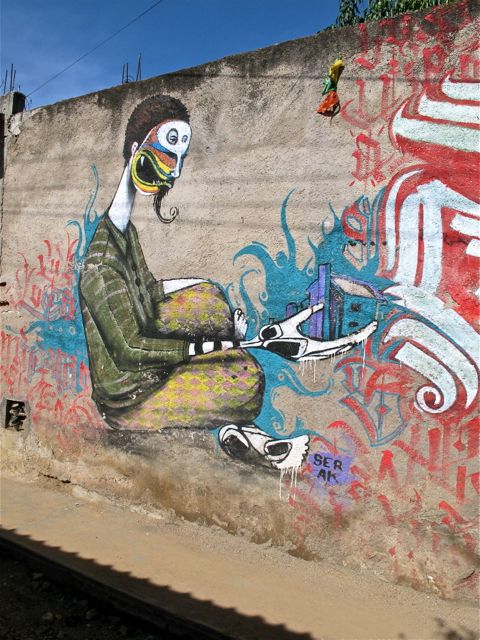
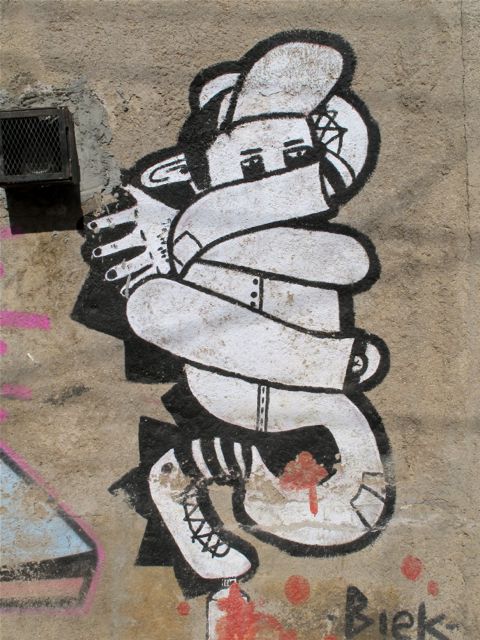
Walking back from grocery shopping, with a lighter than usual load, I took a detour and stumbled on this wall only two blocks from home.

colorful mural on wall

Closeup of colorfully painted face on wall

Black and white wall art of boy with cap wrapped in arms

Doing a little research, I found a video of it being painted…

Graphic design, Oaxacan style!

Read Full Post »

Recently, I was on the US east coast visiting with family.  Most of the time was spent with three teachers; my sister-in-law who retired after 30+ years of teaching in the Massachusetts public school district, my daughter-in-law who, after teaching in a public school in Connecticut, is currently a teacher in New York, and my son who is a college assistant professor.  They, along with all — not most, all — of my teacher friends in the US, decry the damage No Child Left Behind has wrought.  And, even one of its major proponents, Diane Ravitch, has done a 180 and is now leading the charge against it.  If you are interested, take a look at the Terry Gross interview with her in April 2011.

One of the issues the teachers of Oaxaca are protesting is the Alliance for Quality Education (ACE), modeled after No Child Left Behind.  Thus, the following thoughtful post on the Oaxaca Study Action Group website by Nancy Davies, resonated.

personal note re the Section 22 teachers union strike

I applied for a my first teaching job in Boston. First I took the universal teacher evaluation test, by which the highest scoring were first hired for positions. Then I waited.

By October (school began in September) it was clear that although my score for Boston applicants was third from the topmost person, something fishy was happening. I called the school department. All apologies, they assigned me a school the very next day,from which another teacher had just resigned. It was in an all black (pre-integration) neighborhood of all black kids whose school had no new textbooks and few old ones. There were no functioning bathrooms for the kids, at times of the month when adolescent girls seriously wanted a bathroom and a place to get clean, they stayed home. The boys were often recruited by the male teachers to buy dope. The best joke: the kids put a family of newborn rats in the desk drawer of one teacher. Another joke: hang a fellow student out the window over the asphalt yard by holding his ankles.

I survived, the kids maybe survived. I learned a couple of things: 1) hungry badly treated kids don’t study. 2) teacher tests don’t mean shit.

So here I am surely one of few who supports what Section 22 is doing and saying. Yes, I know the union was corrupted by PRI governors and caciques; and abuses, such inheriting a teaching job, are numerous. I also know that for 27 years Section 22 has been pushing for better salaries but simultaneously for shoes, paid-uniforms, books, bathrooms, breakfasts. I visited the current encampment in the zoc and spoke briefly with a newly graduated normal school teacher, a first-job guy who does not speak any indigenous language, and is not moreno (brown-skinned). He was sitting under a tarp playing cel phone games. Bored, I would say, and happy that somebody spoke to him. He’s not specially political and doesn’t know too much about his union’s history either. In 2006 he was an adolescent in secondary school, and rarely came into the capital. His first classroom is primary grade kids.  I asked him if he likes teaching. Yes, he replied, I am learning so much from the kids! He smiled broadly.

Right away in my book he qualifies as a teacher. His Spanish is good; he graduated from a five year university level program where  pedagogy is  emphasized as well as content information. He’s better prepared in 2012 than I was in 1968 with a  Masters degree from Boston College and accreditation in three areas including Spanish which I couldn’t speak. I learned a lot from my students too, and most of it, since I came from a  middle class neighborhood, was initially incomprehensible. One boy was clearly psychopathic. Two were dyslexic but had never been tested, merely promoted. They were wonderful at memorizing everything they couldn’t read. One girl got pregnant during the year and I didn’t have a clue what to say to her, I still grieve over my stupidity and lack of empathy. One girl told me her grandmother was burned up the night before in a home fire. Another’s boyfriend had been shot dead on the street. So I can sum up what I learned from my students as the stuff nightmares were made of, and it probably radicalized me more than any movement of the time. The Section 22 kid who was hired legitimately when he applied,  tested only by his normal school (and why should we assume they pass youngsters who don’t know either their subject or how to teach it?) told me he learned from his kids and he smiled. I wept.

Section 22 has pushed Cue to accept the fact that one size does not fit all, neither for teacher evaluation nor for curriculum. They decline to walk away from the 26 unprosecuted murders of 2006 and the half dozen since. They champion the indigenous protests over mining and land grabs. They understand the word “neoliberalism”. They understand ghost towns, towns where the remaining people live off family remittances from the USA. They understand impunity and corruption, caciques who stole towns’ entire education budgets, governors who ignore an education level now the worst in Mexico. Blame the teachers? Not me. Been there, done that.

No one likes being held hostage to issues they don’t understand. As I walked past a blocked registry office an angry woman turned to me and shrieked, Lazy bunch of bastards! Her frustration undoubtedly was caused not just by being unable to enter a state office, but also I imagine by having kids at home driving her  (and her mother) nuts because there’ve been no classes for two weeks. Maybe she knows that with all public classes open, her kids still may not be able to go to the public university since there are not enough seats, and very likely they will settle for semi-menial jobs. Or maybe there will be no jobs. Maybe they will try to cross the desert in Arizona.  Or maybe her story is entirely different, I don’t know.

I ask myself why in 2006  500,000 adults spontaneously came out to march with these very teachers. Why the PRI was voted out and will not recover this state. Why now, in 2012 what the media publish are photos of blocked access and uncollected garbage. Cue is backing down, item by item on 22’s demands. Good for him. He’s neoliberal, but he’s not stupid. His education department head has resigned, and thus far no tear gas has been launched.

Read Full Post »
On my first visit to Oaxaca, I was introduced to Jardín Sócrates, part of the Templo de la Soledad/Plaza de la Danza complex, between Independencia and Morelos.  The original Jardín Sócrates was constructed as a public garden in 1881 and remodeled for its 100th birthday.

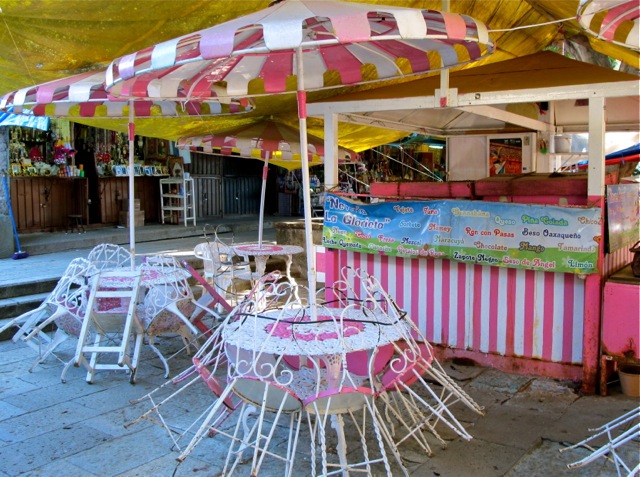
Pink and white iron chairs and umbrella in front of a neveria stand.

I have a weakness for ice cream, sherbet, and gelato and, thus, was completely “in heaven” being surrounded by stands selling the most amazing flavors of  milk and water based frozen desserts.

Green and yellow iron chairs and umbrellas in front of a neveria stand.

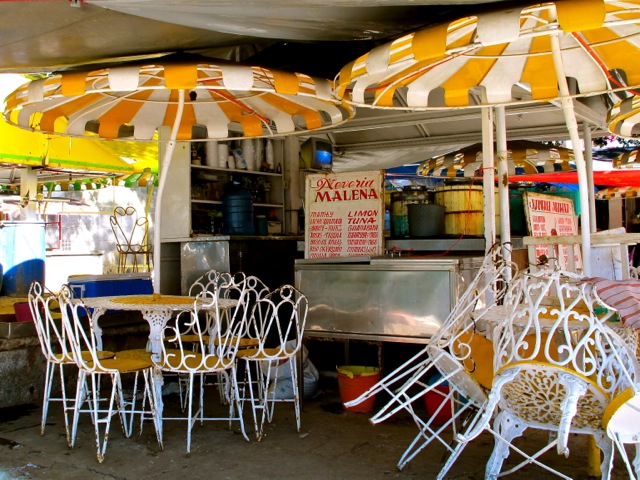
Everyone has their favorite vendor, my friend G was partial to Nevería Malena, and so we sat down at one of their yellow and white iron tables.

Yellow and white iron chairs and umbrellas in front of the Nevería Malena stand.

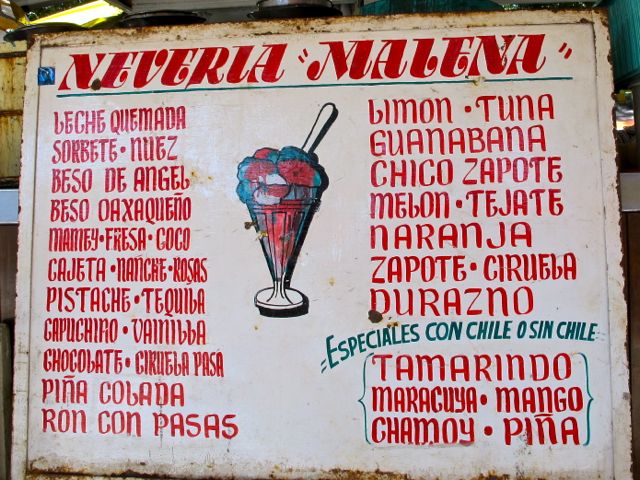
It was SO hard to decide what to order; being tempted by too many choices and being mystified by what many of the flavors actually were.

Nevería Malena sign listing 34 flavors

What in the world is Beso de Angel?  I settled on a scoop of Leche Quemada (burnt milk) with a scoop of Tuna (fruit of the nopal cactus NOT the fish) on top.  I was hooked!

Bowl of leche quemada and tuna nieve on yellow and white iron table.

As it worked out, two years later I moved into an apartment only a block away and I pass by Jardín Sócrates at least a couple of times a week.   However, in mid October 2011, carpenters began constructing wooden puestos along Independencía below the Jardín.  Ready for a feria?  I wondered.  Then they were painted!  These took on a semi-permanent character.  Hmmm…

Wooden puestos lining sidewalk.

Soon, a sign went up explaining the Jardín Sócrates was undergoing an “image enhancement,” courtesy of the federal and municipal governments.

Programa Habitat 2011; Gobierno Federal sign.

Demolition soon began, including the removal of the original green cantera (stone) pavement.

Pile of old paving stones

And, the neverías began moving down to the temporary puestos on Independencia.  I found Nevería Malena, ordered my usual, and asked how long the relocation was going to last.  “No sé.”  (“Don’t know.”) was the answer.

Iron tables, chairs, and puestos on sidewalk.

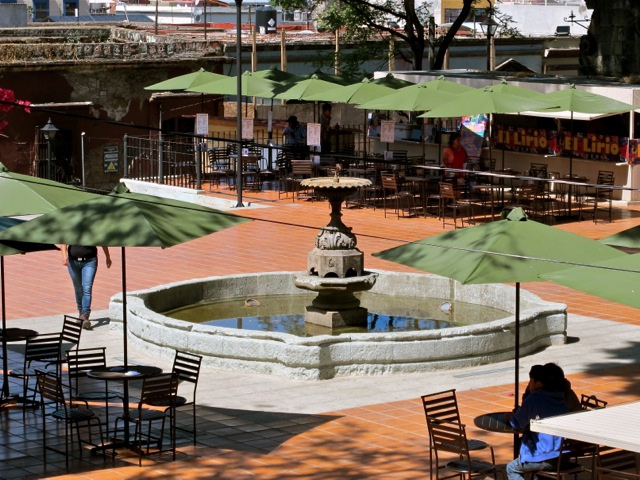
Eight new stalls were constructed, the cantera was replaced with red terracotta tile, and new tables, chairs, and umbrellas materialized.  After five months,  the newly “enhanced” Jardín Sócrates opened on March 29, 2012.

Fountain and green umbrellas on terracotta paved terrace.

It does look lovely — orderly and coordinated — but I kind of miss the color and funkiness of the old.

Read Full Post »