Friday we returned for another extraordinary day — the last day of Carnival.
Again, muchisimas gracias to the gracious and generous people of Teotitlán del Valle.
Posted in Celebrations, Creativity, Culture, Food, Holidays, Religion, Travel & Tourism, tagged Baile de Los Viejitos, Carnaval, Carnival, Holy Week, Mexico, Oaxaca, photographs, photos, Semana Santa, Teotitlán del Valle on April 9, 2013| 3 Comments »
Friday we returned for another extraordinary day — the last day of Carnival.
Again, muchisimas gracias to the gracious and generous people of Teotitlán del Valle.
Posted in Celebrations, Culture, Holidays, Religion, Travel & Tourism, tagged Baile de Los Viejitos, Carnaval, Carnival, Holy Week, Mexico, Oaxaca, photographs, photos, Semana Santa, Teotitlán del Valle on April 6, 2013| 2 Comments »
I’m playing catch-up with blog posts. After the Good Friday Procession of Silence, I thought life would slow down a little. That’s what’s happened in years past — I caught up on the “to do” list on the home-front, leisurely plowed through the hundreds and hundreds of photos from Semana Santa, did a little research and a lot of thinking about what I’d just seen and experienced, and then crafted a few blog posts.
That was before we found out that Teotitlán del Valle celebrates 5-days of Carnival after Easter, not before Lent! A little levity after the solemnity of Semana Santa and in one of our favorite places was not to be resisted. And so, blogger buddy Chris and I set out on Monday afternoon in search of the house in Sección 1 (the village is divided into 5 geographic areas) that was hosting the daytime fiesta that precedes the evening festivities in the Municipal Plaza.


We returned yesterday for the Sección 5 fiesta, so more to come. Now it’s off to Tlacolula for the Nieve, Mezcal y Gastronomia Festival.
FYI: For a more detailed explanation of this Carnival celebration and photos from last year by a professional photographer, check out Ann Murdy’s website.
Posted in Celebrations, Churches, Culture, Food, Holidays, Religion, Travel & Tourism, tagged Easter, Estaciones de la Cruz, Lunes Santo, Mexico, Oaxaca, photographs, photos, popular travel destinations, ritual procession, Semana Santa, Stations of the Cross, tapetes, Teotitlán del Valle, Via Crucis on March 26, 2013| 4 Comments »
Lunes Santo (Holy Monday) in Teotitlán del Valle provided another moving and memorable experience. For some unknown reason, the village re-enacts the 14 stations of the cross on the Monday before Easter. Following a special early morning mass at the Templo de la Preciosa Sangre de Cristo, statues of Jesus and the Virgin Mary are hoisted on platforms and carried from the church to signal the start of the day-long pilgrimage. They are led by a band playing a mournful and dissonant tune as they set off to wind their way through the cobblestone streets of Teotitlán.
“Stations” are set up along the route by designated families — some are decorated with the village’s famous woolen tapetes (rugs). Tamales, non alcoholic beverages (alcohol, even the ubiquitous mezcal, is forbidden during Semana Santa), and nieves (ices) are offered at others. At all, the appropriate prayers are read, incense of copal is burned, and offerings, including of corn and lilies, are made. And, as always, children have important roles to play.
The procession is solemn and dignified and filled with pre-Columbian, along with Catholic, tradition and symbolism. Like all the other ritual celebrations in Teotitlán del Valle, these are not performed for the benefit of tourists — they are some of the strands of the warp and weft that have woven this community together for thousands of years.
Posted in Churches, Environment, Geography, Nature & Science, Science & Nature, Travel & Tourism, tagged El Picacho, Mexico, Oaxaca, photographs, photos, popular travel destinations, Templo de la Preciosa Sangre de Cristo, Teotitlán del Valle on January 4, 2013| 4 Comments »
No Danza de la Pluma, no convite, no patronal festival. The Templo de la Preciosa Sangre de Cristo in Teotitlán del Valle on an ordinary day…

El Picacho up close and personal…
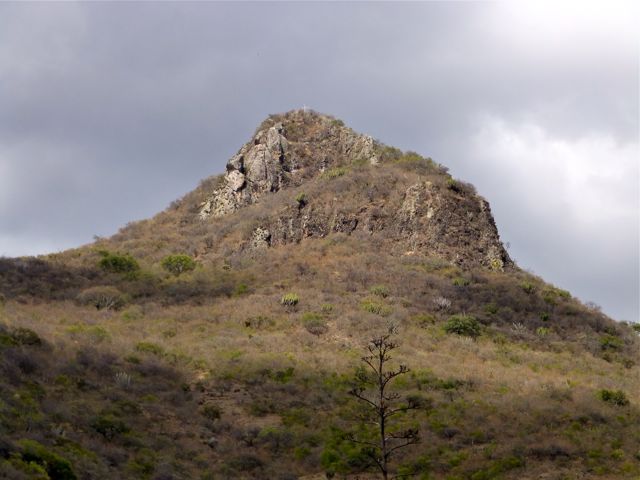
And, the hills where my young Zapotec friend, Sam, “grew up… looking after [his] crazy goats!” He is currently finishing a PhD in Sustainable Manufacturing at the University of Liverpool. I see a connection.
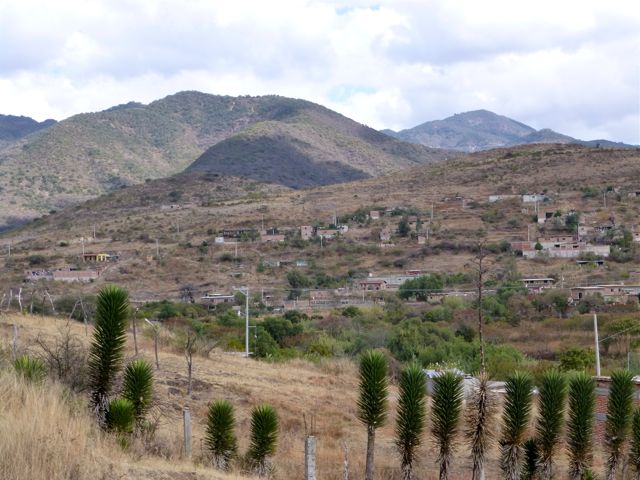
Even unplugged, the hills were alive with the sound of music — a banda could be heard in the distance — a Teotitlán del Valle soundtrack.
Posted in Culture, Religion, Travel & Tourism, tagged balcony, children, decorative iron bars, Mexico, Oaxaca, photographs popular travel destinations, photos, praying figurines, Teotitlán del Valle on October 16, 2012| Leave a Comment »
I don’t know about these two hanging out on a balcony above Independencia, yesterday.
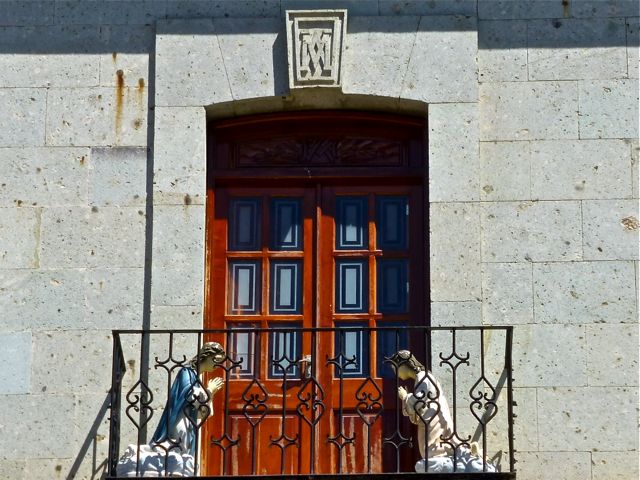
But, who could resist these two??? Waiting for the convite in Teotitlán del Valle last week.

Posted in Celebrations, Culture, Religion, Travel & Tourism, tagged convite, Fiesta de la Virgen del Rosario, flor inmortal, La Santísima Virgen del Rosario, Mexico, Oaxaca, photographs, photos, popular travel destinations, Teotitlán del Valle, travel, Virgin of the Rosary on October 8, 2012| 3 Comments »
It’s that time of year, again. Daylight doesn’t last quite as long, the large red-orange blossoms of the African tulip trees have mostly fallen (onto my terrace!), and the hummingbirds have mostly departed, leaving the airspace to the dragonflies and butterflies.

However, the season of yellow marigolds (cempazuchitl) and the yellows, oranges, and purples of flor inmortal (immortal flower) has begun and that means Días de los Muertos and Noche de Rabanos can’t be far behind.

In the meantime, during the past week, Teotitlán del Valle celebrated La Santísima Virgen del Rosario and early Friday evening, the unmarried girls and women gathered with their canastas for the traditional convite (holy procession).
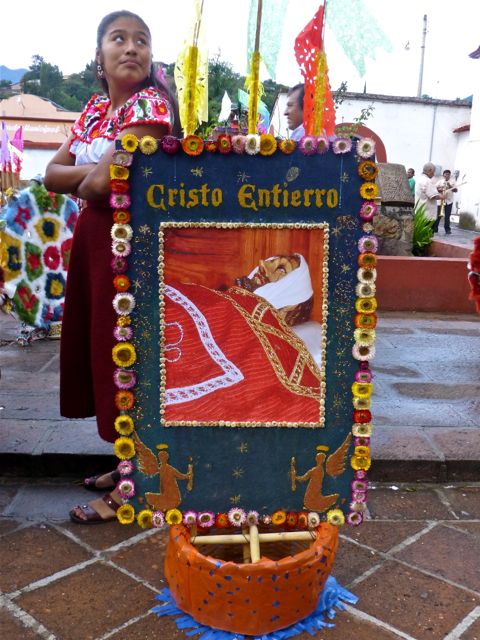
And, given the season, flor inmortal played a prominent role in the decorations of many of the canastas.
And, as always, I’m amazed and captivated by the girls and women who, with arms raised, balance these sizable baskets on their head, as they navigate the sacred route along the cobbled (and, this day, rain-slicked) streets of Teotitlán del Valle — for almost an hour!
It’s a scene that I never tire of — of course, I’m not carrying a canasta on my head!
More photos and commentary over at Oaxaca-The Year After.
Posted in Celebrations, Culture, History, Holidays, Travel & Tourism, tagged celebrations, El Grito, Escuela Primaria Urbana, graffiti, Grito de Dolores, holidays, Mexican Independence Day, Mexico, newsstands, Oaxaca, photographs, photos, popular travel destinations, store displays, Teotitlán del Valle, window displays on September 11, 2012| Leave a Comment »

Where else have you seen El Grito decorations?
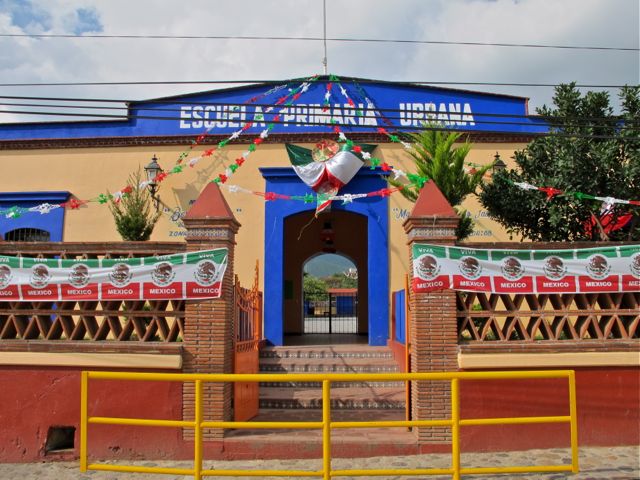
Schools, of course! This one in Teotitlán del Valle.

And, how about newsstands? You can’t miss the green, white, and red — it’s everywhere!
Posted in Celebrations, Culture, Religion, Travel & Tourism, Weather, tagged convite, El Picacho, Fiesta a la Natividad de la Virgen María, Mexico, Oaxaca, photographs, photos, popular travel destinations, Teotitlán del Valle, Virgen de la Natividad on September 9, 2012| Leave a Comment »
Waiting for the convite… Fiesta a la Natividad de la Virgen María.

September 8 was a rainy day in Teotitlán del Valle.
Posted in Celebrations, Churches, Culture, Religion, Travel & Tourism, tagged cargo system, cargosMexico, danzantes, Doña Marina, festivals, fiestas, La Preciosa Sangre de Cristo, Malinche, Oaxaca, patronal festividad, photographs, photos, soldados, Teotitlán del Valle, travel on July 9, 2012| Leave a Comment »
The convite (covered in the Uplifting post) is only one of the traditions of the patronal festival of La Preciosa Sangre de Cristo. During the five days of the celebration, the church is filled with floral arrangements and believers stream in and out clutching flowers; the Danza de la Pluma (with Moctezuma, Cortez, Malinche, Doña Marina, danzantes, and soldados) is performed several times; and the cargo holders of the community preside, are honored, and presented with fresh fruits, vegetables, sacred herbs, and beverages.
Sunday was another amazing day in Teotitlán del Valle. And I haven’t even mentioned the tacos and tamales we devoured during our three visits this past week!
Posted in Celebrations, Culture, Religion, tagged convite, danzantes, El Picacho, festivals, fiestas, La Preciosa Sangre de Cristo, Mexico, Oaxaca, parade, patronal festividad, photographs, photos, sacred mountain, soldados, Teotitlán del Valle, travel on July 7, 2012| 10 Comments »
Late yesterday afternoon, we returned to Teotitlán del Valle for the convite (parade) of unmarried young women and girls, a part of the annual patronal festival of La Preciosa Sangre de Cristo. The sun was shining, the rains of two days before were nowhere to be seen, and the sacred mountain, El Picacho, gracefully, but commandingly, presided as the soldados and danzantes entered the church courtyard.

Bands also arrived to take part…

Canastas (baskets) were lined up, ready to be carried…
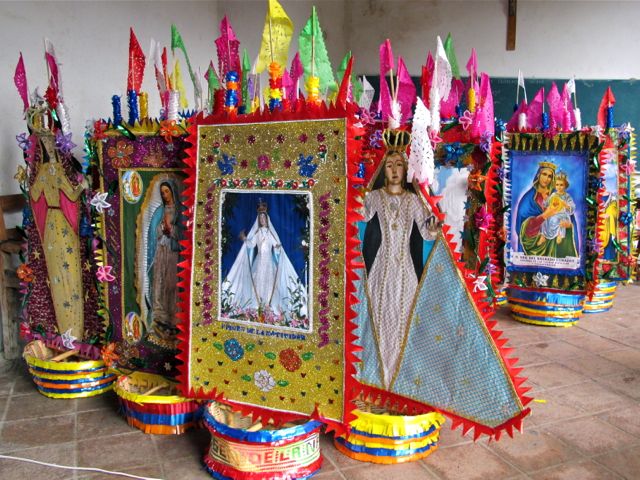
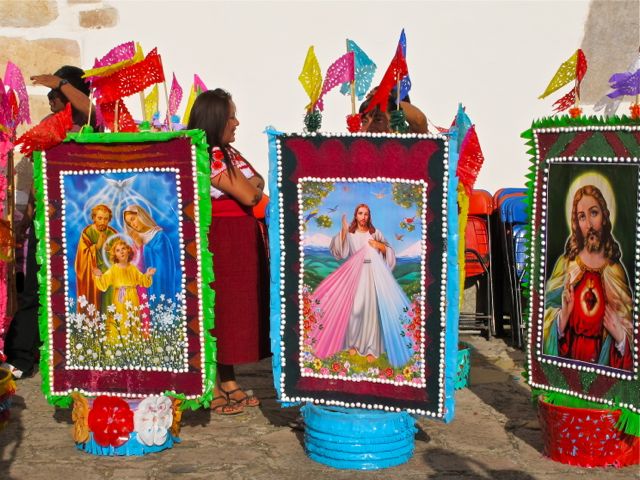

The young men of the village gathered…


Family and friends awaited…

And then the young unmarried women and girls, the stars of the evening, raised the canastas over their heads…


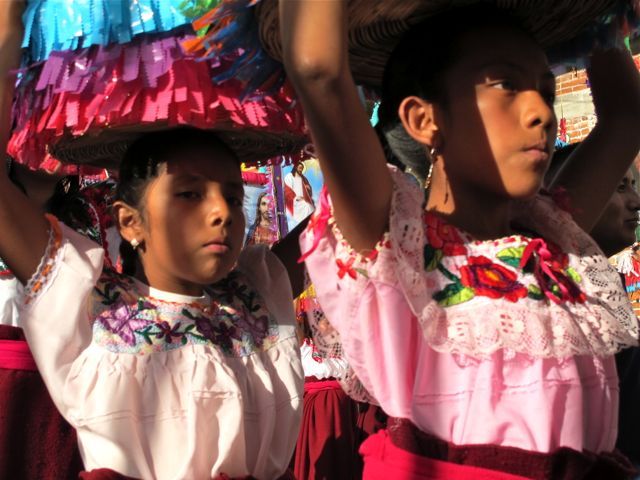
Balancing the canastas, they processed from the courtyard, down several long and cobblestone blocks, turned left, and headed back up another street to where they had begun, to be greeted by proud family and friends, who had gathered to acknowledge and celebrate the young women and girls of Teotitlán del Valle.
For some inexplicable reason, we never cease to feel moved and uplifted by this ritual.
Posted in Celebrations, Culture, Travel & Tourism, tagged festivals, fiestas, La Preciosa Sangre de Cristo, Mexico, Oaxaca, patronal festividad, photographs, photos, Teotitlán del Valle, travel on July 5, 2012| Leave a Comment »
Yesterday, fellow blogger, Chris, and I drove out to Teotitlán del Valle for their yearly patronal festividad de La Preciosa Sangre de Cristo. The rains came and we didn’t stay long. But, as we almost always find, just being out there provides much appreciated food for the soul.

Posted in Creativity, Culture, People, tagged Celestino Bautista Lazo, Dixza Rugs, El Picacho, Lark Crafts, Leonor Lazo González, Mario Bautista Martínez, Mexico, Oaxaca, rugs, Samuel Bautista Lazo, tapetes, Teotitlán del Valle, The Crafts of Oaxaca, weaving on March 6, 2012| 5 Comments »
Samuel Bautista Lazo is one of the smartest, joyous, and Zen-like people I know.

Sam is my young, previously mentioned, Zapotec friend who is getting his Ph.D. in Sustainable Manufacturing at the University of Liverpool. Sam is from Teotitlán del Valle in Oaxaca, a village watched over by El Picacho, the sacred mountain — whose presence is unmistakable and palpable.

The village is known for its traditional performances of the Danza de la Pluma (about which I’ve posted on numerous occasions) and their skillful and creative weavings with wool. Like a majority of its Zapotec residents, Sam and his family weave — father, Mario Bautista Martínez; mother, Leonor Lazo González; and brother, Celestino Bautista Lazo.

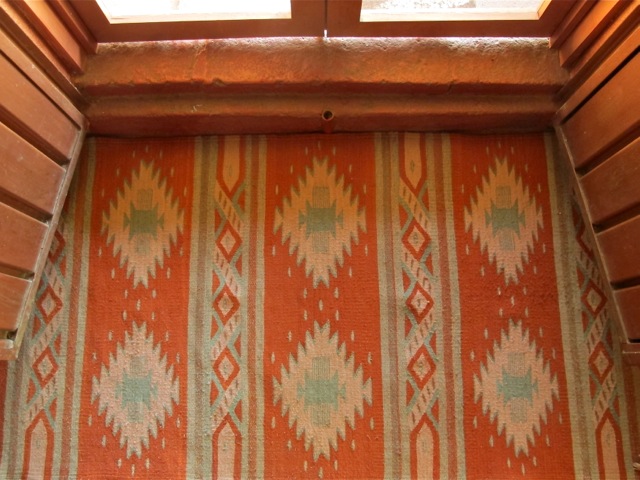
The family was featured last year in an article, The Crafts of Oaxaca, posted on the Lark Crafts website. Like many others, on my first visit in 2007, I couldn’t resist buying a couple of tapetes (rugs), including this one, which now serves as a welcome to all who enter my little casita.
A friend and I returned six months later and had the privilege of climbing to the top of El Picacho with Sam.
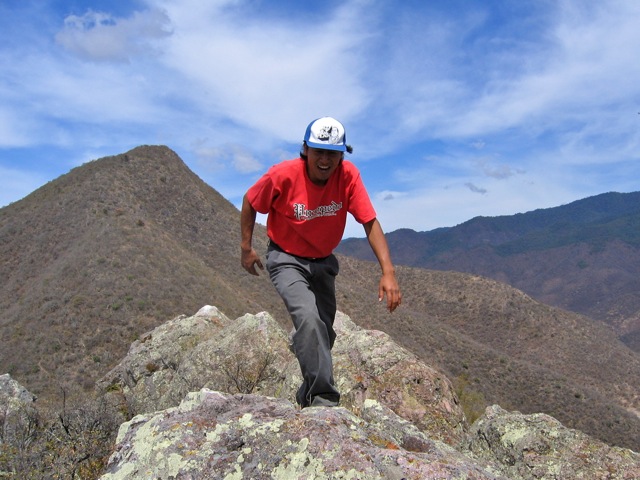
And no, I did not join Sam in leaping from one rocky peak to the other!
Looking forward to your return, Sam!
(ps) Here is a Dixza video of Sam from 2008, where he discusses the interpretation of the symbols and patterns woven into Zapotec rugs. You might also want to check out others in his Dixza series from Teotitlán del Valle.
Posted in Buildings, Creativity, Culture, tagged 142 Throckmorton, El Picacho, Mexico, Mill Valley, Mt. Tamalpais, Oaxaca, Teotitlán del Valle, wall art, Zio Ziegler on January 4, 2012| 1 Comment »
Wall art from here…

Wall of 142 Throckmorton theatre on Madrona, Mill Valley, CA by Zio Ziegler
to there.

Wall of Espacio Zapata on Porfirio Díaz, Oaxaca de Juárez, OAX
And, sacred mountains from here…

to there.
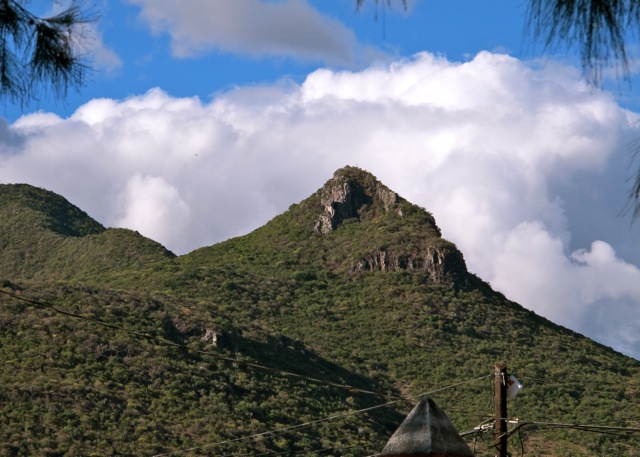
Transition time… Mill Valley back to Oaxaca.
Posted in Celebrations, Churches, Holidays, tagged Danza de la Pluma, Mexico, Oaxaca, Plume Dance, Teotitlán del Valle, textiles, Virgen de Guadalupe, Virgen de Juquila, Virgin of Guadelupe, Virgin of Juquila on December 14, 2011| Leave a Comment »
December seems to be quite a month for the Virgins of Oaxaca.
December 8, I was awakened by cohetes (rockets… all bang, no bling) at 4:45 AM. They continued sporadically until about an hour later, when wildly clanging church bells heralded a non-stop barrage of more cohetes for several minutes… they eventually faded away, but a banda was heard in the distance.
It was the feast day of the Virgin of Juquila (La Virgen de Juquila), one of Oaxaca’s own. According to legend, in 1633, when a fire burned the small Chatino village of Amialtepec to the ground, a small statue of the Virgin Mary was rescued amidst the ashes. It was a miracle; she was undamaged, save for her light skin color, which was permanently darkened by the smoke… causing her to look more like the Chatino people, who revered her.
Here she is, in a field alongside La Virgen de Guadalupe, almost at the crest of the new carretera between Oaxaca and San Martín Tilcajete.
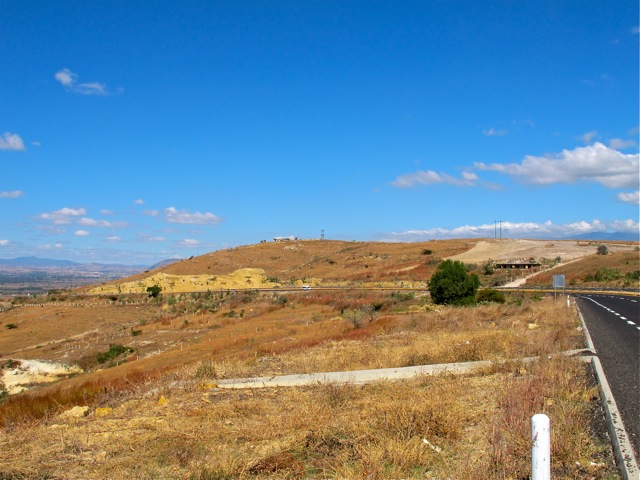
La Virgen de Guadalupe on the left and La Virgen de Juquila on the right.
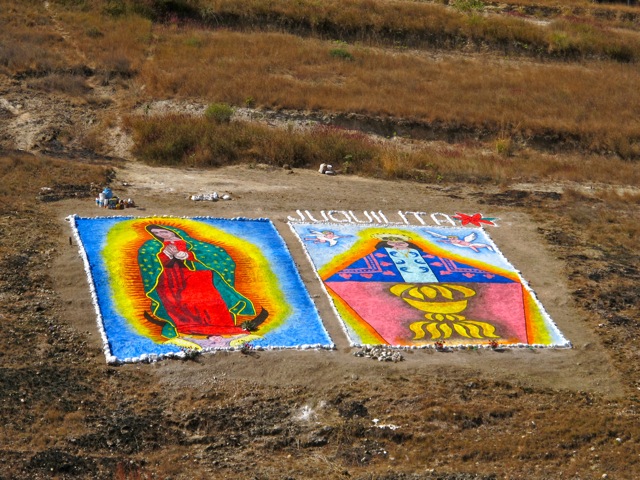
The Virgin of Guadalupe had her day only four days later, on December 12. La Virgen de Guadalupe is known as the Queen of Mexico and Empress of America, and is the patron saint of México. Reports estimate that 5.8 million of the faithful made the pilgrimage this year to Basilica of Our Lady of Guadalupe in Mexico City to honor the dark-skinned virgin who appeared to Indian peasant Juan Diego on Dec. 12, 1531 near what is now Mexico City.
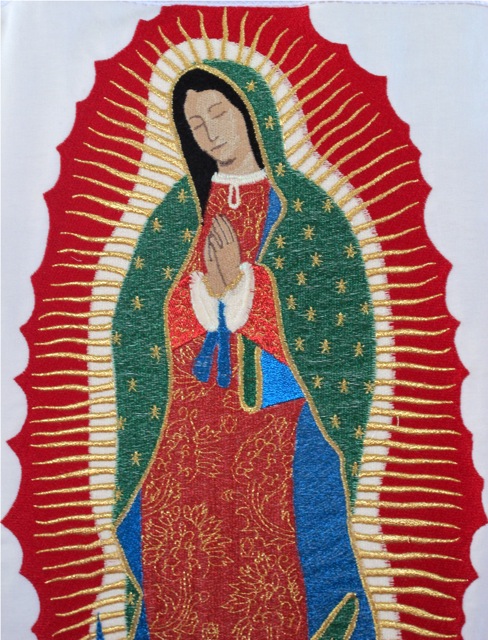
In Oaxaca, worshipers flocked to the Chapel of Guadalupe at the north end of Llano Park and a carnival filled the park for all the little Juan Diegos and girls in period costume to be entertained. However, I headed out to Teotitlán del Valle to see this Zapotec village honor La Virgen de Guadalupe with their traditional Danza de la Pluma. Several of the Danzantes (dancers) were wearing capes woven and embroidered especially for this day…
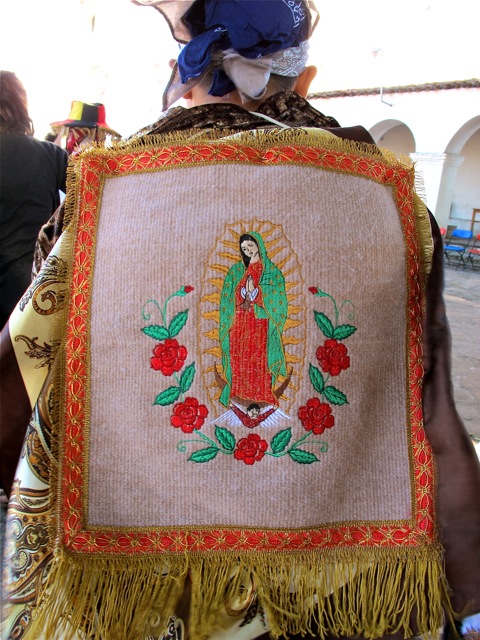
The weaving and embroidery were spectacular!
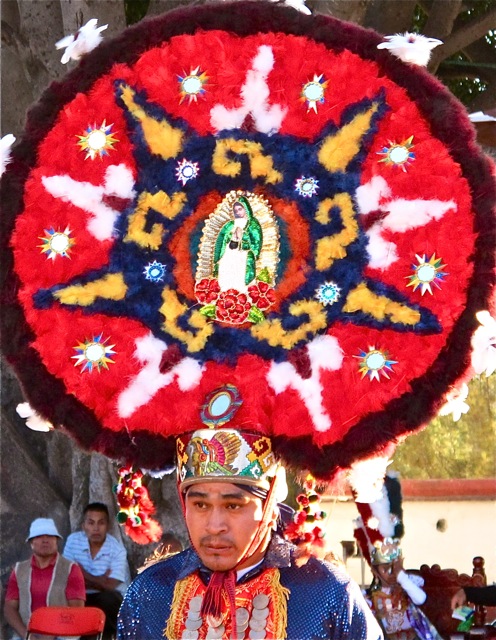
And, at least one of the Danzantes had an image of the Virgin of Guadalupe in the middle of his corona (feathered headdress).
Malinche and Doña Marina also had similar images on the skirts of their dresses. To see those and several other photos of the dancers, you should take a look at what Chris has posted at, Oaxaca-The Year After.
Next on the “Virgin” calendar is December 18, the feast day of La Virgen de la Soledad (the Virgin of Solitude), Oaxaca’s patron saint. Stay tuned…
Posted in Celebrations, Holidays, tagged Day of the Dead, Días de Muerto, Mexico, Oaxaca, Teotitlán del Valle on November 2, 2011| Leave a Comment »
I’m still trying to wrap my mind around the last 48 hours. It’s been a profusion of sensations… sights, sounds, smells, and tastes. Today in Teotitlán del Valle…
Much more to come!


 Mexican Peso Converter
 View From Casita Colibrí