Feeds:
Posts
Comments

Posts Tagged ‘Semana Santa’

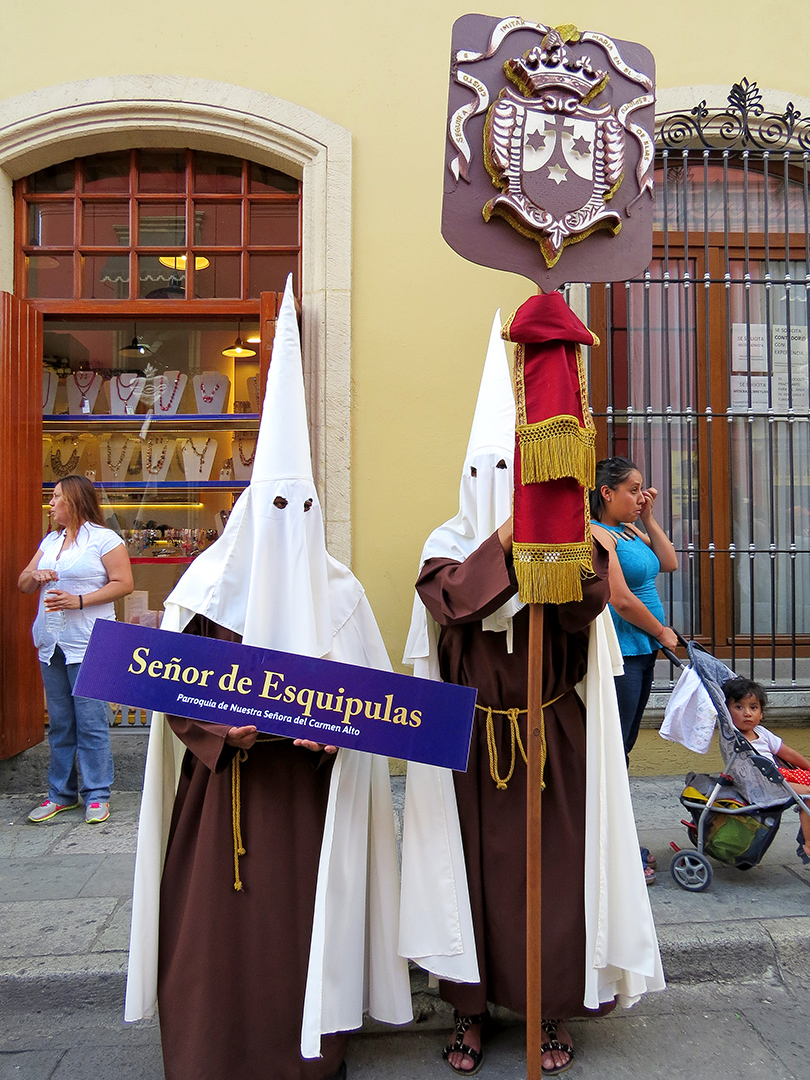
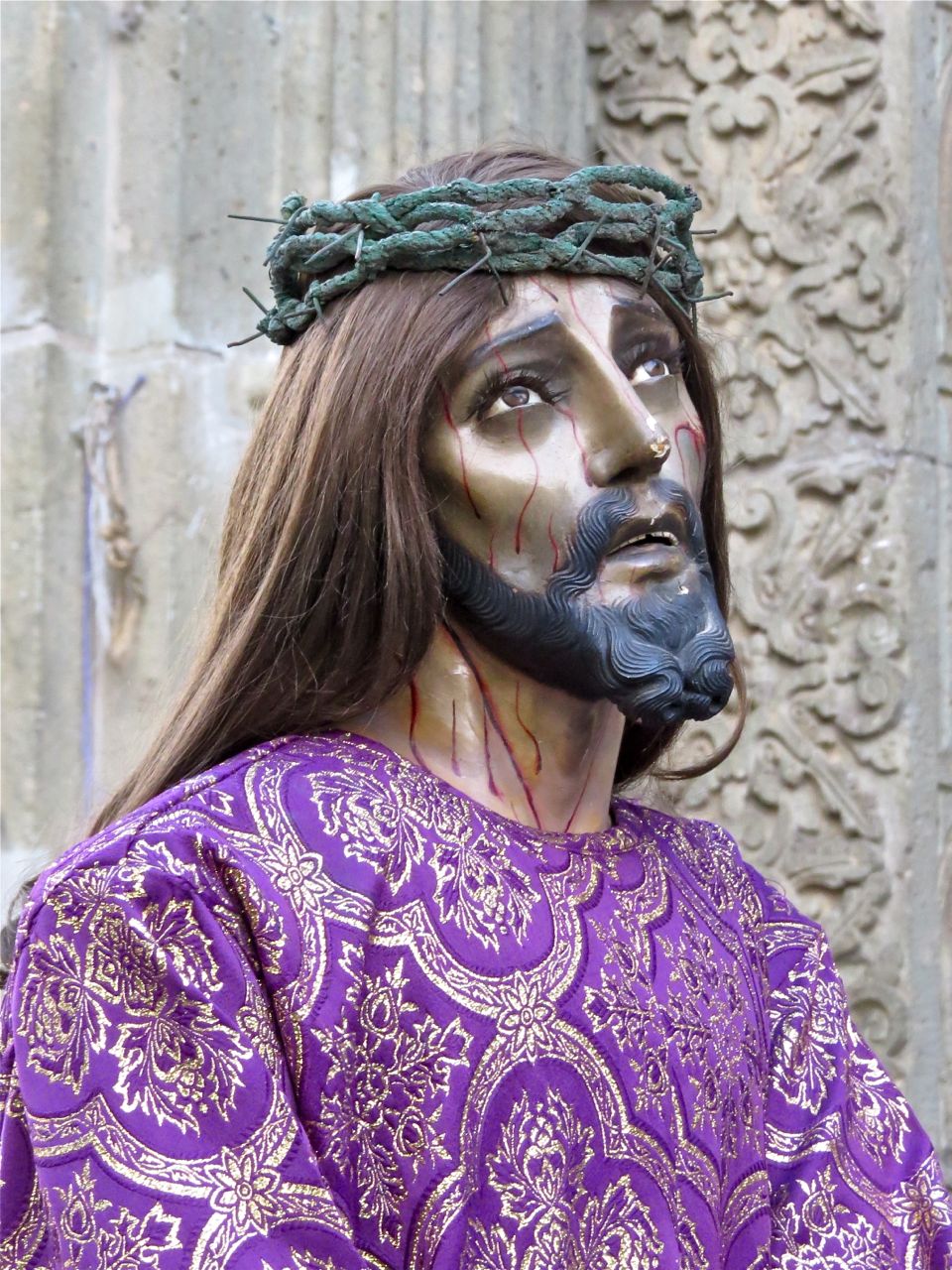
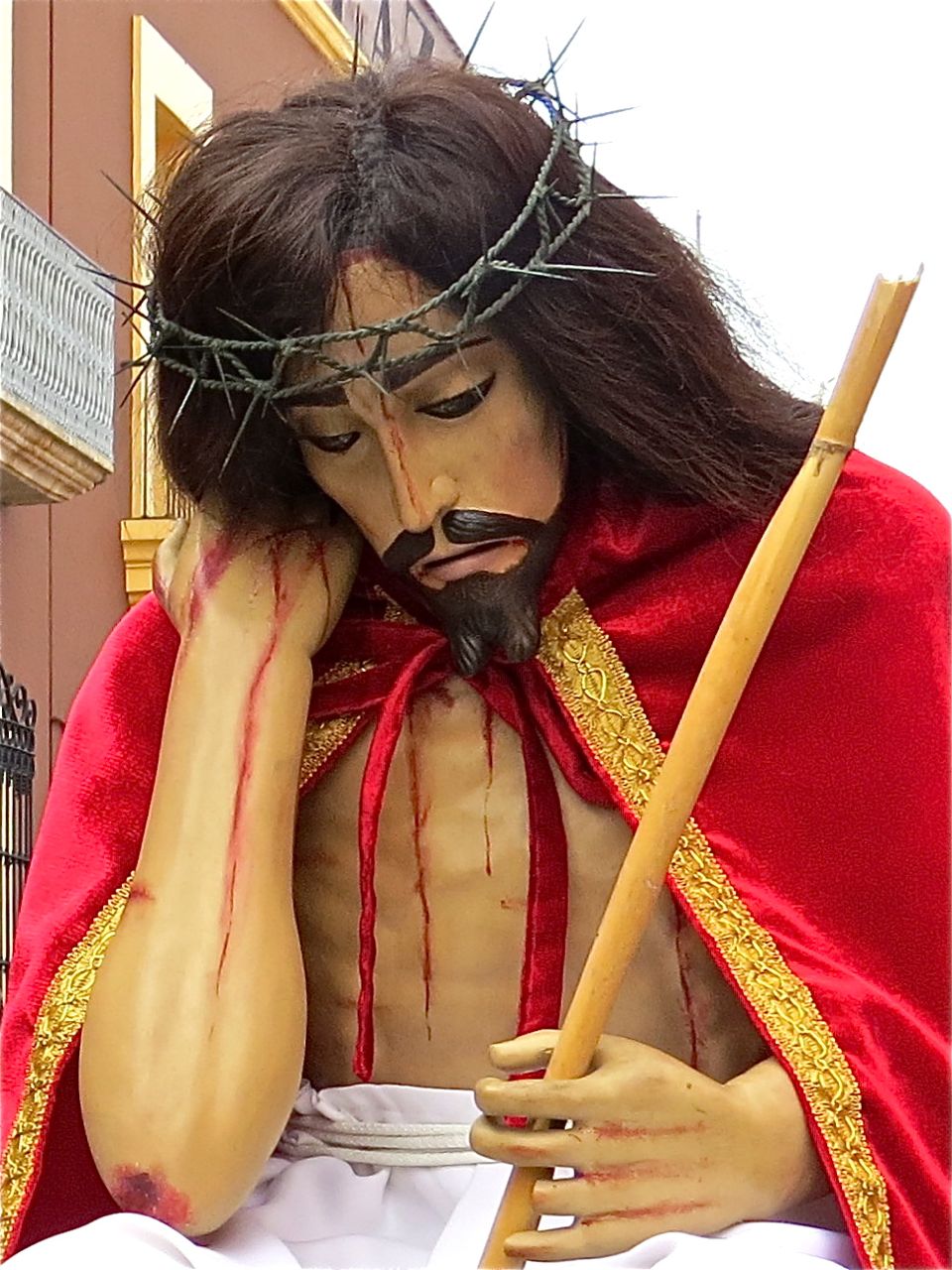
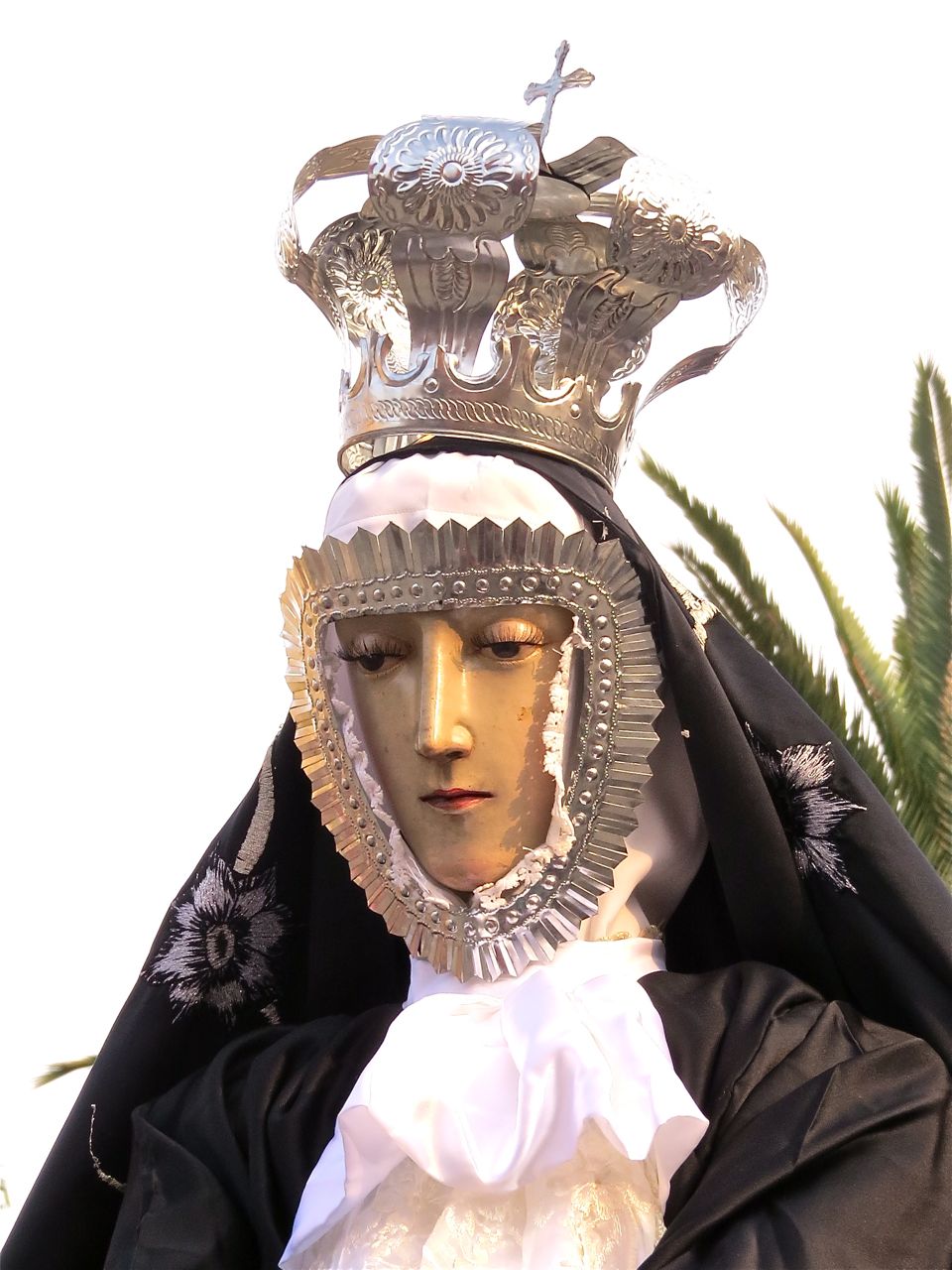
As far as I’m concerned, Señor de la Humildad y Paciencia was the patron saint of Friday’s, Procession of Silence.  He waited for hours inside the Templo de la Preciosa Sangre de Cristo, while we waited for hours outside, for the procession to begin.

IMG_7505

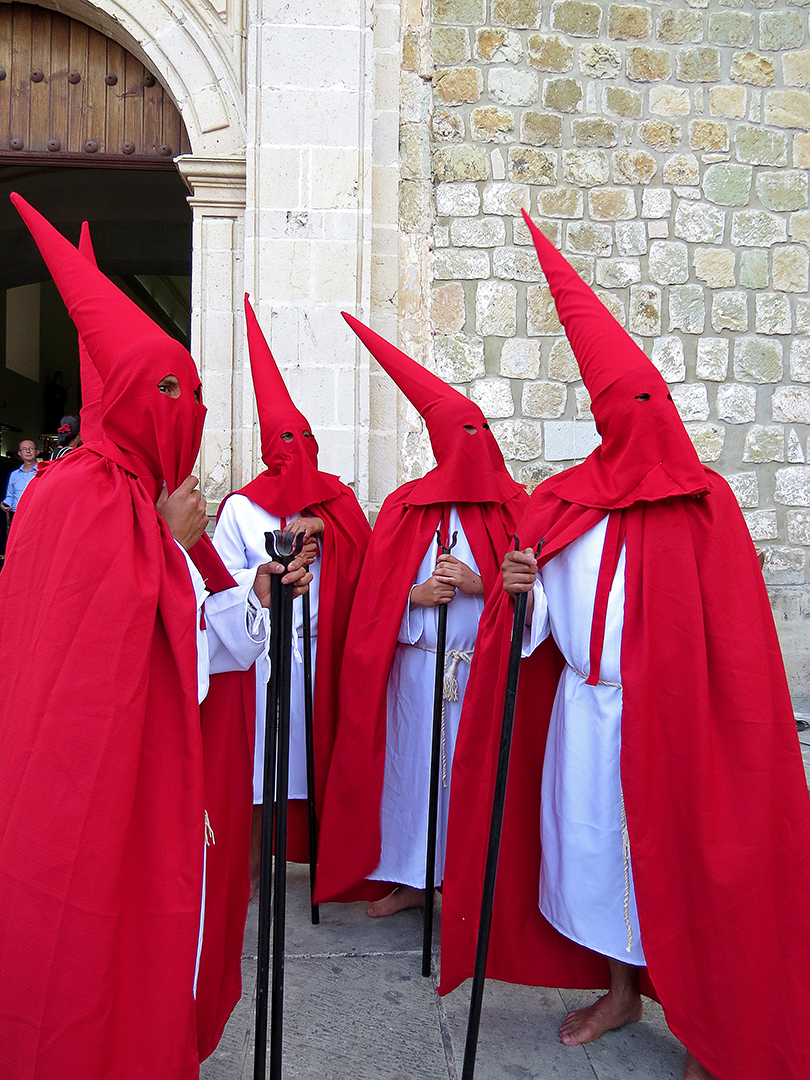
At least he was sitting down.  For the penitents, their lot was a lot of standing around.
IMG_7577

IMG_7539

IMG_7563

IMG_7555

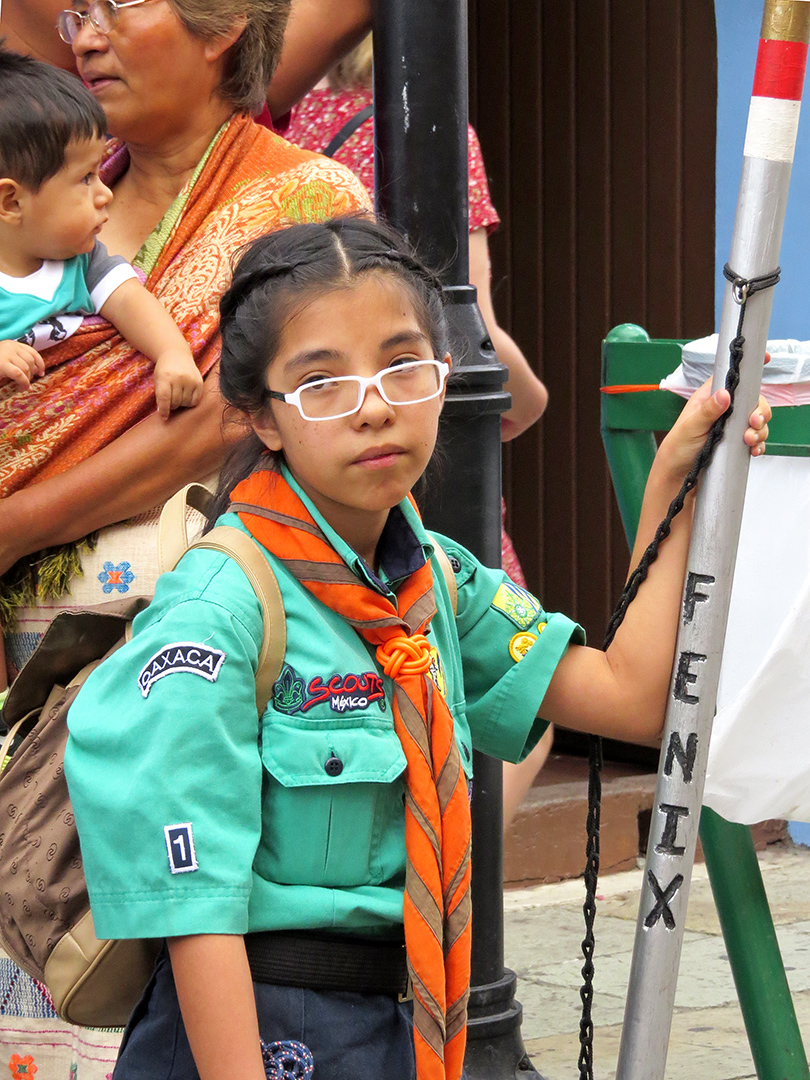
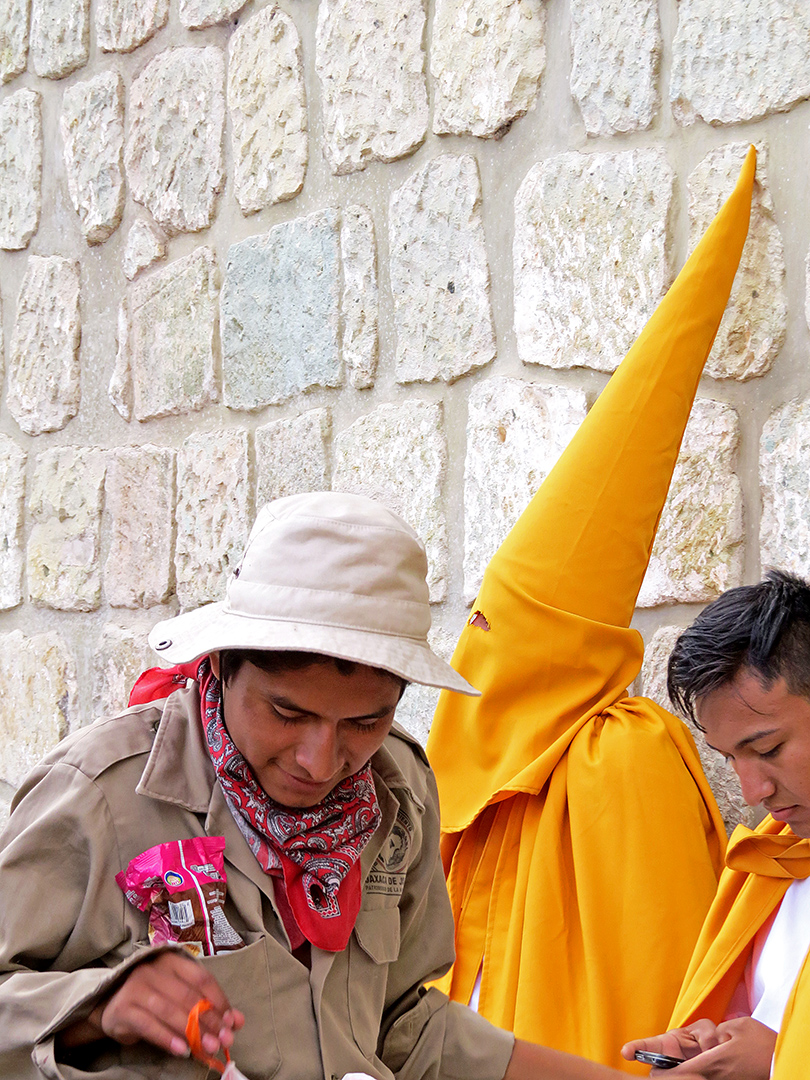
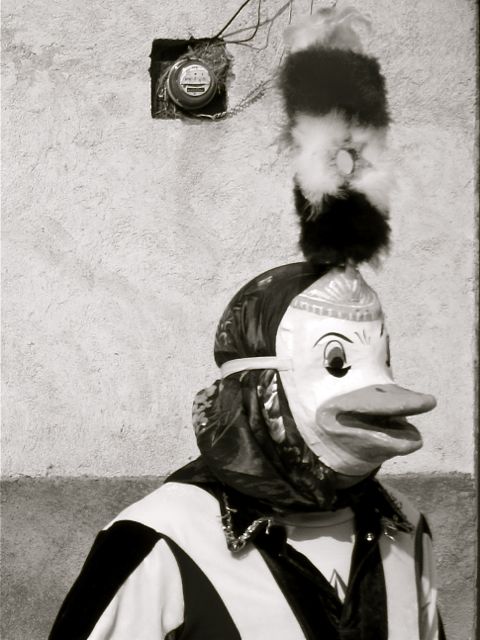
Some of the participants passed the time joking around (and occasionally teasing this gringa blogger), others looked incredibly bored, but all remained patiently stationed in place.  After all, in the words of one guy’s t-shirt, “don’t panic,”  it will eventually start.

IMG_7543

IMG_7524

IMG_7617

IMG_7615

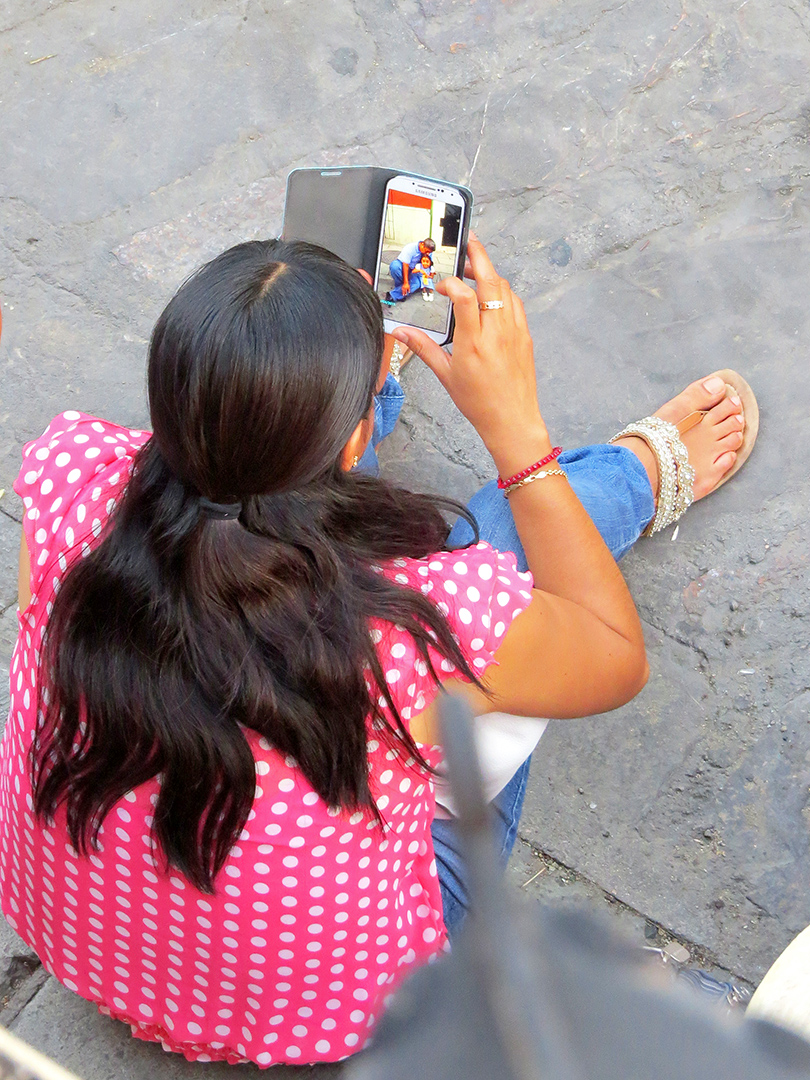
Then, there is always one’s cell phone to provide a bit of distraction.

IMG_7544

IMG_7538

IMG_7630

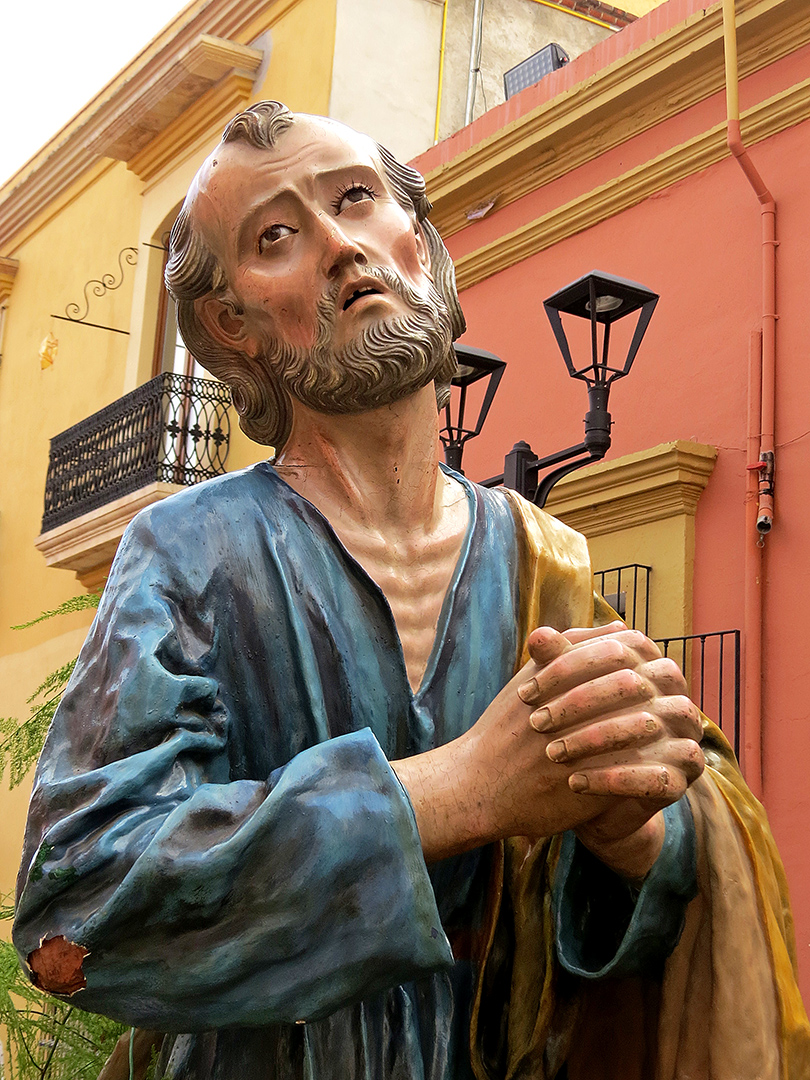
The 6 PM start time for the procession came and went, as did the daylight and my hope for taking any decent photographs of the actual procession.  (One of these days, I will master night photography of moving objects, she says, hopefully!)  It looked like even San Pedro was looking to the heavens for divine intervention to get the show on the road.
IMG_7500

About 6:45 PM, with lights flashing, a small phalanx of motorcycle police signaled our prayers had been answered and a hush fell over the multitudes lining the sidewalks, streets, and balconies — the Procesión del Silencío had finally begun.

Read Full Post »

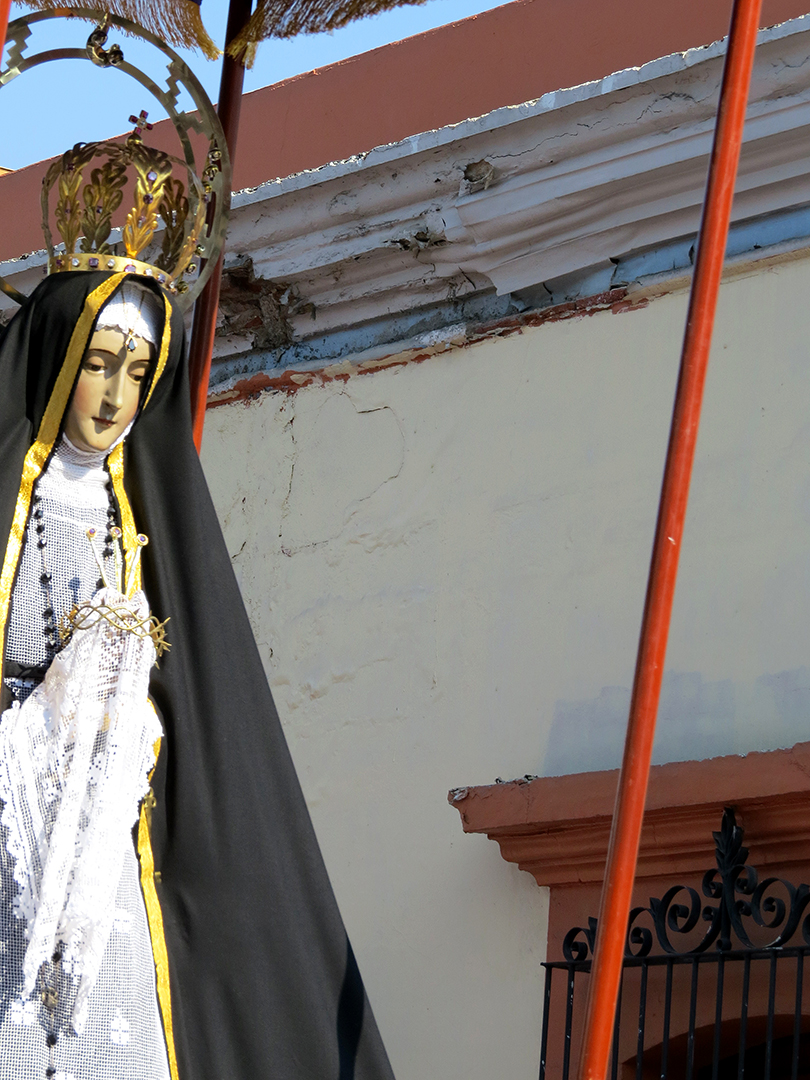
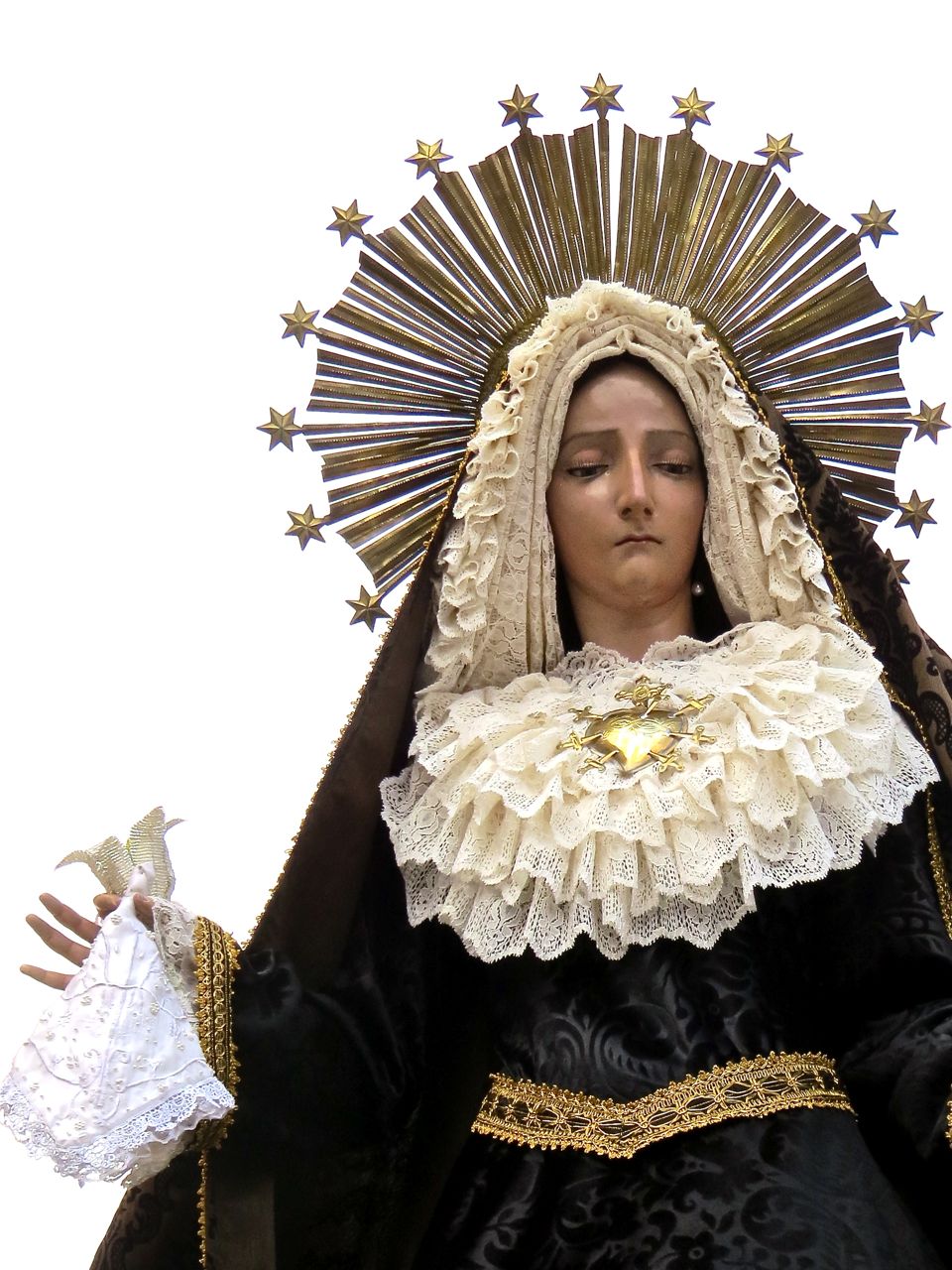
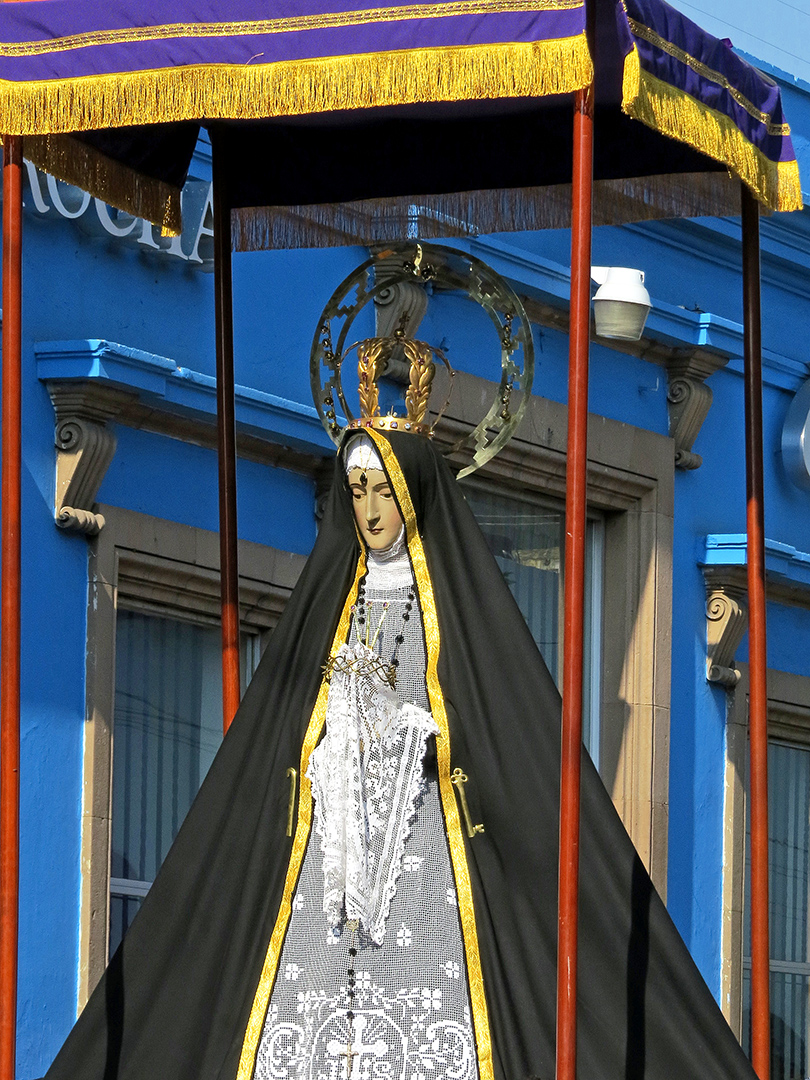
Good Friday morning, the streets of Oaxaca are quiet, and solitude seems to be the order of the day.  The only sounds that could be heard coming from the streets in my ‘hood were prayers being sung as Our Lady of Solitude left her eponymous home at the Basílica de Nuestra Señora de la Soledad.

IMG_7356

As you can see, alone, Oaxaca’s patron saint was not; acolytes carried and accompanied her on her morning stroll.

IMG_7364

A crystal clear, brilliant blue sky provided a backdrop for her sojourn.

IMG_7379

Slowly she made her way down Independencia en-route to the Cathedral.
IMG_7378

She was one of the first to arrive at this ritual Viernes Santo gathering.

IMG_7398

The guys took over and maneuvered her into position at the side of the Cathedral, as the faithful awaited.

IMG_7404

There, she would soon be joined by other images of the Santísima Virgen and Jesús from many of the numerous churches in the Historic District.

IMG_7401

After at least two hours of prayers and songs and more prayers, Soledad returned to the Basilica, perhaps to rest (like me) before again taking to the streets for this evening’s Procession of Silence.

Read Full Post »

Another magical Domingo de Ramos spent in San Antonino Castillo Velasco.  Experiencing Palm Sunday in this small Zapotec village never fails to nourish the soul.

A band played outside the panteón as villagers, from niños and niñas to abuelas and abuelos, arrived bringing their biggest and most beautiful fruits and vegetables, breads and baked goods, carved wooden toys and embroidered clothing, not to mention, goats, chickens, rabbits, and even a pig or two.  Three silver-haired abuelas inspected each donation; their faces expressing gratitude and appreciation for each offering, as they affixed a price tag.  Following the procession to the templo and a mass, all would be sold to raise money for the work of the church.

These were offerings to San Salvador, who sat proudly atop el Señor del Burrito, who was up to his ears in produce and bread.

At 11:00 AM, after prayers were offered in gratitude and for continued abundance in this fertile valley, led by the beat of two tambors and the high-pitched lilt of a chirimía, a procession to the church began.  Palm crosses were distributed to villagers and visitors, alike, and many carried (or led, in the case of the livestock) the offerings that had been collected.

Once secured, it took twenty men to hoist and carry the bounty-laden anda, with San Salvador and the burro, a ritual reenactment of the Biblical story of Jesus entering Jerusalem riding on a burro to celebrate the Passover.  As the procession made its way to the church, the rhythmic sounds were occasionally overpowered by shouts warning the men of topes (speed bumps) and low hanging telephone wires that must be navigated, and then there were the stairs leading up to the church atrium.

I cannot begin to express how warm and welcoming the people of San Antonino Castillo Velasco were.  Countless times, as I was taking photos, officials encouraged me to come closer and villagers ushered me to the front.  How many magical experiences can one person have?

Read Full Post »

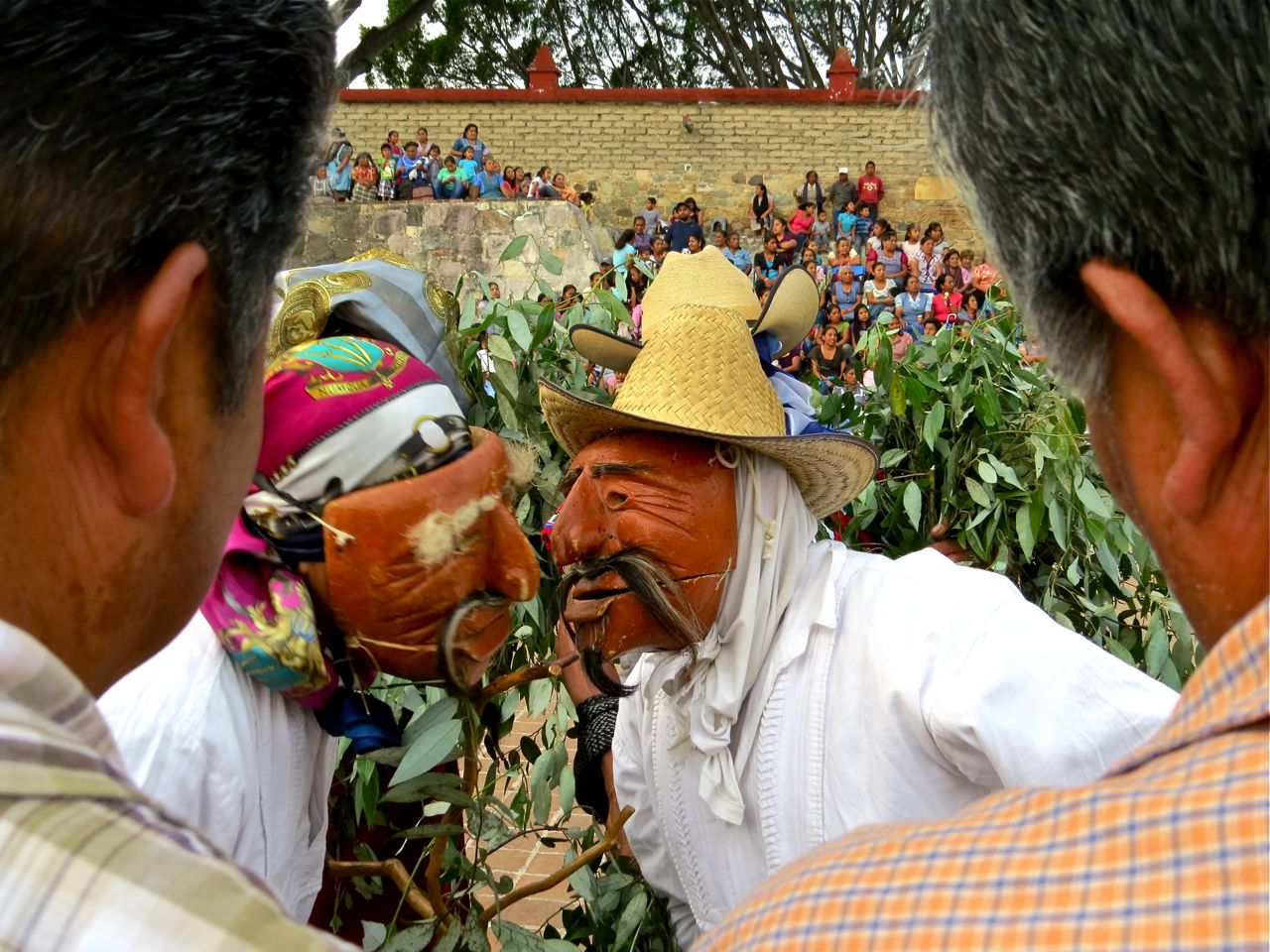
2 viejitos, nose to nose

Tête-à-tête between Viejitos (I know, I’m mixing languages), seen between the shoulders of two municipal leaders, on the Municipal Plaza in Teotitlán del Valle during this year’s previously mentioned Carnaval.

Read Full Post »

True confession:  I’m not in Oaxaca!  I arrived in the San Francisco Bay Area a week ago for a 3-week visit.  While I love seeing family, friends, “my” mountain (Mt. Tamalpais), and the Pacific Ocean, it also means bone-chilling summer fog, driving instead of walking most everywhere, and the absence of my regular blog fodder — no calendas, ferias, festivals, saints days, bandas, and urban art.  (Though, I will probably head to San Francisco for the latter!)

However, this break-in-the-action gives me time to look back through thousands of photos and create posts that had been put on the back-burner when something bigger, better, or more timely cropped up.

3 viejitos

So, here we go, back to Friday, April 24, 2014 — the last of five days of Carnaval in Teotitlán del Valle.

Chihuahua

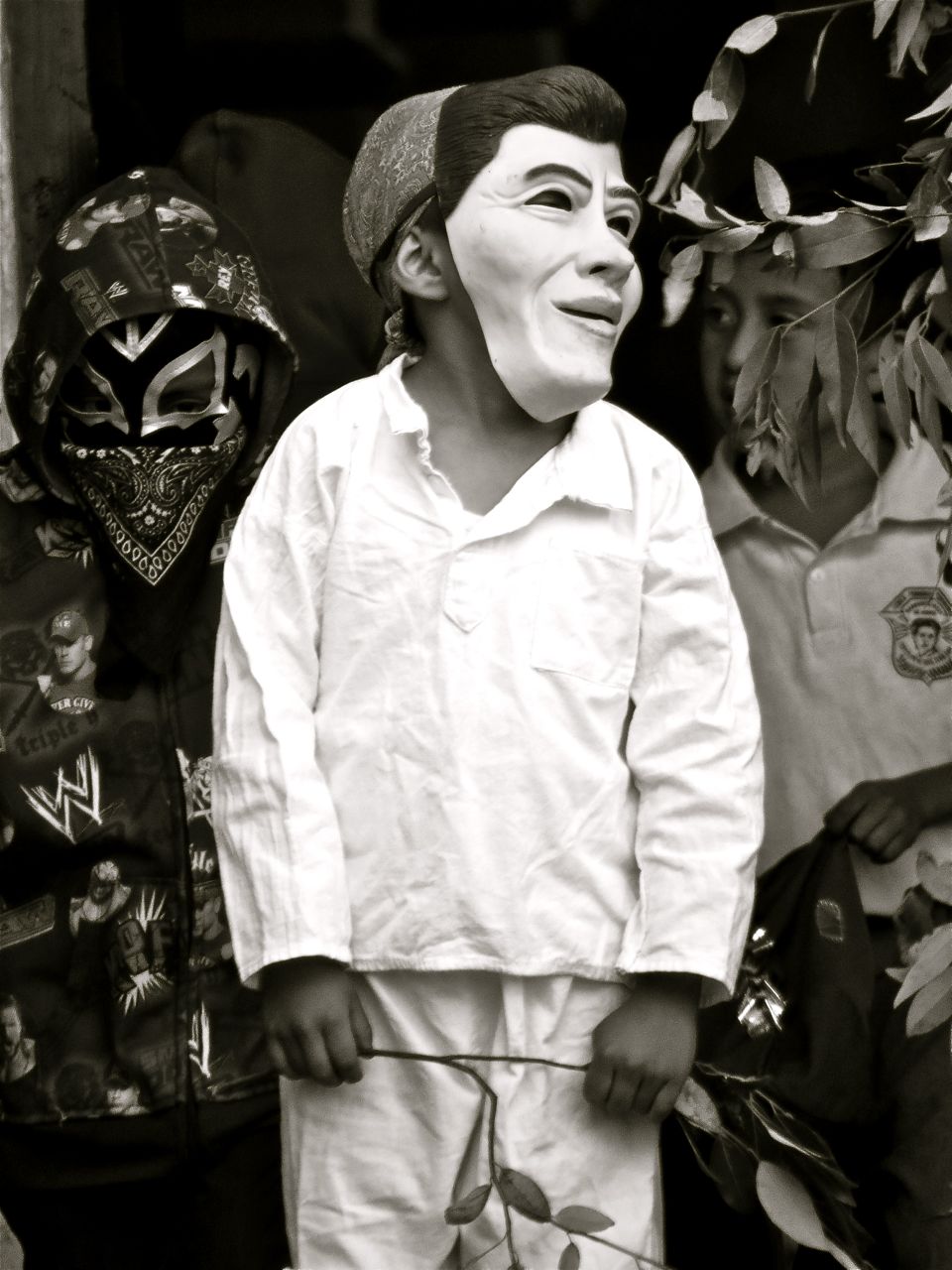
While there are masks, costumes, men dressed as women, and merriment, this is not your Christian pre-Lenten Fat Tuesday/Mardi Gras Carnival.

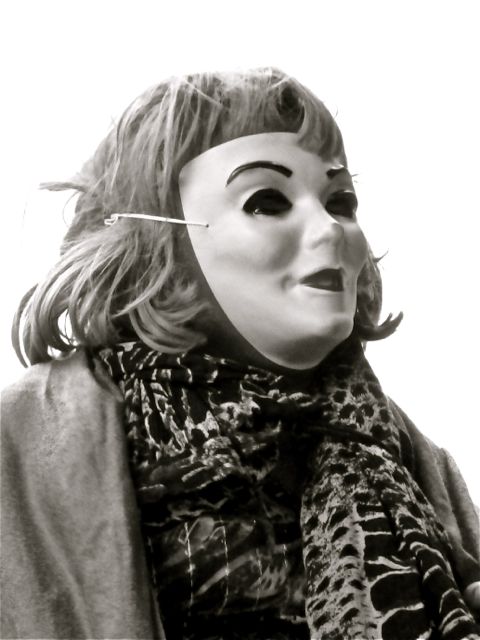
Man wearing female mask, wig, and clothing

This is a pre-Hispanic celebration that happens the Monday through Friday after Easter, not before Lent.

Close-up of viejito

Via El Baile de Los Viejitos (the Dance of the Old Men), it brings the community and elected leadership together to remind each of their social contract — in an extremely humorous way.

Young viejito

A procession, gathering participants along the way, leads to the Municipal Plaza, where it seems as if the entire village assembles.

2 elderly women watching Dance of the Old Men

And, of course, the dance and ritual continue late into the night…

Read Full Post »

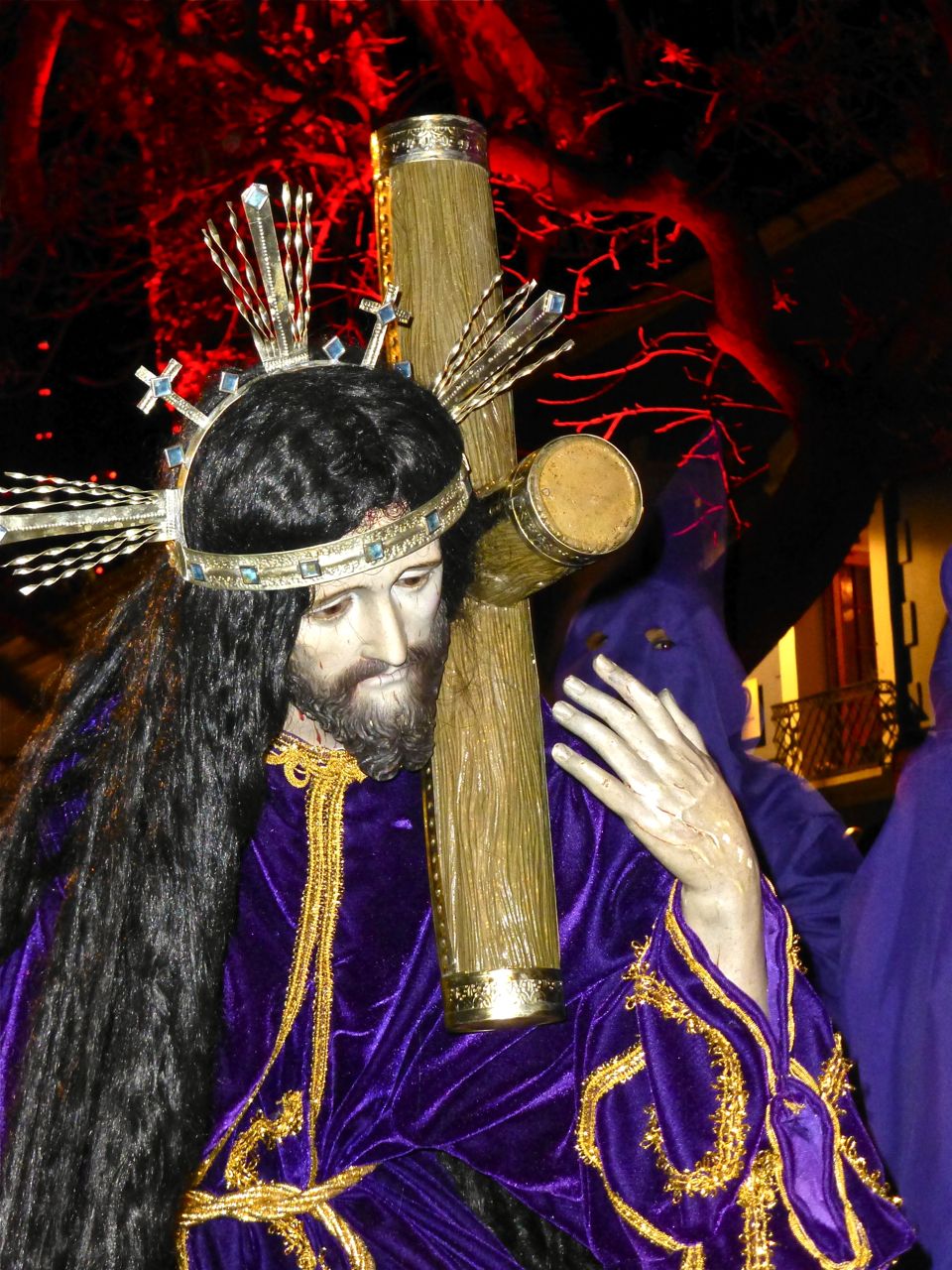
Good Friday wasn’t all about Mary.  Viernes Santo processions present larger-than-life images of Jesús in all his piety and suffering.

IMG_3270

IMG_3273

IMG_3444

IMG_3496

P1030621

P1030667

Jesus Christ, Jesus Christ
Who are you? What have you sacrificed?
Jesus Christ Superstar
Do you think you’re what they say you are?

Superstar, lyrics by Andrew Lloyd Webber

Read Full Post »

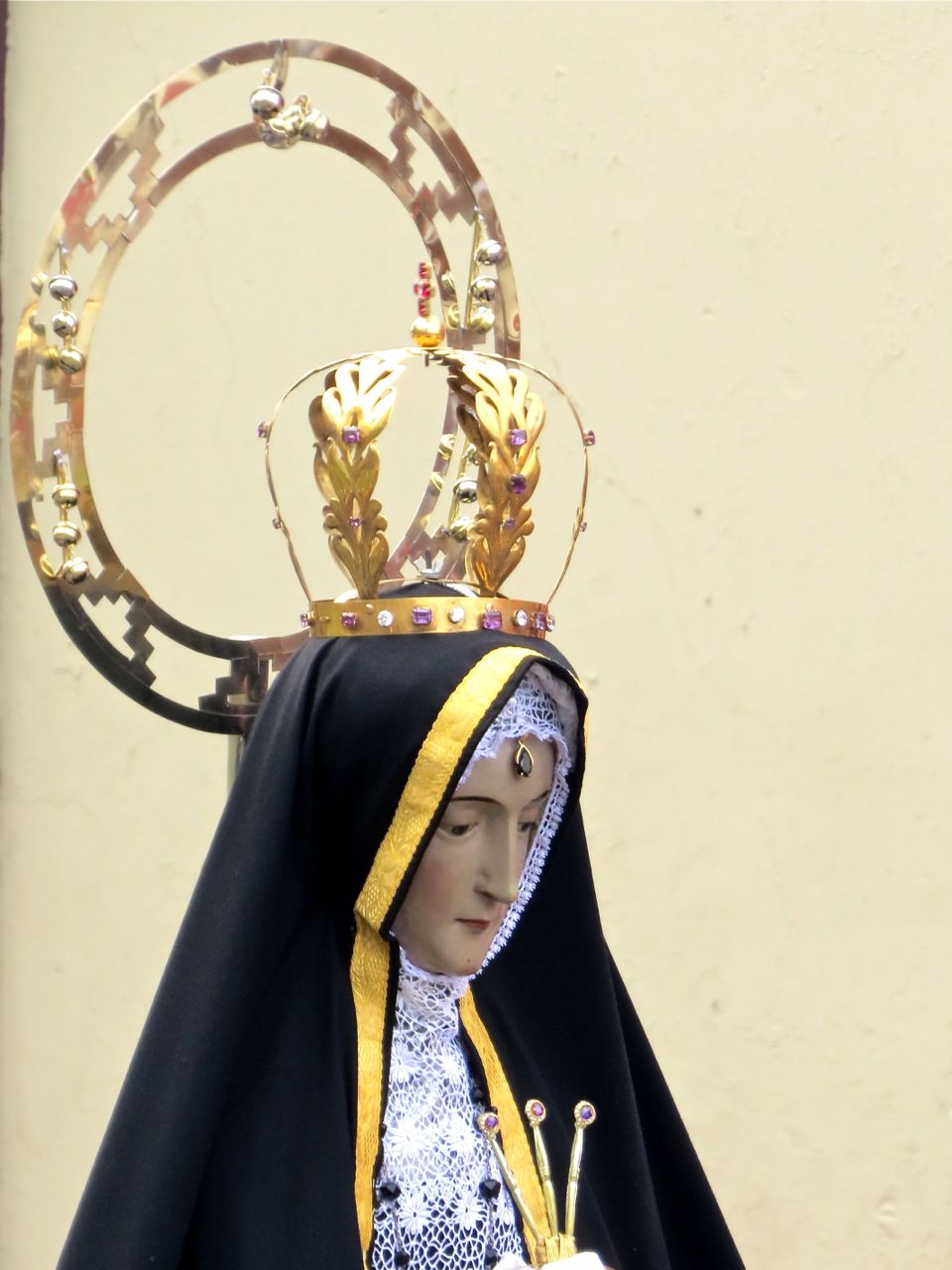
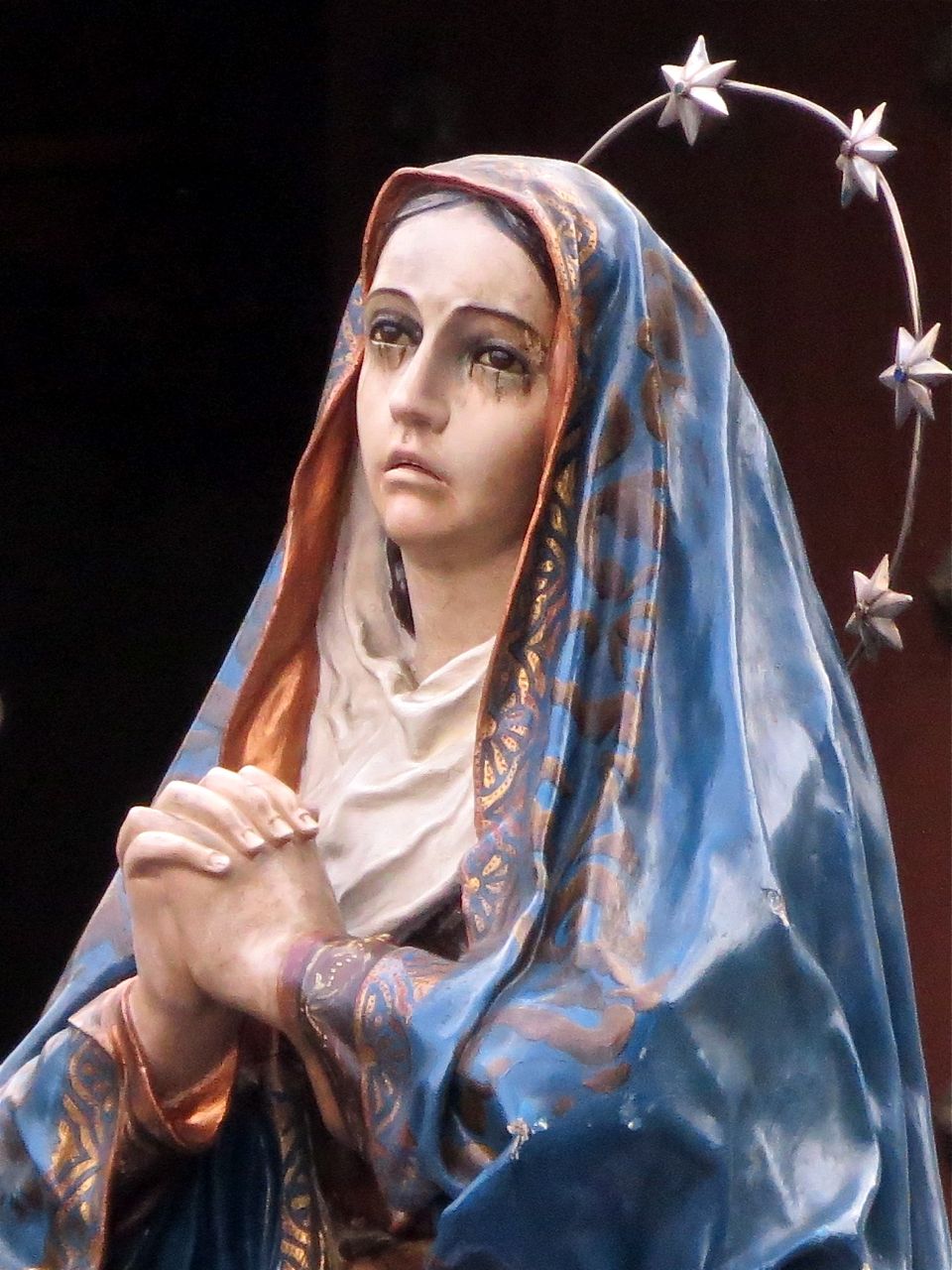
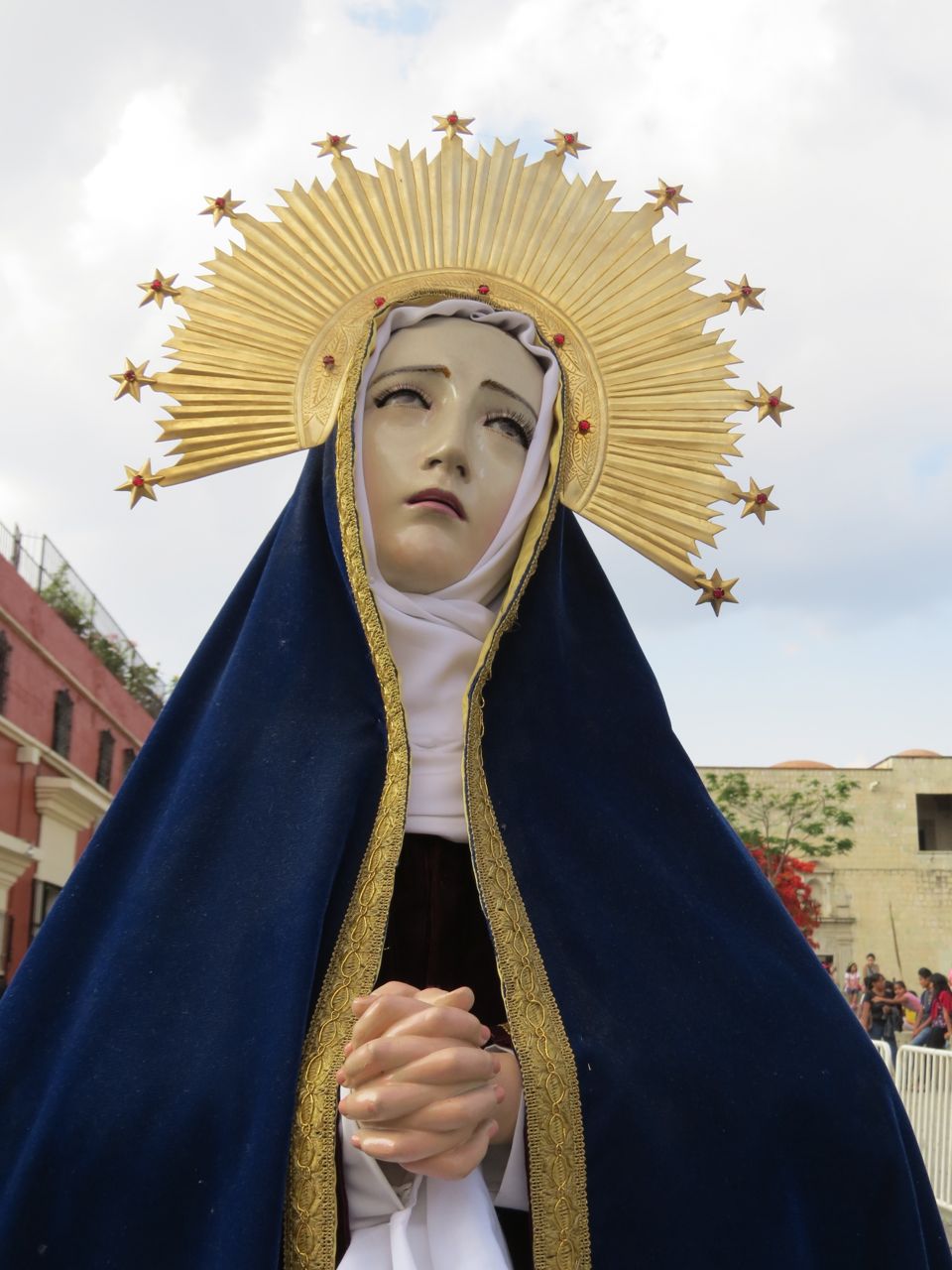
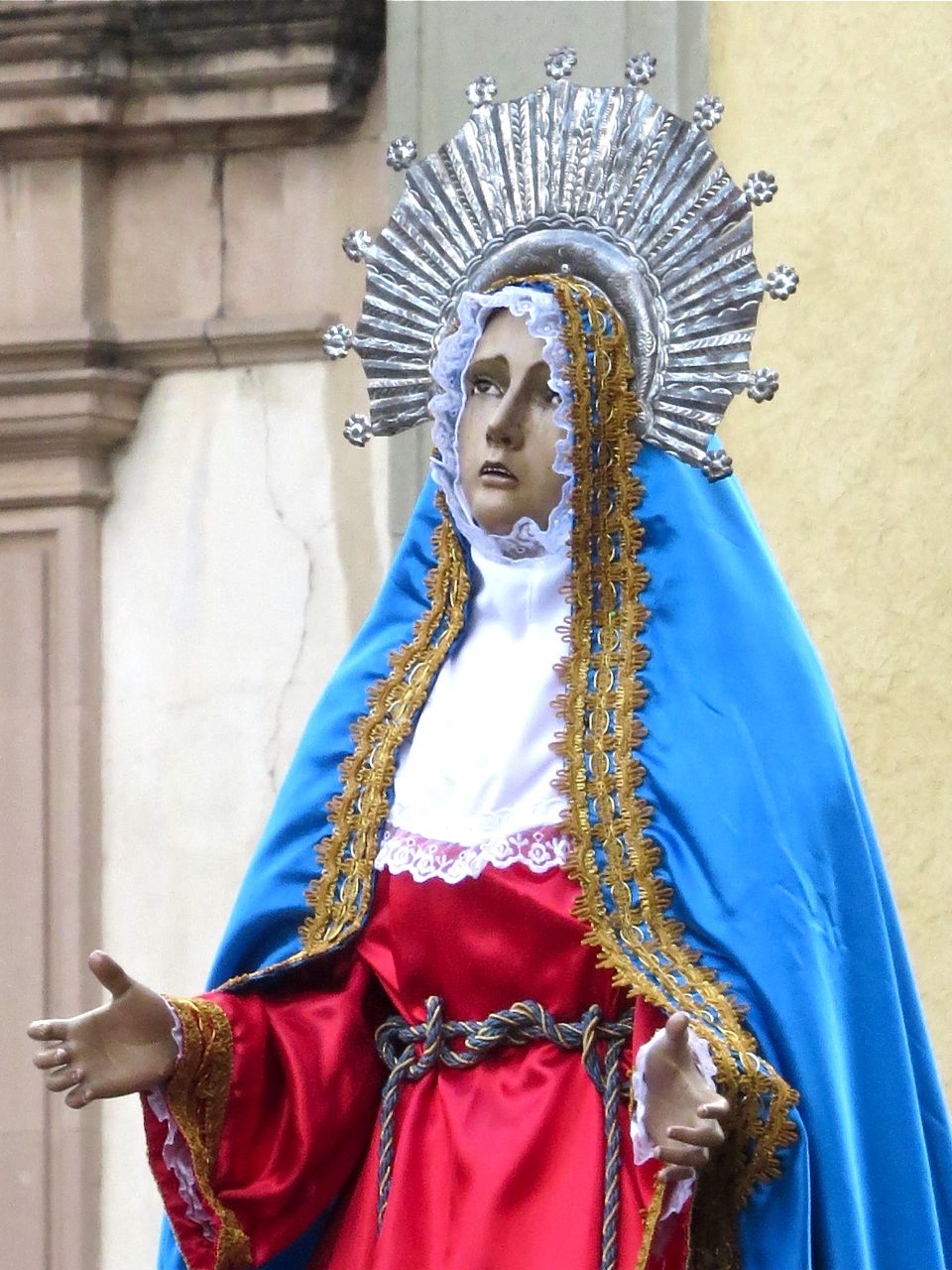
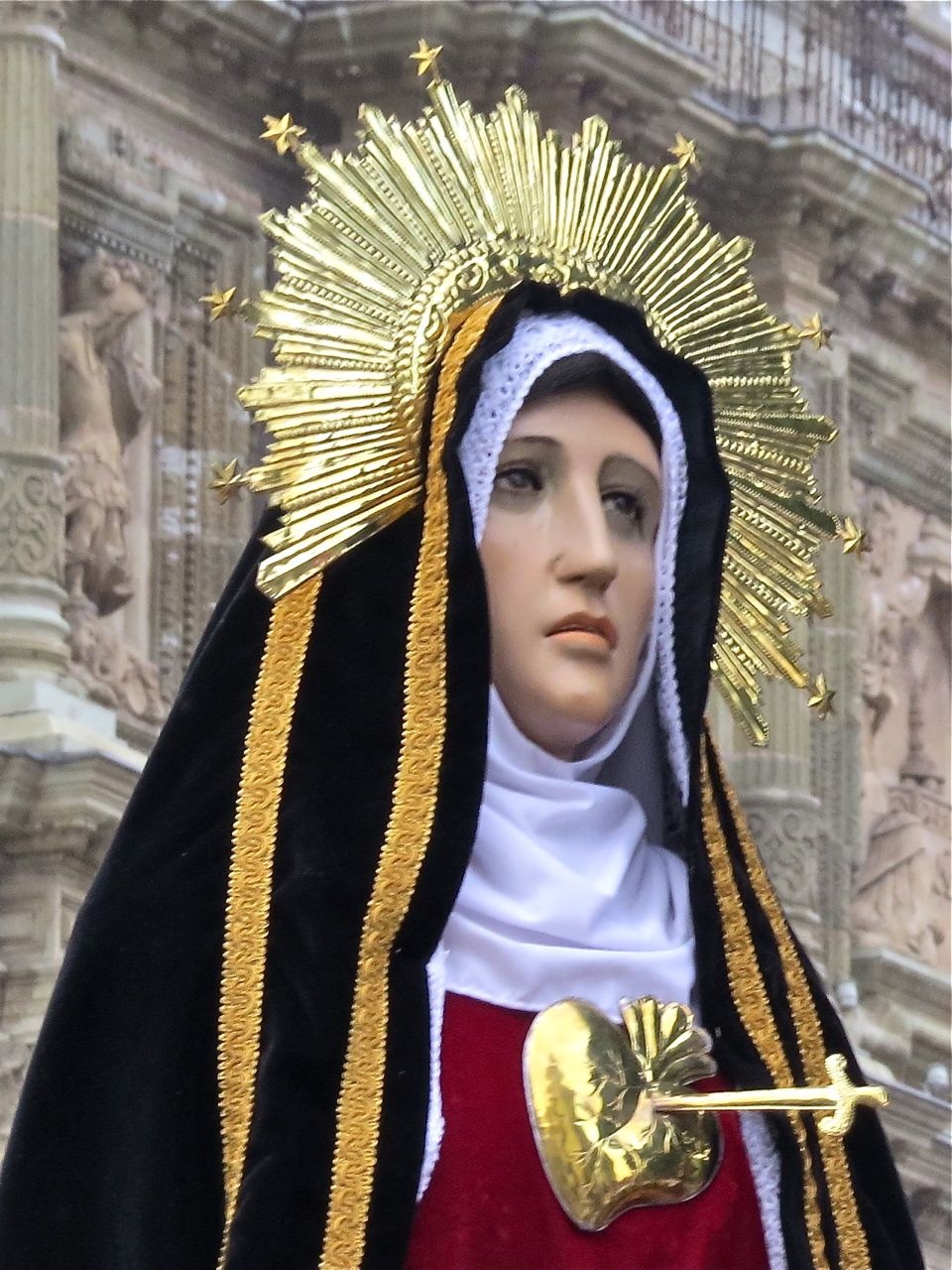
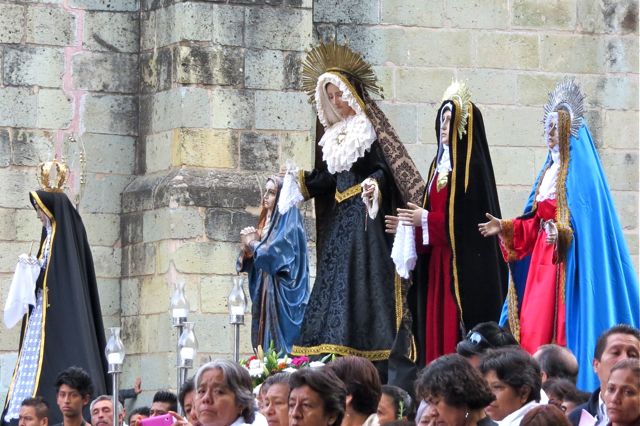
Good Friday in Oaxaca… Jesús may be the one who they say was crucified and resurrected, but María is never far from his side.

IMG_3412

IMG_3309

IMG_3439

IMG_3313

IMG_3378

IMG_3535

IMG_3363

IMG_3450_copy

From frequent traveler to Oaxaca, Liza Bakewell’s book, Madre:  Perilous Journeys with a Spanish Noun:

One can travel all over Spain and its former viceroyalties and never see as many elaborately bedecked and bejeweled Virgins as one will see here in Mexico — neither in number, nor in glory.  Yes, in Peru there are many famously ornate ones.  In Colombia, too.  Argentina, Chile, Bolivia, Ecuador have their share.  The Philippines is a runner-up.  But Mexico has all of them beat.  Marian devotion, the worship of the Virgin Mary in all her forms through song, prayer, writing painting, sculpture, and shrines, went wild in Mexico.  (p. 169)

Read Full Post »

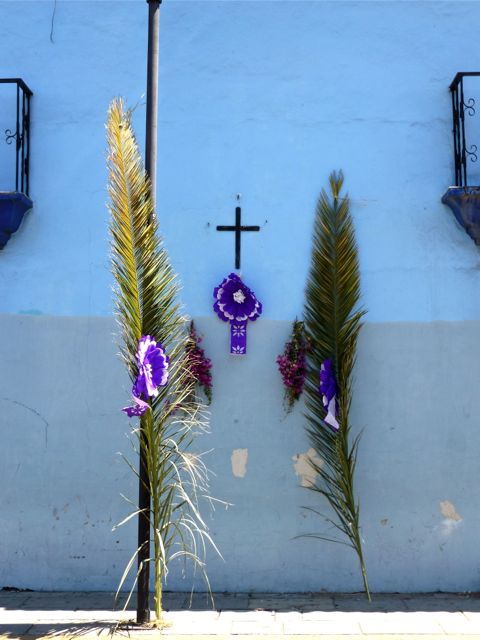
From the streets of Oaxaca today, wishing you happy Easter Sunday…

Palm fronds and cross against blue wall

Four Twenty Day

Caps with Bob Marley image & marijuana leaves

almost Earth Day…

T-shirt "Local food = primary care"

And, though nothing seen around the streets of the city, a happy Passover!


Read Full Post »

Last night, fortified by tostadas, guacamole, and a little vino, a gal pal and I set out for the Jueves Santo (aka:  Holy Thursday and Maundy Thursday) tradition of visiting seven churches.  According to that fount of knowledge, Wikipedia, “The tradition of visiting seven churches on Holy Thursday is an ancient practice, probably originating in Rome.”

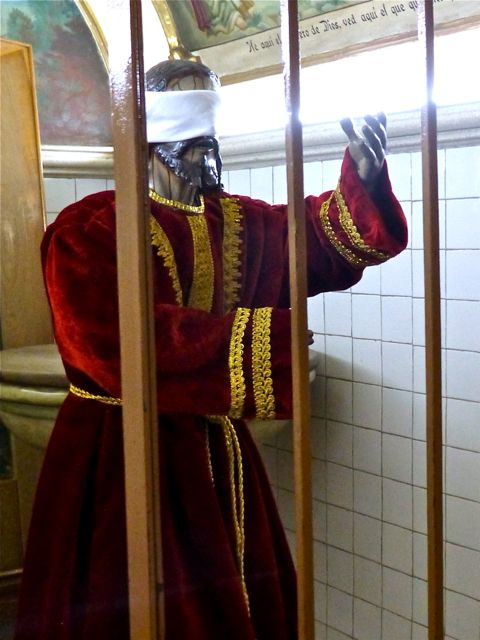
We purchased our bag of Pan Bendito (bread that had been blessed) and set off.  As always, the sidewalks were teeming with people in a combination of a semi-solemn pilgrimage, street festival, family night at the fair, and date night.  (Of course, there was canoodling.)  And, despite the “Entrada” and “Salida” signs on the doors of many of the churches, foot traffic was often gridlocked.  I didn’t help matters when I stopped short.  Jesus wearing a blindfold?

Blindfolded statue of Jesus

At another church, another blindfolded Jesus…

Blindfolded Jesus behind bars

And, another…

Blindfolded statue of Jesus behind bars

Holy Thursday, Batman, how could I have missed these blindfolded Jesus figures in 2010, 2011, 2012, and 2013???

(For those, like me, who are clueless where this blindfold business comes from:  According to the Gospels of Luke (22:64) and Mark (14:65), Jesus was blindfolded, mocked, and beaten following his trial and before his crucifixion.)


Read Full Post »

And so, Viernes Santo began…

Procession

Processions from churches in the Historic District began at 7:00 AM.

IMG_3281

They converged at the Alameda, on the south side of the Cathedral,

IMG_3336

where “our Lord meets his most Holy Mother going towards Calvary.”

IMG_3316

The faithful, now as one, then proceeded east on Independencia…

People dragging wooden crosses

along with the images of Mary and Jesus…

Statues of Mary and Jesus

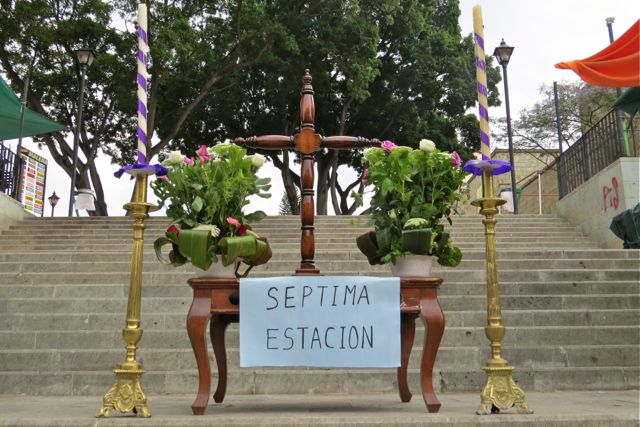
stopping along the way at Stations of the Cross.

Septima Estacion - altar on outside stairs

I left at 9:30 AM — they were still going.  Early this evening, all will again gather for the Procession of Silence.  No rest for the faithful or weary bloggers!

Read Full Post »

San Antonino Castillo Velasco continues to enchant.  What’s not to like about a village known for growing flowers, decorating graves with designs created with flor inmortal (immortal flowers) during Día de los Muertos, and floral designs executed in exquisite embroidery?!!

Then there is Palm Sunday and the tradition of gathering at the panteón, loading El Señor del Burrito with locally grown bounty, blessing by the priest, an incense led procession carrying it to the church, and then selling it to raise money for a local orphanage.

It never ceases to amaze!  The produce loaded onto the Little Burro, along with the overflow, was fantastic — enormous cabbages, the whitest of white cauliflower, perfect roses, cacao beans, squash, fruits, and on and on…

Then there are the people… young and old, they are always gracious and welcoming. And this year, under temperatures threatening 90ºF, women were circulating throughout the gathering crowd, offering thirst quenching aguas to stave off dehydration.

Oh yes, there were also kids and animals — and sometimes together!  As I think I’ve mentioned before, children in these indigenous communities seem to always be included and when old enough (5 and up, I’m guessing), given responsibilities — joy and exuberance, along with patience and commitment, abound.

I loved watching the little boys wrangling the goats as the procession proceeded from the panteón to the church.


Read Full Post »

Sometimes color seems like a distraction, so an experiment in de-saturation from the last day of Carnaval in Teotitlán del Valle.

For some outstanding up-close and full color photos, head over to Oaxaca-The Year After.

Read Full Post »

Friday we returned for another extraordinary day — the last day of Carnival.

This slideshow requires JavaScript.

Again, muchisimas gracias to the gracious and generous people of Teotitlán del Valle.

Read Full Post »

I’m playing catch-up with blog posts.  After the Good Friday Procession of Silence, I thought life would slow down a little.  That’s what’s happened in years past — I caught up on the “to do” list on the home-front, leisurely plowed through the hundreds and hundreds of photos from Semana Santa, did a little research and a lot of thinking about what I’d just seen and experienced, and then crafted a few blog posts.

That was before we found out that Teotitlán del Valle celebrates 5-days of Carnival after Easter, not before Lent!  A little levity after the solemnity of Semana Santa and in one of our favorite places was not to be resisted.  And so, blogger buddy Chris and I set out on Monday afternoon in search of the house in Sección 1 (the village is divided into 5 geographic areas) that was hosting the daytime fiesta that precedes the evening festivities in the Municipal Plaza.

We returned yesterday for the Sección 5 fiesta, so more to come.  Now it’s off to Tlacolula for the Nieve, Mezcal y Gastronomia Festival.

FYI:  For a more detailed explanation of this Carnival celebration and photos from last year by a professional photographer, check out Ann Murdy’s website.

Read Full Post »

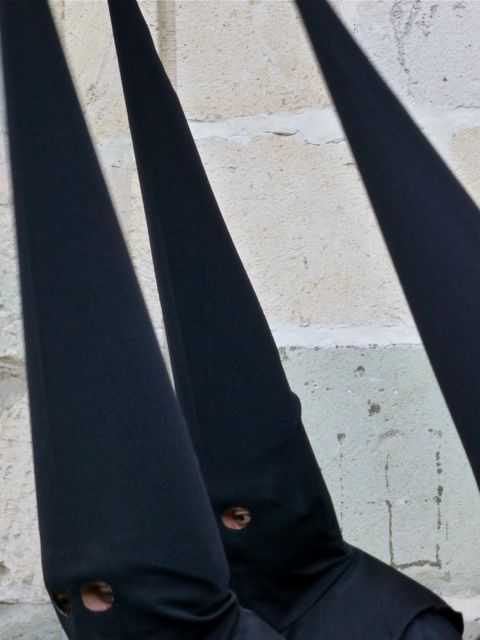
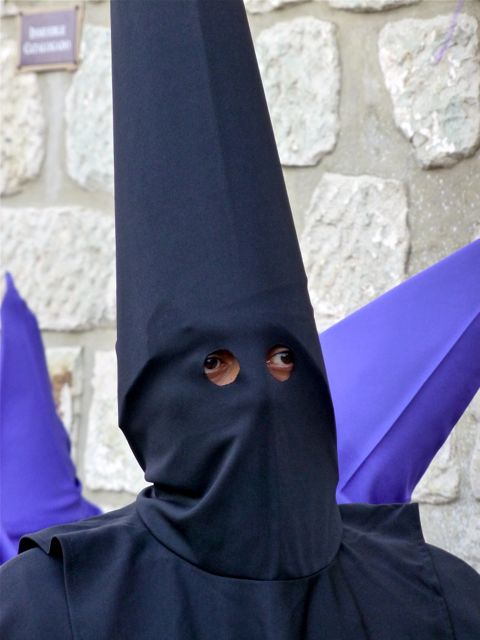
In Oaxaca the penitents gathered…

Purple hooded penitent

in front of Preciosa Sangre de Cristo on Good Friday…

3 black hooded penitents

preparing for the Procession of Silence.

Purple hoods behind black hooded penitent

For those who are wondering, “What’s with the hoods (capirotes)?”  The answer can be traced back to the Middle Ages.  Members of lay religious charitable organizations (cofradías) would don the masks and hoods to guarantee anonymity and promote humility in their service.

From the Holy Week in Seville, Wikipedia page:

At the heart of Semana Santa are the brotherhoods (Hermandades y Cofradías de Penitencia),[1] associations of Catholic laypersons organized for the purpose of performing public acts of religious observance; in this case, related to the Passion and death of Jesus Christ and to perform public penance.

The brotherhoods, besides the day-to-day work in preparation for the processions, also undertake many other self-regulated religious activities, and charitable and community work. Many brotherhoods maintain their own chapel, while others are attached to a regular parish.

The Spanish brought the tradition to Mexico and penitents continue to play a major role in the Viernes Santo, Procesión del Silencio in Oaxaca.

Read Full Post »

« Newer Posts - Older Posts »