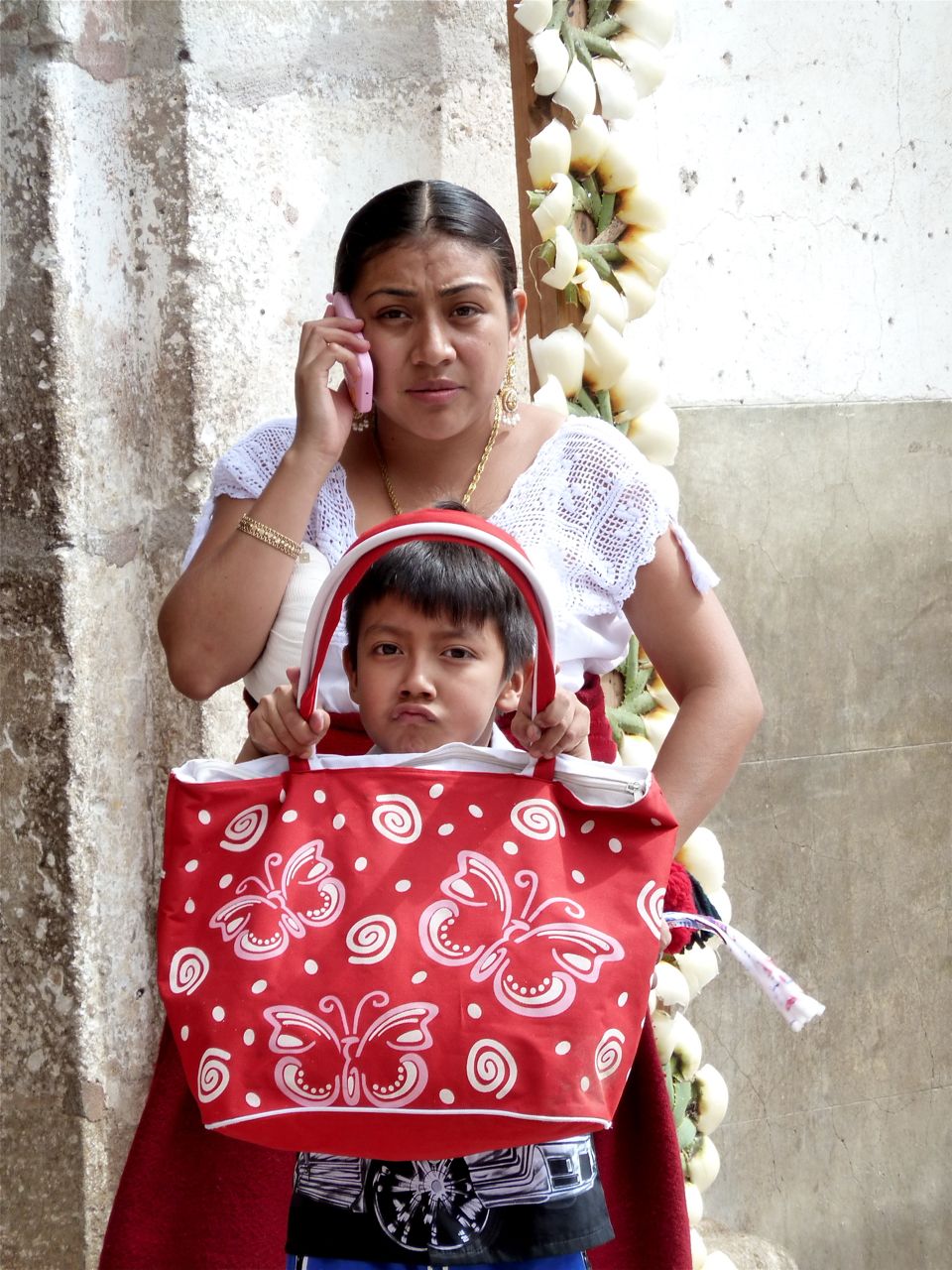
Outside Templo de Santa María de la Asunción, Tlacolula de Matamoros, on Friday, waiting for the calenda to begin.
Posted in Celebrations, Culture, Travel & Tourism, tagged calendas, cell phones, Mexico, Oaxaca, parades, photographs, photos, popular travel destinations, Señor de Tlacolula, Tlacolula de Matamoros on October 13, 2013| Leave a Comment »
Outside Templo de Santa María de la Asunción, Tlacolula de Matamoros, on Friday, waiting for the calenda to begin.
Posted in Celebrations, Culture, Religion, Travel & Tourism, tagged baskets, calendas, canastas, Fiesta de la Virgen del Rosario, Mexico, Oaxaca, parades, popular travel destinations, Tlacolula de Matamoros, Virgin of the Rosary on October 8, 2013| 2 Comments »
Before returning to honor al Señor de Tlacolula this Friday, I figured I’d better finish posting pics from last Friday’s la Virgen del Rosario calenda.


This annual procession slowly winds its way through the streets of Tlacolula de Matamoros. Participants stop at “stations” throughout the village, where religious ritual is performed, rest breaks are taken, and tamales, sweets, and beverages (yes, including mezcal) await. This goes on until after midnight. I don’t know how they do it!
Posted in Celebrations, Culture, Religion, Travel & Tourism, tagged calendas, Fiesta de la Virgen del Rosario, marmotas, Mexico, Oaxaca, parades, popular travel destinations, Tlacolula de Matamoros, Virgin of the Rosary on October 5, 2013| Leave a Comment »
Yesterday, we headed about 20 miles southeast of the city to Tlacolula de Matamoros for their calenda (parade) in honor of la Virgen del Rosario (the Virgin of the Rosary). While we go to Tlacolula often, especially for their Sunday market, and while we’ve been to countless calendas, this particular one was a first — and what fun it was!
I’m always amazed at the variations from one village to another — even those only a few miles apart. I have to say, one of the most striking features of Tlacolula’s calenda was the masses of marmotas. No, I’m not talking the groundhog/woodchuck variety. These, at their most awesome, are ginormous cloth globes on a pole that are carried in every calenda I’ve ever seen down here.

Little boys start out with little marmotas — learning how to position it in the holster and becoming comfortable carrying it for several blocks.


The pre-teens graduate to bigger and heavier marmotas and the lesson here is one of balance — learning to find one’s center — and that you get by with a little help from your friends.


Teens refine their moves and their “look.” Look ma, no hands! After all, a central part of the calenda is a procession of the unmarried girls and young women of the village!
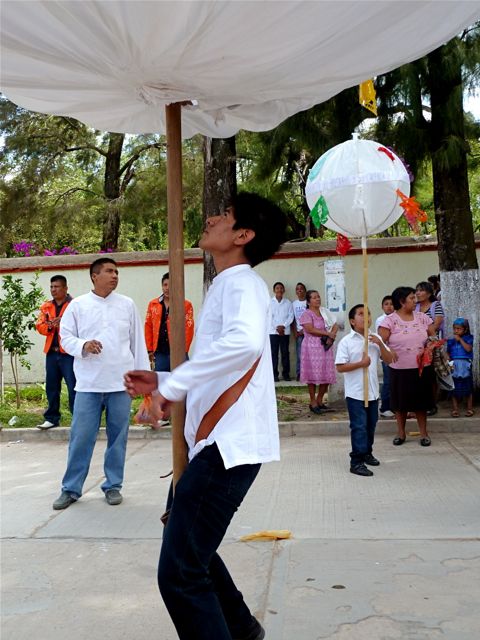
Young men eventually become good-natured and married journeymen…
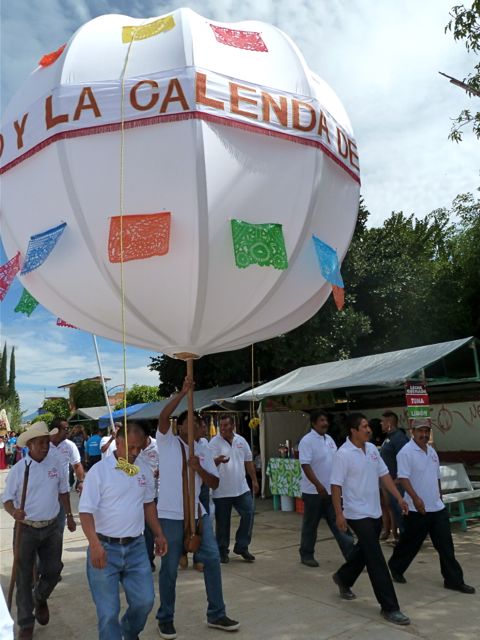
I’m guessing it never ceases being a source of macho pride — enough to tempt one of Tlacolula’s senior citizens into showing, he’s still got it!

And then there was the gringo…

Check out Oaxaca–The Year After for this hilarious tale in his own words. (I’m still laughing!)

Marmotas on parade — it was a spectacular sight!
Posted in Archaeology, Culture, History, Travel & Tourism, tagged archaelogical site, archaeological zone, archaeology, Mexico, Oaxaca, photography, photos, popular travel destinations, Santa María Atzompa, Zona Arqueologica de Atzompa on September 24, 2013| 4 Comments »
Almost a year after our first visit to the newly opened Atzompa archaeological site, yesterday, we returned. The beautiful paved road up from Santa María Atzompa (elevation 1,580 meters) now brings one to a parking lot right across from the entrance, making for less of a haul up the hill for those less mobile or challenged by the altitude — at the top it is almost 300 meters above the village below — even we were huffing and puffing.

Atzompa was part of Monte Alban and one of its largest settlements. At the top of the stairs (above), is the largest (45 meters by 22 meters) of the 6 ball courts found among the Monte Alban communities.

Investigations of the Atzompa site first began in 1940 by Jorge R. Acosta, who was part of the Monte Alban Project. However, in 2007 the National Institute of Anthropology and History began formal explorations using a team of architects, archeologists, topographers, and restorers.

Though the path is currently difficult to see, make sure to go around to the left of the building above to see the north quadrant. Informational placards in Spanish and English are now in place throughout the site and most of the facts in this post are taken from them, but, of course, I neglected to take a photo of the placard for the building below!

Residents from the land cooperatives in the surrounding communities have been hired to do much of the field and lab work. Not a bad setting to work…

One can, in the words of The Who, “see for miles and miles and miles and miles and miles…”
 Except for the birds, insects, lizards, and workers, we had this spectacular setting to ourselves — I think we only saw 3 other visitors the entire time we were there. Perhaps when the second entrance on the Monte Alban side opens, it will attract more attention. In the meantime, the peace and tranquility are a gift in these chaotic times.
Oaxaca–The Year After has more from yesterday’s visit.
Posted in Creativity, Culture, People, Travel & Tourism, tagged entertainment, film, film festivals, international film festivals, Mexico, movies, Oaxaca, Oaxaca Film Festival, Oaxaca FilmFest4, photographs, photos, popular travel destinations, Ramiz Adeeb Azar on September 18, 2013| 1 Comment »
Today the Oaxaca Lending Library played host to Oaxaca FilmFest4 founder and artistic director, Ramiz Adeeb Azar. He and 4 members of the festival staff came to the library to “pitch” the festival, which opens September 21 and runs through the 28th. (Note: it has moved from November to September). It wasn’t a hard sell, as many of us have been following it since it began in 2010. And, I’ve got to say, it’s come a long way in a short amount of time. According to Ramiz, it has…
The festival has already set up shop in Plaza San Jerónimo (on Macedonio Alcalá) where staff and volunteers are hard at work and, like last year, the site will serve as the festival’s Hospitality and Information Center.


If you love film, but have never been to a film festival, I highly encourage you to give it a try. Prior to relocating to Oaxaca, for 7 years, one of the highlights of my calendar year was volunteering at the Mill Valley Film Festival. Besides being a lot of fun (never forget, on my hands and knees mopping up spilled red wine at the feet of Katherine Ross and Sam Elliot), I had the opportunity to see some truly wonderful films — especially shorts and documentaries that are rarely shown in the big chain multiplexes. The MVFF was one of the things I missed most (along with crusty sourdough bread and being able to flush toilet paper down the toilet) when I moved down here.
However, along came the Oaxaca FilmFest and, though it didn’t satisfy my craving for sourdough bread or cause new plumbing to be installed in Oaxaca, it does come with a well-considered, eclectic, and always creative selection of films (feature-length and shorts) from all over the world.


Last year, El último hielero (The Last Ice Merchant) a touching documentary from Equador was a favorite of mine, as was The Cart, a humorous short from Russia. And, if the two short films Ramiz showed today — the animated, Sleight of Hand and the very moving, Part of the Change — were any indication, the selectors did a terrific job again this year. So, if you are in Oaxaca, get thee to the Oaxaca FilmFest4 information center at Plaza San Jerónimo and pick up your festival schedule or download it from the festival website.
FYI: All screenings are public and free (except Cinemex and Foundation Nights) and every film is projected in its original language, with Spanish, English, or dual subtitles.
Posted in Celebrations, Culture, History, Holidays, Travel & Tourism, tagged desfile, holidays, Mexican Independence Day, Mexico, military, Oaxaca, parade, photographs, photos, popular travel destinations, women military on September 16, 2013| 6 Comments »
What do the guys do while waiting for an Independence Day parade to begin?
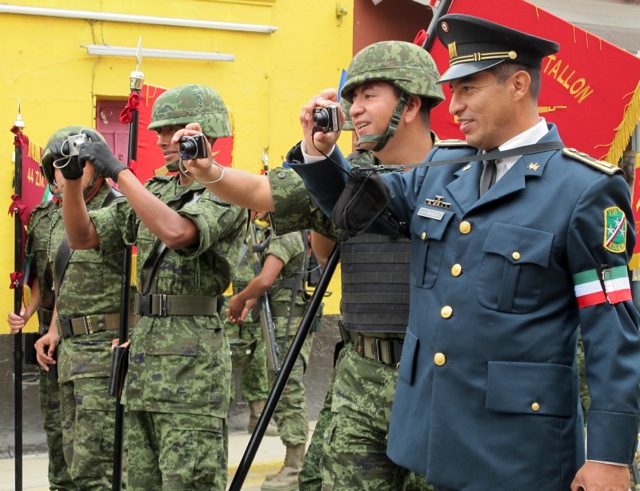
And, what do gals do? Pose for them!
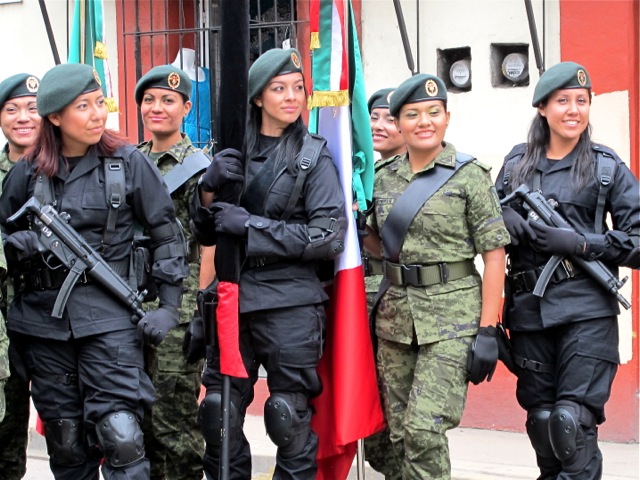
A mother takes twenty years to make a man of her boy, and another woman makes a fool of him in twenty minutes. — Robert Frost
Posted in Celebrations, Culture, Travel & Tourism, tagged Danza de la Pluma, danzantes, Doña Marina, El Picacho, Fiesta a la Natividad de la Virgen María, fiestas, Malinche, Mexico, Oaxaca, penachos, photographs, photos, popular travel destinations, Teotitlán del Valle on September 8, 2013| 2 Comments »
Yippee, I’m back in Oaxaca! Last night’s flight was smooth, on-time, and mostly empty. I have to admit to always getting a goofy grin as the little Embraer comes in over the lights of the city and the smile continues through immigration and baggage claim. It usually falters and turns to a grimace when I have to hoist my 50 pound suitcase up onto the x-ray conveyor belt. However, last night the grin returned when I pressed the “to search or not to search” button, got the green light, and was able to proceed directly to the booth to buy my colectivo ticket — 60 pesos for door-to-door service to the historic district ‘hood. An easy return to home.
Unpacking done, late this morning I walked down to my local mercado to restock the larder with some basics: 2 perfect avocados, 1 pristine white onion, a bunch of unblemished small and sweet bananas, half kilo of quesillo (Oaxacan string cheese), and 6 freshly made tamales (mole, rajas, and verde). I’d actually asked for 4, but my regular tamale gal threw in 2 extras. How often does that happen in el norte? A welcoming return to home.
This afternoon, blogger buddy Chris and I drove out to Teotitlán del Valle for the Fiesta a la Natividad de la Virgen María performance of the Danza de la Pluma. We stepped up onto the plaza of Templo de la Preciosa Sangre de Cristo and it was like emerging into the middle of a technicolor movie. We’ve been there countless times, but today we were blown away by the scene. Mother Nature had conspired to use her enhance wand on the sky, clouds, sun, and costumes. A spectacular return to home!


The recent trip to California was to sign papers finalizing the sale of the house my grandparent’s built in 1957. Prior to relocating to Oaxaca, it had been my home for 30 years, where I’d raised my kids and made many wonderful memories. Needless to say, selling it was an emotionally challenging ordeal and it has engendered a lot of thinking about the notion of “home.”
However, these past 24 hours have reinforced my belief in bumper-sticker wisdom seen many years ago, “When you live in your heart, you are always home.” It’s good to be home!
Posted in Culture, Transportation, Travel & Tourism, tagged colectivos, crucifix, flags, Jesús crucifado, Mexican flag, Mexico, Oaxaca, photographs, photos, popular travel destinations, Virgen de Guadalupe on August 24, 2013| 4 Comments »
Down to Mercado de Abastos late this morning to catch a colectivo out to Etla. I’ve actually come to enjoy the 10-block walk through this definitely not-spiffed-up-for-tourist-consumption neighborhood. However, crossing the Periferico Sur is another story! Cars, taxis, colectivos, buses, trucks, motorcycles, hand-trucks, and pedestrians all in motion or poised to move. Did I mention the potholes ready to swallow people and vehicles? There is a pedestrian bridge a block down the street, but what’s the fun in that?
Needless to say, we all need all the help we can get! I think my colectivo driver had all his bases covered, invoking Mexico’s “Holy Trinity” — La Virgen de Guadalupe, Jesús crucificado, and patriotismo.

Of course he had the rear view mirror covered, too!
Posted in Casita Colibrí, Celebrations, Culture, Travel & Tourism, tagged fireworks, fuegos artificiales, Guelaguetza, Mexico, Oaxaca, photographs, photos, popular travel destinations on July 30, 2013| 6 Comments »
And so, Guelaguetza 2013 ended last night in an explosion of fireworks from Cerro del Fortín…


Not a bad view from Casita Colibrí!
Posted in Culture, Environment, Food, Science & Nature, Travel & Tourism, tagged Atole rojo, ecotourism, Feria Regional de Hongos Silvestres, food, hongos, Mexico, mushrooms, Oaxaca, photographs, photos, popular travel destinations, Pueblos Mancomunados, quotations, San Antonio Cuajimoloyas, Wild Mushroom Festival on July 26, 2013| 2 Comments »
“But one day we shall be rich, and the next poor. One day we shall dine in a palace and the next we’ll sit in a forest and toast mushrooms on a hatpin….” — Katherine Mansfield, The Aloe.
Last Sunday, via a narrow winding road, we drove up into the Sierra Norte for the 13th Regional Wild Mushroom Fair (Feria Regional de Hongos Silvestres) in San Antonio Cuajimoloyas. The village is part of the Pueblos Mancomunados, a union of seven villages formed to protect the forest, preserve local traditions, and promote ecotourism, in order to provide employment. Thirty-seven miles northeast of Oaxaca city, 10,433 feet above sea level, and often in the clouds, Cuajimoloyas has an ethereal feel and seems a world apart from the valley below.


“I am… a mushroom on whom the dew of heaven drops now and then” — John Ford, The Broken Heart (1633).
Entering the plaza in front of the portales of the municipal building, we were surrounded by the 20 species of wild mushrooms endemic to the region. There were mushrooms with shiny orange caps; mushrooms resembling coral, trumpets, a head of cauliflower, flower petals; baskets of freshly dug mushrooms, baggies of dried mushrooms, a bowl of spores; mushrooms sauteed, grilled on hot coals, stuffed in empanadas and tamales, and made into candy.


“Nature alone is antique, and the oldest art a mushroom.” — Thomas Carlyle, Sartor Resartus.
And there were the people of Cuajimoloyas… I quickly found the enchanting abuela from last year, again selling Atole Rojo and it hit the spot! Another abuela was selling fragrant fresh herbs, most I’d never heard of. I forgot about a sprig she gave me and it was a pleasant surprise when I returned home and emptied my pockets.


I’m already looking forward to next year…
Posted in Celebrations, Culture, Food, Travel & Tourism, tagged chichilo mole, Feria del Tejate y el Tamal, festivals, food, Mexico, Oaxaca, photographs, photos, popular travel destinations, San Andrés Huayapam, San Andrés Huayapan, tamales, tea towels, tejate, Unión de Mujeres Productoras del Tejate on July 24, 2013| 4 Comments »
There is SO much going on in Oaxaca right now that the doing isn’t leaving much time for the writing!
However, I’ll give it a try with today’s Feria del Tejate y el Tamal. The festival is part of an effort to preserve the food culture of the Zapotec.

What, you may ask, is tejate? It’s a frothy, refreshing, and nutritious non-alcoholic pre-Columbian beverage made from Nixtamal corn mixed with tree ash, toasted cacao beans, mamey seeds, and Rosita de Cacao flowers. The sale of tejate is the main economic activitity in San Andrés Huayapam, located about 7 miles north of the city, and it is prepared and served by the tejateras of the Unión de Mujeres Productoras del Tejate.


Then, of course, there were the tamales — in tin buckets and giant pots covered in layers of tea towels, many colorfully embroidered. So many vendors anxious to reach into the steaming buckets and so many varieties to choose from. Where does one start?


Blogger buddy Chris recommended the Rajas and Verde from the gal “down at that end,” a taste of a friend’s Flor de Calabaza added that to the list, Mole is a given, and I had to find Chichilo. The latter is one of the seven moles of Oaxaca, it is only served on special occasions, such as weddings and christenings, or when the crops have been harvested. Chilhuacle negro, mulatto, and pasilla chiles; blackened tortillas and seeds of the chiles; and avocado leaves (the latter imparting a subtle anise flavor) give it its distinctive flavor. After three unsuccessful attempts, eureka, I found it! And so I returned home with five mouth-watering tamales.

Speaking of ingredients like corn, cacao, chiles, and calabaza, for a graphic of foods Mexico gave to the world, click HERE.
¡Buen provecho!
Posted in Celebrations, Culture, Food, People, Travel & Tourism, tagged Alejandra Robles, Diosa Centéotl, Expo Feria de Queso y Quesillo, Festival de los 7 Moles, food, Guelaguetza, Jimena Santiago Vasquez, Laura Esquivel, Mexico, Oaxaca, photographs, photos, popular travel destinations, Reyes Etla on July 20, 2013| 10 Comments »
Yesterday, we began the marathon than is Guelaguetza in Oaxaca. First on the day’s agenda was a morning trip to Reyes Etla.
The Señor de las Peñas church sits atop at hill and views of the lush green fields (gracias, rainy season) and the mountains were breathtaking.
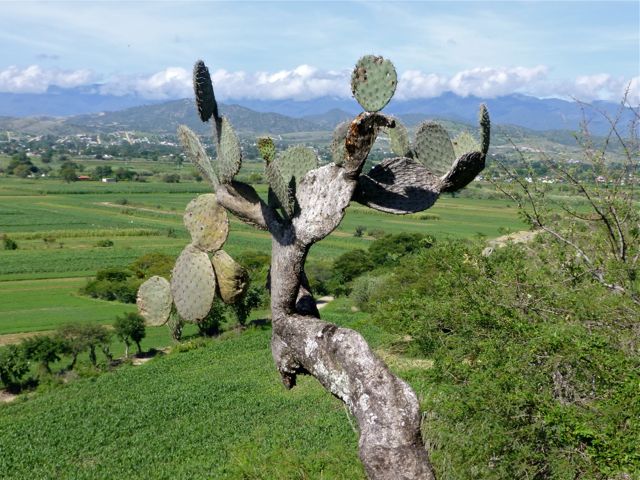
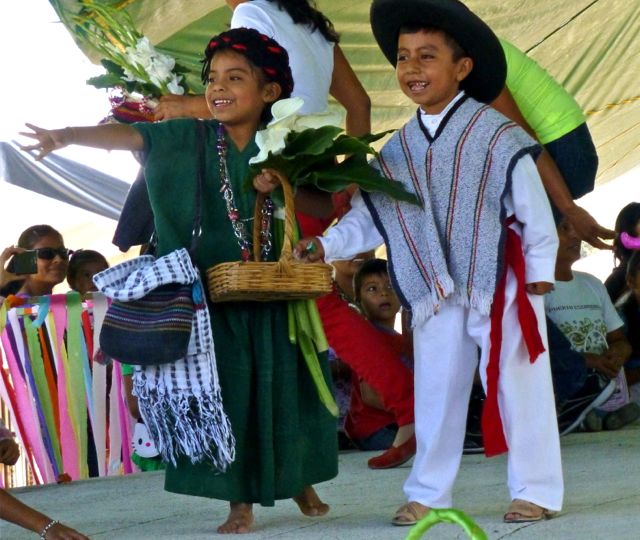
Impossibly adorable children danced and shared, in the spirit of Guelaguetza.
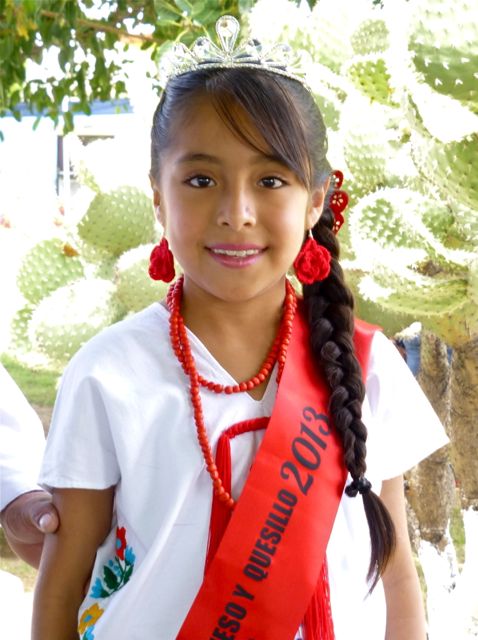
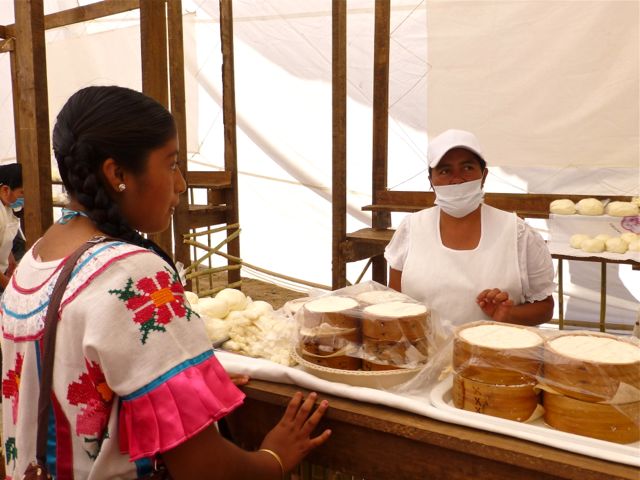
We were in the heartland of Oaxaca cheese country for the crowning of Jimena Santiago Vasquez, as queen of the third Expo Feria de Queso y Quesillo.
Did I say cheese? Oh, yes — stalls and stalls of yummy cheese. The fair runs through Monday and we will be back!
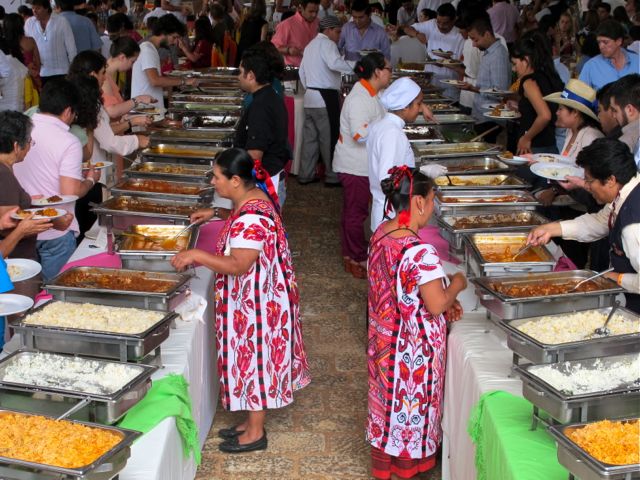
Next on our itinerary was a return to the city for a little (?) gluttony — the Festival de los 7 Moles opening banquet on the grounds of the Jardín Etnobotánico de Oaxaca. Botanas Oaxaqueña (cheese, chicharrón, chiles rellenos), followed by Sopa de Fandango, 15 (not 7) Moles, 4 Tipos de Arroz, followed by a platter of pastries and scoops of Leche Quemada and Tuna nieves (sorbets). Oh, and did I mention, cervesas and mezcal?
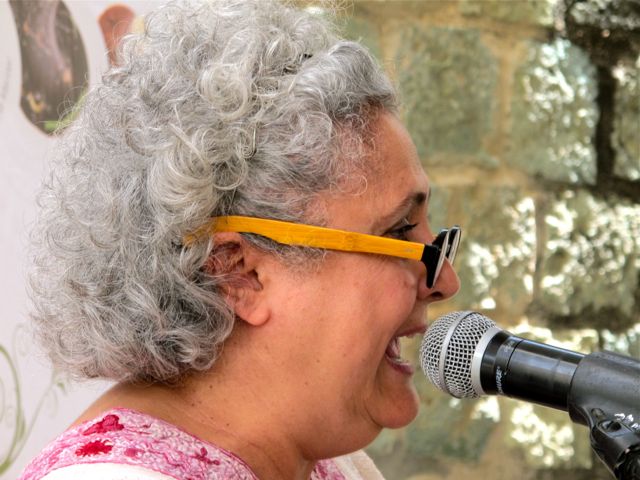
We even got a little culture, as author, Laura Esquivel (Like Water for Chocolate) spoke, though it was a little hard to hear her, with all the eating, drinking, and related conversations!
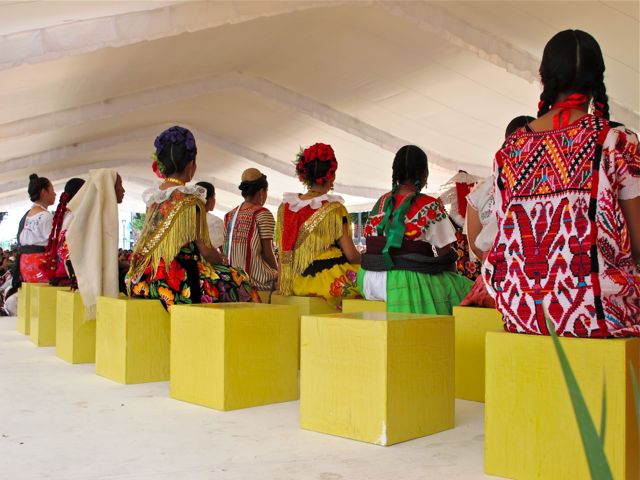
Moving rather slowly, we pushed back from the table and headed down to the Alameda (oh, it felt good to walk!) to take in the last stage of the Diosa Centéotl competition — the chosen “Goddess” presides over Guelaguetza. However, the area surrounding the tented stage was a mass of people by the time we arrived and the best I could do was see the backs of the magnificent traje. (See Chris’s blog for close-ups from the stage one competition.) And, the winner is… Dulce Yanet Grijalba Martínez, from the Zapotec community of San Pablo Villa de Mitla.
After a brief siesta, I rendezvoused with some young friends and we walked over to the Plaza de la Danza for a free performance by Alejandra Robles, one of my favorite Oaxaqueña singers. (For video from the last time I saw her, click HERE.)

The night was still young for my young friends and they were off to get a nieve at Jardín Socrates. I was off to bed, because I’d already had my day’s allowance of nieve AND we’ve only just begun!
Posted in Animals, Creativity, Culture, Science & Nature, tagged Chiapas, Colibríes, hummingbird, Mexico, NASA photo, photo, photographs, popular travel destinations, San Cristóbal de las Casas, street art, The Hummingbird Galaxy, urban art, wall art on July 15, 2013| Leave a Comment »
Colibríes? I can’t resist!
Hummingbird from a wall in San Cristóbal de las Casas in Chiapas…

Hummingbird from a NASA’s Hubble Space Telescope photo…

Separated at birth? Cool article from Slate about this photo…
By Phil Plait
I was pondering writing a longish post about the picture above, talking about what galaxies are, how they can physically collide, how their gravity can twist and distort their shapes into all sorts of weird things …
But seriously. That galaxy looks like a hummingbird.* What more do you need?
OK, you need a little more. For one, I’ve written quite a bit about how galaxy collisions happen, so you can read about how these work here and here. The two galaxies in this collision are called NGC 2936 (the blue birdie one) and NGC 2937 (the smaller cottonball one). Together they are known as Arp 142, named for an astronomer who observed weird, distorted galaxy pairs.They’re located about 300 million light-years from Earth.
Two things really stand out to me in this picture (besides a galaxy that looks like a flippin’ hummingbird). One is the long, delicate tendril of dark reddish dust exhumed from the previously spiral-shaped galaxy NGC 2936, flung into a long arc across tens of thousands of light-years of space. I wish we had more three-dimensional data here; I’d love to know what this structure really looks like from different angles. Since dust is very dark, it blocks light coming from behind it, so this tendril is in front of the hummingbird galaxy, or perhaps embedded in it.
The other thing is that the smaller galaxy seems to have survived this collision pretty well. The shape is only mildly distorted; you can see a bit of off-centered nature to the glow of stars around the core. I suspect its more compact nature has a lot to do with that; the stars are closer together, perhaps, and the overall gravity of all those stars helped it retain its shape.
And there is one other thing. These are two very different galaxies colliding! The ex-spiral galaxy is very blue, indicating lots of star formation happened recently. Young, massive stars are blue, and when galaxies collide, the gravitational interaction can cause huge clouds of gas to collapse and furiously form stars.
The other galaxy is yellower, indicating an older, more stable population—blue stars don’t live long, so a galaxy this color must not have formed stars in a long, long time. Billions of years, for sure. You can tell by looking that it doesn’t have much gas and dust in it, which fits; if it had, the collision would have stirred them up, and we’d see more blue stars there as well.
Note too that you can see a handful of far more distant galaxies in the picture. The ones to the lower right are red, which is most likely due to having their light absorbed and reddened by the dust in the hummingbird galaxy; that’s another thing interstellar dust does, much like dust and haze in the air can make a sunset look red.
All in all, there’s a lot going on in this image! The hummingbird shape makes me smile, and don’t get me wrong, it’s cool. But what you’re seeing here is far more than just a shape in the clouds; you are seeing a massive collision on a cosmic scale, the collective might of 100 billion suns, their gravity reaching out and twisting the shapes of these galaxies, stretching them like taffy, molding them like clay.
The Universe operates on the grandest of all scales, manipulating forces and energies far too large for us to grasp in our puny brains. Yet when it does so, it generates beauty and perhaps even amusement in those same brains. It helps us appreciate it and gives us another reason to want to. And, after a while, we really can begin to grasp what the Universe is telling us.
Maybe our brains aren’t so puny after all.
*Some folks say it looks like a penguin. I can see that, but it’s silly. I mean, c’mon, a galaxy shaped like a penguin? Ridiculous.
h/t Chris
Posted in Celebrations, Culture, History, Holidays, Travel & Tourism, tagged Danza de la Pluma, Doña Marina, Feather dance, festivals, fiesta, Fiesta de la Preciosa Sangre de Cristo, Malinche, Mexico, Moctezuma, Oaxaca, photographs, photos, popular travel destinations, Subalternos, Teotitlán del Valle on July 13, 2013| Leave a Comment »
We returned to Teotitlán del Valle on Tuesday and Wednesday for performances of the Danza de la Pluma, a ritual re-enactment of the battles between the Aztec and Spanish. According to OaxacaWiki:
The origin of this dance goes back to the spiritual and physical conquest of Mexico by the Spanish – La Guerra de Conquista. The dance originated in the town of Cuilpam de Guerrero where Martin Cortes (son of Cortes) celebrated the first baptism of his child. Martin played the role of his father and the locals played the roles of the conquered indigenous peoples.
The story is told in 41 bailes (dances) and lasts from early afternoon into the night. Selected years in advance, it is an honor to be a dancer and they perform their roles for 3 years. This week, during the multi-day fiesta honoring Preciosa Sangre de Nuestro Señor Jesucristo, we saw the first performances by the new cast and they looked great!
Presenting the Cast of Characters
Montezuma


Doña Marina (hat) and Malinche (headdress)


2 Subalternos


16 Danzantes: Teotiles (2), Capitánes (2), Reyes (4), and Vasallos (8)


They are going to be fun to watch during the next 3 years. (By the way, the costumes may change from day-to-day, but the cast remains the same.)


 Mexican Peso Converter
 View From Casita Colibrí
What’s black and white…?
Posted in Creativity, Culture, Politics, Protests, Travel & Tourism, tagged graffiti, Mexico, Oaxaca, photographs, photos, political commentary, popular culture, popular travel destinations, posters, street art, wall art on October 3, 2013| Leave a Comment »
Remember the childhood riddle, “What’s black and white and red all over?”
Old answer: A newspaper. New answer: The walls of Oaxaca.
Share this:
Read Full Post »