Feeds:
Posts
Comments

Posts Tagged ‘Oaxaca’

We returned to Teotitlán del Valle on Tuesday and Wednesday the Danza de la Pluma — more of the multi-day fiesta honoring Preciosa Sangre de Nuestro Señor Jesucristo.

Moctezuma and Danzantes

An airborne Moctezuma and the Danzantes

The Danza de la Pluma is a ritual re-enactment of the Spanish conquest.  The story is told in 41 bailes (dances) and lasts from early afternoon into the night.  It is an honor to be a participant — the Danzantes, Moctezuma, the Subalternos, Malinche, and Doña Marina are selected years in advance and make a promise to the church and community to perform their roles for 3 years.

Dance of Malinche and Doña Marina

Dance of Malinche and Doña Marina

All is not completely serious — the Subalternos provide a little levity along the way.

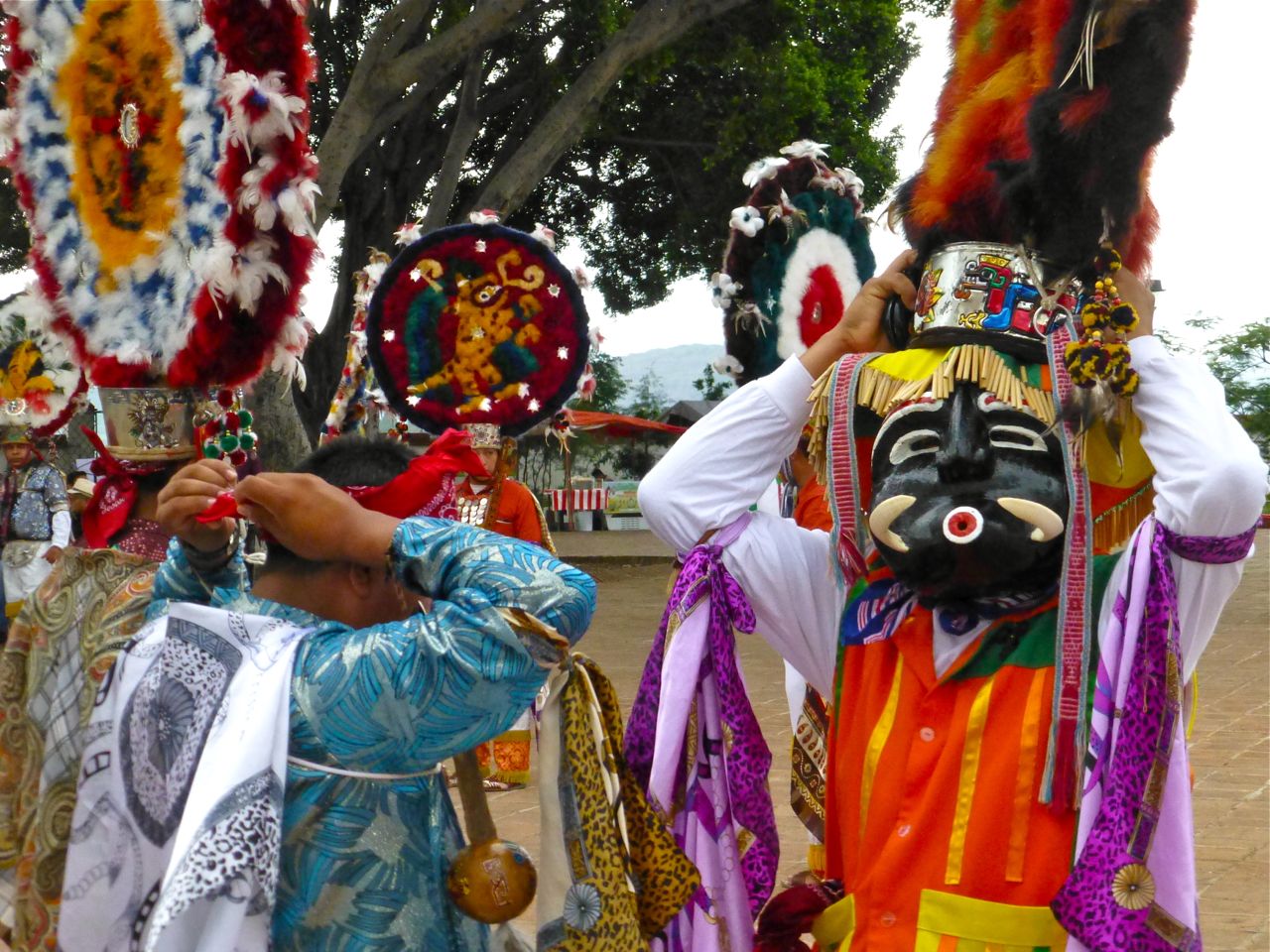
Subalterno trying on the Penacho of a Danzante

Subalterno trying on the Penacho of a Danzante

The subtext and “hidden” narratives of the danza are multiple and complex and after 5 years, I’m only in the infant stages of understanding.  I will leave it to the two scholarly articles listed below to attempt interpretation.

Danzantes with El Picacho in background

References:

Cohen, Jeffrey.  Danza de la Pluma:  Symbols of submission and separation in a Mexican Fiesta.  Anthropological Quarterly, Jul 93, Vol. 66 Issue 3, p. 149-158.

Harris, Max. The Return of Moctezuma.  The Drama Review, Sp 97, Vol. 41 Issue 1, p. 106, 29 p.

Read Full Post »

July in the valley of Oaxaca has begun!  There will be festivals of mole, mushrooms, cheeses, and tamales.  And, there will be the costumes, calendas, and music of Guelaguetza in the city and in several of the surrounding villages.  But first…

Subalterno with open arms

Under a dark and threatening sky, the people of Teotitlán del Valle began their week-long Fiesta titular a la Preciosa Sangre de Nuestro Señor Jesucristo (Festival to the Precious Blood of Our Lord Jesus Christ).  Wearing traditional embroidered blouses and wool skirts woven in this Zapotec village known for its weaving, the unmarried young women and girls gathered in front of the church (Templo de la Preciosa Sangre de Cristo) for the convite (procession) that kicks off Teotitlán’s most important fiesta of the year.

Young Zapotec women and girls in front of church

The rain held off and the procession left the confines of the church courtyard.

Marmotas and people leaving entry gate

Marmotas (giant cloth globes), music, and pyrotechnics led the way…

Banda marching down street

along with little boys holding canes of carrizo and poles topped with small marmotas, fluffy sheep, and airplanes (don’t ask me).

Little boy carrying small marmota

And then came the young women and girls, carrying canastas with images of the saints on their heads.  I have to note here, these baskets are REALLY heavy.  I know, because last year one of the gals asked if I’d like to try — I did for all of about five seconds.  They carry them for almost an hour!!!

Young women with carry canastas on their heads

Most of the residents came out to watch at prime viewing locations.  (Teenage boys were especially prominent, but they deserve another blog post.)

Men, women, and children standing on street

Under the watchful eye of El Picacho (the sacred mountain of Teotitlán), the procession wound its way up and down the cobblestone streets…

Procession in mid-ground and mountain in background

and eventually returned to the church courtyard, where it all began.

For more photos, including some of the pyrotechnic guys in action, check out Oaxaca-The Year After.

Read Full Post »

Here are some of the more colorful people in mine…

More from Friday’s walk up to Barrio Xochimilco.  Couldn’t help thinking of the Sesame Street song, Who Are the People In Your Neighborhood?

Read Full Post »

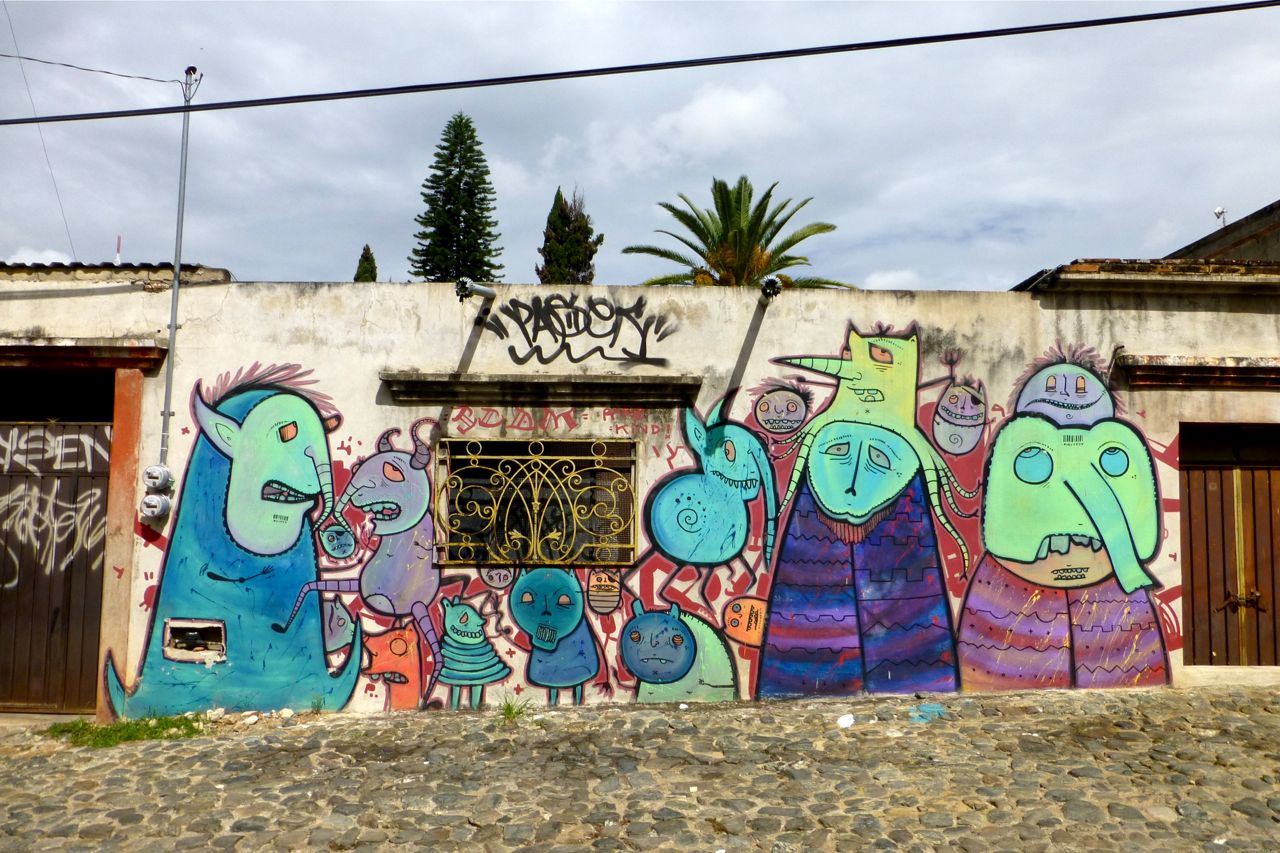
I felt like I was being watched, as I walked through Barrio Xochimilco this morning…

Mural of creatures painted by SCOM on wall

Stumbled upon, what could be, the stairway to heaven…

Outside stairs at Templo Santo Tomás Xochimilco

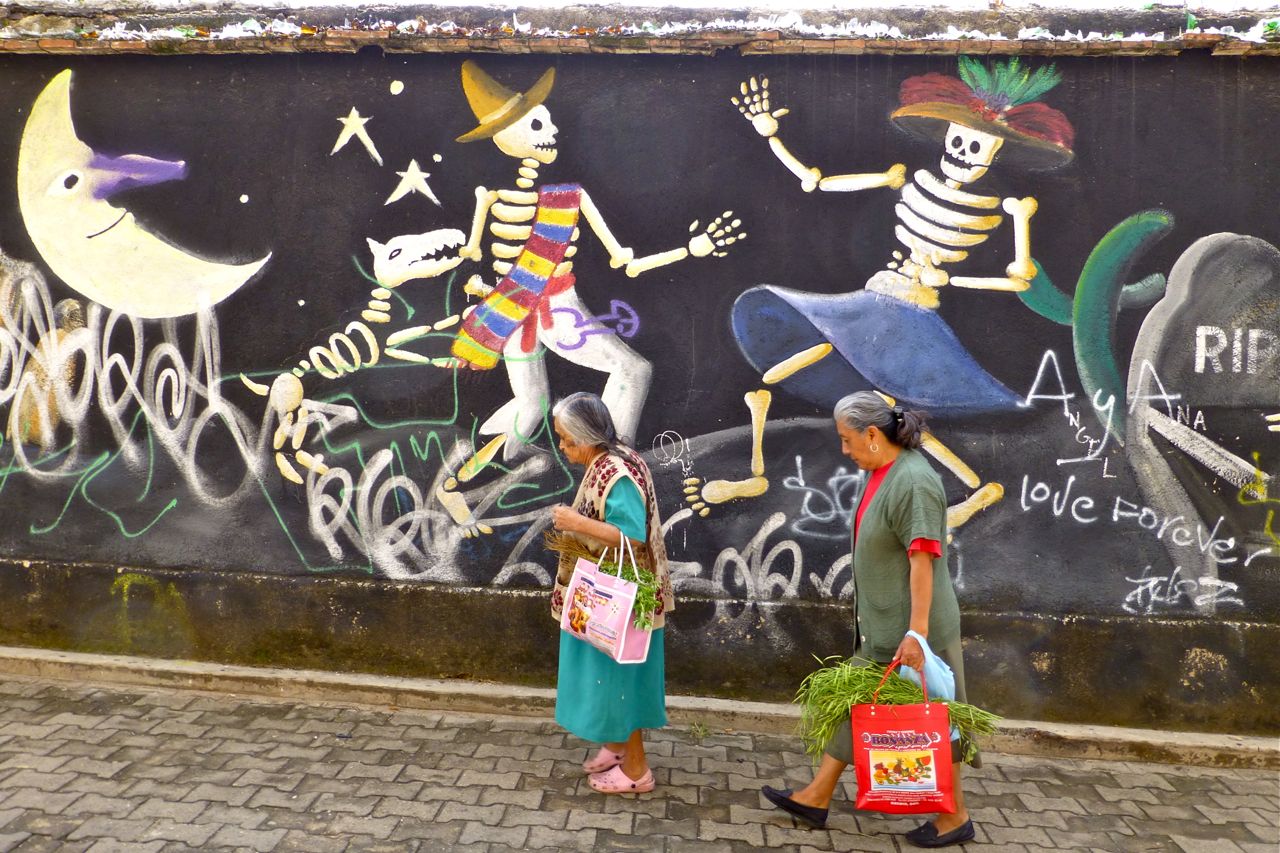
Just passing through…

2 women in front of mural with2 dancing skeletons

Aren’t we all?

Read Full Post »

The azucena is a variety of tuberose and its name is familiar in Oaxaca.  A popular boutique hotel near Casita Colibrí and  a well-known restaurant at the entrance to San Martín Tilcajete are both namesakes. This must be a special flower.  It is!  A few evenings ago, I went out onto the terrace to soak in the view, as lights came on in the city, and discovered azucenas blooming in an old planter box on the terrace wall.  Another night bloomer joins my pitahaya and night-blooming cereus.

Stalks of flowering azucenas

As Judy Sedbrook at Colorado State University, Cooperative Extension, explains, flowering plants on The Night Shift take over as the sun sets.  They are often white or light-colored, to better reflect the moonlight, and exhibit a heady scent, both in an effort to attract their night flying moth and bat pollinators.

2 azucenas flowers against dark sky

I love these sweet-smelling nighttime surprises!

Read Full Post »

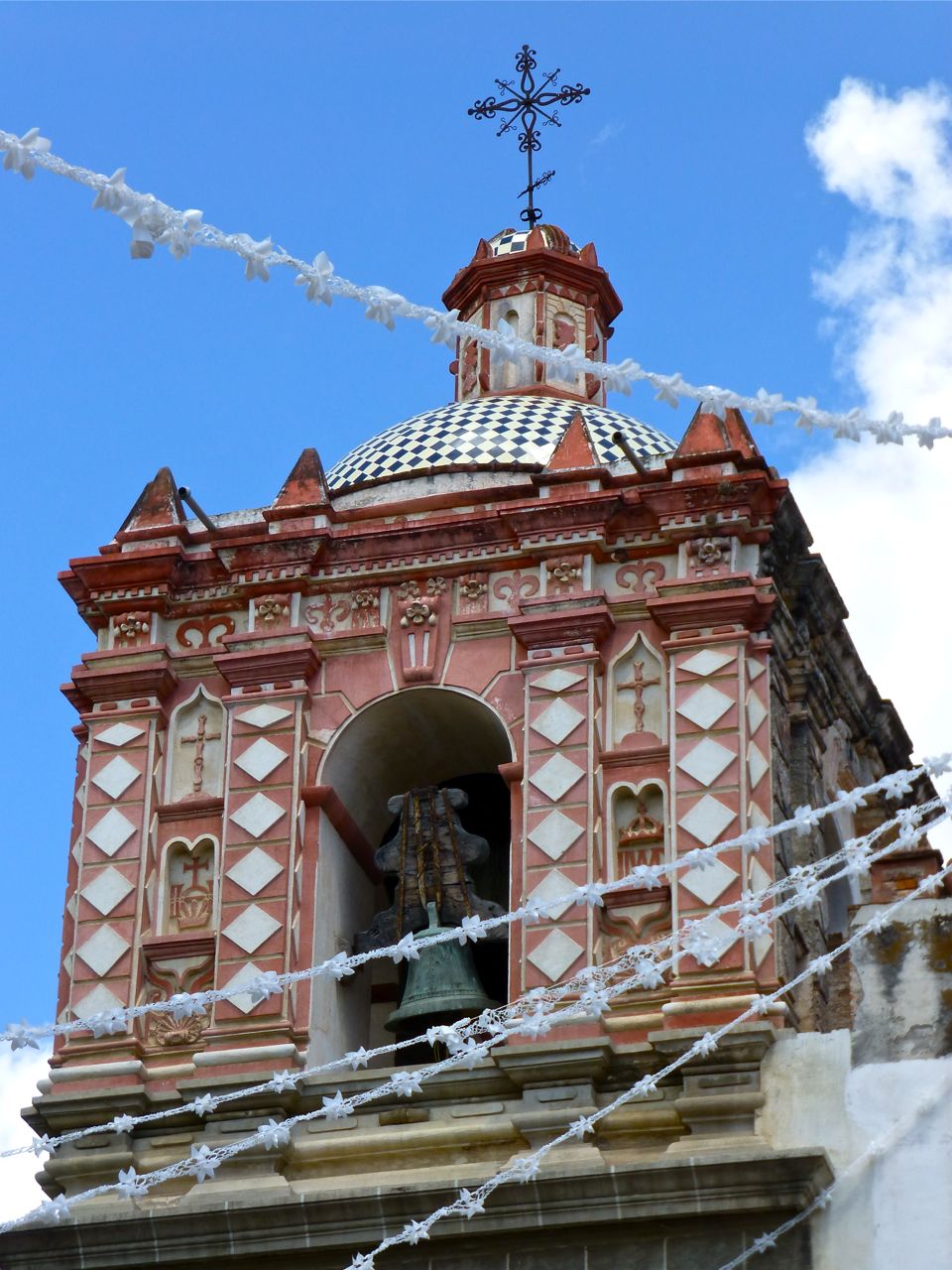
Awaking to the sounds of church bells chiming.  I must be back in Oaxaca.

Templo del Carmen Bajo, Oaxaca de Juárez, OAX

Templo del Carmen Bajo, Oaxaca de Juárez

Iglesia de la Asunción de Nuestra Señora, Tlacolula de Matamoros, OAX

Iglesia de la Asunción de Nuestra Señora, Tlacolula de Matamoros

Parroquia de San Juan de Dios, Oaxaca de Juárez, OAX

Parroquia de San Juan de Dios, Oaxaca de Juárez

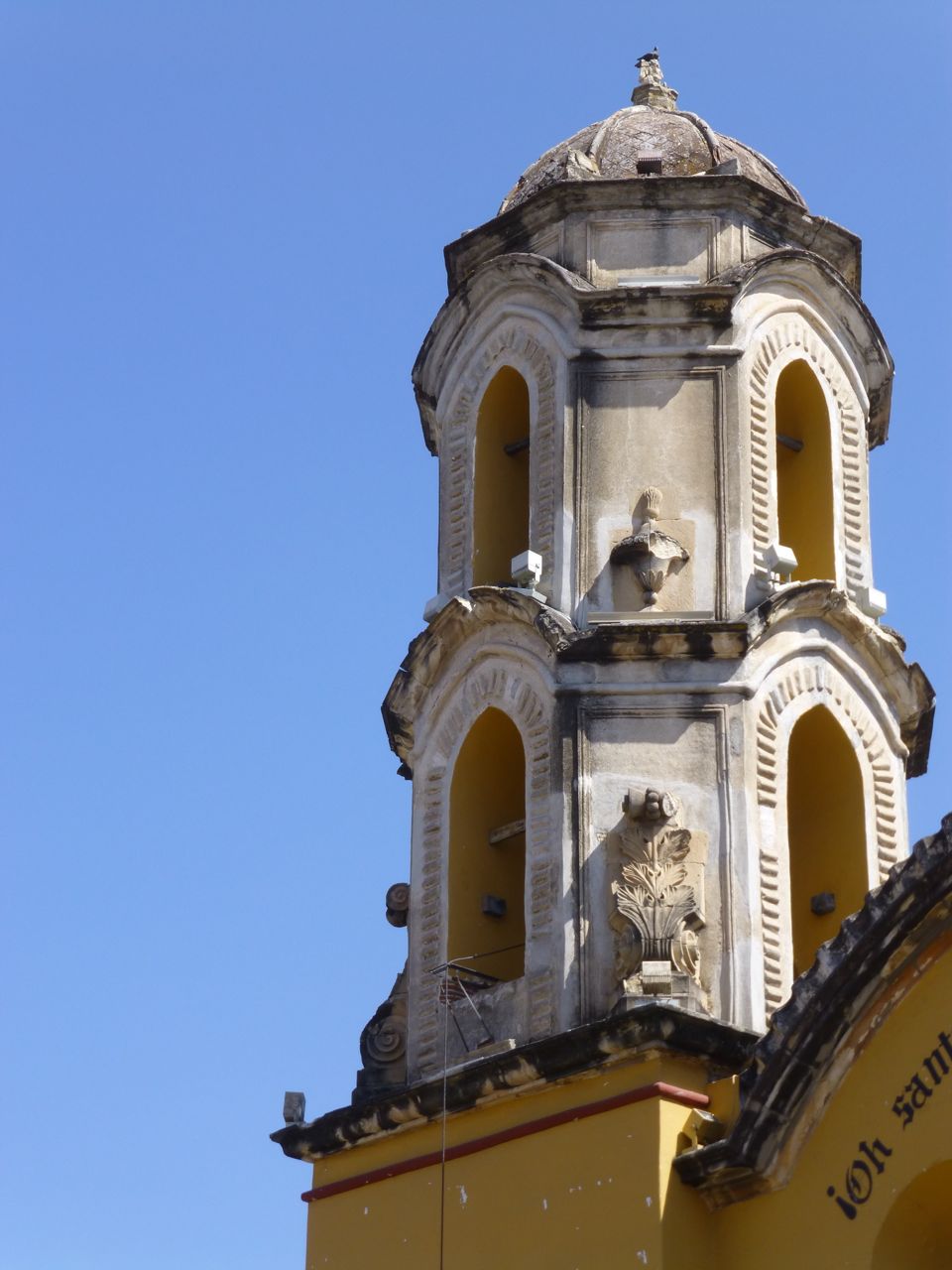
Church bell tower

Church somewhere between San Baltazar Chichicapam and Oaxaca de Juárez

Anyone know the name and location of this church?  I think maybe I should turn on my camera’s GPS!

And, just one more…

Templo de San Cosme y San Damian, Oaxaca de Juárez

Templo de San Cosme y San Damian, Oaxaca de Juárez

Read Full Post »

It’s been a great visit to Mill Valley, California, the town where I grew up and lived most of my life.   But, I’m ready to return to Oaxaca.  However, besides differences in latitude and attitude, there is much they have in common.

There are sculptures in public places (click on each to enlarge image)…

There are murals…

There are depictions of aquatic animals…

AND, there are signs reminding drivers to wait and take turns.  Remember my What’s easy??? post from last week?  Look what just went up in Mill Valley.  Discourteous drivers know no boundaries!

Rather than dwelling on the differences — which I did when I first began living this dual-country life — I now choose to appreciate the similarities.  Of course it doesn’t hurt that both places are situated in beautiful settings, fresh fruits and vegetables abound, have relatively mild climates, and an appreciation for the arts.

And so… I bid a fond “adiós” to Mill Valley and “hola” to Oaxaca.

Read Full Post »

What a game; three goals in 10 minutes in the second half!!!   Another thrilling win by El Tri advances Mexico to the next stage in World Cup 2014.  They struggled and needed a little help from their “friends” in el norte to even play in Brazil.  However, against all odds, this team exhibits a gutsy and tenacious heart and soul that can’t help but have people rooting for them — much like the country of Mexico, itself.

Mural under fútbol stadium in Oaxaca - Dec. 2012

Mural under fútbol stadium in Oaxaca – Dec. 2012

Francisco Goldman wrote an op-ed in yesterday’s New York Times.  His article, “Fooling Mexican Fans,” relates the current politics of Mexico, the “bread and circuses” diversion of the World Cup, and the notion that El Tri might exemplify all that is inspiring and hopeful in the Mexican national character.

Goldman’s op-ed begins…

The day before the Mexican soccer team’s thrilling underdog tie with the World Cup favorite, Brazil, last week, the lead editorial of the news site SinEmbargo was titled, “Ready for your Clamato and Gatorade?” — common hangover remedies. “In about three weeks, when you wake from your World Cup dreams,” the editors wrote, “remember that when the soccer fest began, the country was on the verge of monumental decisions. If upon waking, you realize that the country’s energy reserves have been cheaply sold off or whatever else, don’t bother protesting because this is a chronicle foretold.”

To debate and pass laws that could open Pemex, the nationalized oil company, to foreign investment, the Mexican Congress scheduled legislative sessions from June 10 to 23, dates precisely coinciding with you know what. Final passage might be pushed back, but it originally looked like it was supposed to happen on Monday, when Mexico plays Croatia to decide which country advances to the elimination rounds.

As I wrote previously, Mexicans have been Expressing the outrage since last year, when Mexico’s newly elected president Enrique Peña Nieto (initials EPN), from the PRI party, first made the Pemex energy “reform” proposal.
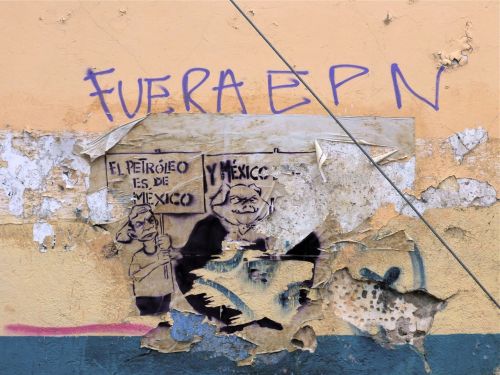
Graffiti seen on a wall south of Oaxaca's zócalo, May 23, 2014.

Graffiti seen on a wall south of Oaxaca’s zócalo, May 23, 2014. 

Goldman goes on to discuss this and other “reforms,” the role of the PRI, and the current overall political climate in Mexico.  However, as dismal as it all sounds, he ends on a hopeful note…

There has been much talk lately about the way the style of soccer teams manifests national characters. I don’t know if that’s true. But when I look at the Mexican team which, after barely even qualifying for the World Cup, has been playing so well, I see a team without stars — a gritty, hard-working, pretty humble, resourceful, creative, disciplined, joyous, friendly-seeming group of players who seem to be learning to play the game as it is meant to be played.

These are values that we see enacted and re-enacted all over Mexico, and in Mexican communities elsewhere, every day. Someday Mexico will get another chance to vote the PRI away and to restart the long process of building the country from the ground up. It could do worse than take some inspiration from its national team.

Absolutely, those are the values I, too, see exhibited in Mexican communities both in Mexico and the US.  There is hope for the future — and not just on the pitch!   I encourage you to read Goldman’s op-ed in full.  In the meantime, Mexico vs. Netherlands on Sunday at Estadio Castelao Forteleza.  ¡¡¡ VAMOS EL TRI !!!

h/t K Hackbarth for the article

Read Full Post »

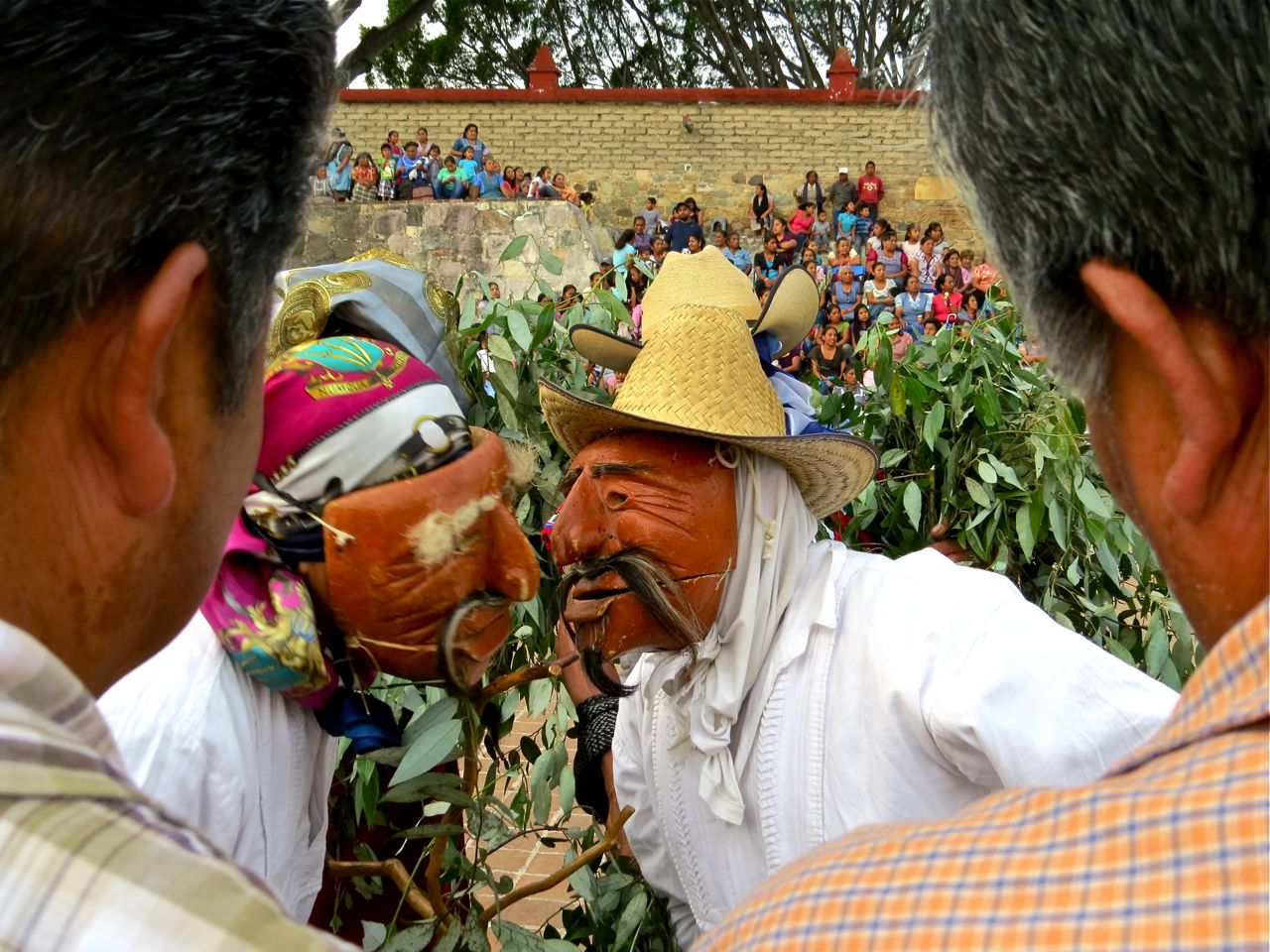
2 viejitos, nose to nose

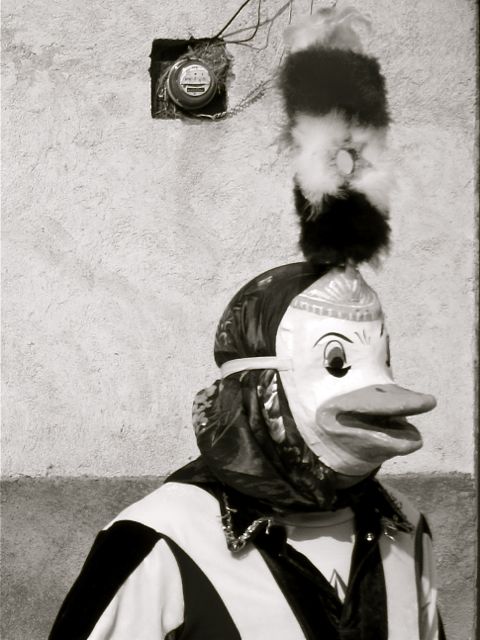
Tête-à-tête between Viejitos (I know, I’m mixing languages), seen between the shoulders of two municipal leaders, on the Municipal Plaza in Teotitlán del Valle during this year’s previously mentioned Carnaval.

Read Full Post »

One by one…

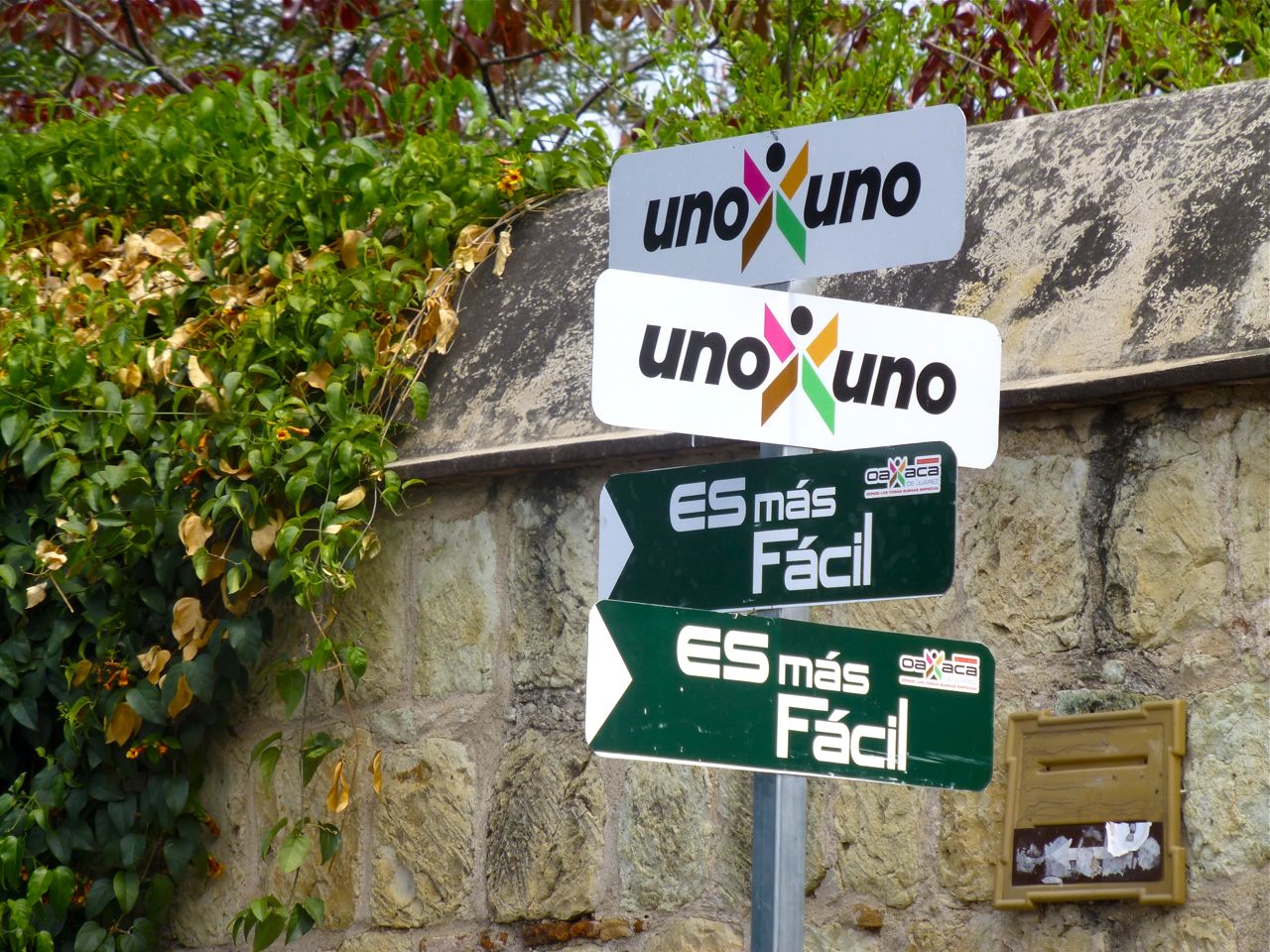
Street signs: uno x uno; es más fácil.

These signs cropped up last month on a number of streets in Oaxaca.  I saw this one on Calle Berriozábal near the Alcalá.  But, I’m confused…  What’s easy???  Certainly not dealing with the health insurance industry in the US.  I am SO ready to return to Oaxaca!

Read Full Post »

To all the loving fathers out there…

This slideshow requires JavaScript.

A very happy Father’s Day!

Read Full Post »
True confession:  I’m not in Oaxaca!  I arrived in the San Francisco Bay Area a week ago for a 3-week visit.  While I love seeing family, friends, “my” mountain (Mt. Tamalpais), and the Pacific Ocean, it also means bone-chilling summer fog, driving instead of walking most everywhere, and the absence of my regular blog fodder — no calendas, ferias, festivals, saints days, bandas, and urban art.  (Though, I will probably head to San Francisco for the latter!)

However, this break-in-the-action gives me time to look back through thousands of photos and create posts that had been put on the back-burner when something bigger, better, or more timely cropped up.

3 viejitos

So, here we go, back to Friday, April 24, 2014 — the last of five days of Carnaval in Teotitlán del Valle.

Chihuahua

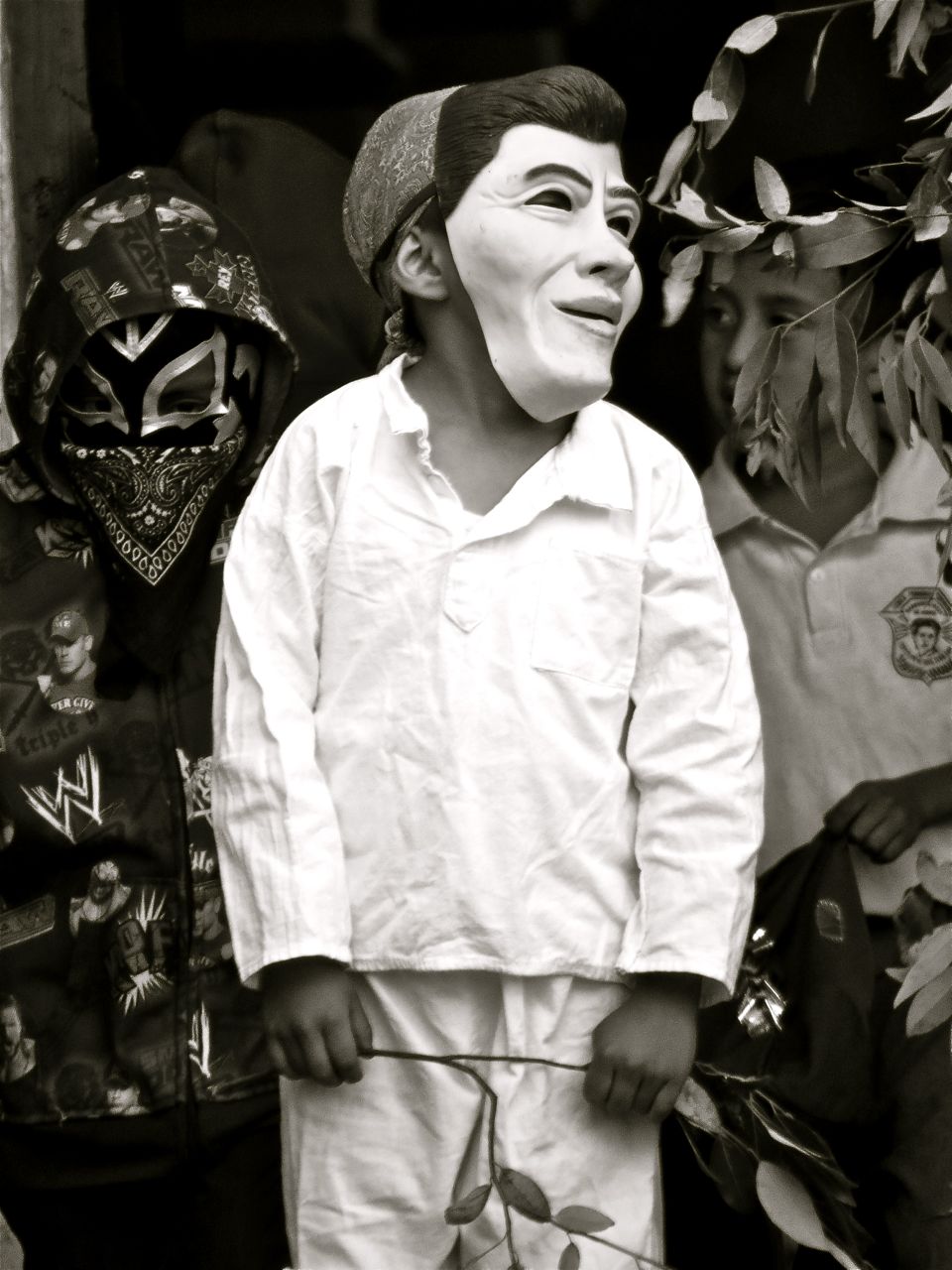
While there are masks, costumes, men dressed as women, and merriment, this is not your Christian pre-Lenten Fat Tuesday/Mardi Gras Carnival.

Man wearing female mask, wig, and clothing

This is a pre-Hispanic celebration that happens the Monday through Friday after Easter, not before Lent.

Close-up of viejito

Via El Baile de Los Viejitos (the Dance of the Old Men), it brings the community and elected leadership together to remind each of their social contract — in an extremely humorous way.

Young viejito

A procession, gathering participants along the way, leads to the Municipal Plaza, where it seems as if the entire village assembles.

2 elderly women watching Dance of the Old Men

And, of course, the dance and ritual continue late into the night…

Read Full Post »
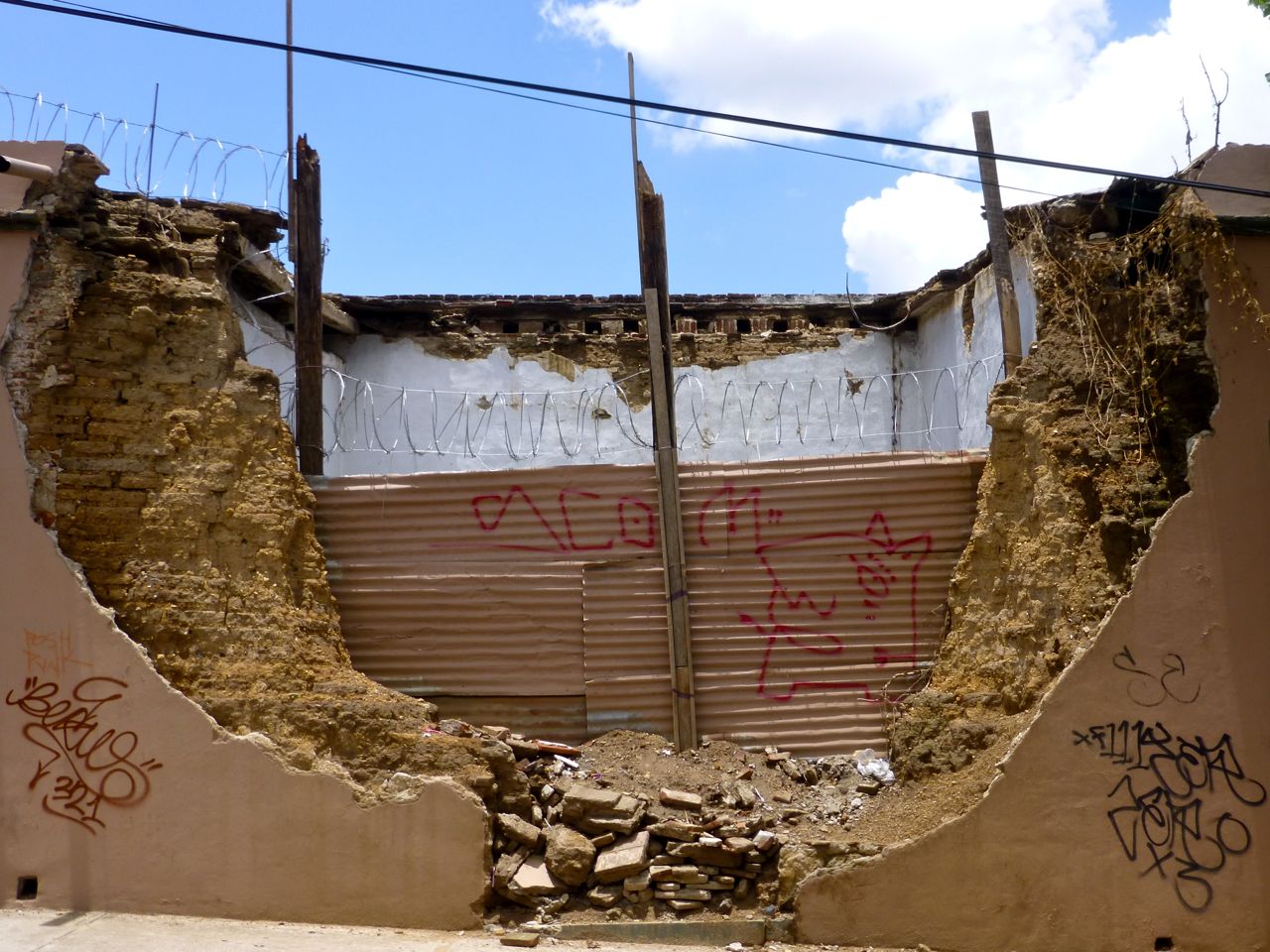
The “buildings in a bad state” in Oaxaca continue to multiply.

crumbling adobe wall with sign "precaución! inmueble en mal estado"

Where some see unsightly decay, others see opportunity…

Crumbling adoble & brick wall with graffiti, "This is a good spot"

including urban artist, SCOM.

Crumbling adobe wall with graffiti creature by SCOM

Read Full Post »

Several mornings ago, after a day and night of rain, I went out on the terrace to check on the garden and found…

Pitaya flower with rain drops

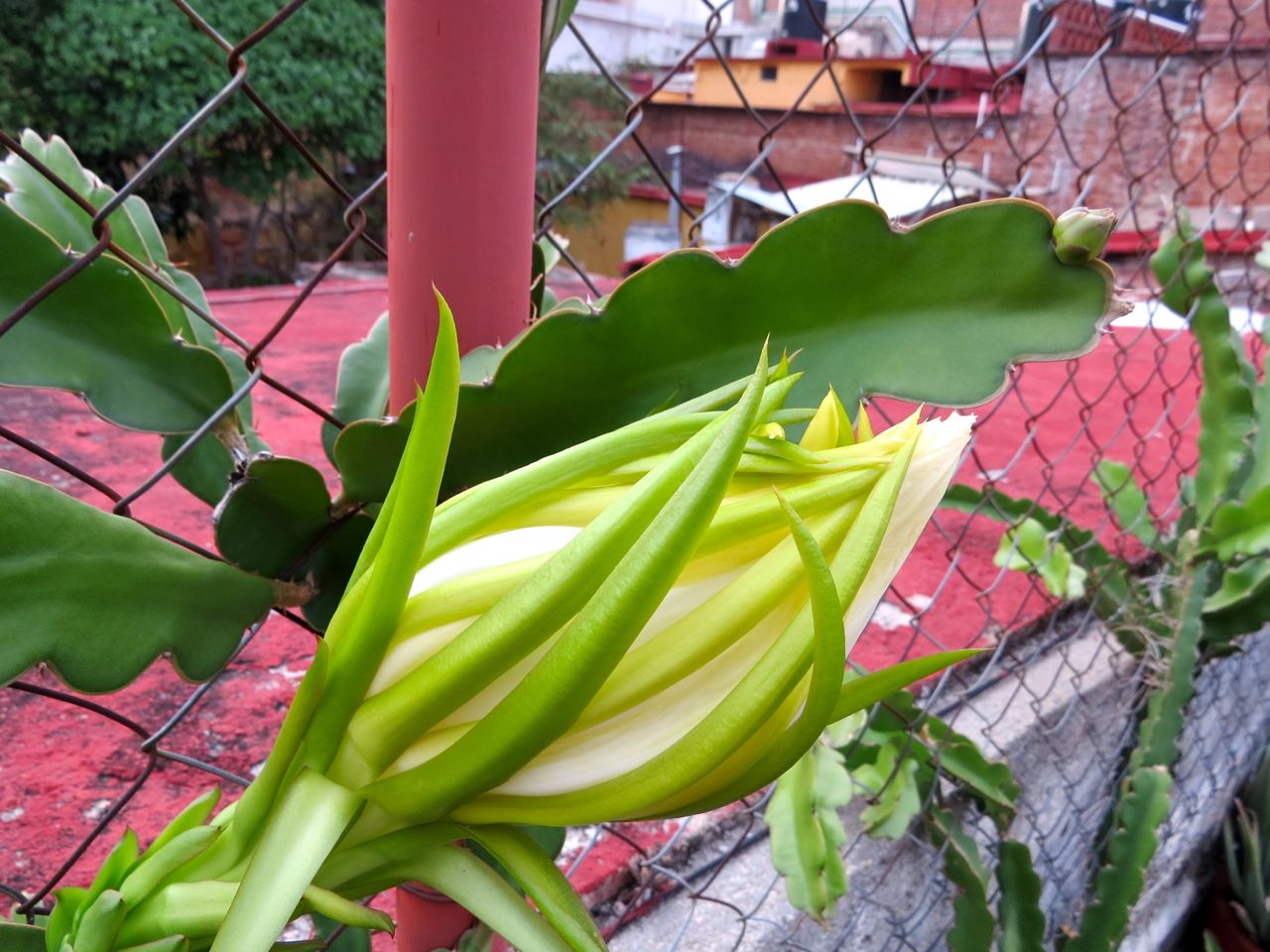
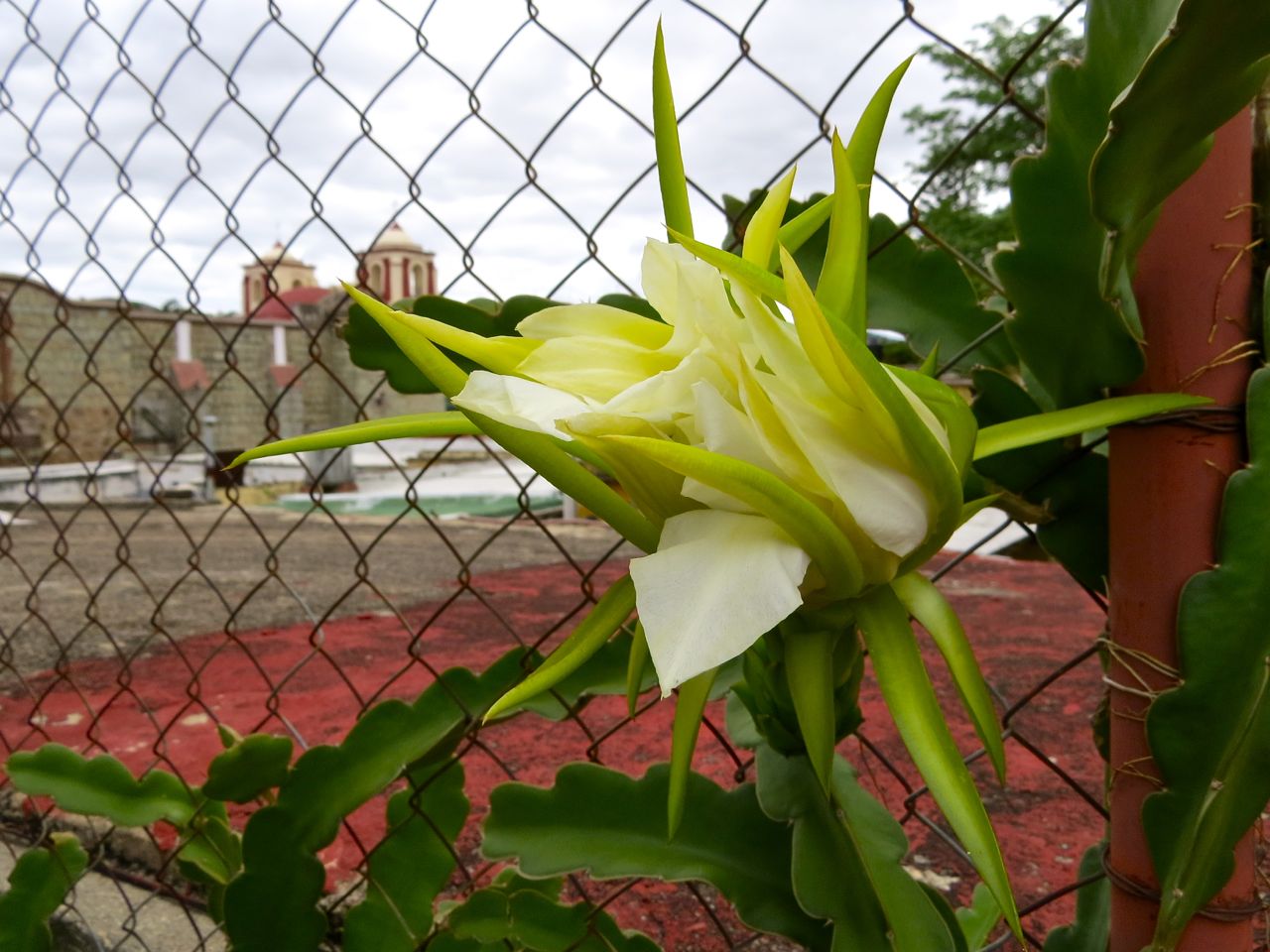
Yikes, one of my Pitahaya (Hylocereus undatus – aka, Dragon fruit) had bloomed overnight!  Must be a relative of my other Night Blooming Cereus.

Two years ago, the original cuttings had been laying in the campo of a friend in San Martín Tilcajete.  When Chris (Oaxaca-The Year After) asked if we could have some, the answer was, “¡Por supuesto!”  Loving the wall of Pitahaya at Centro Académico y Cultural San Pablo, six months later, with the original five cuttings becoming fifteen, I could use them to begin to screen the chain link fence at the new Casita Colibrí.  I kept pruning and sticking them in the planter boxes.

Pitahaya climbing chain link fence

June 2, 2014, 8:40 AM

And now, they have begun blooming.  Having missed the “night-blooming” of my first flower, I was determined not to miss the unfolding of the second blossom, seen above near the top of the pole, providing the weather cooperated.  It did!

Pitahaya blossom

June 2, 2014, 7:20 PM

Pitahaya flower

June 2, 2014, 8:40 PM

Pitahaya flower, side view

June 2, 2014, 11:00 PM

By the next day, it had closed, never to reopen again.

Pitahaya flower closed

June 2, 2014, 2:54 PM

However, there will be fruit…

Read Full Post »

The rainy season has definitely arrived in the city, bringing several hours of lluvia every night for the past five nights.  The first rains of the season also bring (drum roll, please) chicatanas!  Early this morning, I went out onto the terrace with my coffee to be greeted with these not-so-little insects.  Flying (into my hair, eeek!) and crawling all over the place!

Female chicatana on blue oilcloth

Female chicatana on a very wet table.

What, you may ask are chicatanas?  They are giant flying ants that emerge with the first rains of the season — and by giant, I mean about 4 cm from the head to the tip of the wings for the females.  (As in much of the insect world, males are smaller and wingless.)

Male chicatana on wood deck

Male chicatana on the deck.

This occurs early one morning each year and lasts only a few hours.  My first experience with them was a couple of years ago, when I arrived at Oaxaca’s airport for my 8:30 AM flight one May morning, to find, yikes(!) an infestation of insects.  I had no idea what they were, but nobody seemed to mind, and kids were running around collecting them.  The answer came after I boarded the plane and began talking with a Oaxaqueña across the aisle.  She explained that the arrival of the chicatanas was a much-anticipated event because they are a delicacy.  As the video below documents, they are soaked, cleaned, toasted on a comal, ground, seasoned, and made into a salsa.

According to this post in a Chicago based culinary chat site, it has been almost “500 years since Bernardino de Sahagun reported to Europe on the tzicatana [chicatana in Nahuatl] in his Nueva Historia, from its divine associations to its swarm ethology (mirroring the movements of the Aztecan armies) to its apparent deliciousness to the Nahuan-speaking people in the region.”  And, long before that, tzicatanas were mentioned in the Florentine Codex.

Female chicatana on her back

Female chicatana doing the back stroke on the table.

By 9:30 this morning, they were gone.  However, should you find yourself in Oaxaca during a brief visit by the chicatanas, here is a recipe for Chicatana Salsa.

Read Full Post »
« Newer Posts - Older Posts »