Feeds:
Posts
Comments

Archive for the ‘Religion’ Category

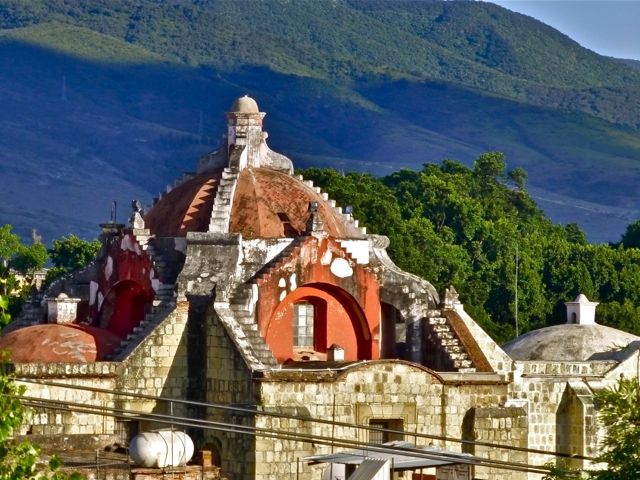
Yesterday, standing on the terrace, playing with the zoom on my new camera.  Looking southeast, as the sun was about to disappear behind the sierras to the west.

Terracotta dome of San Felipe Neri

Templo de San Felipe Neri, a couple of blocks from Casita Colibrí.

Two yellow domes of Templo San Francisco

Templo de San Francisco, about twelve blocks away.  Going to keep working on it, but liking my little Lumix!

h/t  Chris

Read Full Post »

It’s that time of year, again.  Daylight doesn’t last quite as long, the large red-orange blossoms of the African tulip trees have mostly fallen (onto my terrace!), and the hummingbirds have mostly departed, leaving the airspace to the dragonflies and butterflies.
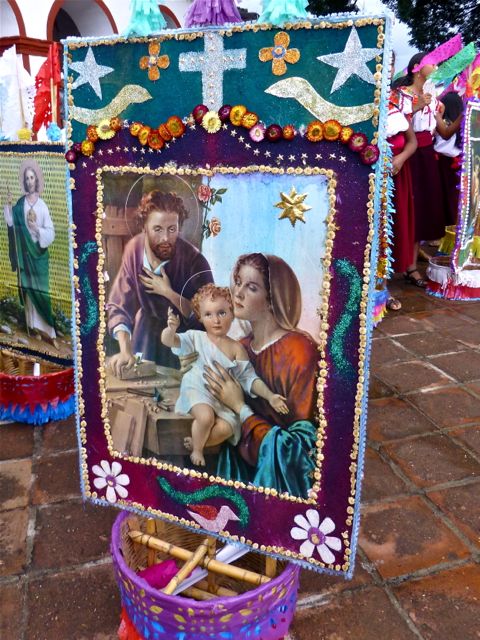
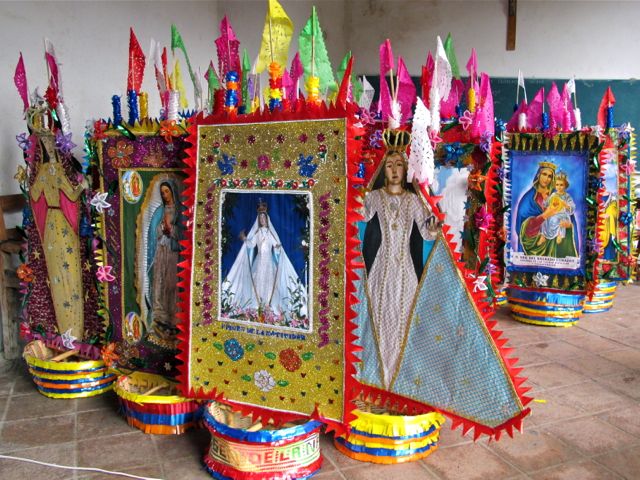
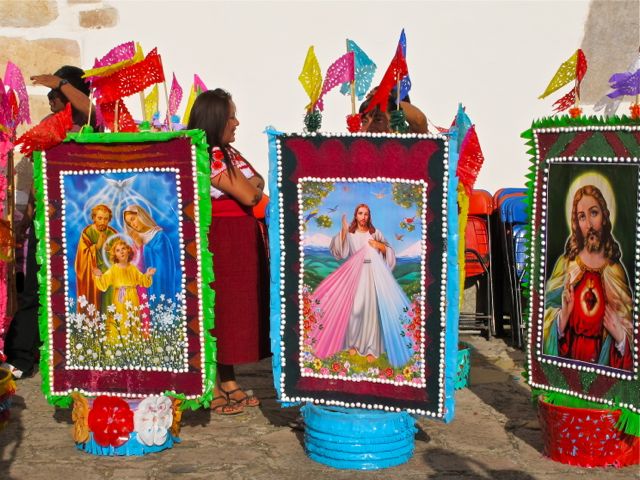
Decorated canasta with religious scene.

However, the season of yellow marigolds (cempazuchitl) and the yellows, oranges, and purples of flor inmortal (immortal flower) has begun and that means Días de los Muertos and Noche de Rabanos  can’t be far behind.

Decorated canasta with image of Virgin Mary.

In the meantime, during the past week, Teotitlán del Valle celebrated La Santísima Virgen del Rosario and early Friday evening, the unmarried girls and women gathered with their canastas for the traditional convite (holy procession).
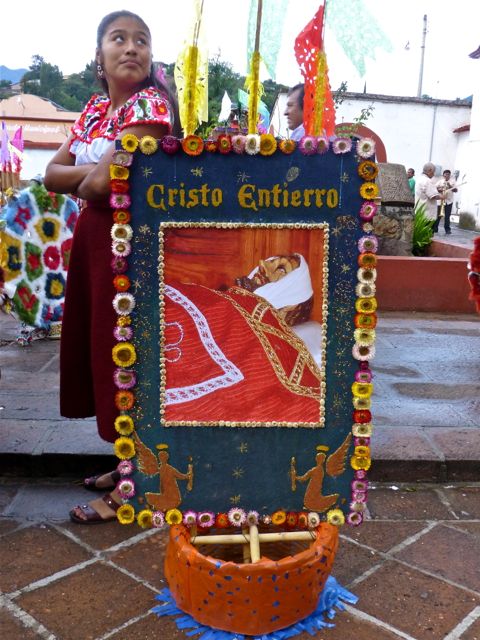
Decorated canasta with image of bandaged head of Jesus.

And, given the season, flor inmortal played a prominent role in the decorations of many of the canastas.Flor inmortal surround a crucifixion scene on a canasta.

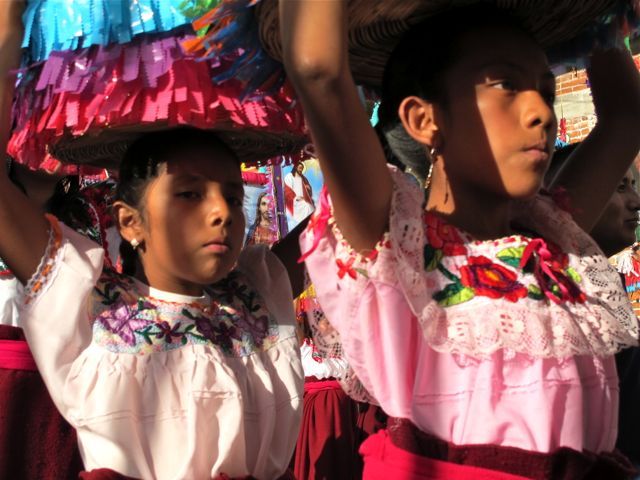
And, as always, I’m amazed and captivated by the girls and women who, with arms raised, balance these sizable baskets on their head, as they navigate the sacred route along the cobbled (and, this day, rain-slicked) streets of Teotitlán del Valle — for almost an hour!Young women wearing dark red wool wrap skirts and embroidered white blouses, carry large canastas on their heads
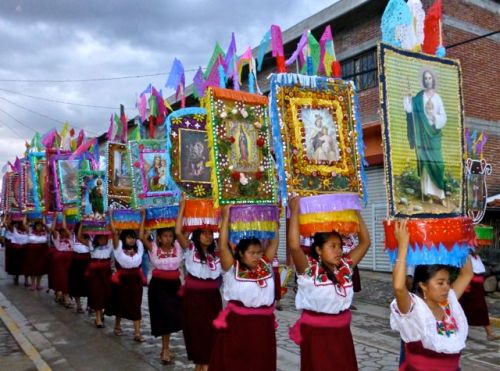
It’s a scene that I never tire of — of course, I’m not carrying a canasta on my head!

More photos and commentary over at Oaxaca-The Year After.

Read Full Post »
Waiting for the convite… Fiesta a la Natividad de la Virgen María.

Cloudy sky; young girl surrounded by plastic covered canastas; Cerro Picacho in background.

September 8 was a rainy day in Teotitlán del Valle.

Read Full Post »

… and fish and turtles and ducks.  On August 31, as the rain fell, all of the above and more, assembled at Templo de Nuestra Señora de la Merced for the annual Bendición de los Animales.  Animals and their human keepers were there to celebrate the feast day of San Ramón de Nonato, patron saint of women in labor, persons falsely accused, and keeper of animals.

There were some familiar faces, both human and animal, from last year’s blessing.  However, this year the dogs were extremely vocal and, on occasion, tested the strength of the human at the other end of their leash — perhaps it was in anticipation of the evening’s “blue moon” or maybe being restrained and made to just sit or stand in the rain made them grouchy.

This slideshow requires JavaScript.

This morning’s article in Noticias covering the blessing, led off  with this quote from Benito Juárez García:

La protección de los animales forma parte esencial de la moral y de la cultura de los pueblos civilizados.  (The protection of animals is an essential part of morality and culture of civilized people.)

For more on this year’s Blessing of the Animals, head over to Oaxaca-The Year After.

Read Full Post »

The convite (covered in the Uplifting post) is only one of the traditions of the patronal festival of La Preciosa Sangre de Cristo.  During the five days of the celebration, the church is filled with floral arrangements and believers stream in and out clutching flowers; the Danza de la Pluma (with Moctezuma, Cortez, Malinche, Doña Marina, danzantes, and soldados) is performed several times; and the cargo holders of the community preside, are honored, and presented with fresh fruits, vegetables, sacred herbs, and beverages.

This slideshow requires JavaScript.

Sunday was another amazing day in Teotitlán del Valle.  And I haven’t even mentioned the tacos and tamales we devoured during our three visits this past week!

Read Full Post »

Late yesterday afternoon, we returned to Teotitlán del Valle for the convite (parade) of unmarried young women and girls, a part of the annual patronal festival of La Preciosa Sangre de Cristo.  The sun was shining, the rains of two days before were nowhere to be seen, and the sacred mountain, El Picacho, gracefully, but commandingly, presided as the soldados and danzantes entered the church courtyard.

Soldados and danzantes with the mountain in the background

Bands also arrived to take part…

Band with tuba in front; mountain in background

Canastas (baskets) were lined up, ready to be carried…

Canastas with images of the Virgen Mary lined up.

3 canastas with images of Jesus

Canasta with Virgen de la Navidad woven into the design

The young men of the village gathered…

Young men sitting on a ledge

Young men in profile

Family and friends awaited…

Women standing and facing down the street

And then the young unmarried women and girls, the stars of the evening, raised the canastas over their heads…

Young women and girls in red skirts and white blusas carrying canastas on their heads lined up and

3 young women carrying canastas on their heads

Close-up of 2 young women carrying canastas on their heads

Balancing the canastas, they processed from the courtyard, down several long and cobblestone blocks, turned left, and headed back up another street to where they had begun, to be greeted by proud family and friends, who had gathered to acknowledge and celebrate the young women and girls of Teotitlán del Valle.

For some inexplicable reason, we never cease to feel moved and uplifted by this ritual.

Read Full Post »


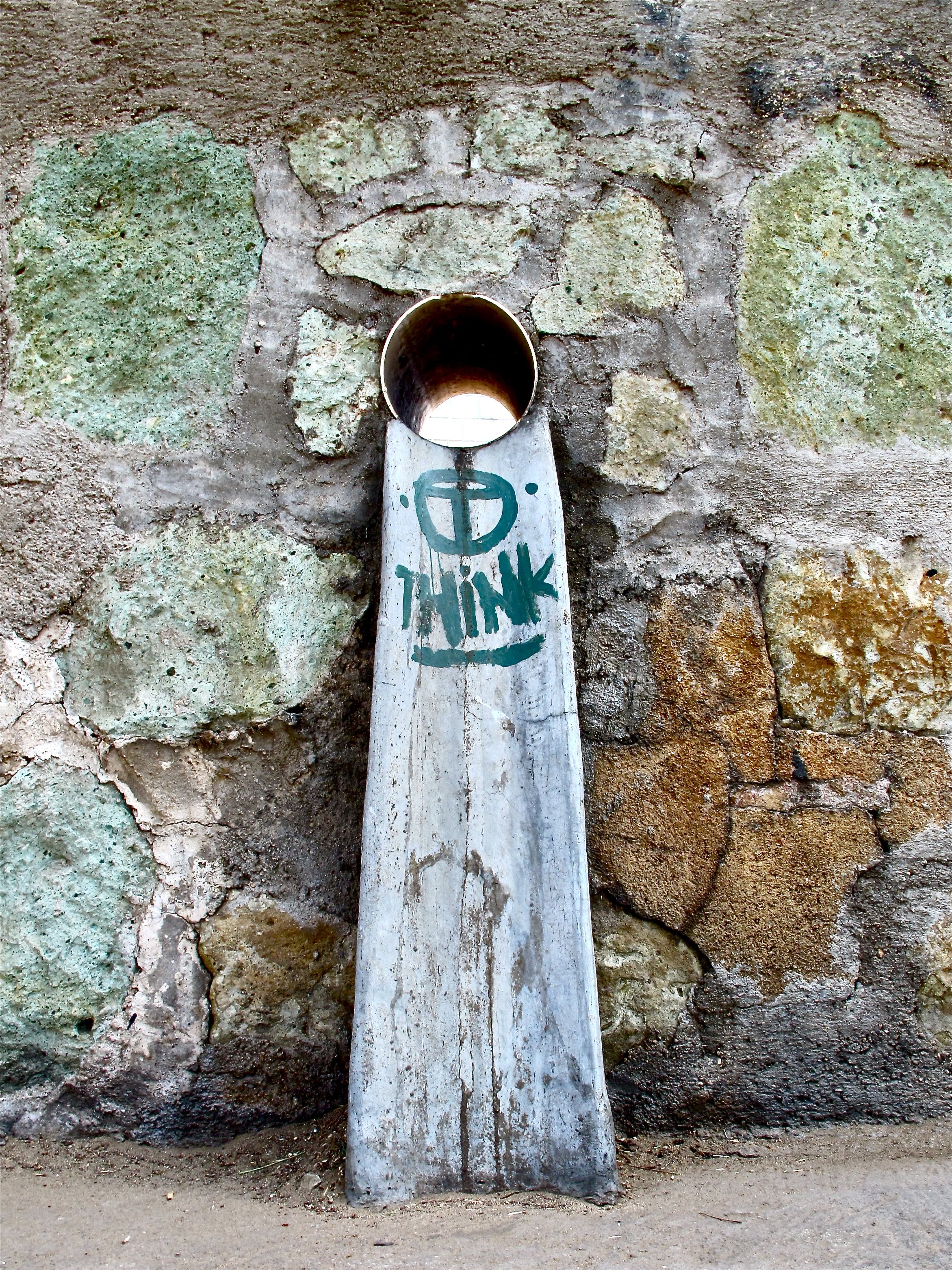
Concrete trough, coming out from stone wall. On the trough: an encircled cross with the word "Think" written under the cross.

Read Full Post »

It’s been a week since the end of Semana Santa and I’m still sorting through photos and videos and reflecting on impressions and feelings.  However, I’m finding that, with too much thinking, the experience slips through the fingers and the magic vanishes.

Thus, I give you the night of Pascuas (Easter) at Carmen Alto…

And then, the hisses, bangs, and brilliant explosions of a castillo…

Flaming castillo

brought Semana Santa to a spectacular close.

Read Full Post »

The back of the official 26th anniversary t-shirt for the Good Friday, Procesión del Silencio, doesn’t come close to telling the tale.

Back of T-shirt: Face of Jesus; text "1986 Procesion del silencio 2012"

Images of belief add texture to the ritual procession of mourners grieving the crucifixion and death of Jesus, as related in the New Testament of the Christian Bible.

Close up of a bleeding Jesus head and torso on a cross

But it’s the eyes of believers…

purple hooded face with only eyes showing

that gives the narrative a silent voice.

Virgin Mary statue with halo from shoulders up.

And, grieving mothers everywhere understand.

Profile of a woman wearing black veil and glasses.

No matter where one lands on the belief continuum, it’s hard not to be moved.

(ps)  For lots more terrific photos, take a look at Chris’s posting, The Procession of Silence.

Read Full Post »

Today is Thanksgiving in los Estados Unidos de América… and besides my wonderful family and friends, I am so grateful to see and experience places like San Antonino Castillo Velasco during los Días de Muertos.

This slideshow requires JavaScript.

¡Feliz Acción de Gracias a todos!

Read Full Post »

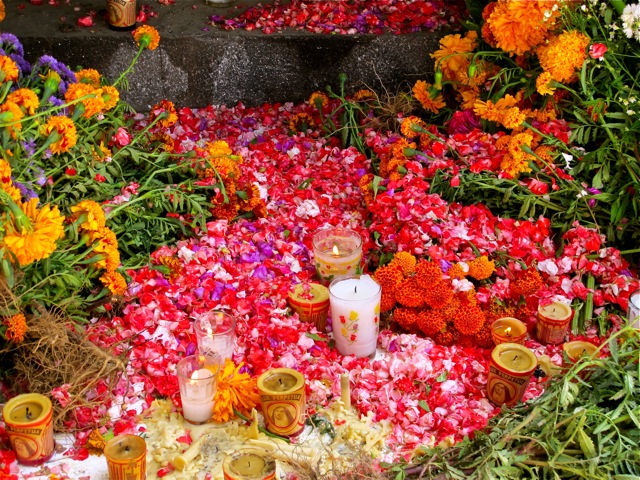
San Antonino Castillo Velasco, a Zapotec community near Ocotlán, is a village known for its flowers.  They are, no doubt, the inspiration for beautifully embroidered linens and clothing sold in the mercados and found in museum collections.  And, a specialty is the “flor inmortal” (immortal flower), so named because, even when dried, it retains its brilliant colors.  They are used to create intricately designed figures on display December 23 in the city of Oaxaca, during Noche de Rábanos and to decorate the graves of  loved ones during Días de Muertos in San Antonino.

This slideshow requires JavaScript.

As I’ve previously mentioned, each village seems to have its own unique traditions for the Days of the Dead.  Villagers here mix the area’s very fine dirt with water, cover the graves, use a trowel to smooth it, outline designs and religious imagery into the dried coating, and then use flowers (fresh and dried), to paint the scene.  Entire families are involved, young and old, and the atmosphere is filled with joy, purpose, and most of all… Love.

For a very special moment, that is a metaphor the two days spent at San Antonino, see Chris’s post, Moments make a life..

Read Full Post »

On the road during los Días de muertos led us to Santiago Apóstol in the municipality of Ocotlán de Morelos…

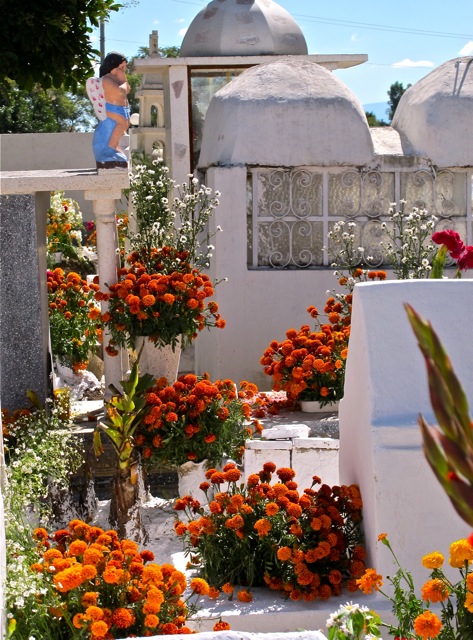
Profusion of flowers against whitewashed graves

Entering their Panteón, the play of light and shadow and explosion of greens, reds, oranges, yellows, and magentas against whitewashed graves was stunning.

Multicolored flowers surrounding whitewashed tomb

Unique artistry was evident in each of the cemeteries we visited.

Multicolored flowers surrounding a grave

One of the special and fragrant features here was the rose petals scattered atop graves.

Pink and red rose petals covering a grave

Have I mentioned…  No matter where one seems to go in Oaxaca, the senses are filled!

Over view of whitewashed graves and the profusion of flowers

More to come…

Read Full Post »
Pan de muerto is the traditional Days of the Dead sweet yeast bread.  It is decorated and placed on ofrendas (altars), along with candles, flowers, fruit, pictures, mementos, other foodstuffs, and beverages, as offerings to the departed.

This slideshow requires JavaScript.

The intricately decorated pan de muerto are from the Tlacolula Valley, and reference the geometric designs and mosaic fretwork found in the archeological sites in and around Mitla, a photo of which I’m using as browser background on this blog.

Read Full Post »

Decorations have begun going up around town and, at this time of year, La Olla offers the complete dining experience…

Skeleton in pink skirt and feather boa seated on a bench

A warm welcome from the hostess.

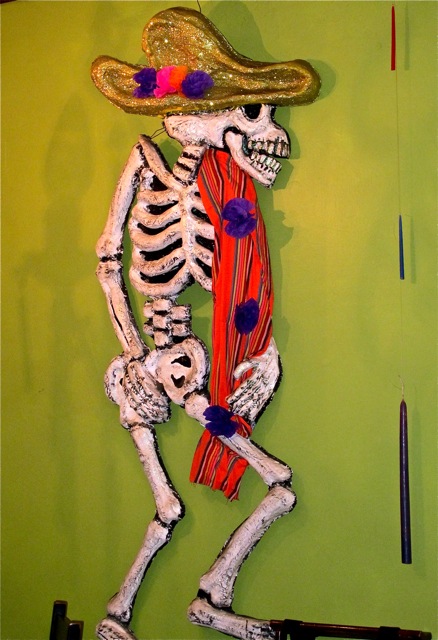
Skeleton with sombrero hanging on wall.

Waiters standing ready to take your order.

Day-glo orange butterfly skeleton hanging in a tree.

And, una mariposa hanging out, ready to wish you “¡buen provecho!”

Read Full Post »
Sunday, in the Plazuela de Carmen Alto, celebrations honoring the Christ of Esquipulas (Black Christ) were in full swing. I was awakened at 6 AM to the sound of fuegos artificiales (fireworks) and eventually drifted off to sleep after 11:30 PM, as fireworks’ explosions resumed.

Festivities lasted all day and I couldn’t resist heading up to the church courtyard to see what was happening.

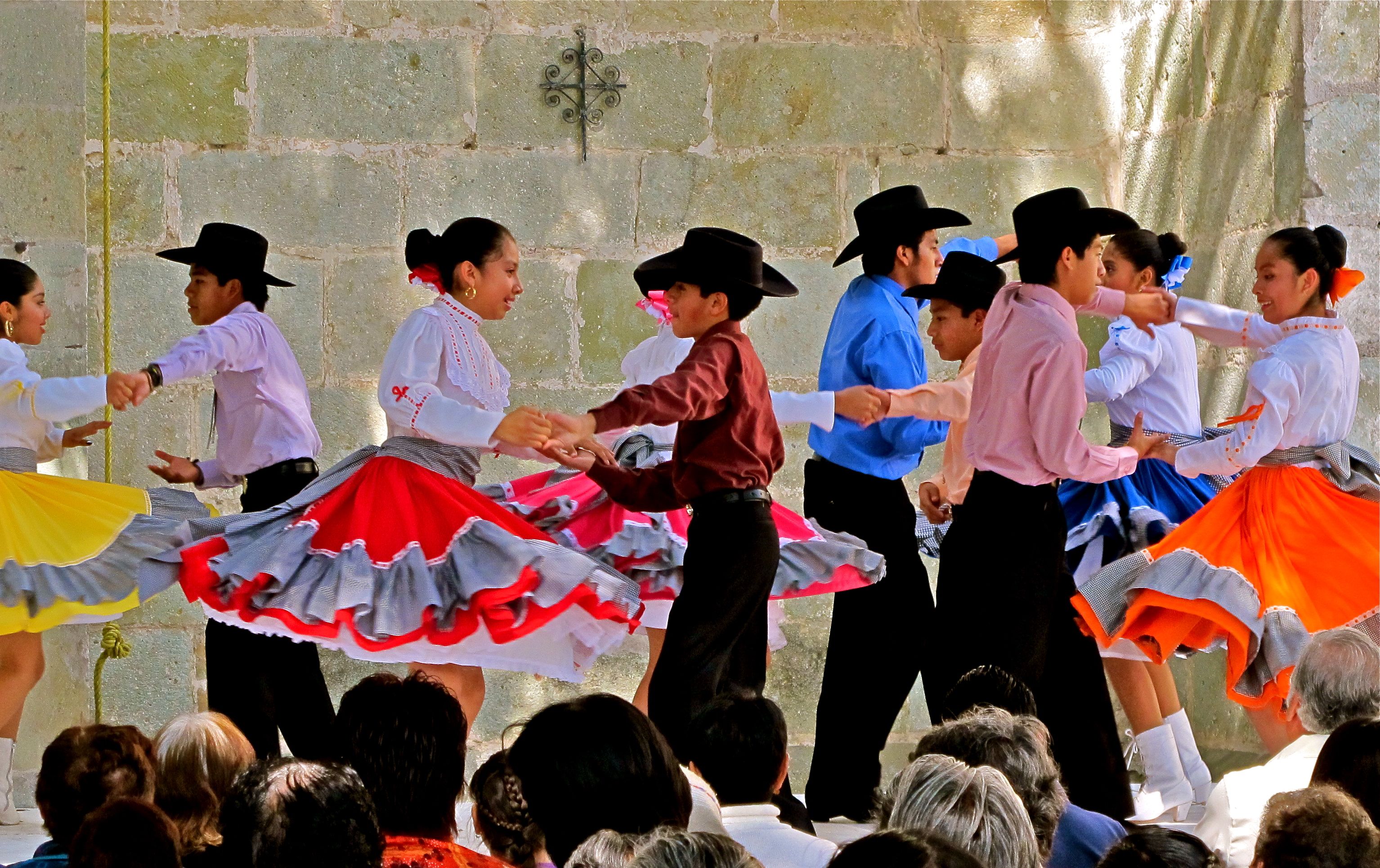
When I arrived, seats in the shade were filled and a small crowd was gathered behind a barricade; a castillo, laying on its side in three parts, was being constructed; a teenage Oaxacan brass band, with the requisite tuba towering over the other instruments and their players, was waiting to play; and young dancers were performing with a combination of earnestness and joy.

Skirts flying

Dance always seems to be an integral part of celebrations both secular and religious, and, in reflecting on my love for this, at times, perplexing and contradictory place, dance is one of the things that resonates the most.

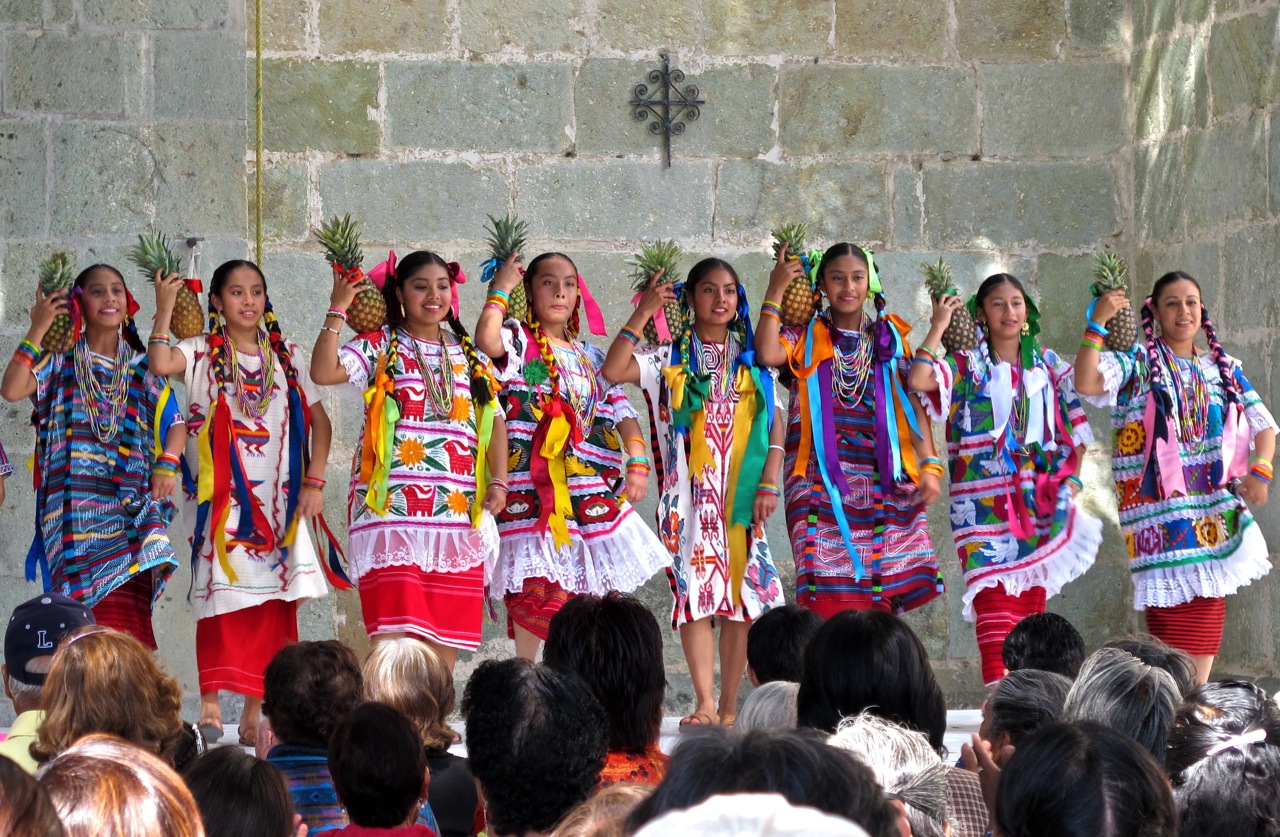
Piña Dancers

A small stage set up under the trees; dancers, their handmade and unique costumes; energetic music; choreographed steps passed down through generations spirited me back to my childhood…

Mom and me

Let’s dance!

Read Full Post »

« Newer Posts - Older Posts »