Feeds:
Posts
Comments

Archive for the ‘Politics’ Category

Felipe Calderón’s 6-year term as president of Mexico is coming to a close and running for a second term is prohibited.   Campaigning is limited to the 3-month period immediately prior to the upcoming July 1 election day.  (USA, doesn’t that sound great?!!)  It had a boring “business as usual” beginning.  However, the new student-led, “Yo Soy 132” movement has livened things up beyond all expectations.  It is already being likened to  the Occupy Wall Street movement and the early days of the “Arab Spring” uprisings.

First, the cast of presidential candidates:

  • Andrés Manuel López Obrador from the PRD (Party of the Democratic Revolution).  Popular former mayor of Mexico City, favorite of the Left, and thought by many to have been the legitimate winner of the last presidential election.
  • Enrique Peña Nieto – PRI (Institutional Revolutionary Party).  Former governor of the State of Mexico and candidate of the party that ruled Mexico with an iron fist for 71 years.  He is married to a popular telenovela actress and has the support of the right-wing, PVEM (Green Party).
  • Josefina Vázquez Mota – PAN (National Action Party).  Former member of the federal House of Deputies.  She’s currently running 3rd in the poling, tarnished by the violence and failure of Calderón’s drug war.
  • Gabriel Quadri de la Torre – PANAL (New Alliance Party).   Former advisor of the National Institute of Ecology and former chief of the External Financing sector in the Bank of Mexico.  He has the support of the extremely powerful (and many say, corrupt) head of the teacher’s union, Elba Esther Gordillo.

Next, what’s it all about?

A Mexican Spring Begins to Blossom

Marta Molina
Waging Nonviolence / News Report
Published: Tuesday 29 May 2012

“They are party-less but not apolitical. The supposed apathy and individualism by which the Mexican youth have been characterized has been disproved on the streets and on the web.”

In Mexico City’s daily life — in the shops, taxicabs, cafes and lines waiting for the bus — one could hear conversations between people of all ages saying Enrique Peña Nieto would, without a doubt, win the presidential elections. “Either something huge will happen,” a taxi driver told me, “or he will win.” And when people referred to “something huge happening,” they were referring to violence, or some unbearable crisis.

But it hasn’t happened like that. Far from anything originally expected, it is the Mexican youth and university students who are doing “something huge.” They have altered the political agenda in the country to prove that no one wins an election until the election itself.

The gathering began on May 23 at the Estela de Luz, or Pillar of Light — a monument that has caused much controversy due to the billions of pesos the government invested in its construction. The students appropriated this symbol of corruption to illuminate it with their democratic demands in a key pre-electoral moment.

… In the end, twenty thousand students from different universities, public and private, marched for four hours along the main avenues of Mexico City. The protests that followed have sparked talk of a “Mexican Spring,” making reference to the uprisings that began in North Africa at the end of 2010.  [Full article]

###

Student Movement Dubbed the ‘Mexican Spring’

Allison Kilkenny on May 29, 2012 – 9:34 AM ET


A university student holds the Mexican flag during a protest against Enrique Peña Nieto, presidential candidate of the opposition Institutional Revolutionary Party (PRI), and to demand balance in the media coverage of the presidential race in Mexico City May 28, 2012. The “YoSoy132” movement was organized by students to create awareness of Mexico’s current political situation and media censorship, local media reported. Reuters/Edgard Garrido

A coalition of thousands of mainly university students, unionized workers, and farmers in Mexico City have taken to the streets to demand greater freedom of speech and also to protest the possible return of power by the Institutional Revolutionary Party (PRI).

One banner read, “I have a brain, I won’t vote for the PRI.”

<snip>

Dubbed the “Yo Soy 132” movement (Twitter users can follow protest updates by searching #YoSoy132), or the “Mexican Spring” by observers, this latest wave of protests marks the third large student demonstration in less than a week.

The name “I Am 132” symbolizes the continuation of the original demonstration by 131 students during Peña Nieto’s visit to the Jesuit-run Ibero-American University (UIA).

New America Media:

“Our main goal is to seek greater democracy within Mexican media,” said fellow activist, Rodrigo Serrano.

The name, “YoSoy132” alludes to a group of students from the Universidad Iberamericana, who heckled PRI presidential candidate Enrique Peña Nieto during a recent visit to the university that chased him off the premises.

After the incident, PRI leaders accused the Iberoamericana students of being intolerant, inconsiderate “stooges” paid to protest against Peña Nieto by the leftist PRD party.

Students claim their heckling of Peña Nieto was a grassroots event, uninspired or funded by any political party.

In particular, students have expressed frustration with the “monopolization” of Mexican politics and media. The example New America Media provides is a company named Televisa, which along with TV Azteca, controls 95 percent of Mexico’s TV market.

Similarly, students believe PRI has a monopoly of sorts on Mexican politics. The party has ruled Mexico unchallenged for seven decades, and has a very good shot of winning the July 1 elections.  [Full article with video]

###

And, lastly (for now)…

On May 26, the students of Oaxaca met in the courtyard of Santo Domingo de Guzmán to join the national effort, forming  Yo Soy 132 Oaxaca

And, of course, a Facebook page has been set up.   This is getting interesting.  Vamos a ver…

Read Full Post »

It’s been almost 6 years since the October 27, 2006 day in Oaxaca when Indymedia video journalist, Brad Will, was murdered as he was filming a confrontation between APPO (Popular Assembly of the Peoples of Oaxaca) and paramilitary forces affiliated with then governor, Ulises Ruiz Ortiz, during the (at that point) 5-month long teachers’ strike.

Mexico catches suspect in death of a journalist Bradley Will

By Mark Stevenson / AP Wednesday, May 23, 2012. 1 day ago

MEXICO CITY (AP)‚ — Prosecutors in southern Mexico say they have captured a man suspected in the killing of a U.S. journalist Bradley Will during protests against the Oaxaca state government in 2006.

A spokesman for the Oaxaca state prosecutors office says suspect Lenin Osorio was captured early Wednesday.

The spokesman says he is not authorized to be quoted by name, and that he does not know which side of the conflict the suspect was on.

Bradley roland will Mexico catches suspect in death of a journalist Bradley Will

Will was shot as he videotaped a clash between protesters and government supporters.

The New York man was covering the conflict for Indymedia.org. He sympathized with the protesters, one of whom was arrested in 2008 for the killing but was later released.

The protests started as a teachers’ strike and paralyzed Oaxaca’s capital for months until federal police intervened.

###

As I write, journalists are being targeted all over the world and the teachers are again occupying Oaxaca’s zócalo, as they have every year since.  However, perhaps there will be justice for one of the 26, 2006 murder victims.  Vamos a ver….

The Revolution Next Door is a video tribute to Brad Will and includes footage shot by him, including his last tape.

To follow this news on Twitter, The Friends of Brad Will website lists the following Spanish language sites:

Oaxaca journo on the scene’s twitter feed:
https://twitter.com/#!/Jorgeopl

PGJE in Oaxaca’s feed:
https://twitter.com/#!/pgje_oaxaca

http://twitcasting.tv/Jorgeopl

Read Full Post »

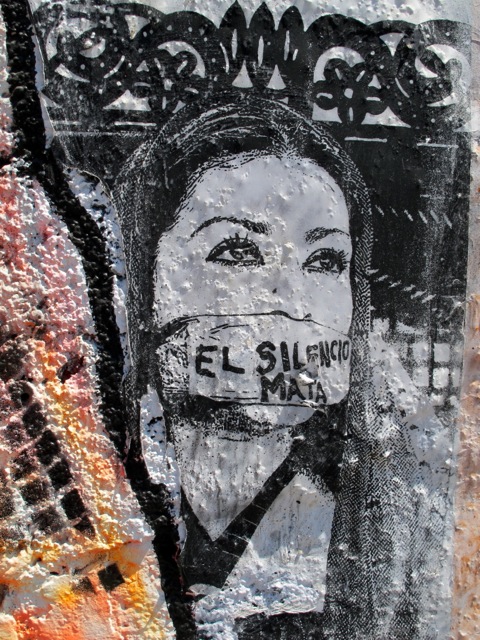
For a whole variety of reasons, this is so appropriate not just here, but…

all over the world…

And, given the current war on women’s hard won reproductive rights, it’s especially pertinent during this “election” season in the USA.

Silence does indeed kill!

Read Full Post »

The Occupy movement continues… clashes with the Oakland, CA police on Saturday are making headlines.  And, when I was in Mexico City two weeks ago, an indignado planton (encampment) was firmly established in front of the domed building that houses the Mexican stock mark.  Please note the biblioteca (library).

This slideshow requires JavaScript.

I must admit to feeling right at home, as plantons are an almost ubiquitous part of Oaxaca’s zócalo.  For more on plantons, David Bacon provides a cross border historical context to the planton/occupy movements in his article, Unions and Immigrants Join Occupy Movements,

Read Full Post »

Vive Oaxaca, one of my favorite websites that covers things cultural in Oaxaca, had the following on their homepage today:

Vive Oaxaca website banner:  No a la censura de la red; S.O.P.A. Stope Online Piracy Act; Internet nació seguirá siendo libre Do not censor the web; S.O.P.A. Stop Online Piracy Act; the Internet was born and will continue being free!

There is a video explanation of S.O.P.A. (in Spanish) and a couple of great posters.

Two posters: #1 listing websites going dark toda; #2 showing a face being gagged.

As the Vive Oaxaca website suggests, these Acts will not just affect access to information in the USA, they have worldwide implications.

For more information and links to other articles opposing SOPA and PIPA, check out Wikipedia’s SOPA and PIPA – Learn more page.

Update:  And to become even more informed, resources from the Progressive Librarians Guild:  Learn more about SOPA, censorship, & piracy:

The Swiss study (2011)…Piracy pays for itself

Read Full Post »

Mexico’s favourite singer-songwriter dishes on development, gender, indigenous issues, peace and music.  An interview with Lila Downs (in English) from the IFAD social reporting blog:

http://blip.tv/ifad/lila-downs-reverence-hope-change-5672813

By the way, Chris, over at Oaxaca-The Year After has posted more from the recent concert at the Guelaguetza Auditorium, covered in my Sublime sounds and spectacle post.

Read Full Post »

A Global Day of Action, in solidarity with Occupy Wall St. has been called for tomorrow, October 15.  According to a current tally, demonstrations will be held in 950+ US cities and 80+ countries, the latter including Mexico City.   Who knows what will unfold in Oaxaca, where occupations, marches, and road blocks are an almost daily event.

Si no te oyen haz que te vean, #15o, monumento a la revolucion, 12 hrs., Ciudad de MexicoConfession:  This is personal… I’m one of the 99% and lost my job as a result of the economic collapse brought about by the voracious, unconscionable, and unbridled greed of US capitalism.  Heck, even in my old ‘hood, more than 200 ‘Occupy Marin’ protesters demonstrated in front of Bank of America a few days ago.  It’s one of the few times, I wish I was still in El Norte, so I could participate.

BTW, the poster art and slogans coming out of this movement are awesome!  Take a look at the following sites:

If you don’t hear us, can you see us???

Read Full Post »

Octavio Paz, writing about the Mexican independence movement in The Labyrinth of Solitude:

The eighteenth century prepared the way for the Independence movement.  In fact, the science and philosophy of the epoch… were necessary intellectual antecedents of the Grito de Dolores.  [p. 118]

…the insurgents vacillated between Independence (Morelos) and modern forms of autonomy (Hidalgo).  The war began as a protest against the abuses of the metropolis and the Spanish bureaucracy, but it was also, and primarily, a protest against the great native landholders.  It was not a rebellion of the local aristocracy against the metropolis but of the people against the former.  Therefore the revolutionaries gave greater importance to certain social reforms than to Independence itself:  Hidalgo proclaimed the abolition of slavery and Morelos broke up the great estates. 

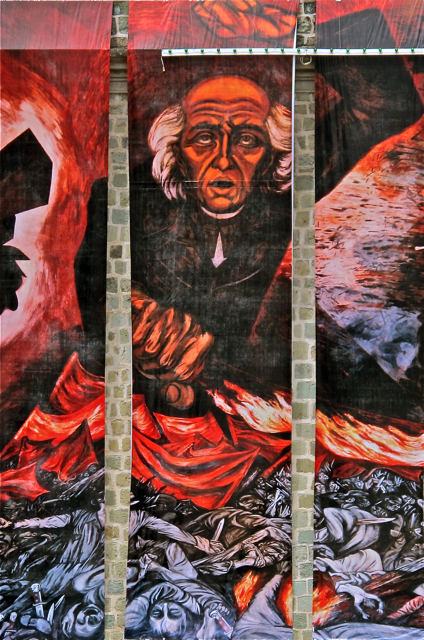
Banner on Oaxaca's Municipal Building; reproduction of mural by José Clemente Orozco of Miguel Hidalgo y Costilla.

The Revolution of Independence was a class war, and its nature cannot be understood correctly unless we recognize the fact that unlike what happened in South America, it was an agrarian revolt in gestation.  This is why the army (with its criollos like Iturbide), the Church and the great landowners supported the Spanish crown… [p. 123]

Paz, Octavio.  The labyrinth of solitude, the other Mexico; Return of the labyrinth of solitude; Mexico and the United States; The philanthropic ogre.  New York:  Grove Press, 1985

Read Full Post »

Following the example of the 32 autonomous municipalities set up in the Mexican state of Chiapas flowing from the EZLN led uprising in 1994, another Oaxacan community has declared itself independent.

Roadside billboard: Ejido Jotola Adherentes de la otra campaña de la Sexta Declaracion de la Selva Lacandona

Chiapas billboard between San Cristóbal de las Casas and Palenque

The Mex Files provides some background and historical context for the actions taken by the residents of San Francisco Tlapancingo, in the Mixteca Region of the state of Oaxaca.  The posting, Days of future past in Oaxaca, explains:

Oaxaca has always been the most complicated of Mexican states.  Where the rest of us make do with municipalities (roughly equivalent to a U.S. county, and usually doubling as a federal congressional district), the challenge, since Colonial times, has been to impose a centralized governing system on a multi-cultural, multi-linguistic, geographically fragmented political sub-division.  In modern (post-Revolutionary) times, the state has been divided into eight regiones that correspond to various traditional ethnic communities, the regions being further divided into distritos, which have any number of municipios. Complicating the political situation, with the recognition of “usos y costumbres” added to the Federal Constitution in 2001, and to the state constitution, local government and elections may not conform to the standards of the modern state, but follow time-honored practices for better or worse.

Over the past few years, the state has been best known to outsiders for the sometimes violent confrontations between an entrenched PRI state machine and  various opposition groups.  With the electoral success of an opposition coalition in capturing the governor’s office last year, the state’s political troubles seem to have dropped off the radar for most of us, who forget that with the complicated governing structure in Oaxaca, there are still opportunities for  heavy-handed machine politicians to maneuver, on a less noticeable scale.

In San Francisco Tlapancingo, a municipio of about 1250 people in the Silacayoapam distrito of the Mixteca region, the same election that saw the end of the PRI’s 80 year dominance of the state government and put a Convergenia candidate running as the head of the anti-PRI coalition, Gabino Cué Monteagudo, into the Governor’s office, also returned a PRI municipal government.

Claiming Governor Cué did nothing about the alleged fraud in the local election (San Francisco Tlapancingo’s presidente municipal, Pablo Abelardo Vargas Duran enjoying the backing of two powerful PRI deputies [state legislators], as well as having his own armed bodyguards, 200 or so citizens walked into the municipal palace and “went native”.  They simply declared the community would be run by “usos y costumbres”, locking out the elected (and they say fraudulently elected) officers, installing their own, and informing the state elections commission that an assembly of the people would be running the community from now on. 

The new municipal government is rejecting any state interference, including development, in their community, planning to go it alone through self-financing and “tequios” — compulsory communal labor.  Oh, and by the way, that state interference includes the state courts, the state police and the federal army.

This may not be one of those types of events I mentioned in the post below.  Or it may be.   Mexico is not a primarily agrarian society (and hasn’t been in a very long time), so the happenings of an indigenous rural commune may not be all that important.  Nor is  San Francisco Tlapancingo exactly on anyone’s political or cultural radar, and what happens in Oaxaca generally stays in Oaxaca.

What makes it worth noticing is that here, the people are turning to tradition — history — to find a way out of what they see as a failed political and security situation.

***  For an explanation (in Spanish) of “usos y costumbres,” see the document, Usos y Costumbres y Derecho Indígena.

Read Full Post »

Banner - close-up of eyes, nose, and tears running down cheeks.The Marcha del Color de la Sangre (Caravan of the Color of Blood), by the Triqui of San Juan Copala and their supporters, mentioned in my May 23 post, was prevented from entering the village.

Banner:  Face of mother and son and slogan:  Autonomia, justicia, paz, dignidad; Municipio Autónomo de San juan Copala.According to Angry White Kid, a National and International Day of Action in Solidarity with the Autonomous Municipality of San Juan Copala, Oaxaca, Mexico has been called for June 3.

Banner in the style of a huipil with text:  Apoyo al planton de mujeres y niños desplazados de San Juan Copala.

These banners graced the portales of the Government Palace during the encampment.

Banner - Triqui woman with slogan: Justicia y paz con dignidad; Municipio Autónomo San Juan Copala

Beautiful and poignant, I could never pass by without pausing…

Read Full Post »

Propping up fallen trees isn’t the only activity on the Alameda… 3 tents under the Indian Laurel trees on the Alameda

Today, Sección 22 del Sindicato Nacional de Trabajadores de la Educación (the teachers’ union) is beginning an occupation of Oaxaca’s zócalo, Alameda, and several side streets.2 tents under the portales of the Governor's Palace According to a report in the Latin American Herald Tribune, Teachers Call for Strike in Southern Mexican State, the teachers are not demanding wage increases, instead focusing on social issues, including “better uniform allowances for students, computers in all of the state’s elementary schools and electricity in all schools.”  Privatization is also an issue.Green banner with text reading:  ¡No a la privatización de la educación!

This annual activity by the teachers’ union is extremely contentious.  Adding bold-face to the lines above will be my only comment on the subject.

However, the teachers aren’t the only people converging on the zócalo today…Poster: Marcha del Color de la Sangre; 23 de Mayo; Zocalo de Oaxaca a la Ciudad de MexicoThe displaced Triqui, who were driven out of their village of San Juan Copala after several years of political violence, have decided to return home, leading a march/caravan from Oaxaca to Mexico City and finally back to San Juan Copala.Triqui women and baby await the arrival of the march/caravan For more information, see the blog posting by Angry White Kid, The displaced decide to return to our community: Caravan of the Color of Blood and for background on their struggle for autonomy, see Repression, Impunity and Resistance in Oaxaca: One Year After the Copala Caravan Ambush.

Read Full Post »

In my attempt to begin to understand the people and culture of my new home, my reading has focused on all things Mexican… history, novels, cookbooks, travel writing, you name it!

Right now, I’m finishing Barbara Kingsolver’s historical novel, The Lacuna.  The story begins in 1929 Mexico, moves back and forth between Mexico and the USA, and ends in 1959.  It follows the protagonist, Harrison Shepherd, as he grows into adulthood, all the while navigating the turbulent political waters of these two countries.

Shepherd’s employment with artists Diego Rivera and Frida Kahlo brings him into Leon Trotsky’s household in Coyoacan, Mexico City, where lively debates, as Trotsky answers Stalin’s slanders and formulates a transitional program to move from capitalism to socialism, help inform Shepherd’s own political development — and all in the household work tirelessly day and night (eventually unsuccessfully) to protect Trotsky from Stalin’s assassins.  It is “a plot that turns many times on the unspeakable breach—the lacuna—between truth and public presumption.”

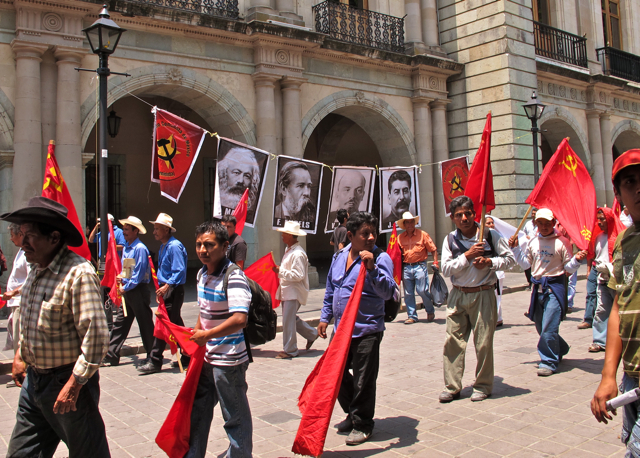
And so, I was brought up short when I encountered yesterday’s demonstration by the Partido de los Comunistas Mexicanos…

Demonstration by the Partido de los Comunistas Mexicanos with red flags and posters of Karl Marx, Frederick Engels, Vladimir Lenin, and Josef Stalin.

Yes, that’s Josef Stalin’s portrait (far right) the demonstrators strung from the portales of Oaxaca’s Government Palace.  Hmmm… has word of Khrushchev’s revelations in 1956, at the 20th Congress of the Soviet Communist Party, not yet reached Oaxaca?   Or, do we have a perfect illustration of a lacuna between truth and public perception?

Of course, I didn’t need to come down here to see unspeakable breaches…

Read Full Post »

« Newer Posts