Revolutionaries behind bars.

Couldn’t resist just one more El Grito window display!
Posted in Celebrations, Culture, Holidays, Travel & Tourism, tagged El Grito, Mexican Independence, Mexico, Oaxaca, photographs, photos, popular travel destinations, store displays, window display on September 13, 2012| 2 Comments »
Revolutionaries behind bars.
Couldn’t resist just one more El Grito window display!
Posted in Celebrations, Culture, History, Holidays, Travel & Tourism, tagged celebrations, El Grito, Escuela Primaria Urbana, graffiti, Grito de Dolores, holidays, Mexican Independence Day, Mexico, newsstands, Oaxaca, photographs, photos, popular travel destinations, store displays, Teotitlán del Valle, window displays on September 11, 2012| Leave a Comment »

Where else have you seen El Grito decorations?
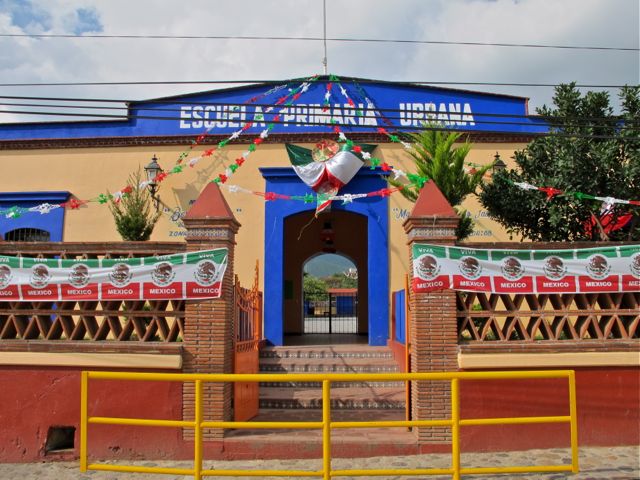
Schools, of course! This one in Teotitlán del Valle.

And, how about newsstands? You can’t miss the green, white, and red — it’s everywhere!
Posted in Celebrations, Culture, History, Holidays, Travel & Tourism, tagged celebrations, clothing, costumes, El Grito, Grito de Dolores, holidays, Mexican Independence Day, Mexico, Oaxaca, photographs, photos, popular travel destinations, store displays, traje on September 5, 2012| Leave a Comment »
El Grito is coming, El Grito is coming!!! Green, white and red is on display all over the city, including clothing stores, as tradition calls for wearing the colors.
Are you in the market for a traditional look?
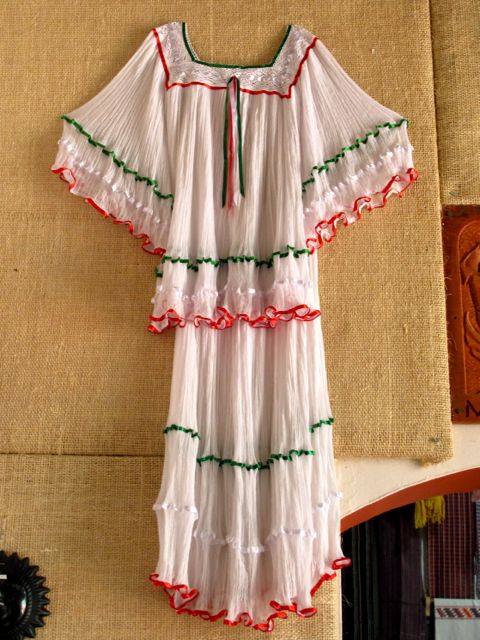
A huipil and rebozo?

Or, are you leaning toward an updated mix and match style?

Do you need a sweater for going down to the zócalo on the evening of September 15?

By all means, don’t forget to accessorize!

On a more serious note: Despite its current challenges (which are many and serious), Mexicans are extremely proud of being Mexicanos. And, in my humble opinion, they have every right be! They can trace their history back to ancient and highly developed civilizations, their national cuisine has been placed on the World Heritage List by UNESCO, and Mexico is considered one of the most geographically and biologically diverse countries in the world. Plus, when was the last time you heard Mexico had invaded another country?
Posted in Celebrations, Holidays, Travel & Tourism, tagged cab drivers, cars, Día de los Taxistas, Día del Taxista, Mexico, monos, Oaxaca, photographs, photos, taxis, taxista, taxistas, transportation, travel, Virgen de Guadalupe, Virgin of Guadalupe on August 12, 2012| 2 Comments »
Hmmm… hope you didn’t need a taxi in Oaxaca today. It’s not that they weren’t around; they were everywhere! August 12 is Día del Taxista and, instead of picking up fares, taxis are decorated and parade through the city, accompanied by banners, bands, monos, and the Virgen de Guadalupe.
I think I managed to capture one of each of the (color-coded) taxi organizations participating — 13 by my count. However, the procession didn’t seem as long this year and I’m thinking some of the organizations were missing. Charges of corruption, going back to the previous governor have been ramping up and the July 25th blockade that paralyzed transportation into and out of the city, by some taxistas, seemed to put the issue on the front burner. But, who knows??? Certainly not this gringa!
Posted in Celebrations, Culture, History, Holidays, tagged Día de la Madre, Liza Bakewell, Madre: Perilous Journeys With a Spanish Noun, Mexico, Mother's Day, mothers, Oaxaca, photographs, photos, women on May 10, 2012| 3 Comments »
Today, May 10, is Día de la Madre in Mexico and it is celebrated in much the same way as in el norte.
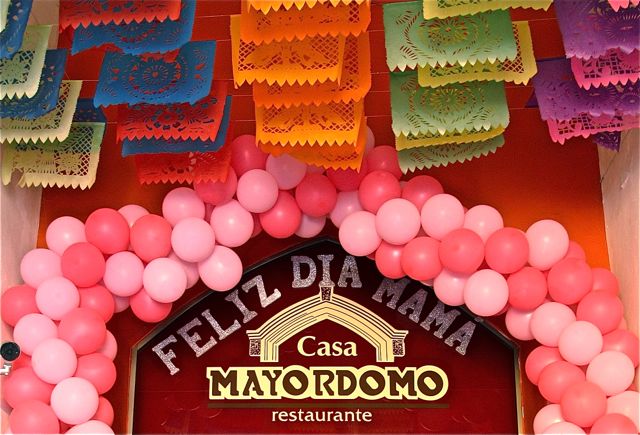
The celebration migrated south from the USA in the early 20th century and was embraced and promoted by the Catholic Church AND the anticlerical Revolutionaries. As for their reasons, I will quote from Liza Bakewell’s book, Madre: Perilous Journeys with a Spanish Noun.
… around the 1850s the Liberals… were nervous about women’s growing participation in the public sphere. Establishing motherhood as venerable and the home as sanctified… would give women a sphere of their own where they could be boss. Also, it would keep them off the streets and out of the workplace where they had begun to compete with men for jobs.
Under their watch, everyday motherhood became an exalted madre-hood…. The twentieth-century Revolutionaries who succeeded them took the idea and ran with it, adding in 1922 a ritual, Mother’s Day… [p. 84]
Needless to say, the women of Mexico have not stayed home! As I write, hundreds of women are marching on Mexico City, participating in the March of National Dignity: Mothers Looking for their Sons and Daughters and Searching for Justice. And, as for the workforce, according to a report citing the 2010 census, 33.3% of women work and this doesn’t even include those working in family operated enterprises.
However distasteful the reasons behind the establishment of Mother’s Day in Mexico, it does nothing to diminish the need to honor these beautiful, hardworking, formidable, and loving women.
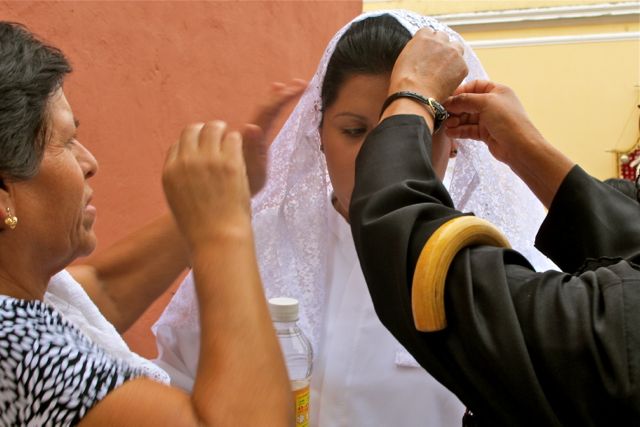

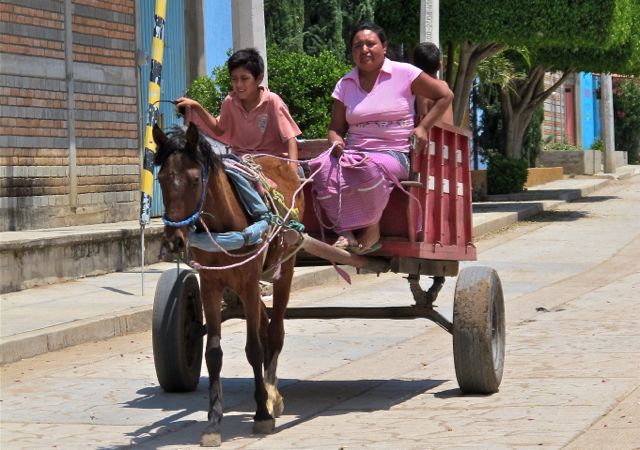
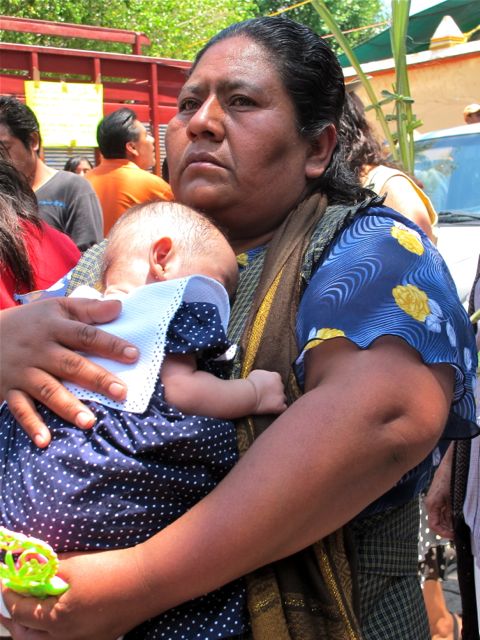
¡Feliz Día de la Madre mis compañeras!
Posted in Celebrations, Economics, Holidays, Labor, Protests, tagged Confederación de Trabajadores de México, CTM, Día de los Trabajadores, Día Internacional de los Trabajadores, demonstrations, holiday, International Workers' Day, labor, May Day, Mexico, Oaxaca, photographs, photos, workers on May 1, 2012| 4 Comments »
Like 80+ countries in the world, International Workers’ Day is a national holiday in Mexico. Early this morning in Oaxaca, streets were closed as contingents began gathering and then marching toward the city center. And for hours, they poured into the Zócalo and Alameda for speeches, music, and bottle rockets, all of which will, no doubt, continue for hours more.
FYI: CTM stand for the Confederación de Trabajadores de México, the largest confederation of Mexican labor unions. Think, AFL-CIO in El Norte (though with some significant differences).
¡Feliz Día Internacional de los Trabajadores!
Update: For a more nuanced view of yesterday’s march, see the report by longtime resident, Nancy Davies.
Posted in Celebrations, Culture, History, Holidays, tagged 480th anniversary, birthday, celebrations, fireworks, fuegos artificiales, Happy Birthday Oaxaca, history, Mexico, Oaxaca, photos on April 25, 2012| Leave a Comment »
Tonight, instead of candles…

Fuegos artificiales exploded from the Alameda de León…

As Oaxaca celebrated her 480th birthday!

Posted in Celebrations, Culture, History, Holidays, tagged 480th anniversary, calendas, celebrations, Happy Birthday Oaxaca, history, Mexico, Oaxaca, photos on April 25, 2012| Leave a Comment »
Today is Oaxaca’s 480th birthday as a colonial city . Of course, among other events, a calenda (parade) marked the date.
In 1532 Spanish settlers (their bloody way paved by Hernán Cortés and his conquistadores) successfully petitioned the Queen of Spain for a land grant of 1 square league. The colonists had already established their own town on the site of Huaxyacac, renamed it Antequera (after an old Roman city in Spain) and received a Royal Charter from King Charles I of Spain.
However, Cortés had successfully gotten the entire Valley of Oaxaca (hundreds of thousands of acres) declared as his own private marquisate and, his greed knowing no bounds, kept trying to evict the colonial townspeople. By obtaining the queen’s charter, this end-run around Cortés insured the rights of the townspeople to the land.
Thus, April 25th continues to be celebrated as Oaxaca’s birthday. ¡Feliz Cumpleaños!
Posted in Celebrations, Churches, Culture, Holidays, Music, Religion, tagged Carmen Alto, castillo, culture, Danza de la Pluma, Easter, fireworks, fuegos artificiales, Mexico, Oaxaca, Pascuas, photo, photographs, Semana Santa, toritos, travel, video on April 16, 2012| Leave a Comment »
It’s been a week since the end of Semana Santa and I’m still sorting through photos and videos and reflecting on impressions and feelings. However, I’m finding that, with too much thinking, the experience slips through the fingers and the magic vanishes.
Thus, I give you the night of Pascuas (Easter) at Carmen Alto…
And then, the hisses, bangs, and brilliant explosions of a castillo…

brought Semana Santa to a spectacular close.
Posted in Celebrations, Churches, Holidays, Religion, tagged Bible, Christianity, culture, Good Friday, Jesus, Mexico, Oaxaca, photo, photographs, Preciosa Sangre de Cristo, Procesión del Silencio, Procession of Silence, religion, ritual procession, Viernes Santo, Virgin Mary on April 10, 2012| Leave a Comment »
The back of the official 26th anniversary t-shirt for the Good Friday, Procesión del Silencio, doesn’t come close to telling the tale.

Images of belief add texture to the ritual procession of mourners grieving the crucifixion and death of Jesus, as related in the New Testament of the Christian Bible.

But it’s the eyes of believers…

that gives the narrative a silent voice.

And, grieving mothers everywhere understand.

No matter where one lands on the belief continuum, it’s hard not to be moved.
(ps) For lots more terrific photos, take a look at Chris’s posting, The Procession of Silence.
Posted in Celebrations, Churches, Holidays, tagged Christianity, culture, Good Friday, Mexico, Oaxaca, photo, photographs, Preciosa Sangre de Cristo, Procesión del Silencio, Procession of Silence, religion, Viernes Santo on April 7, 2012| 6 Comments »


In front of Preciosa Sangre de Cristo Templo on Viernes Santo (Good Friday), waiting for the Procesión del Silencio (Procession of Silence) to set off up the Álcala, down Garcia Vigil, and back up the Álcala to Sangre de Cristo.
Posted in Buildings, Celebrations, Churches, Holidays, tagged Carmen Abajo, Carmen Alto, Cathedral, Christianity, full moon, Holy Week, Jueves Santo, La catedral de Nuestra Señora de la Asunción, Maundy Thursday, Mexico, Oaxaca, pan bendito, photo, photographs, Preciosa Sangre de Cristo Templo, religion, Santo Domingo, Semana Santa, Templo de la Compañía de Jesus, Templo de San Felipe Neri, Templo de San José on April 6, 2012| 1 Comment »
Yesterday, under a full moon…

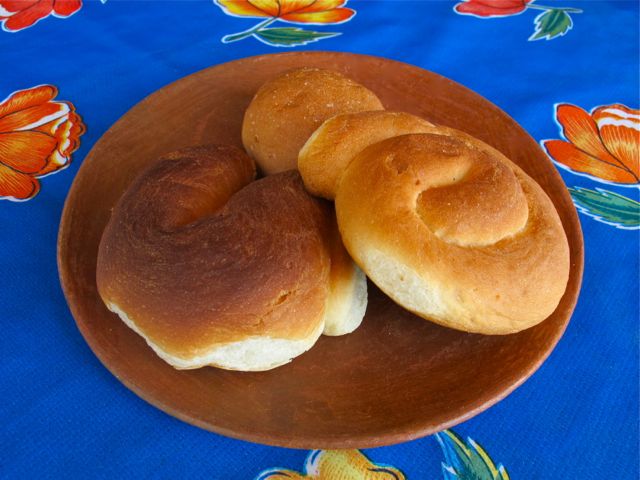
and clutching our “pan bendito” (blessed bread), we began our pilgrimage. Jueves Santo (Holy/Maundy Thursday) tradition calls for visiting 7 churches (la visita de las siete casas) in the city with one’s pan bendito, which must be kept to offer to guests, should any grace our doorstep. This all relates back to Jesus’s Last Supper, which this date commemorates.
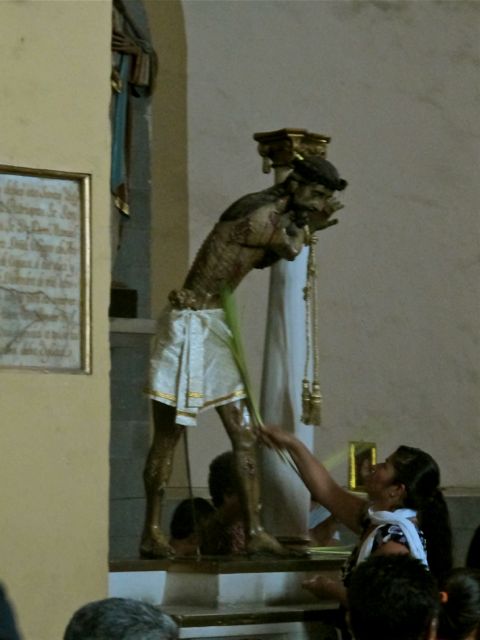
First stop was the nearby Templo de San José, where palm fronds were also distributed and believers used them to brush up and down the statue of Jesus. Hands also ran down his legs and then were used to touch one’s face.
After emerging from the side door of the jam-packed church, we set off for Templo de San Felipe Neri (whose picturesque dome can be seen (left of center) on my blog banner-head).
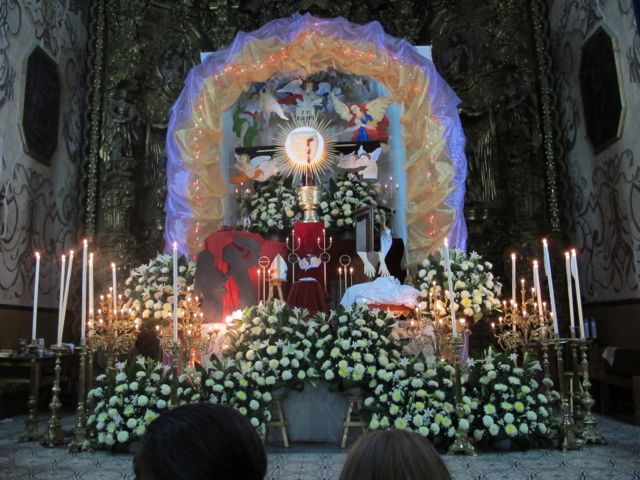
Next stop was Carmen Abajo…

followed by the far right side chapel of the La Catedral de Nuestra Señora de la Asunción. A plaque at the entrance of the chapel read, “El maestro esta aqui y te llama” (The teacher is here and calls you) and the multitude seemed to be heeding the call.

We then strolled across the zócalo to the Jesuit, Templo de la Compañía de Jesus.

We changed direction and headed north up the Álcala. Big mistake! A mosh pit (Chris, this WAS a mosh pit) surrounding a Tuna band that was playing in the middle of the street, causing gridlock and bringing us to an abrupt stop. Eventually, following our blocker (my son, the lineman would be proud), we eventually found light and continued up to Preciosa Sangre de Cristo Templo, where we had earlier spent 1-1/2 hours (and it was still going on when we left!) at a mass where the priest reenacted Jesus washing the feet of his disciples at the Last Supper.
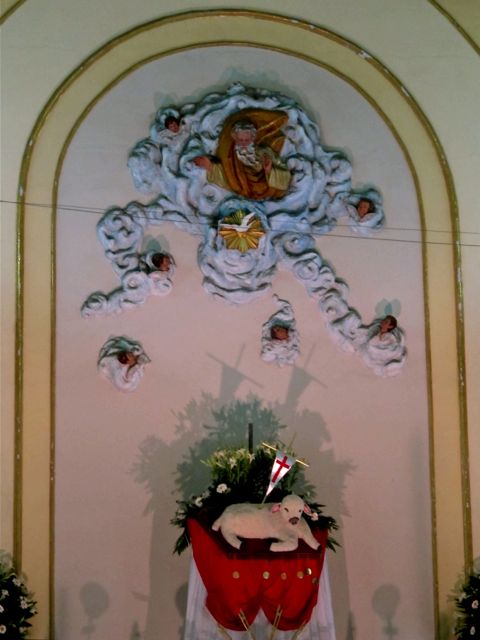
Strolling across the Álcala to Santo Domingo was much less challenging. The aisle to Santo Domingo’s main altar was blocked and we were routed to a side chapel. Hurray, we did it — this made seven churches visited!
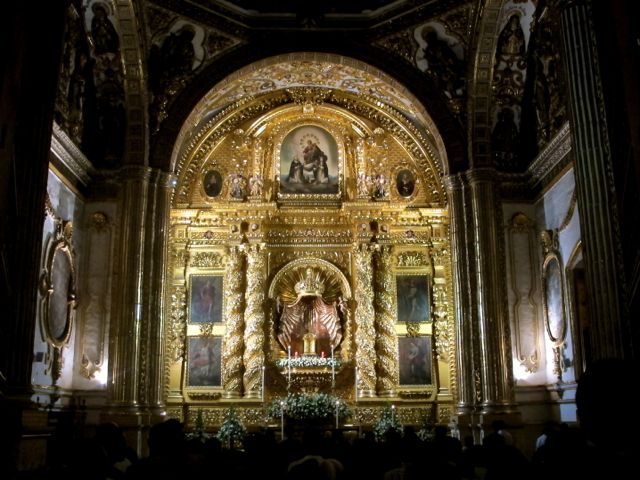
However, though bleary-eyed (as evidenced by the photo below), we opted for just one more, Carmen Alto.

Home beckoned… and sleep came easily under the watch of the moon, now appropriately encircled by a halo.

Posted in Celebrations, Churches, Holidays, tagged culture, Domingo de Palmas, Holy Week, Mexico, Palm Sunday, photo, photographs, religion, Santiago Apóstol, Señor del Burrito, Semana Santa on April 4, 2012| 3 Comments »
Palm Sunday also brought us to the village of Santiago Apóstol and one of my favorite painted churches.

This beautiful facade was hidden behind a stage, presumably set up for outdoor masses during Semana Santa.

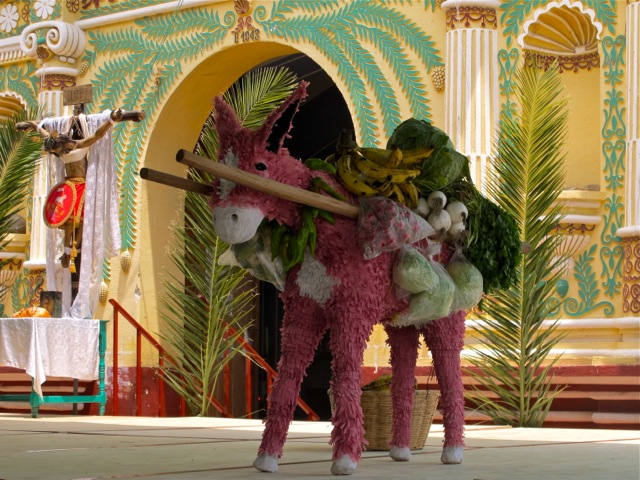
We weren’t the only ones who negotiated the dusty back roads out of San Antonino Castillo Velasco; Señor del Burrito was already there when we arrived. Apparently, he knew a shortcut!
Inside the empty church (pews had been moved outside), amidst the smoky incense filled haze, the ethereal voices of these women transported us…

This wasn’t the first time we had been enchanted in Santiago Apóstol. During Días de muertos, the entire Panteón is whitewashed and filled with an explosion of red, orange, yellow, and magenta flowers.
Posted in Celebrations, Churches, Culture, Holidays, tagged Christianity, culture, Domingo de Palmas, Holy Week, Mexico, offerings, palm crosses, Palm Sunday, photo, photographs, religion, San Antonino Castillo Velasco, Semana Santa on April 2, 2012| 7 Comments »
Yesterday, I spent another magical day with friends in San Antonino Castillo Velasco (about 23 miles/1 hour from the the city). It was Domingo de Palmas (Palm Sunday) and San Antonino celebrates in its own unique, warm, and welcoming way.
Townspeople gather in the cemetery to decorate the “Señor del Burrito” with fruit, vegetables, flowers, and everything they sell or grow during the year. In addition, livestock (goats, chickens, pigs, etc.), more foodstuffs, flowers, etc. are gathered and priced. The pastor of the parish church arrives to bless the “Lord of the Little Burro” and offerings. Palm crosses are distributed, all are invited to help carry the offerings to the church, 10-12 men hoist the burro (now laden up to his neck and weighing who knows what!), and a procession to the church commences, lead by a fast-tempo drum beat and punctuated by shouts warning the men carrying “Señor del Burrito” of upcoming topes (speed bumps) and telephone wires, which must be navigated.
At the church, “Señor del Burrito” has an honored place in the courtyard and the offerings are gathered and arranged. Many then attend an hour-long mass inside the church, while others partake in yummy amarillo and pork empanadas, taste mezcal, and browse the wares of the artisan booths. By the way, at least two of the “maestros” from the new, previously mentioned, book, Grandes Maestros del Arte Popular de Oaxaca were present: Familia García Mendoza (ceramics) and Antonina Cornelio, who makes the exquisitely embroidered clothing typical of San Antonino Castillo Velasco (and seen in one or two of the photos above). Following the mass, the offerings are sold, with the proceeds going to an orphanage in the village.
Muchisimas gracias to the people of San Antonino Castillo Velasco for being so gracious and allowing us to share this special day with them.
Posted in Celebrations, Holidays, tagged altar, animal figurines, Chia Pets, Día de la Virgén de Dolores, Mexico, Oaxaca, Our Lady of Sorrows, photos, popular travel destinations, virgen de dolores, Virgin of Sorrows on March 30, 2012| Leave a Comment »
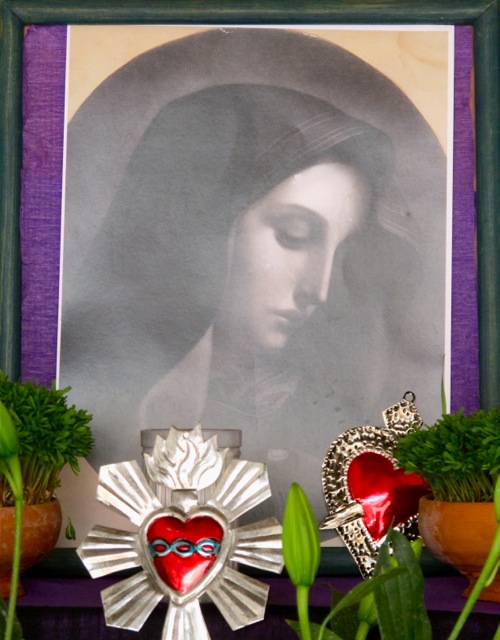
Today, the 6th Friday of Lent, is El Día de la Virgen de Dolores, the Virgin of Sorrows.

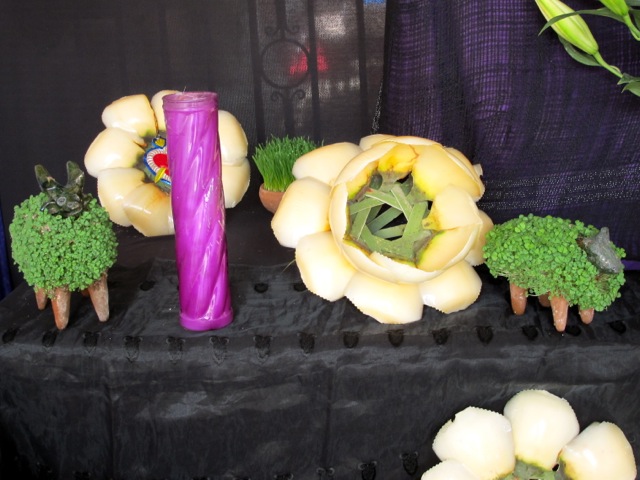
Altars have been set-up in courtyards and businesses around town, including this one at Hotel Las Mariposas (butterflies).

It commemorates the pain suffered by the Virgin Mary on the death of her son.
By the way, note the “chia pets.” This is where the US entrepreneur originally got the idea in the late 1970s for the terracotta animal figurines planted with Salvia Hispanica.
Tonight, I’m headed to a special Día de la Virgen de Dolores program, including a concert of sacred music performed by the Coro de la Ciudad (chorus of the city of Oaxaca), at the Templo del Carmen Bajo.
(ps) Ooops! Apparently, the concert is tomorrow night.


 Mexican Peso Converter
 View From Casita Colibrí