Feeds:
Posts
Comments

Archive for the ‘Culture’ Category

It’s been a wonderful Bay Area visit, but Saturday at Hardly Strictly Bluegrass the performance by Los Cenzontles with Max and Josh Baca of Los Texmaniacs brought a wave of homesickness for Mexico.

Guess it’s time for me to go…  Next stop, Mexico City!

Read Full Post »

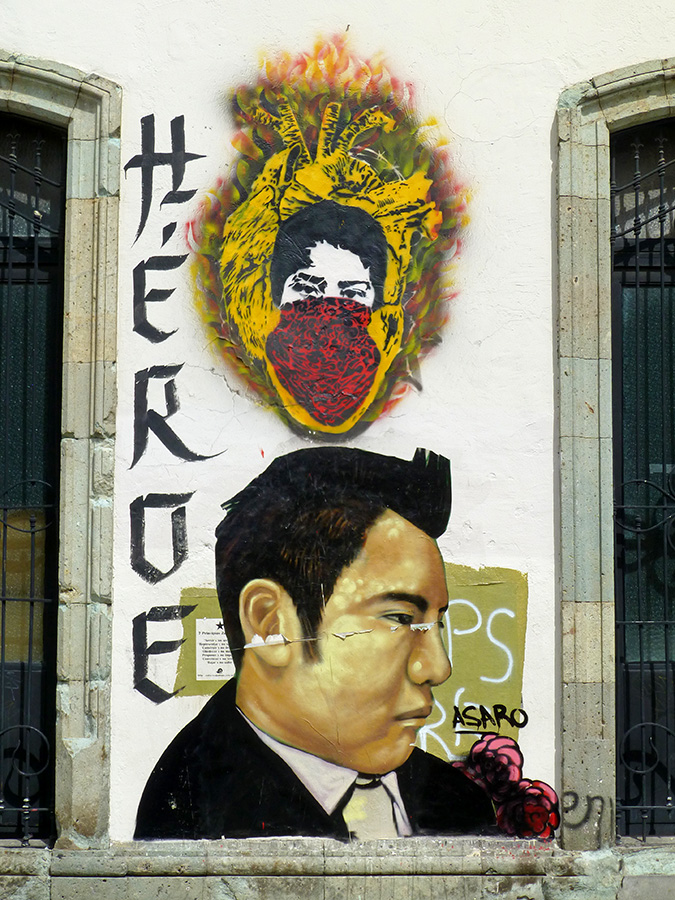
It’s been two years since that tragic night in Iguala, Guerrero when busloads of students (normalistas) from the Ayotzinapa Rural Teachers College were violently attacked.  Six students were killed, 25 were injured, and 43 disappeared.  It’s been two years of agony for families and friends.  It’s been two years of questions and discredited answers for the people of Mexico.  And, it’s been two years of artists around the world doing their part to not let us forget.

p1190763

p1190767

p1190768

p1190769

p1190766

p1190765

p1190772

p1190773

p1190778

p1190777

p1190776

p1190775

p1190781

Images of some of the missing by Asamblea de Artistas Revolucionarios de Oaxaca (ASARO) seen June 18, 2016 on Av. Morelos in Oaxaca, including 18-year old Cristian Tomás Colón Garnica from Tlacolula de Matamoros, Oaxaca.

Read Full Post »

Despite 2000 miles between here and there, similarities abound between the two places I call home.

Art on walls.  (Left) A massive new mural in Mill Valley, above the side wall of the Sequoia Theater, by Zio Ziegler.  (Right)  One of the many murals by Sanez (Fabián Calderón Sánchez) in Oaxaca.  By the way, I’ve previously posted murals by both artists:  click Sanez and/or Zio Ziegler.

Agave.  (Left) Of course in Mill Valley (California), it’s solely ornamental for those meticulously landscaped gardens.   (R) Whereas in Oaxaca, it’s vital crop — land without agave means life without mezcal!

Fluttering swags of flags.  (Left) Cloth Tibetan prayer flags flying outside the 142 Throckmorton Theatre in Mill Valley welcome patrons to the Mountainfilm festival.  (Right) Ubiquitous papel picado found inside and out in Oaxaca, in paper or plastic, for events special or just because.

Sacred mountains.  (Left) Mt. Tamalpais, the Sleeping Lady and mountain of my childhood dreams, teen driving lessons, and adult peace, joy, and renewal.  (Right) Cerro Picacho (in Zapoteco, Quie Guia Betz), brother/sister mountain — the sacred mountain in Teotitlán del Valle, where, among other times, villagers make a pilgrimage to the top on Día de la Santa Cruz (Day of the Holy Cross).

And, last but not least, colorfully costumed couples.  (Left) Soon after arriving at the Mill Valley Fall Arts Festival, I ran into this twosome.  Turns out, in the “it’s a small world” universe, they are actually friends of a couple I know in San Miguel de Allende.  (Right) During July’s Guelaguetza in Oaxaca, the delegation from Putla de Guerrero representing their celebration of Carnaval, is garish and gaudy and wild and wacky — in other words, fantastic!

Creativity is a challenge. It requires us to be fully human — autonomous yet engaged, independent yet interdependent. Creativity bridges the conflict between our individualistic and our sociality. It celebrates the commonality of our species while simultaneously setting us apart as unique individuals.  —Greg Graffin

Save

Save

Save

Save

Save

Save

Save

Save

Save

Read Full Post »

Mexico’s El Mes de la Patria (the month of the homeland) is upon us and overnight, as August turned to September, the streets erupted in green, white, and red.

p1210919

Mexico celebrates September 16, 1810 as the beginning of its fight for independence from Spain.

p1220023

Flags are flying everywhere and are for sale on every other street corner, along with all manner of patriotic tchotkes.

p1220025

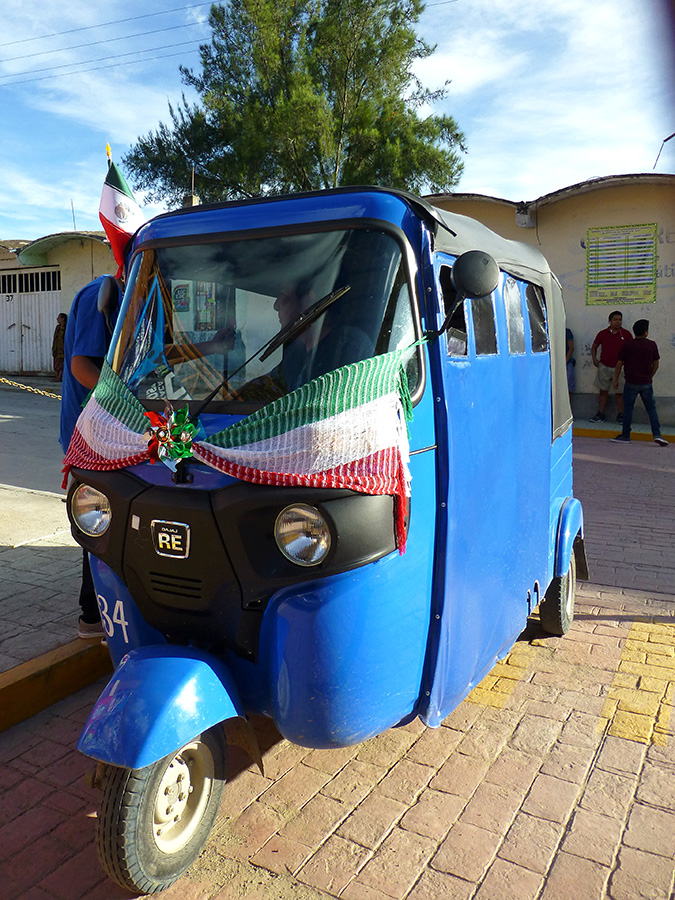
From buses in the city to moto-taxis in the villages, everything is decked out in the green, white, and red of the Mexican flag.

p1220066

As for Oaxaca?  The five-month renovation project at Mercado Benito Juárez has been completed and vendors have moved from their temporary stalls on the surrounding streets back into the market; Sección 22 teachers have returned to their classrooms and 80% of the encampment in the zócalo has been disassembled; the governor will give his final Grito de DoloresGrito de Dolores at 11:00 PM on September 15th; and the annual patriotic parade will fill the streets of the Historic District with participants and observers on the 16th.

Save

Read Full Post »

While waiting for yesterday’s convite to begin, the Danza de la Pluma subalternos, Florentino Martínez Ruiz and Juan Bautista Ruiz, knew how to keep young, old, all those in between, and the photographers entertained.

p1220053

A little “splendor in the grass” for Juan?

p1220055

And, the fun didn’t stop there, once the convite began, Florentino snatched a marmota from one of the little boys to give it a try.

img_2036

And, everyone laughed, especially the boy!  That’s entertainment, Teotitlán del Valle style!

Read Full Post »

For ten years, since the 2006 teacher uprising in Oaxaca, with scissors, paper, paint, and talent, the Lapiztola collective has been cutting through propaganda and meaningless phrases to lead, provoke, and inspire with their art.  Looking across the Alcalá from Santo Domingo, a new stenciled mural in front the Instituto de Artes Gráficas de Oaxaca (IAGO) caught my eye…
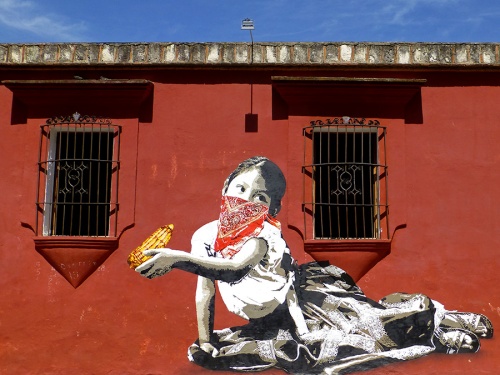
P1210914

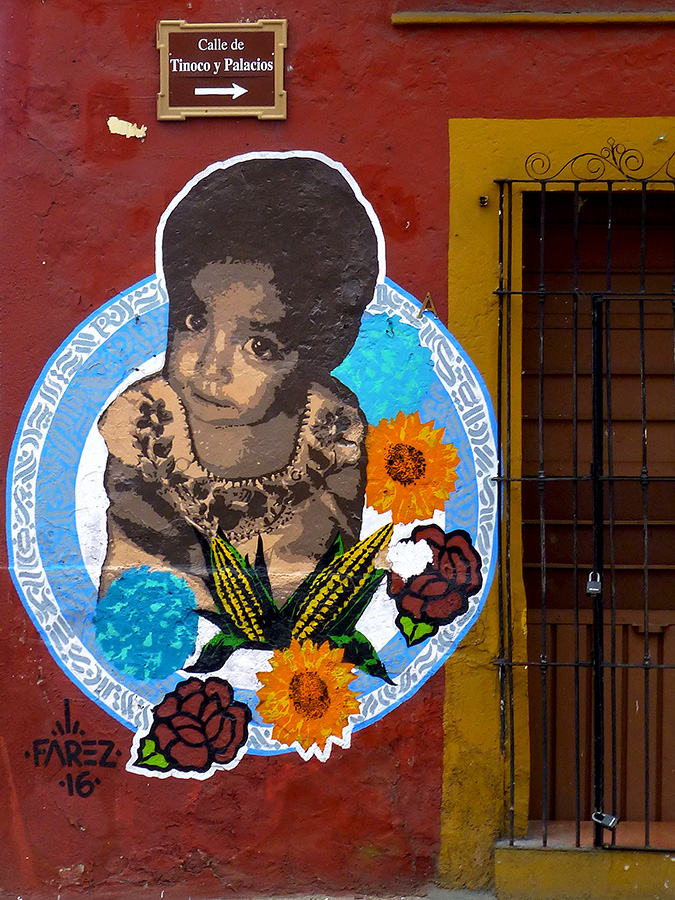
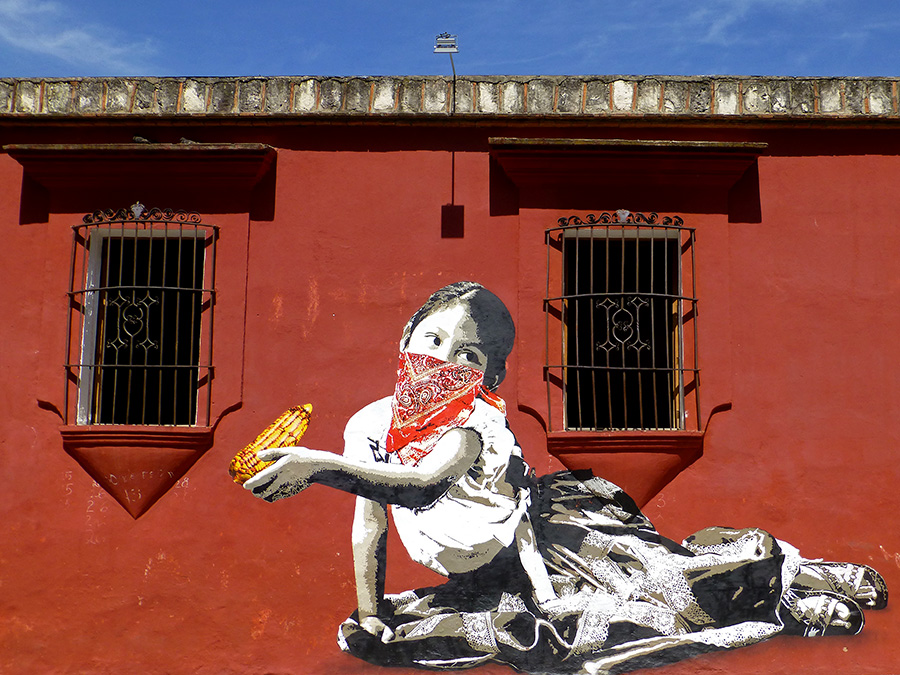
There she was, beckoning, much like the beautiful and haunting mural, We sow dreams and harvest hope on the Tinoco y Palacios wall of Museo Belber Jimenez (before it, along with others, was unceremoniously ordered removed by the city government).  Another mural by Colectivo Lapiztola.

P1210916

The symbolism of the corn, the bandana, and a young indigenous girl is rich in the layers of rebellion and resistance of modern-day Oaxaca.  And so I went up the stairs of IAGO and into the courtyard where Benito Juárez presided over the entrance to the exhibit, Corte Aquí (Cut Here), by the Lapiztola collective.

P1210940 (1)

Lapiztola consists of three artists:  Rosario Martínez, Yankel Balderas, and Roberto Vega.  This small exhibit (3 stencils and 7 graphic works), with its larger-than-life images, covers three rooms and stimulates our hearts and our minds.

P1210922

Over the past ten years, as the exhibition demonstrates, Lapiztola has taken on the issues of social protest, disappearances, the protection of natural resources, and drug-trafficking — the latter, as evidenced below.

Also included, is one of the first Lapiztola images that fascinated me.  It covered the front of the Espacio Zapata in 2012 and speaks volumes about modern society.

P1210930

If you go to the exhibition, don’t miss the third room; in it hangs the three massive stencils (below) used to produce the brilliant mural I named the Art of Agave, celebrating the human face of agave cultivation.  It once educated and enlivened the wall of Piedra Lumbre on Tinoco y Palacios, before it, too, was painted over.

P1210927

I’m not sure how long the exhibition will last.  However, if you are in Oaxaca, I encourage you to pay it a visit and to all, when you are in Oaxaca, make sure to pay attention to the walls — they have something tell you.

Read Full Post »

It’s here!!!  Sam messaged me Saturday night to say that my Tree of Life tapete was finished.  So, my trusty blogger buddy Chris (he had an ulterior motive) and I drove out to Teotitlán del Valle to pick it up.

P1210878_crop

This very unique Tree of Life was designed by Sam Bautista Lazo (above on the left) and I had been immediately drawn to the use of a corn stalk, instead of a tree.  After all, this is the valley where corn was thought to be first cultivated. Sam’s father, Mario Bautista Martínez chose the colors and, as I recounted in my Yagshī for my Tree of Life blog post, Sam’s mother Leonor Lazo González (above, second from right) dyed the wool.

P1210871

The plan had been for Sam’s father to weave the rug, but farm work was taking the bulk of his time, so he turned it over to Jacinto (above left), a weaver in the village who specializes in the Tree of Life.  Sam was incredulous that Jacinto didn’t draw the design on the warp and, instead, just did it “free hand” — weaving from a photo of the larger rug Sam had provided.  And, if you are wondering, it took 72 hours to complete.

P1210906

Here it is, up close.  As you know, the moss/celery green color came from the yagshī plant.  The brown was made from dried granada (pomegranate) skins and the yellow came from bejuco (dodder), a parasitic plant that can be seen draping itself over the branches of the Piru tree in Teotitlán.  Añil (indigo) supplied the blue and the reds came from cochinilla (cochineal).  While the other dyes can be gathered in the village, these latter two must be purchased and can be quite expensive.

P1210903

Here it is, hanging in its new home at Casita Colibrí.  I am SO grateful to Sam, Leonor, Mario, and Jacinto for their creativity, talent, and hard work in bringing my tapete to fruition and to Mother Nature for the resources she provides Teotitlán del Valle.  It takes a village to make a Tree of Life!!!

Read Full Post »

Five days ago, Norma Schafer blogger at Oaxaca Cultural Navigator and moderator of the Facebook group, Mexico Travel Photography, issued a 5-day “Mexico Colors” photo challenge to the Facebook group — one photo a day for five consecutive days.  I think she was giving us a gentle prod, because up until then, most of us had been pretty lax about posting photos.  However, with her challenge, the floodgates opened.  Unsurprisingly, my five entries were all about the colors of Oaxaca.

P1210349_day1

Day 1:  Naturally dyed yarn hanging to dry at the family home of Porfirio Gutiérrez and his sister, Juana Gutiérrez Contreras.

P1090252_day2

Day 2:  My empty wine bottles hand painted by Isabel in San Antonio Arrazola, Oaxaca — waiting to be filled with mezcal!

IMG_1305_day3

Day 3:  Danza de la Pluma in Teotitlán del Valle, Oaxaca — during this year’s patronal festival honoring Preciosa Sangre de Cristo.

P1170253_day4

Day 4:  The “only in Oaxaca” celebration of Día de la Samaritana in Oaxaca city.

P1200734_day5

Day 5:  Flor de Piña dancers from San Juan Bautista Tuxtepec at this year’s second Guelaguetza desfile in Oaxaca city.

Norma has hinted that there may be more challenges to come.  We shall see!


Read Full Post »

Murals seen in mid July on Garcia Vigil, between Independencia and Morelos.  A month later, they have been painted over, but in Oaxaca, god and resistance never die…

P1200168

P1200169

P1200172

P1200174

P1200175

P1200396

P1200404

The public school fall semester is scheduled to start Monday, August 22 and, as you can see from the Oaxaca-The Year After blog post, for good reason, no one is holding their breath.

So, while we wait, take a deep breath, exhale, and watch Lila Downs performing Dios Nunca Muere live HERE.

Save

Read Full Post »

The morning of August 12:  Almost continuous explosions of cohetes (rockets), shrill incessant traffic whistles, honking horns, and the distant sounds of a band (or two or three).  What in the world?  I had errands to run, so out into the cacophony to confront the unknown, I went.  It only took walking to the end of my block to realize what I’d forgotten.

IMG_2335

It’s Día del Taxista, the day when cab drivers and their families decorate their taxicabs and process en mass through the streets of the city, accompanied by bands, monos, and pirotecnicos (hence the booms and bangs).

IMG_2333

I not only forgot what day it was, but I also forgot my never-leave-home-without-it little Lumix, so the above were taken with my iPhone — something I almost never do and which explains the “creative” image below.

IMG_2326

I have NO idea how it happened, but I’ve got to say, it does illustrate what riding in a taxi in Oaxaca often feels like!

Save

Read Full Post »

Today, August 9, is International Day of the World’s Indigenous People, so designated by the United Nations.  This year’s focus is on the right to education — a timely and white-hot issue in Oaxaca and several of the other Mexican states with significant indigenous populations.  I can think of no better way to honor the day and native peoples worldwide, than to share yesterday’s adventure in the Zapotec village of Teotitlán del Valle.

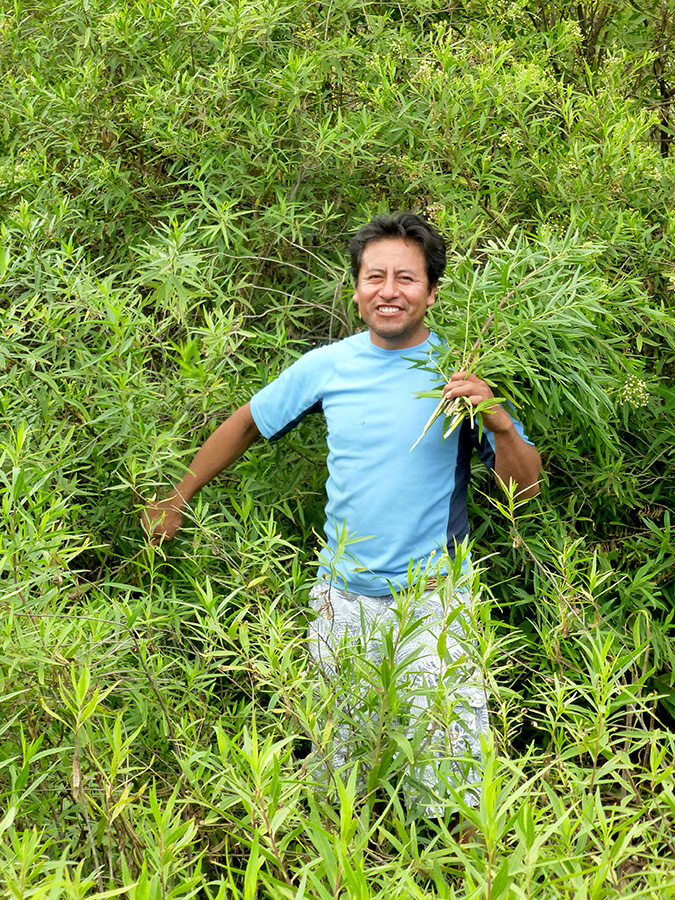
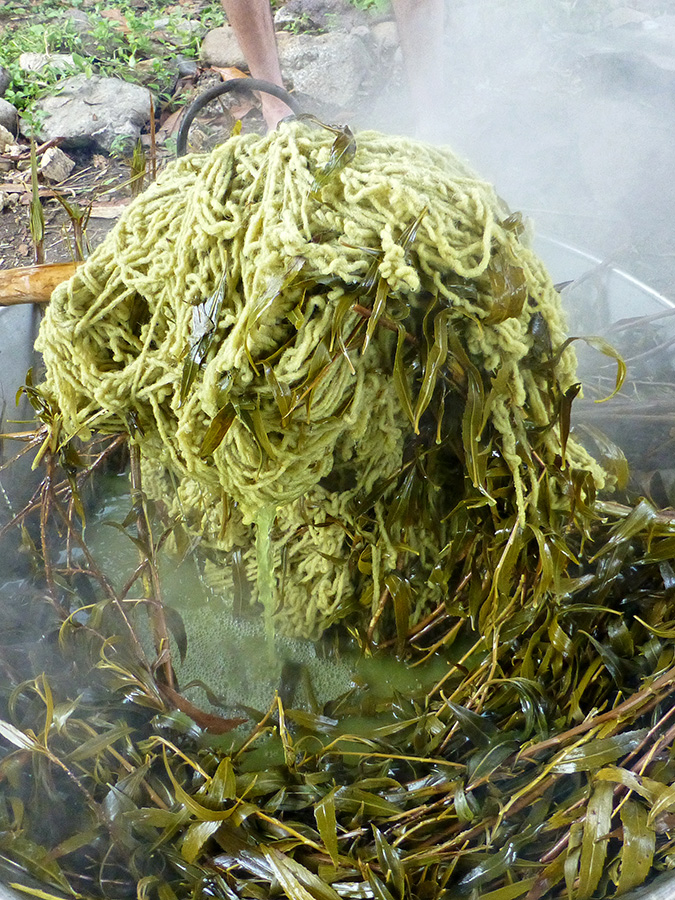
As I previously mentioned, in my endeavor to single-handedly boost the local economy, I commissioned the weaving of a tapete (rug) from my friend, Samuel Bautista Lazo’s family business, Dixza Rugs.  The design is a Tree of Life, with a light moss green background.  Thus, yesterday, led by Sam, we (a young Aussie fellow staying at the family’s Airbnb, blogger buddy Chris, and I) ventured out near the far end of the village dam to gather yagshī, the plant to be used to dye wool the desired color.

P1210646

Sam is explaining that his mother wants the young bright green shoots for the dye bath, as she wasn’t at all satisfied with the color the older leaves yielded.

P1210650_crop

Sam, about to hand off a bundle of yagshī to me to put on our pile.

P1210655

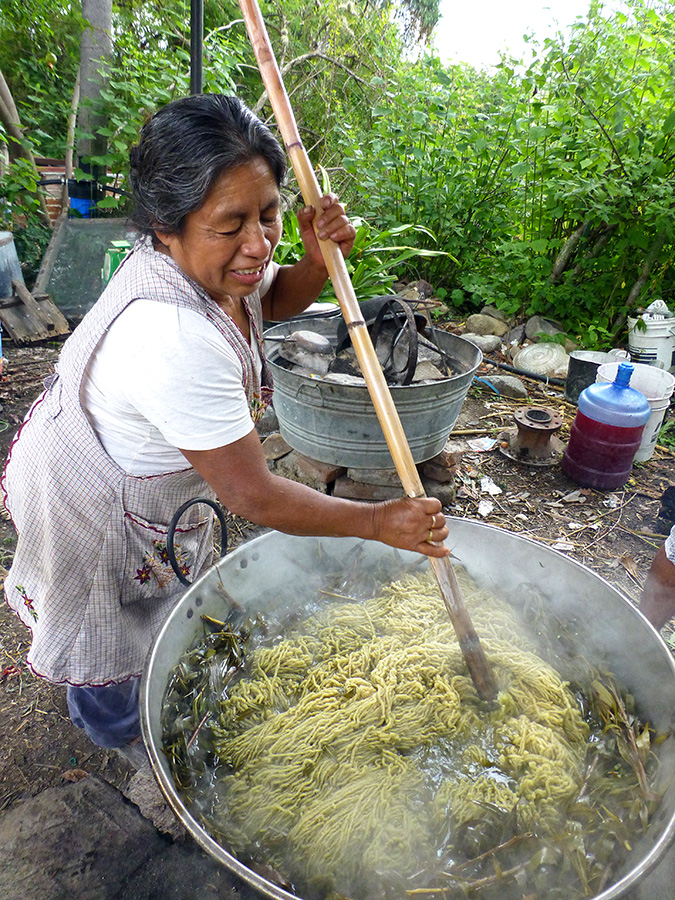
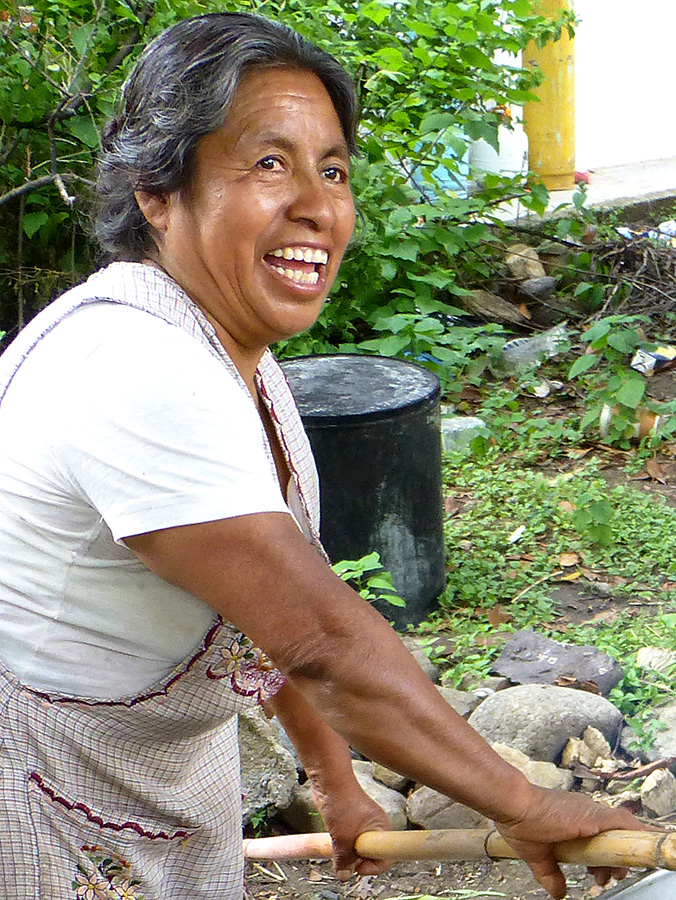
Into the cauldron of hot water, it went.  That’s Sam’s tiny powerhouse mother, Leonor Lazo González.  She was making that face because the smoke from the hardwood fire below really stung the eyes.

P1210678

Like strands of spaghetti, into the yagshī dye bath, the lana (wool) yarn went.

P1210682

Now you see Sam, now you don’t!

P1210684

Leonor stirring the pot.

P1210665

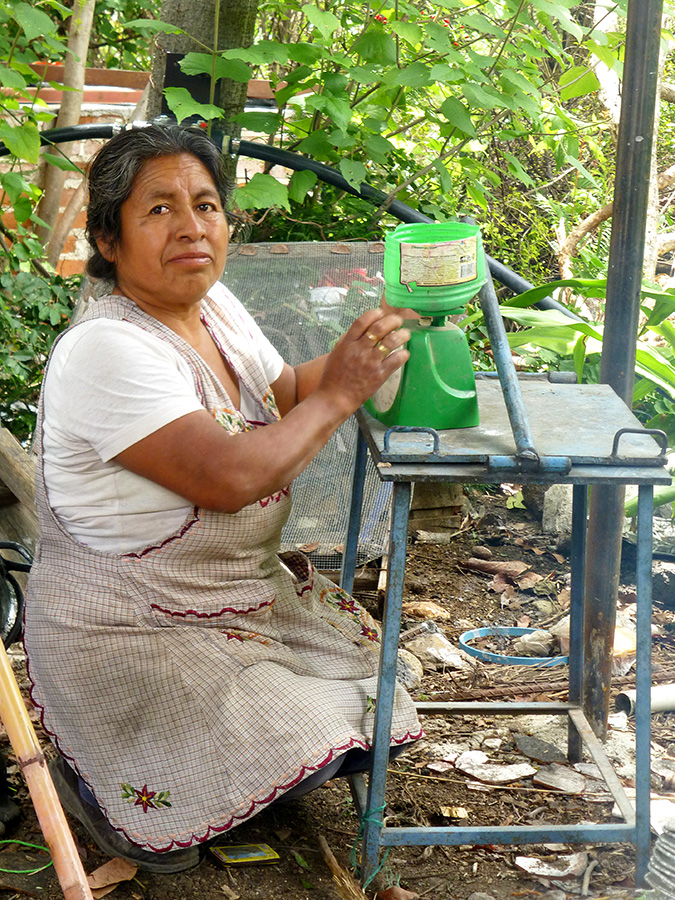
Leonor measuring the weight of the alum mordant to be used to set the dye.  Yes, she’s using a tortilla press as a table.

P1210686

Sam adding the alum (dissolved in water) to the pot.

P1210691

Pasta al pesto?  The yarn will marinate in the dye bath overnight.

P1210693

Mom knows best and seemed to be pleased with the day’s results!

Sam is a very smart guy and has a Ph.D. in Sustainable Manufacturing from the University of Liverpool.  However, being schooled in the traditions, language, and Zapotec way of knowing by his parents, grandparents, and elders of the community is an education that is just as valuable and should never be lost.

Save

Save

Save

Save

Save

Read Full Post »

The reports are in regarding tourism during the Guelaguetza and, unfortunately, they confirm our observations and discussions with merchants, restaurateurs, and hoteliers.  Hotel occupancy was only at 53% and tourism was 37 points below estimates for the period, July 22 to August 1.  Artisans had to pay 2,600 pesos (US$138.00) for a stall at the state sponsored, Encuentro Artesanal Guelaguetza (exposition and sale), which ran from July 16 to August 1, and many said they barely broke even, especially when taking into consideration expenses getting to and from the site and having to purchase meals.

However, I tried my very best to help the local economy throughout Guelaguetza.  As regular readers know, I love the textiles of Oaxaca and thus I have a few new treasures hanging in my closet.  First, this modern take by Muchitos on the traditional huipil.

P1210430

I purchased it at Letra Capital, a 4-day contemporary design market, held in the courtyards of the Biblioteca Pública Central de Oaxaca.

P1210436

And, then there was this traditional huipil woven by Juana Reyes García from San Juan Colorado, Oaxaca, and purchased at the 4-day Tianguis Artesanal at the Centro Cultural San Pablo.

P1210408

Juana has been recognized for her work using natural dyes and has won several prizes.

P1210426

Then there was the tunic-length (at least on me) blusa from one of the extraordinary embroiderers of San Antonino Castillo Velasco — bought at the above-mentioned Encuentro Artesanal Guelaguetza.

P1210569

I have been wanting one for years and years.  However, whenever I’m in San Antonino, it’s usually for a festival or during Día de los Muertos and, while there are stalls upon stalls selling blouses and dresses,  I’m distracted by the event at hand — never mind, that I don’t usually carry enough money to pay for one of these treasures.  Isn’t the work exquisite?

P1210583

I’ve already worn all three of my new textile treasures several times.  And, that wasn’t the end of my shopping spree.  My other big splurge was commissioning a tapete from my friend, Samuel Bautista Lazo’s family business, Dixza Rugs.  They had a stall at the Encuentro Artesanal Guelaguetza and a rug I fell in love with.  Alas, it was too big, so they are making me a smaller one.  Sam has promised it will be done within a month.  Blog post to follow!

Save

Save

Read Full Post »

Unlike last Saturday, there was no rain on yesterday’s Guelaguetza parade.  There was music, mezcal, and tepache. (Click on photos for full image.)

There were headdresses and bling.

There was awesome pride and joy.

And, there were kids to carry on the traditions.

Muchisimas gracias to the extended family of Hotel Casa Catrina who allowed me to seek shelter from last Monday’s rain and yesterday, saw me across the street and invited me for a shot of mezcal and to watch the desfile with them.  That’s Oaxaca — warm, welcoming, and wonderful!!!

Read Full Post »

A pause in the Guelaguetza action…

I was last on Callejón de Hidalgo about a month and a half ago and a new (to me) mural charmed me.  I’ve been meaning to post photos, but there has been way too much going on and they got lost in the pictures shuffle.

P1190669

Murals are usually a “no-go-zone” for graffiti.  However, yesterday, walking with friends, I again found myself on that lovely little lane, but was dismayed to discover someone(s) had tagged Peter Cottontail and his tree-lined neighborhood with graffiti.

P1190666

I don’t know who you are, Mainy-Dauer, but I want you to know your mural made be smile.

P1190667

I’m glad I have the above photos to remember it by.


Read Full Post »

As regular readers know, I have a huge soft spot in my heart for the people and cultural traditions of the Zapotec village, Teotitlán del Valle.  Blogger buddy Chris and I go out there often, especially for their major festivals where the Danza de la Pluma is performed.  Earlier this month, a new group of danzantes de promesa assumed the sacred 3-year commitment to perform the Danza de la Pluma and, for the first time in recent memory, they were selected to dance in this year’s official Guelaguetza.  As you can see from the Vive Oaxaca video below, their 17-minute performance Monday evening was spectacular!

¡Felicidades! to the band, Los Reformistas, led by Maestro Antonio Servando Bautista González; to the breathtaking dancing of Sergio Gutiérrez Bautista (Moctezuma), who was front and center and flawless during the entire performance; and to all the Danzantes, who impressively executed the complicated and visually stunning choreography of Maestro Javier Gutiérrez Hernandez.  While I may only be a (albeit, frequent) visitor to Teotitlán del Valle, I couldn’t help but feel incredibly proud of the dancers and the way they represented their strong, vibrant, and historic community.

Read Full Post »

« Newer Posts - Older Posts »