Feeds:
Posts
Comments

Posts Tagged ‘Oaxaca’

… and for everything good, you also should.”  — old Oaxaca saying.

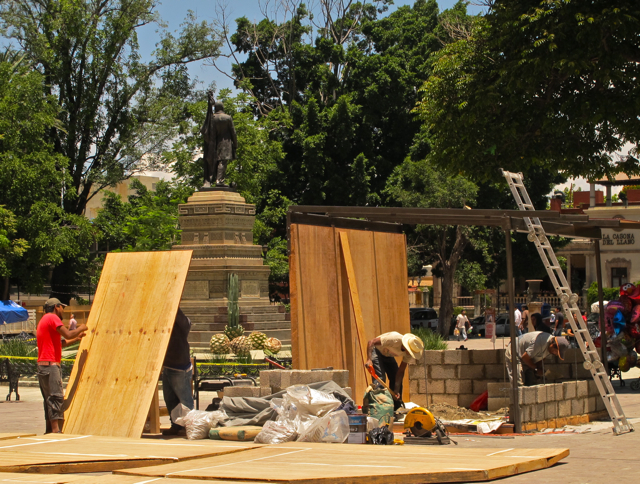
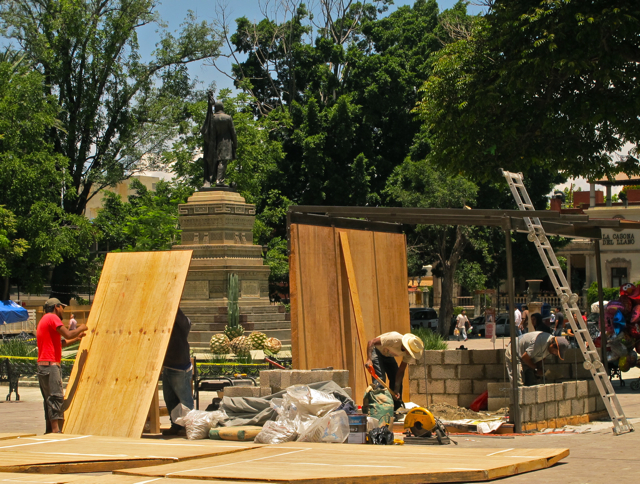
Today, the XIV Feria Nacional del Mezcal opens in el Paseo Juárez el Llano.  Preparations were in full swing yesterday afternoon, when I walked passed Llano Park (as it is more commonly known).

Behind the back of Benito Juárez, carpenters were busy.

Carpenters building a booth in Llano Park next to statue of Benito Juárez

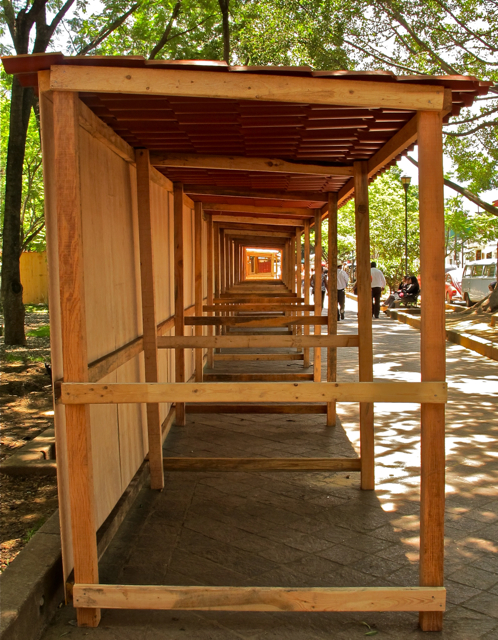
Newly constructed puestos lined the sidewalk on Pino Suarez, waiting to be filled with vendors and displays…

Empty booths along sidewalk
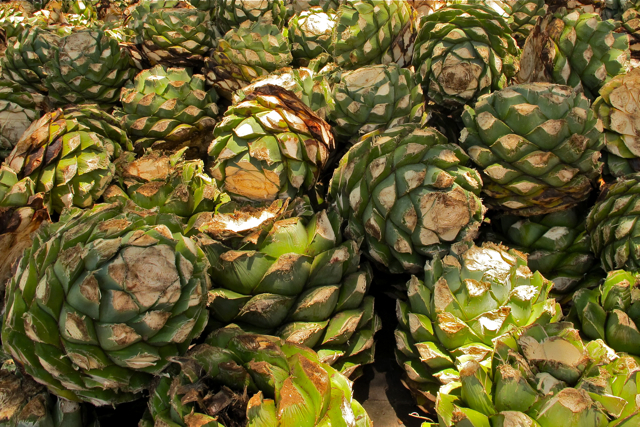
… and hearts of the maguey  (called piñas, because they look like pineapples) were piling up all around the park.

Pile of hearts of the maguey

For more information about mezcal, including how it differs from tequila, see:

In the meantime… “¡Arriba, abajo, al centro y pa’ dentro!”

Update:  Posters, website, and other publicity to the contrary, the feria did not begin today.   Mañana is the word!

Read Full Post »

Hammock time

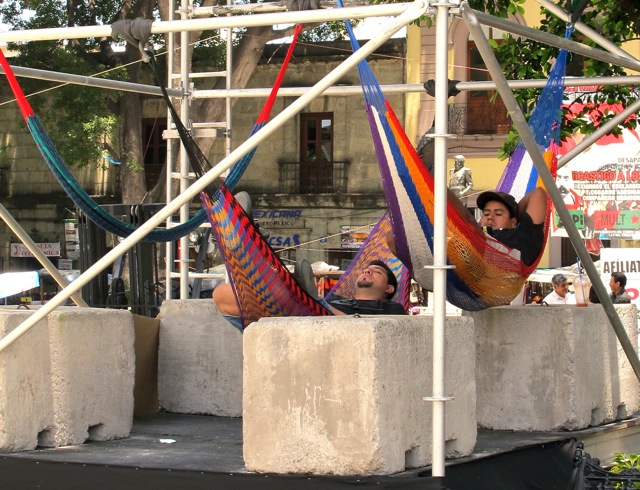
Guelaguetza is almost here, the Zócalo is teeming with tourists, and a massive stage is being set up opposite the cathedral.  I think these guys are guarding it.  I want their job!


Two guys in hammocks hanging from stage scaffolding

Hmmm… there’s an empty hammock.  Maybe I should apply!

Read Full Post »

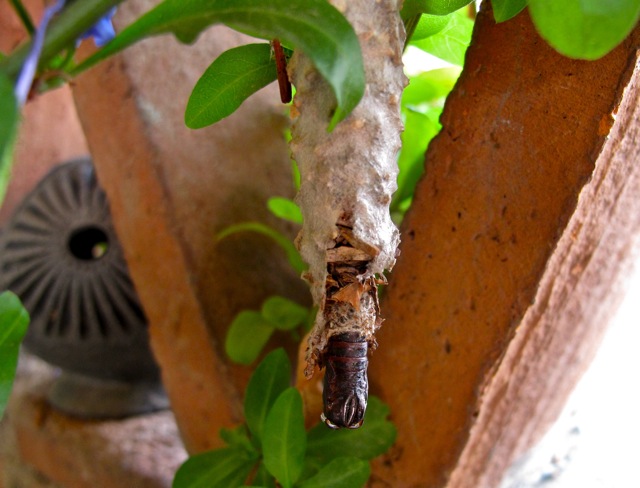
Back on January 10th, I posted a photo of a pupa that had materialized on my plumbago while I’d been up in the USA for a month.Butterfly pupa hanging on a plumbago stem
What I haven’t mentioned is that the next day, it moved!  It began traveling up and down the plumbago.  I ran inside, grabbed my new Canon G12, set it to video, and began recording.  Video was edited, music was added, and the following resulted:

However, that isn’t the end of the story.  I kept close tabs on the terrace’s new resident, checking daily, but no more plumbago strolling; the pupa remained firmly fastened to one of the branches.

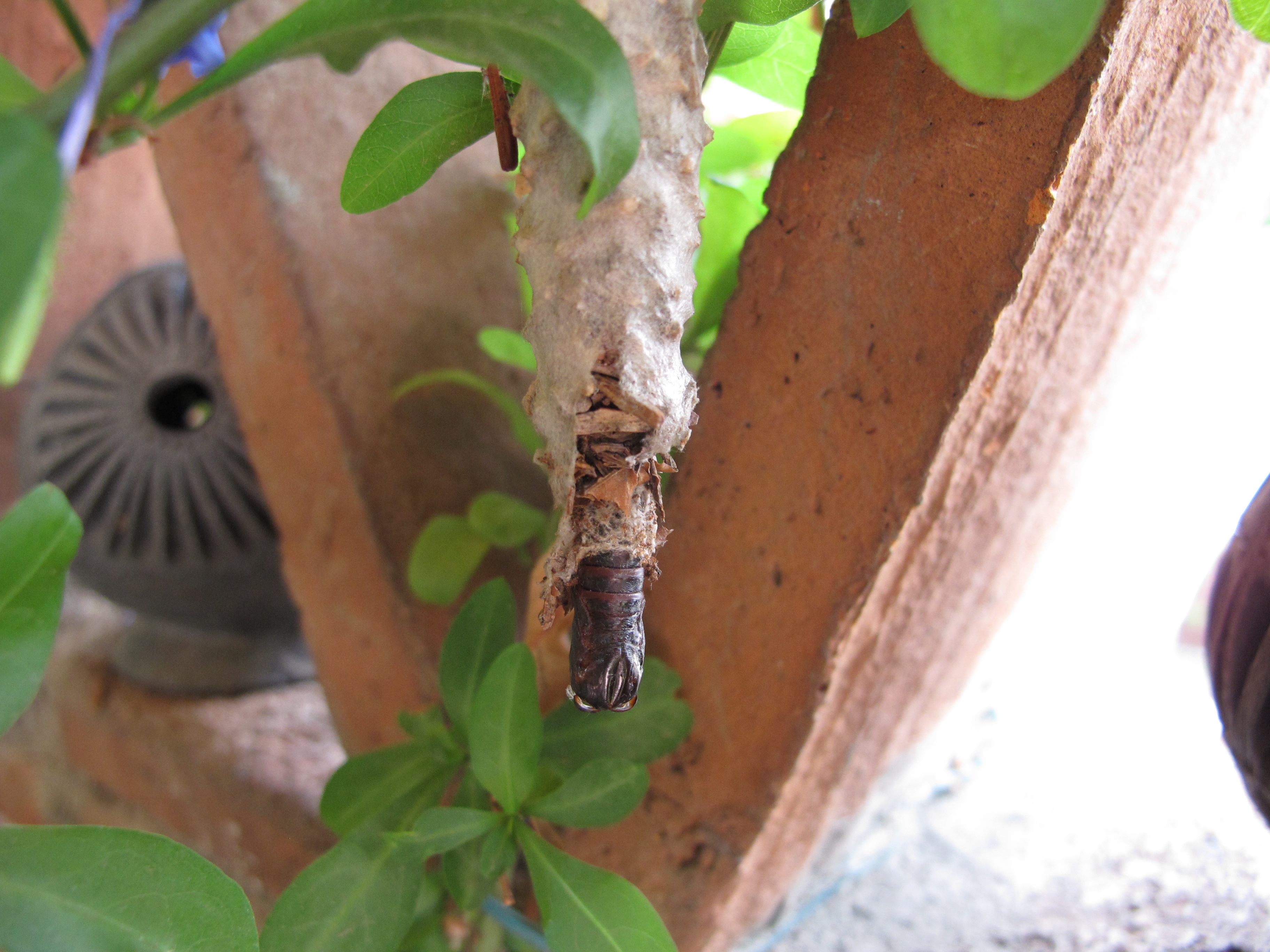
Then on April 17th, over 3 months later, I noticed a significant change in the pupa…

Butterfly pupa
A butt protruding?  Was a butterfly in the process of emerging???  Daily observations continued… no change.  I returned to the USA for a month, returned to find… NO change!

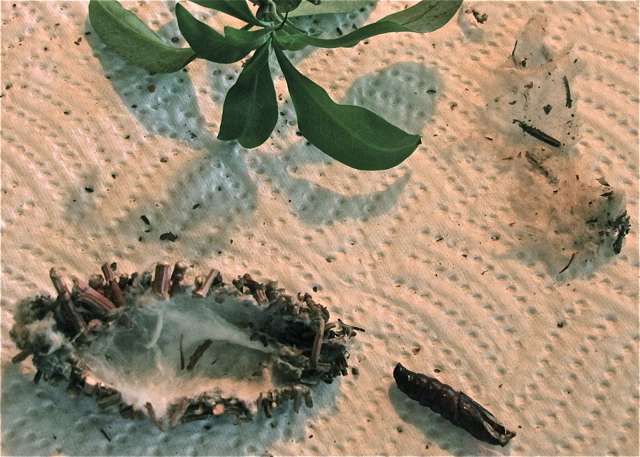
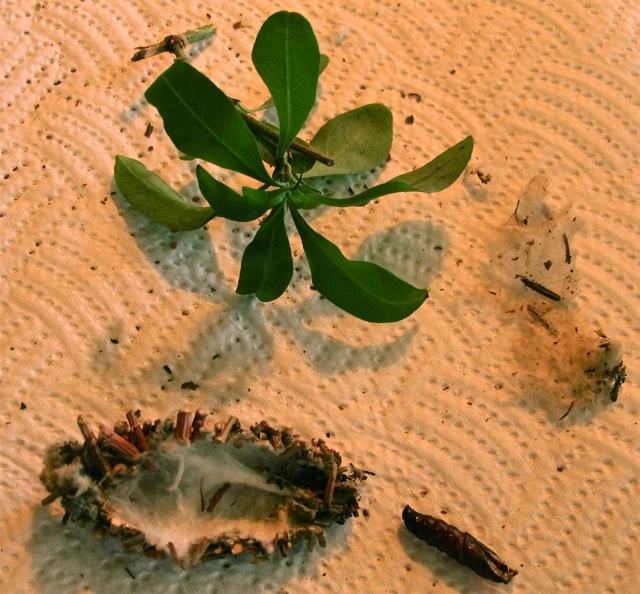
Finally, on July 2nd, I couldn’t stand it any longer.  With the Skype encouragement from my friend G, I snipped the pupa from its home of almost six months and began a dissection;  the industrial strength silk was peeled away and the woody chrysalis was cut into with my gardening shears… a hollow shell of the “butt end” and an empty cottony interior was revealed!

Open chrysalis, silk from pupa, shell, and leaves from plumbagoThe butterfly had flown…


Save

Read Full Post »

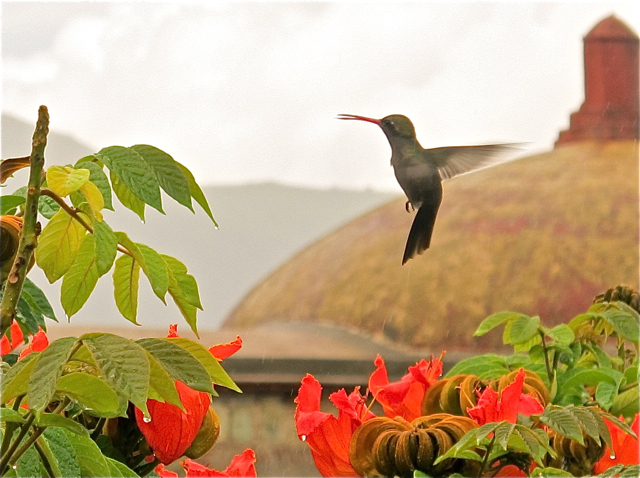
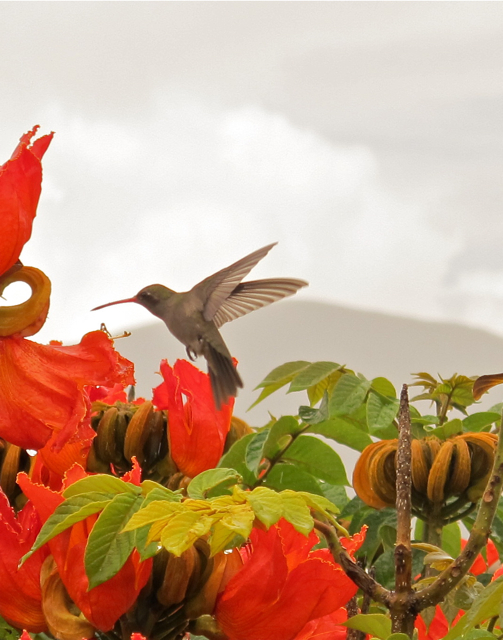
A major source of entertainment these gray rainy days is watching the colibríes darting in, around, and through the African tulip trees surrounding my terrace; sipping nectar from the profusion of giant red-orange blossoms 3 times their size;


Hummingbird hovering over African tulip tree
… chasing each other as they protect their turf (Hey guys and gals, there’s enough for everybody!); catching insects with their rapier like tongues; and pausing for a brief rest at the tip of a branch,

Hummingbird hovering over African tulip tree blossoms

… but always on guard.


Read Full Post »

After the two days spent in Teotitlán del Valle last week, I’ve been thinking a lot about the following article, written for the Guardian International Development Journalism competition.

Theme: What stops children in rural areas going to school? sponsored by the David Rattray Memorial Trust

Elena Gonzales folds yarn between her fingers. Her tapestry is woven in an intricate pattern of ochre and indigo, with fibre that has been dyed using moss and bark, fruit and flowers. Here in the hills of Oaxaca, in southern Mexico, indigenous Zapotec communities have been weaving rugs for more than two thousand years. Elena spins the loom and the centuries fall away.

Like many Zapotec children growing up in the 1980s, Elena did not attend school. Faced with a primary curriculum that took no account of Zapotec language or culture, her parents decided that she should be educated by her community. She was taught to weave by her grandmother. Self-sufficiency is the historic norm in Oaxaca, but in recent decades as rural life has become increasingly entretejidos – interwoven – with the modern market economy, Zapotec children who have not gone to school are finding themselves on the wrong side of an urban-rural education divide that excludes them from employment and contributes to deepening poverty.  [Read full article]

Multicolor tapete

Tapete purchased in Teotitlán del Valle by a friend. It was woven by Demetrio Bautista Lazo but was started by his young son.

Read Full Post »

Way back in the very early 1980s, I was captivated by the PBS series, The Flame Trees of Thika, based on the Elspeth Huxley memoir, by the same name, about her early years in Kenya.

African Tulip tree reddish orange blossoms

We had a black and white TV back then and so, if they even showed the “Flame Trees,” they never “registered.

African Tulip tree reddish orange blossoms

However, here I am in Oaxaca, Mexico and I’ve got two African Tulip Trees (aka, Flame of the Forest) hovering over my terrace, bursting with color, providing a modicum of shade, feeding the hummingbirds, and adding to the enchantment of Casita Colibrí.

African Tulip tree reddish orange blossoms

There was something about the sky, the light, and the trees this morning…

Read Full Post »

I must confess, I’m partial to Teotitlán del Valle and this fiesta.  It was photos from the 2007 celebration that first persuaded me to visit Oaxaca.  However, this is it… I promise… no more photos from the Preciosa Sangre de Nuestro Señor Jesucristo in Teotitlán del Valle until next year!

This slideshow requires JavaScript.

However, if you, like me, can’t get enough… check out Chris’s photos over at Oaxaca-The Year After.

Read Full Post »

A brief slice from the hours and hours of dancing done by the Danzantes de Promesa, in the plaza in front of the church in Teotitlán del Valle, during the multi-day fiesta honoring Preciosa Sangre de Nuestro Señor Jesucristo.

The Danza de la Pluma consists of 41 “bailles” (pieces of music) that, on the surface, reenact the conquest.  Cortes and his troops are played by very young through teenage boys.  They occasionally march around, but mostly stay seated.  The Danzantes representing the Aztec, on the other hand, are young (and not so young!) men and dance at least 70% of the time.  In addition, Moctezuma has some solos and La Malinche and Doña Marina perform several lively dances.

A 20+ piece orchestra accompanies the dancers, playing the proscribed music, including, incongruous to me, waltzes, polkas, and schottisches. According to the Harris article referenced below, at the end of the 19th century the orchestra replaced the original indigenous drum and flute.

The subtext and “hidden” narratives of the danza are multiple and complex and I’m only in the infant stages of understanding.  For now, until my Spanish language skills improve significantly and I can talk with someone who is a member of the community, I will leave it to the two scholarly articles listed at the end of this post to attempt interpretation.

By the way, the day was overcast and windy at times, with gusts threatening those enormous and extremely top-heavy headdresses.

References:

Cohen, Jeffrey.  Danza de la Pluma:  Symbols of submission and separation in a Mexican Fiesta.  Anthropological Quarterly, Jul 93, Vol. 66 Issue 3, p. 149-158.

Harris, Max. The Return of Moctezuma.  The Drama Review, Sp 97, Vol. 41 Issue 1, p. 106, 29 p.

Now that I’ve done some research (alas, after the fact)… I want to see it again!

Read Full Post »
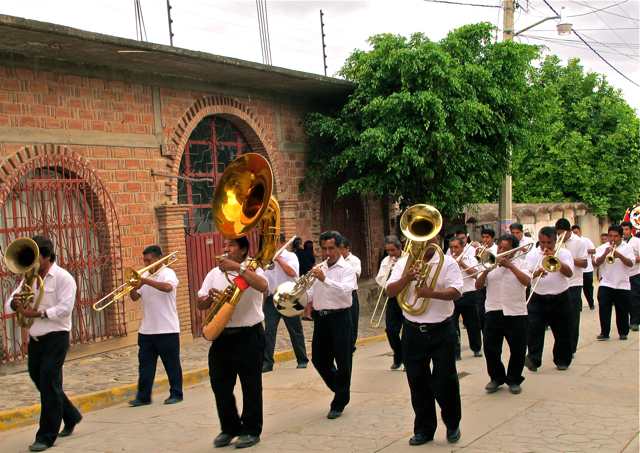
After all the waiting, the calenda (parade) of the Preciosa Sangre de Nuestro Señor Jesucristo began winding its way from the church courtyard down the narrow streets of Teotitlán del Valle and back up to the courtyard.

Arms raised, the unmarried young women of the village carried these bamboo-framed canastas floreadas above their heads for the entire route.

And, naturally there was a band… with the requisite tuba!

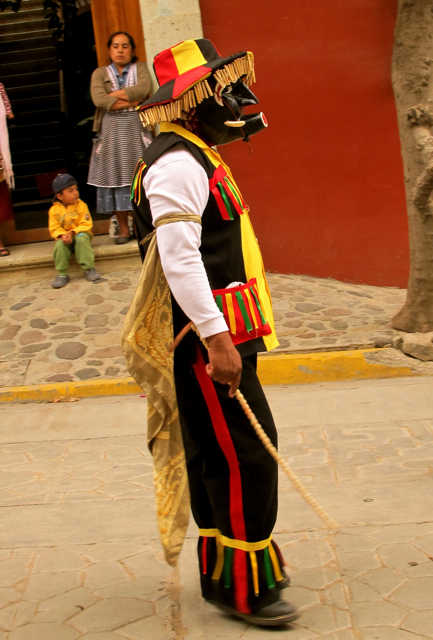
This Subalterno (one of two who keep their eyes on the festivities) kept the procession moving along…

including the young Soldaditos of Hernan Cortes.

They were followed by the Danzantes de Promesa (note the other Subalterno to the far right)…

and bringing up the rear, Moctezuma with the dual personalities of the same woman, La Malinche and Doña Marina.

In this village, known for its weaving, a complex tapestry of religious ritual, historic legend, and tangled mythology has been woven together to celebrate community and identity.

Definitely worth the wait… AND there’s more to come!

Read Full Post »
The participants also did a lot of waiting…

This slideshow requires JavaScript.

How do they remain in such good humor???

Read Full Post »

Waiting is something one does here… and, no matter what the age, it always seems to be done with a Zen-like patience.  Today it was for the traditional calenda of the Preciosa Sangre de Nuestro Señor Jesucristo  in Teotitlán del Valle.

This slideshow requires JavaScript.

More on the fiesta in upcoming posts…

Read Full Post »

Viejas peligrosas was the headline of an article in yesterday’s Noticias, chronicling the dangerous old buildings in the 484-block historic center of Oaxaca.  According to the article, 23 properties are at high risk of falling, are magnets for trash disposal, and are sources of disease.

Although en español, I encourage even non Spanish speakers to take a look at the revealing slideshow of some of the more egregious, but highly photogenic, properties at the end of the article.

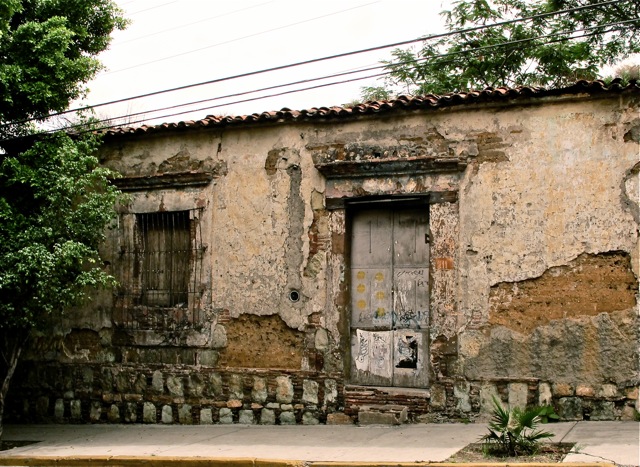
In addition, I’d like to nominate this building:

Front of dilapidated building

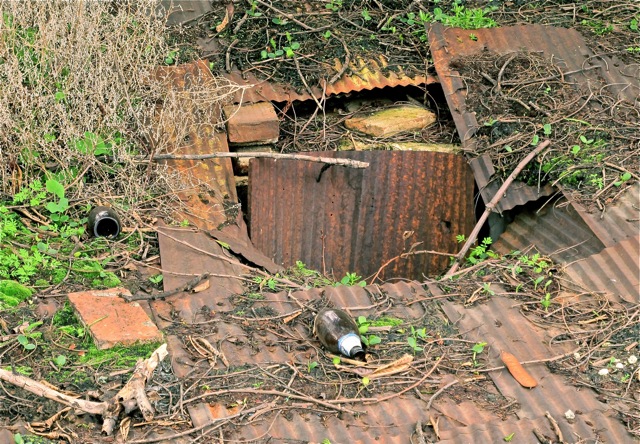
And, what do you think about the roof???

Collapsing tin roof

Read Full Post »

Sadly, the tree mentioned in my last post didn’t fall as a result of wind and rain.   According to newspaper reports, it was slammed into by a Chevy Silverado; the driver apparently had fallen asleep at the wheel.

Sidewalk memorial to Victor D. Diaz Gonzalez

Víctor Damián Díaz González was killed instantly.

Read Full Post »

After 35 days up in the USA (and yes, I was counting), I’m back in Oaxaca.  The old stove still “decorates” the driveway of my apartment compound, apparently following in the footsteps of the two refrigerators which graced the driveway for almost a year.

Old stove sitting on the side of driveway

However, there are a few changes in the ‘hood.  I arrived home yesterday, to discover a delightful new neighbor moving into one of the apartments below me; the stump of a tree across the street that must have toppled during one of the recent storms;

Tree stump in front of building

and a new canopy atop the Guelaguetza Auditorium.

Sun-shade on the Guelaguetza Auditorium

This is a “take two” attempt at this controversial sunshade; the first tore before it was even finished, causing last year’s Guelaguetza performances to be relocated to the university’s soccer stadium, across the city — making yours truly a very unhappy camper!  With family visiting, it was the first time I had shelled out the big bucks to attend and, not only could we not just walk up the hill to the event, we weren’t able to enjoy the fabulous views of the city and the mountains to the east, that the Guelaguetza Auditorium provides.

FYI:  Over the past week, Chris at Oaxaca-The-Year-After, has been blogging about the controversy.

Read Full Post »

One of the sights on the streets of Oaxaca that always brings a smile is a father holding his young daughter’s hand in one hand and her little pink backpack in the other.  In the absence of a photo of that delightful scene, here are a few other padres y hijos…

This slideshow requires JavaScript.

Read Full Post »

« Newer Posts - Older Posts »