Feeds:
Posts
Comments

Posts Tagged ‘convite’

Defining the terms…

According to Harrap’s Spanish and English Pocket Dictionary, convite means reception.  However, if I drag my weighty Larousse Standard Diccionario down from the shelf, convite translates to “invitation” or “banquet.”  And, if one turns to Google or Bing translation programs, a convite is a “treat.”

All pretty much agree, the English translation for cochinilla is cochineal.  As Wikipedia explains, “Cochineal is probably from French cochenille, Spanish cochinilla, Latin coccinus, meaning ‘scarlet-colored,’ and Latin coccum, meaning ‘berry (actually an insect) yielding scarlet dye.'”  It has been called, A Perfect Red and was much sought after by Europeans.  Home to said insect is the nopal cactus and guess who and where it was probably first cultivated?  In the valley of Oaxaca by her indigenous people, long before the Spanish set foot on the continent.

Which brings us to last Saturday (September 6) in Teotitlán del Valle, under the watchful eye of el Picacho, the sacred brother/sister mountain, for the convite that precedes the Virgen de la Natividad (Nativity of Mary) festival day, held annually on September 8…

This slideshow requires JavaScript.

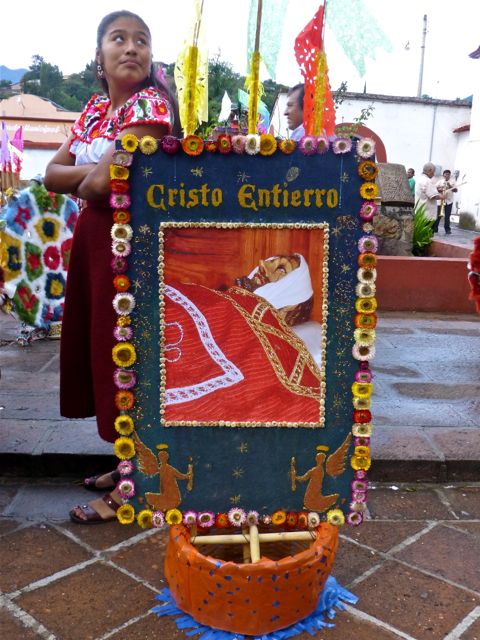
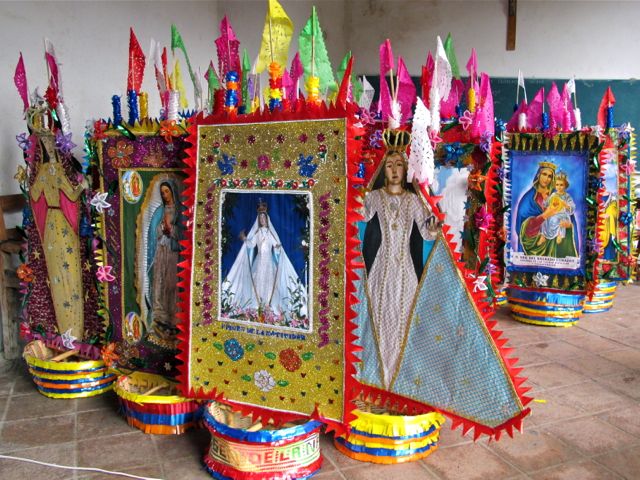
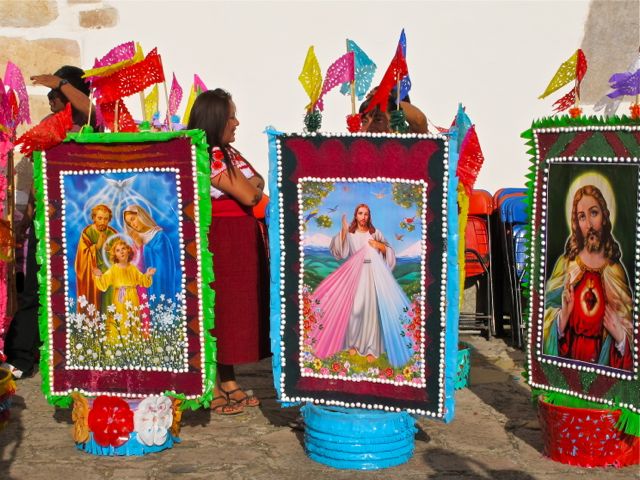
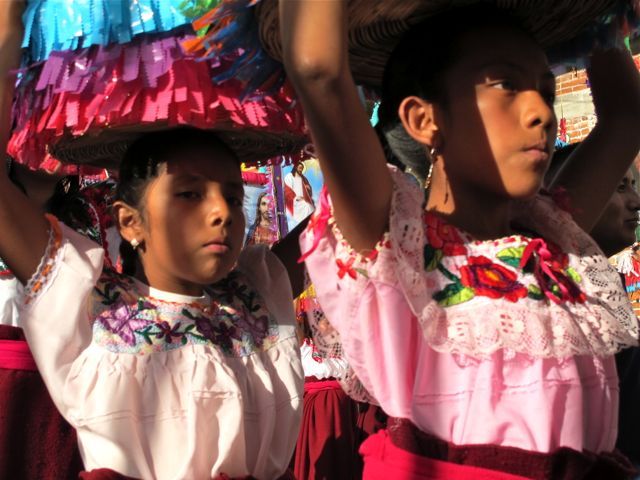
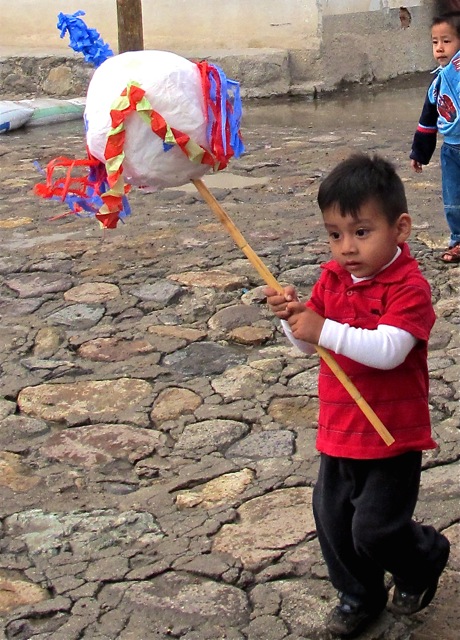
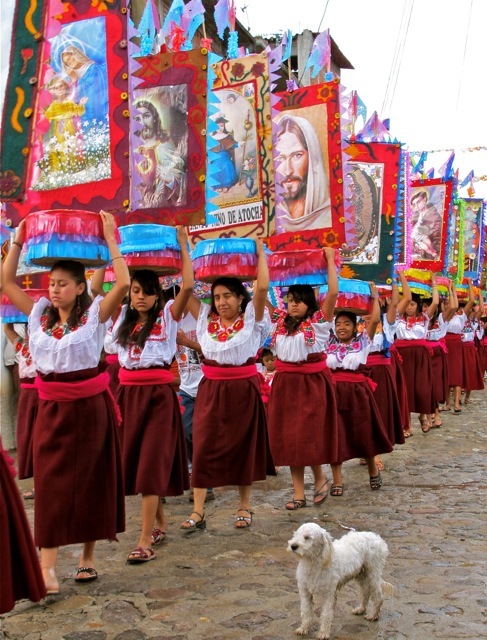
It is the custom in this Zapotec village for the unmarried women of the village to process through the streets two days before this (and a couple of other) important religious festivals, elegantly balancing handmade canastas (baskets), decorated with Catholic and Zapotec imagery, on their heads.  They wear brightly embroidered blusas (blouses) and, in this village known worldwide for its weaving, enredos, hand-woven red wool wrap skirts — the yarn dyed red with cochinilla.  They are accompanied by bands, men carrying enormous (and heavy!) marmotas (cloth globes), little boys carrying poles topped with miniature marmotas, sheep, and airplanes (the significance of the latter is a mystery to me), fearless pirotécnicas announcing the convite’s progress by shooting thunderous rockets into the air, and the dancers who will be performing the Danza de la Pluma in the church courtyard during the following two days’ of festivities.

Borrowing from the definitions above of convite, I would like to think of these processions as a lovely treat, an invitation to the impending fiestas/feast (banquet) days for the saints venerated by the village.  The beauty of the welcoming faces of the young, old, male, and female in the convite provide a warm reception to villagers, visitors, Catholic saints, and Zapotec ancestors, alike.

Read Full Post »

July in the valley of Oaxaca has begun!  There will be festivals of mole, mushrooms, cheeses, and tamales.  And, there will be the costumes, calendas, and music of Guelaguetza in the city and in several of the surrounding villages.  But first…

Subalterno with open arms

Under a dark and threatening sky, the people of Teotitlán del Valle began their week-long Fiesta titular a la Preciosa Sangre de Nuestro Señor Jesucristo (Festival to the Precious Blood of Our Lord Jesus Christ).  Wearing traditional embroidered blouses and wool skirts woven in this Zapotec village known for its weaving, the unmarried young women and girls gathered in front of the church (Templo de la Preciosa Sangre de Cristo) for the convite (procession) that kicks off Teotitlán’s most important fiesta of the year.

Young Zapotec women and girls in front of church

The rain held off and the procession left the confines of the church courtyard.

Marmotas and people leaving entry gate

Marmotas (giant cloth globes), music, and pyrotechnics led the way…

Banda marching down street

along with little boys holding canes of carrizo and poles topped with small marmotas, fluffy sheep, and airplanes (don’t ask me).

Little boy carrying small marmota

And then came the young women and girls, carrying canastas with images of the saints on their heads.  I have to note here, these baskets are REALLY heavy.  I know, because last year one of the gals asked if I’d like to try — I did for all of about five seconds.  They carry them for almost an hour!!!

Young women with carry canastas on their heads

Most of the residents came out to watch at prime viewing locations.  (Teenage boys were especially prominent, but they deserve another blog post.)

Men, women, and children standing on street

Under the watchful eye of El Picacho (the sacred mountain of Teotitlán), the procession wound its way up and down the cobblestone streets…

Procession in mid-ground and mountain in background

and eventually returned to the church courtyard, where it all began.

For more photos, including some of the pyrotechnic guys in action, check out Oaxaca-The Year After.

Read Full Post »

Monday, we returned to Teotitlán del Valle for the Fiesta titular a la Preciosa Sangre de Nuestro Señor Jesucristo — the pueblo’s most important festival of the year.  While special masses have been celebrated at the Templo de la Preciosa Sangre de Cristo (the village church) since June 30, Monday’s convite (procession) by the unmarried women in the village, kicked off the more public events.

Lovingly decorated canastas (baskets) waited in the church to be reclaimed by their owners, placed on their heads, and carried through the streets.

Crowds gathered in the plaza in front of the church and sidewalks and streets along the route.

And then it began — with solemn drum beats, fireworks, church bells, marmotas (cloth balloons on a pole), and a band.

Little boys (and a few girls) carrying model airplanes (don’t ask me why), paper mache lambs, and turkeys followed.

And then came the neatly organized rows of girls and young women.

For over an hour they wound their way up and down and around the streets of Teotitlán del Valle.  The weather was perfect, no late afternoon thunder showers this year, and it was glorious.

Stay tuned, the festivities continue all week.  And, check out Oaxaca-The Year After this week for blogger buddy Chris’s photos and commentary.

Read Full Post »

It’s that time of year, again.  Daylight doesn’t last quite as long, the large red-orange blossoms of the African tulip trees have mostly fallen (onto my terrace!), and the hummingbirds have mostly departed, leaving the airspace to the dragonflies and butterflies.

Decorated canasta with religious scene.

However, the season of yellow marigolds (cempazuchitl) and the yellows, oranges, and purples of flor inmortal (immortal flower) has begun and that means Días de los Muertos and Noche de Rabanos  can’t be far behind.

Decorated canasta with image of Virgin Mary.

In the meantime, during the past week, Teotitlán del Valle celebrated La Santísima Virgen del Rosario and early Friday evening, the unmarried girls and women gathered with their canastas for the traditional convite (holy procession).

Decorated canasta with image of bandaged head of Jesus.

And, given the season, flor inmortal played a prominent role in the decorations of many of the canastas.Flor inmortal surround a crucifixion scene on a canasta.

And, as always, I’m amazed and captivated by the girls and women who, with arms raised, balance these sizable baskets on their head, as they navigate the sacred route along the cobbled (and, this day, rain-slicked) streets of Teotitlán del Valle — for almost an hour!Young women wearing dark red wool wrap skirts and embroidered white blouses, carry large canastas on their heads

It’s a scene that I never tire of — of course, I’m not carrying a canasta on my head!

More photos and commentary over at Oaxaca-The Year After.

Read Full Post »

Waiting for the convite… Fiesta a la Natividad de la Virgen María.

Cloudy sky; young girl surrounded by plastic covered canastas; Cerro Picacho in background.

September 8 was a rainy day in Teotitlán del Valle.

Read Full Post »

Late yesterday afternoon, we returned to Teotitlán del Valle for the convite (parade) of unmarried young women and girls, a part of the annual patronal festival of La Preciosa Sangre de Cristo.  The sun was shining, the rains of two days before were nowhere to be seen, and the sacred mountain, El Picacho, gracefully, but commandingly, presided as the soldados and danzantes entered the church courtyard.

Soldados and danzantes with the mountain in the background

Bands also arrived to take part…

Band with tuba in front; mountain in background

Canastas (baskets) were lined up, ready to be carried…

Canastas with images of the Virgen Mary lined up.

3 canastas with images of Jesus

Canasta with Virgen de la Navidad woven into the design

The young men of the village gathered…

Young men sitting on a ledge

Young men in profile

Family and friends awaited…

Women standing and facing down the street

And then the young unmarried women and girls, the stars of the evening, raised the canastas over their heads…

Young women and girls in red skirts and white blusas carrying canastas on their heads lined up and

3 young women carrying canastas on their heads

Close-up of 2 young women carrying canastas on their heads

Balancing the canastas, they processed from the courtyard, down several long and cobblestone blocks, turned left, and headed back up another street to where they had begun, to be greeted by proud family and friends, who had gathered to acknowledge and celebrate the young women and girls of Teotitlán del Valle.

For some inexplicable reason, we never cease to feel moved and uplifted by this ritual.

Read Full Post »

To borrow from Russian actor and director, Konstantin Stanislavsky, “there are no small parts, only [very] small actors.”  And the children of  Teotitlán del Valle begin learning their lines at a very young age.

They were in full view Friday night as the convite (parade) of unmarried young women and girls opened the multi-day Fiesta de la Virgen del Rosario.

Very young Zapotec girl in traditional dress.

Young boys, carrying marmotas led off the parade, that began at the pueblo’s Sangre de Cristo church.

Very young Zapotec boy carrying a small marmota

They were followed by traditional indigenous drums and a band.

Band with marmota in background

Then the stars of the evening took center stage.  From the oldest to the youngest, all were wearing the traditional red woolen skirt (woven in the village, of course!) and blouses painstakingly and lovingly hand embroidered.

Young Zapotec girl carrying canasta on her head

Arms above head, balancing their canastas, they wound their way through the slick (it was drizzling) cobblestone streets of the village for an hour, before eventually returning to the church.

Procession of young Zapotec women carrying canastas on their heads while a little white dog watches

I don’t know how they did it; even the dogs were in awe!

Sunday’s events to follow…

Read Full Post »

« Newer Posts