Sadly, the tree mentioned in my last post didn’t fall as a result of wind and rain. According to newspaper reports, it was slammed into by a Chevy Silverado; the driver apparently had fallen asleep at the wheel.

Sadly, the tree mentioned in my last post didn’t fall as a result of wind and rain. According to newspaper reports, it was slammed into by a Chevy Silverado; the driver apparently had fallen asleep at the wheel.
Posted in People, Tragedy | Tagged memorials, Mexico, Oaxaca, photo, photographs, sidewalk memorial | 1 Comment »
After 35 days up in the USA (and yes, I was counting), I’m back in Oaxaca. The old stove still “decorates” the driveway of my apartment compound, apparently following in the footsteps of the two refrigerators which graced the driveway for almost a year.

However, there are a few changes in the ‘hood. I arrived home yesterday, to discover a delightful new neighbor moving into one of the apartments below me; the stump of a tree across the street that must have toppled during one of the recent storms;

and a new canopy atop the Guelaguetza Auditorium.

This is a “take two” attempt at this controversial sunshade; the first tore before it was even finished, causing last year’s Guelaguetza performances to be relocated to the university’s soccer stadium, across the city — making yours truly a very unhappy camper! With family visiting, it was the first time I had shelled out the big bucks to attend and, not only could we not just walk up the hill to the event, we weren’t able to enjoy the fabulous views of the city and the mountains to the east, that the Guelaguetza Auditorium provides.
FYI: Over the past week, Chris at Oaxaca-The-Year-After, has been blogging about the controversy.
Posted in Random associations | Tagged Guelaguetza Auditorium, Mexico, Oaxaca, photographs, photos | Leave a Comment »
Thought provoking article from Ed Vulliamy, at the guardian.co.uk:
Mexico’s drug cartels are actually pioneers of the global economy in their business logic and modus operandi
War, as I came to report it, was something fought between people with causes, however crazy or honourable: like between the American and British occupiers of Iraq and the insurgents who opposed them. Then I stumbled across Mexico’s drug war – which has claimed nearly 40,000 lives, mostly civilians – and all the rules changed. This is warfare for the 21st century, and another creature altogether. [Read full article]
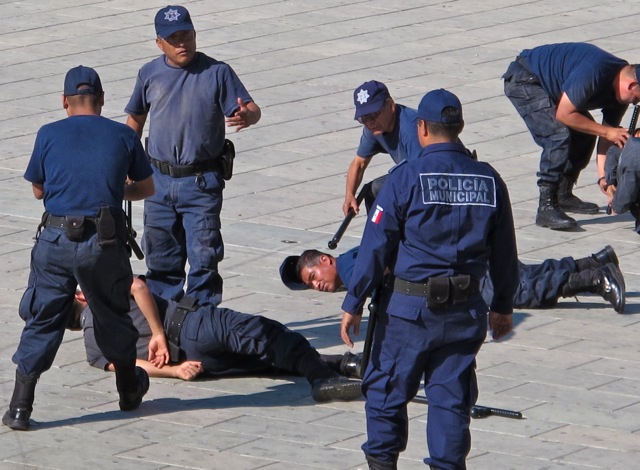
Municipal police practicing in the Plaza de la Danza
Posted in Drug war | Tagged Ciudad Juarez, drug cartels, drug war, Mexico | Leave a Comment »
One of the sights on the streets of Oaxaca that always brings a smile is a father holding his young daughter’s hand in one hand and her little pink backpack in the other. In the absence of a photo of that delightful scene, here are a few other padres y hijos…
Posted in Celebrations | Tagged Día del Padre, Father's Day, Mexico, Oaxaca, photographs, photos | Leave a Comment »
Following the example of the 32 autonomous municipalities set up in the Mexican state of Chiapas flowing from the EZLN led uprising in 1994, another Oaxacan community has declared itself independent.

Chiapas billboard between San Cristóbal de las Casas and Palenque
The Mex Files provides some background and historical context for the actions taken by the residents of San Francisco Tlapancingo, in the Mixteca Region of the state of Oaxaca. The posting, Days of future past in Oaxaca, explains:
Oaxaca has always been the most complicated of Mexican states. Where the rest of us make do with municipalities (roughly equivalent to a U.S. county, and usually doubling as a federal congressional district), the challenge, since Colonial times, has been to impose a centralized governing system on a multi-cultural, multi-linguistic, geographically fragmented political sub-division. In modern (post-Revolutionary) times, the state has been divided into eight regiones that correspond to various traditional ethnic communities, the regions being further divided into distritos, which have any number of municipios. Complicating the political situation, with the recognition of “usos y costumbres” added to the Federal Constitution in 2001, and to the state constitution, local government and elections may not conform to the standards of the modern state, but follow time-honored practices for better or worse.
Over the past few years, the state has been best known to outsiders for the sometimes violent confrontations between an entrenched PRI state machine and various opposition groups. With the electoral success of an opposition coalition in capturing the governor’s office last year, the state’s political troubles seem to have dropped off the radar for most of us, who forget that with the complicated governing structure in Oaxaca, there are still opportunities for heavy-handed machine politicians to maneuver, on a less noticeable scale.
In San Francisco Tlapancingo, a municipio of about 1250 people in the Silacayoapam distrito of the Mixteca region, the same election that saw the end of the PRI’s 80 year dominance of the state government and put a Convergenia candidate running as the head of the anti-PRI coalition, Gabino Cué Monteagudo, into the Governor’s office, also returned a PRI municipal government.
Claiming Governor Cué did nothing about the alleged fraud in the local election (San Francisco Tlapancingo’s presidente municipal, Pablo Abelardo Vargas Duran enjoying the backing of two powerful PRI deputies [state legislators], as well as having his own armed bodyguards, 200 or so citizens walked into the municipal palace and “went native”. They simply declared the community would be run by “usos y costumbres”, locking out the elected (and they say fraudulently elected) officers, installing their own, and informing the state elections commission that an assembly of the people would be running the community from now on.
The new municipal government is rejecting any state interference, including development, in their community, planning to go it alone through self-financing and “tequios” — compulsory communal labor. Oh, and by the way, that state interference includes the state courts, the state police and the federal army.
This may not be one of those types of events I mentioned in the post below. Or it may be. Mexico is not a primarily agrarian society (and hasn’t been in a very long time), so the happenings of an indigenous rural commune may not be all that important. Nor is San Francisco Tlapancingo exactly on anyone’s political or cultural radar, and what happens in Oaxaca generally stays in Oaxaca.
What makes it worth noticing is that here, the people are turning to tradition — history — to find a way out of what they see as a failed political and security situation.
*** For an explanation (in Spanish) of “usos y costumbres,” see the document, Usos y Costumbres y Derecho Indígena.
Posted in Politics, Protests | Tagged Mexico, Oaxaca, San Francisco Tlapancingo, usos y costumbres | Leave a Comment »
Chapulines, illegal??? Say it ain’t so, Joe!!!

One of the ubiquitous chapulines vendors in a Oaxacan mercado.
Article from yesterday’s San Francisco Chronicle’s Inside Scoop:
Posted on 06/08/2011 at 1:29 pm by Paolo Lucchesi in Controversy
Posted in Food | Tagged California, Chapulines, grasshoppers, Mexico, Oaxaca, San Francisco | 2 Comments »
Gray gloom continues to hang over the San Francisco Bay Area and I’m dreaming of a beach vacation…
Playa San Agustinillo on Oaxaca’s Pacific Coast, October 2009.
Posted in Nature & Science, Weather | Tagged beach, Mexico, Oaxaca, San Agustinillo | Leave a Comment »
 The Marcha del Color de la Sangre (Caravan of the Color of Blood), by the Triqui of San Juan Copala and their supporters, mentioned in my May 23 post, was prevented from entering the village.
 According to Angry White Kid, a National and International Day of Action in Solidarity with the Autonomous Municipality of San Juan Copala, Oaxaca, Mexico has been called for June 3.

These banners graced the portales of the Government Palace during the encampment.

Beautiful and poignant, I could never pass by without pausing…
Posted in Politics, Protests | Tagged Mexico, Oaxaca, San Juan Copala, Triqui | 1 Comment »
Propping up fallen trees isn’t the only activity on the Alameda… 
Today, Sección 22 del Sindicato Nacional de Trabajadores de la Educación (the teachers’ union) is beginning an occupation of Oaxaca’s zócalo, Alameda, and several side streets. According to a report in the Latin American Herald Tribune, Teachers Call for Strike in Southern Mexican State, the teachers are not demanding wage increases, instead focusing on social issues, including “better uniform allowances for students, computers in all of the state’s elementary schools and electricity in all schools.” Privatization is also an issue.
This annual activity by the teachers’ union is extremely contentious. Adding bold-face to the lines above will be my only comment on the subject.
However, the teachers aren’t the only people converging on the zócalo today… The displaced Triqui, who were driven out of their village of San Juan Copala after several years of political violence, have decided to return home, leading a march/caravan from Oaxaca to Mexico City and finally back to San Juan Copala.
 For more information, see the blog posting by Angry White Kid, The displaced decide to return to our community: Caravan of the Color of Blood and for background on their struggle for autonomy, see Repression, Impunity and Resistance in Oaxaca: One Year After the Copala Caravan Ambush.
Posted in Buildings, Education, Labor, Parks & Plazas, Politics, Protests | Tagged Mexico, Oaxaca, San Juan Copala, Seccion 22, Teachers union | 4 Comments »
With a little help from its friends, the Indian Laurel has risen — albeit with a Marine-style haircut.
Let’s hope it can, indeed, be saved!
Posted in Weather | Tagged Indian Laurel tree, Mexico, Oaxaca | 2 Comments »
Oaxaca has been trapped in a low pressure trough that, according to Conagua, stretches from Chihuahua to Oaxaca and is bringing moisture from both the Pacific Ocean and the Gulf of Mexico. It’s made for dramatic sunsets!

And, for the past three nights it’s brought spectacular sound and light shows… lightning streaking across the night sky in a 360 degree circle around the city; the rumbling of thunder in the distance and loud cracks when it hits close to home; torrential downpours and hail, even though it’s 80 degrees F (what’s up with that?); and hurricane force winds.
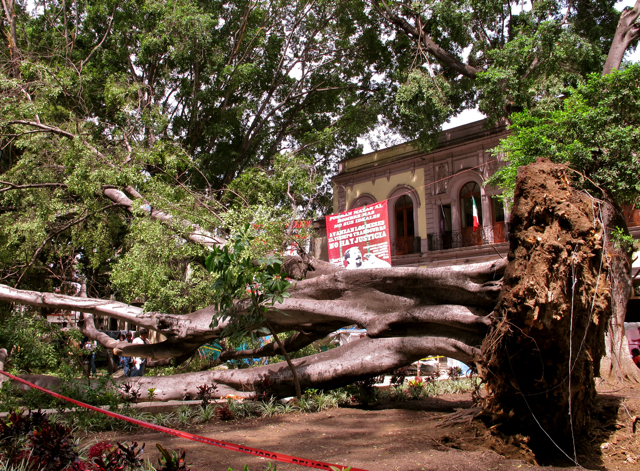
It was all too much for one of the massive 130+ year old Indian Laurel trees on the Alameda…
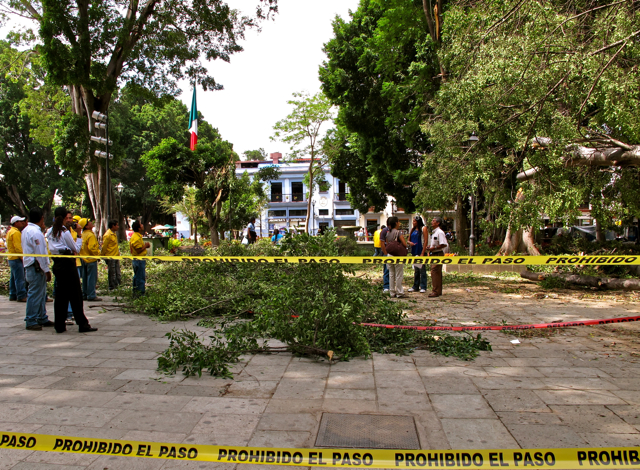
El Instituto Estatal de Protección Civil was on the job, roping off the surrounding area with yellow and red caution tape.
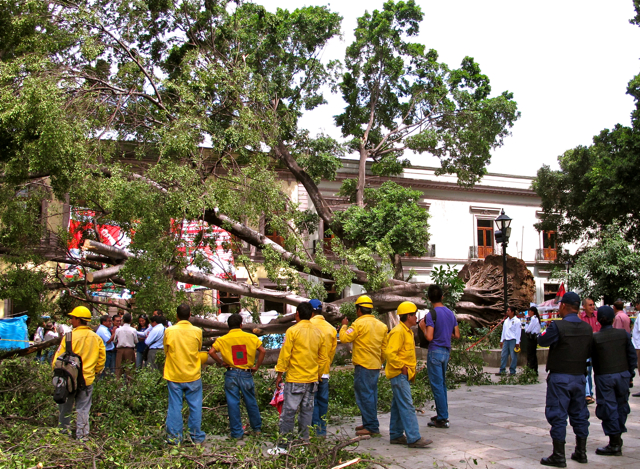
Workers gathered to receive their instructions,
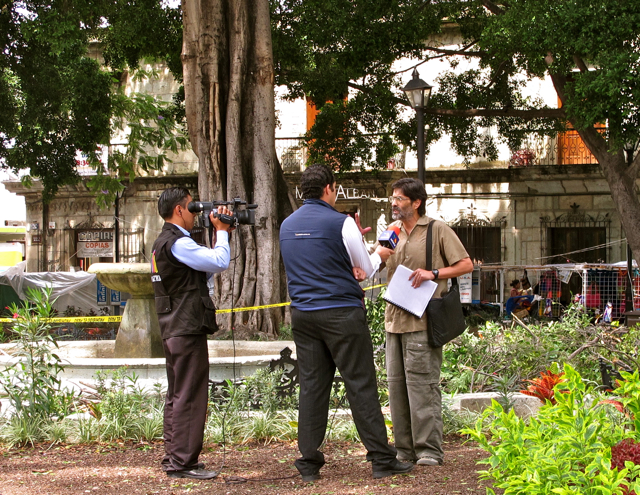
environmentalist and artist Francisco Verástegui was interviewed by TV Azteca Oaxaca,
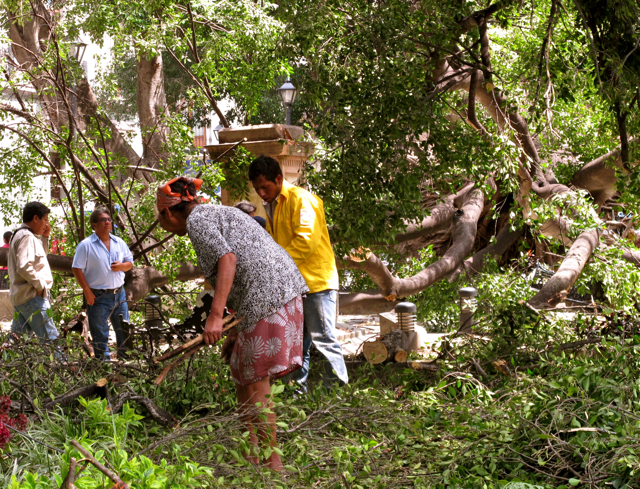
a rope was placed around one of the limbs,

chain saws revved-up, as scavengers went about their work gathering twigs and small branches…
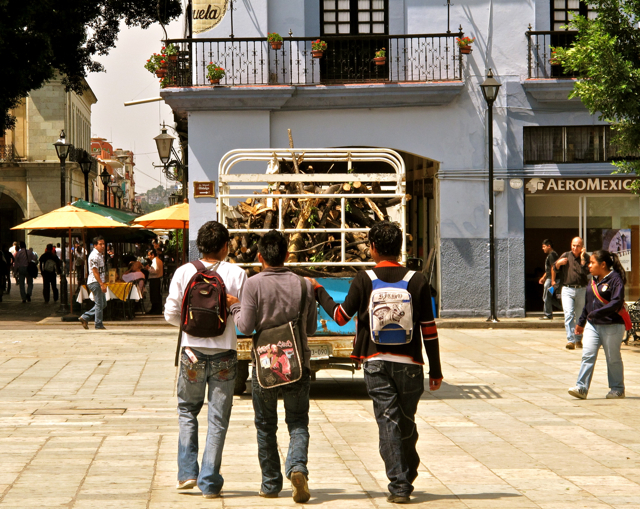
and a truckload of the precious firewood departed the Alameda with a youthful escort.
According to today’s news, this laurel tree wasn’t the only victim of these storms; other fallen trees crushed cars, power went out, and flooding occurred. However, as they say, “ojala,” no human casualties have been reported.
Posted in Environment, Parks & Plazas, People, Science & Nature, Weather | Tagged Francisco Verástegui, Indian Laurel tree, Mexico, Oaxaca, photos | 3 Comments »
Are you…
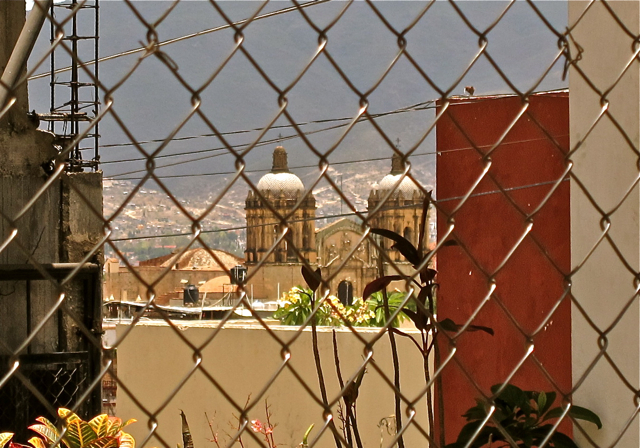
Santo Domingo de Guzmán, Oaxaca

Guerreros de Oaxaca vs. Los Olmecas de Tabasco

Giant Swallowtail Butterfly in Oaxaca.
…inside or outside?
Posted in Random associations | Tagged baseball, beisbol, butterfly, Giant Swallowtail, Guerreros de Oaxaca, Mexico, Oaxaca, photographs, photos, Santo Domingo de Guzmán | 2 Comments »
This review just popped up on my Google Mexico News: Straight-shooting documentary details history of U.S.-Mexico relations, should be required viewing for two distinct American audiences: U.S.-born Latinos who came to know the stoic faces of Mexican revolutionary icons solely from seeing them painted on the sides of Mexican-oriented grocery stores, and anyone who wants a peek at the roots of 100 years’ worth of U.S.-Mexico relations.

Iconic stencil of Emiliano Zapata on a building wall in Oaxaca
The 2-hour PBS documentary, “The Storm That Swept Mexico,” premieres on May 15, 2011 in the USA. I’ve got to get a friend to DVR it for me!
Posted in History | Tagged Mexico, PBS, The Storm That Swept Mexico | Leave a Comment »
Twenty-four hours in the life of one of the more bizarre, and almost prehistoric-looking, residents of the terrace garden, a Stapelia gigantea…
Trying to identify this plant I did a Google search using the terms: cactus, stinky, flies, star flower… because it definitely smells gross, has incredibly large zebra striped star-shaped flowers, and is a favorite of green bottle flies!Posted in Casita Colibrí, Flora, Gardens, Nature & Science | Tagged carrion plant, Casita Colibrí, garden, Mexico, Oaxaca, photographs, photos, Stapelia gigantia, succulents | 5 Comments »


 Mexican Peso Converter


