Feeds:
Posts
Comments

Today in Oaxaca…

This slideshow requires JavaScript.

As Irving Berlin wrote, “Nothin’ but blue skies do I see.”

The Lacuna

In my attempt to begin to understand the people and culture of my new home, my reading has focused on all things Mexican… history, novels, cookbooks, travel writing, you name it!

Right now, I’m finishing Barbara Kingsolver’s historical novel, The Lacuna.  The story begins in 1929 Mexico, moves back and forth between Mexico and the USA, and ends in 1959.  It follows the protagonist, Harrison Shepherd, as he grows into adulthood, all the while navigating the turbulent political waters of these two countries.

Shepherd’s employment with artists Diego Rivera and Frida Kahlo brings him into Leon Trotsky’s household in Coyoacan, Mexico City, where lively debates, as Trotsky answers Stalin’s slanders and formulates a transitional program to move from capitalism to socialism, help inform Shepherd’s own political development — and all in the household work tirelessly day and night (eventually unsuccessfully) to protect Trotsky from Stalin’s assassins.  It is “a plot that turns many times on the unspeakable breach—the lacuna—between truth and public presumption.”

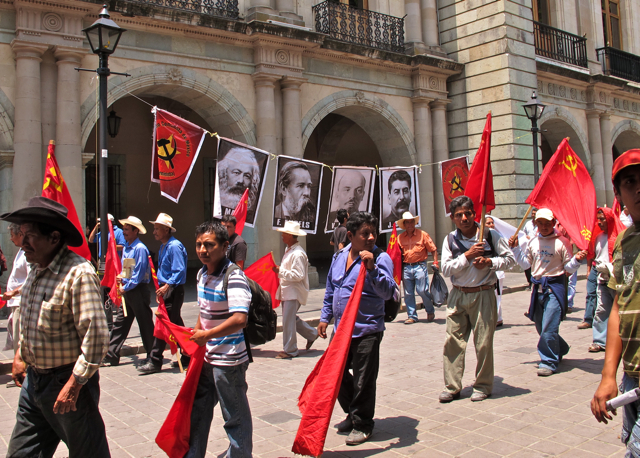
And so, I was brought up short when I encountered yesterday’s demonstration by the Partido de los Comunistas Mexicanos…

Demonstration by the Partido de los Comunistas Mexicanos with red flags and posters of Karl Marx, Frederick Engels, Vladimir Lenin, and Josef Stalin.

Yes, that’s Josef Stalin’s portrait (far right) the demonstrators strung from the portales of Oaxaca’s Government Palace.  Hmmm… has word of Khrushchev’s revelations in 1956, at the 20th Congress of the Soviet Communist Party, not yet reached Oaxaca?   Or, do we have a perfect illustration of a lacuna between truth and public perception?

Of course, I didn’t need to come down here to see unspeakable breaches…
Ya just never know…

… what you will find around the corner.

Today’s drive up into the mountains and pine forests of Cuajimoloyas and Benito Júarez revealed…

Burned out car on mountain road

a burned out car…

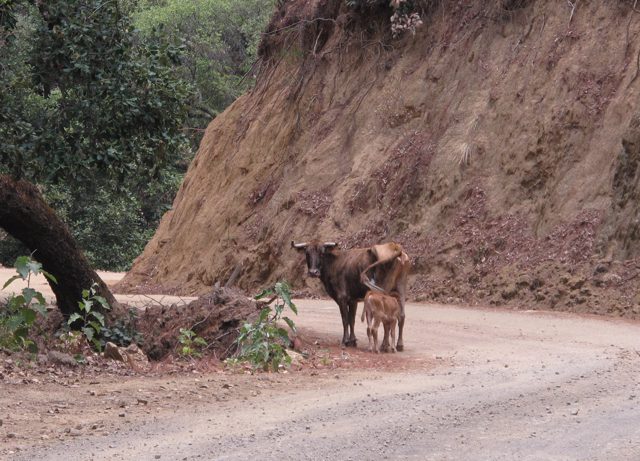
Cow and her calf on the side of mountain road.

a cow and her calf.  And, down the mountain in Teotitlán del Valle…

Brass band on a street in Teotitlán del Valle

a brass band leading a wedding parade.

Working for a living…

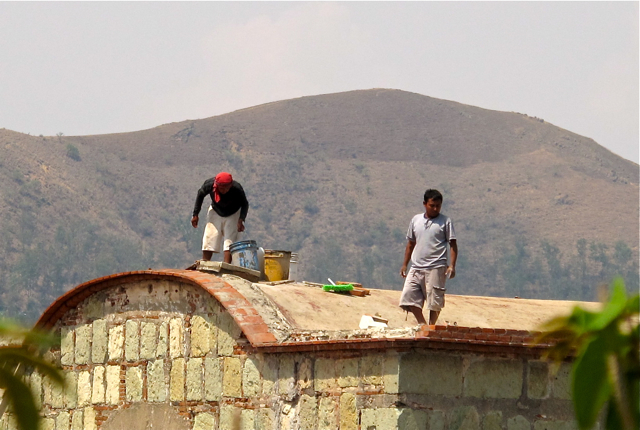
I’ve been watching these guys from my terrace for well over a month…

2 men replacing brickwork on roof of School of Fine Arts, Oaxaca.

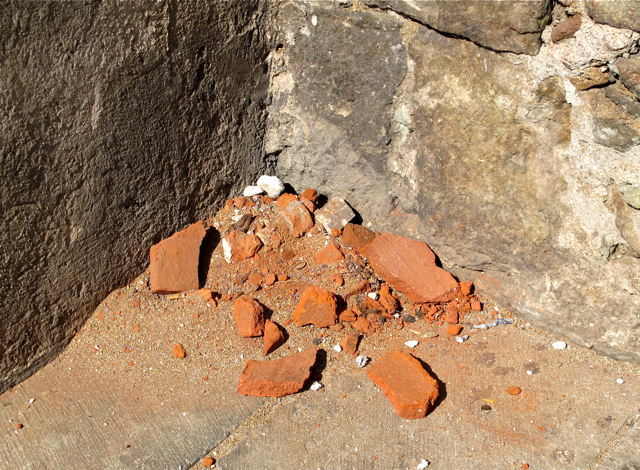
… and dodging the debris on the sidewalk, below.

Brick debris on sidewalk.

Late this afternoon, they were still up there as thunder began rumbling and rain began falling.  Finally, they packed up shop… and I was relieved!

What’s with the hoods?

More than one norte americano has asked, “What’s up with the KKK-like hoods?”  Ahh… a reference question for the librarian!

Purple hooded men carry a Jesus statue

They date back to 15th or 16th century Europe.  Members of lay religious charitable organizations (cofradías) would don the masks and hoods to guarantee anonymity and promote humility in their service. The Spanish brought the tradition to Mexico.

References:

The Procesión del Silencio departed from the Iglesia de la Preciosa Sangre de Cristo and proceeded up the Alcalá to Gómez Farias, where it turned left and left again and down García Vigil to Independencia and then back up the Alcalá. Once the procession began, fellow blogger Chris (Oaxaca-The Year After) and I left the masses on the Alcalá and positioned ourselves on a wall overlooking García Vigil, for an unobstructed view.

Out of respect for what is being commemorated, tradition calls for participants and spectators to remain silent, save for the solemn drum beat and haunting sounds of a chirimia that herald the procession’s arrival and continue to play as the faithful from various neighborhoods and churches carry banners, crosses, and images of the crucified Jesus and his grieving mother through the streets of the city.

Prelude to a procession

Spectators, participants, and the ever-present vendors waiting for the Procesión del Silencio…

Dad holding baby girl

2 red hooded participants waiting.

Participants and spectators

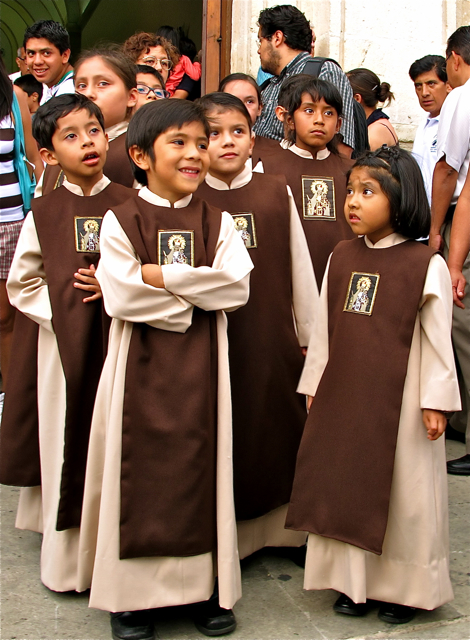
Altar kids lined up
White hood participants waiting

Woman vendor holding basket of candy.

More to come…

I opened the front gate this morning to find the sidewalk had morphed into an Estación de la Cruz.

Station of the cross on the sidewalk with Jesus and Nuestra Señora de la Soledad.

Worshipers prayed, recited the appropriate devotions, and then slowly moved on.

Faces of Jueves Santo

Today was Jueves Santo (aka: Holy Thursday or Maundy Thursday).

Believers gathered to commemorate the Last Supper of Jesus.  Tables are set up in church doorways selling pan bendito (3 buns for 5 pesos of blessed bread).  And, where there are more than ten people, vendors gather….

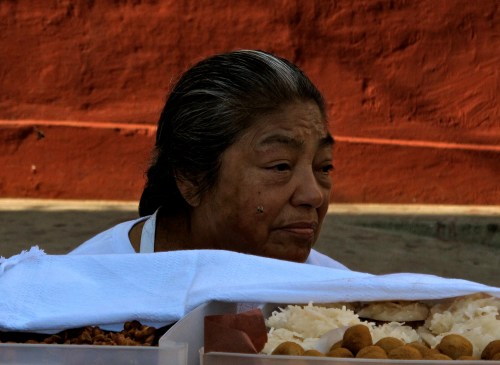
Woman dulce vendor outside Sangre de Cristo

Outside Iglesia de la Preciosa Sangre de Cristo — I suspect her life hasn’t been half as sweet as the dulces she was selling.

Angelic looking altar boy

A little sweetheart on his best behavior and waiting to process.

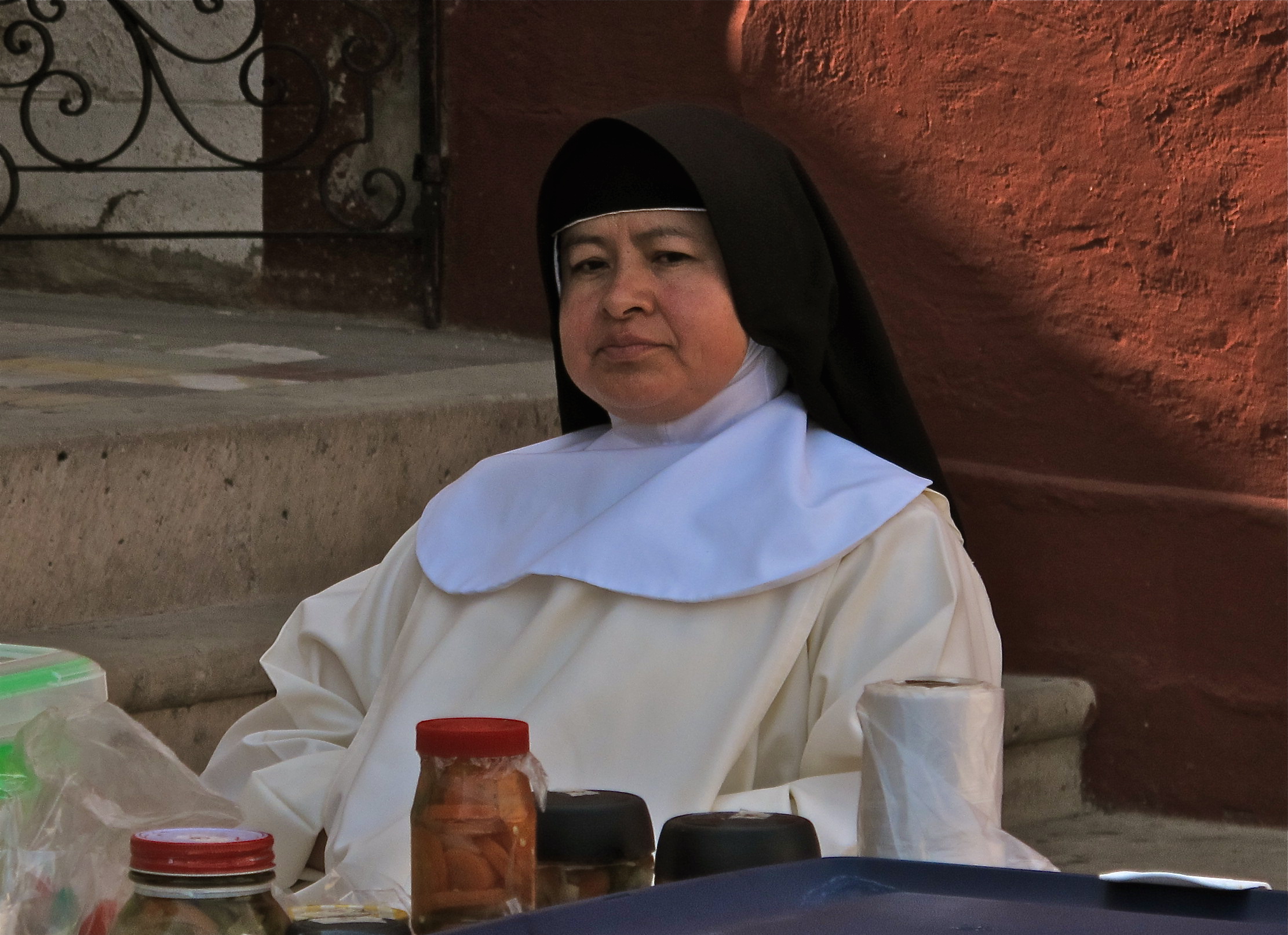
Seated nun

Would you buy pickled carrots or peppers from this woman?

Plastic rain capes vendor

The rains came and the capas del agua vendors miraculously appeared outside Santo Domingo.

Vendor making empanadas, memelas, tortas, and tlayudas on a comal.

After visiting the prescribed 7 churches, I rewarded myself with my (hopefully, not last) supper — a flor de calabaza and quesillo empanada, cooked to order.  Yummm….

Grand installation…

And now a pause in our Semana Santa coverage…

Yesterday was a momentous day at Casita Colibrí.  I arrived home just in time to watch the removal of my late, previously mentioned, but definitely not lamented, baby-size tinaco and the installation of my gigunda, new, and much wished for, tinaco.  It was a sight to behold!

This slideshow requires JavaScript.

These guys looked so young… but worked efficiently and seemed to know exactly what they were doing.  I sure hope so!

Fingers and toes, but not eyes, are crossed that this will, at long last, solve my every-other-day lack of water problem.

Weaving and waiting…

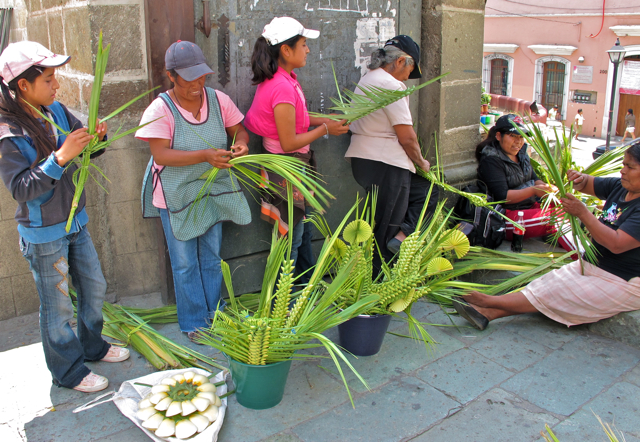
Yesterday, on the stairs leading to the Basilica de la Soledad, I bought my woven palm fronds from these gals.  Palm frond weaving gals

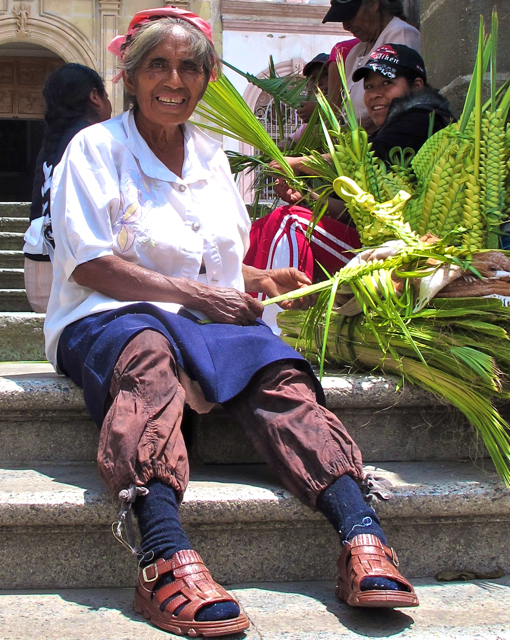
However, this gal insisted I take her picture, too!Palm frond weaver on stairs.

And today, on the plaza in front of the Basilica, the faithful waited for the outdoor mass and the blessing of their palms.Woman seated on stoop with palm fronds.

Sisters, perhaps?2 women wearing rebozos, with their palms.

Yesterday, Oaxaca’s faithful celebrated el día de la Virgen de Dolores… commemorating the pain and suffering of the Virgin Mary upon the death of her son.  I may not be a believer, but there is something appealing about the religious celebrations here.  Special altars were constructed in courtyards and businesses… and benedictions and bands were heard in various parts of the city.
The 5-star ex-convento hotel, Camino Real invited the public to a program, replete with a benediction, speeches by local dignitaries, poetry, and a concert of sacred music by Coro de la Ciudad (Chorus of the City) and Sexteto de Cuerdas Wolfgang Amadeus Mozart (Wolfgang Amadeus Mozart String Sextet).
Sorry about the abrupt ending.  The learning continues…

Books for villages

I’ve been wanting to write this post for almost two months…

Back in February, when L was visiting, we, along with thirty or so other curious and interested (mostly) gringos, toured two of the libraries Libros Para Pueblos has established — one in Santiago Etla and another further up the valley in San Pablo Huitzo.  Local officials and library staff welcomed us and school children read from story books, gave book reports, and performed skits.  It was a non-touristy introduction to Oaxaca for L, and a moving, informative, and inspiring experience for both of us.

This slideshow requires JavaScript.

Libros Para Pueblos is a program of the Oaxaca Lending Library and is staffed by a dedicated group of volunteers, spearheaded by Janet Stanley, a one woman dynamo!  Its mission is, “putting books into the hands of the children of Oaxaca” by establishing  libraries in the villages of the state of Oaxaca, thereby encouraging a love of reading and promoting education.

As I explained in my previous post, Books… children… What’s not to like?!, the need in this state is enormous.  Little by little, progress is being made and over the past ten years, Libros Para Pueblos has set-up, always with the support and participation of the local communities, over 40 libraries.  It is a much-needed program and well worth supporting.

And, speaking of water…

Today’s topic on Fresh Air was The Worldwide Thirst for Clean Drinking Water, in which, the program’s website states,  “Investigative reporter Charles Fishman says the past 100 years have been the golden age of water in the developed world — but now that’s about to change.  He profiles communities grappling with water shortages and details the efforts to conserve water in The Big Thirst.”

In the interview, Fishman makes the point that in the USA, “We don’t even take [water] for granted because taking it for granted would suggest we pay attention to it.”  Not so, living in Mexico; water is considered precious and, thus, respected and conserved.  Water deliveries, be they the non-potable I wrote about yesterday, or listening for the vendors of garrafons (1 equals 20 liters) of drinking water shout from their pickup trucks, “¡Agua!… ¡Agua!… ¡Agua!,” are an important part of daily life here.

I highly recommend clicking on, The Worldwide Thirst for Clean Drinking Water to hear Terry Gross’s interview with Charles Fishman, discussing his new book, The Big Thirst: The Secret Life and Turbulent Future of Water.

My garrafon of veggie and fruit washing, drinking, cooking, and teeth brushing water…Garafon of water with plastic pump

Yikes, it’s raining… gotta go put out my buckets to catch rain to store in my garden watering barrel!

Gravity fed

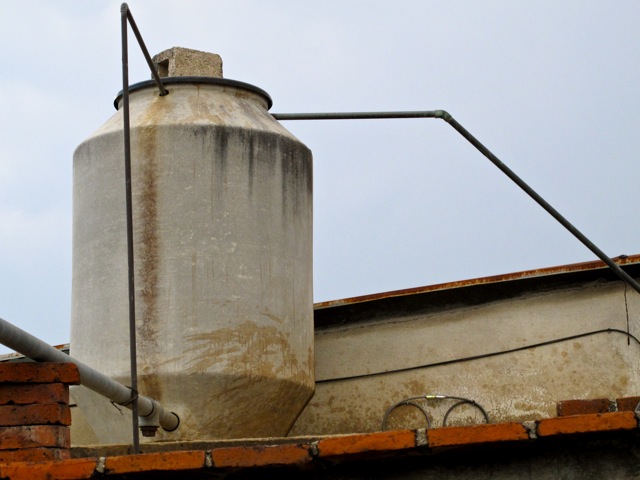
Flying into any airport in Mexico, you see them, Mexico’s ubiquitous rooftop water delivery system, the tinaco.  This is mine…

Tinaco

After living with and cursing it for the past 16 months, word has it I might be getting a newer and larger one.  Even though I’m not superstitious, I’m keeping my fingers crossed!

*** For those of you who are dying to know how the water system here works:  Municipal water is regularly  (or, not so regularly) pumped into an aljibe, a storage tank under our courtyard and driveway; a bomba (pump) is run daily for an hour to bring water from the aljibe up into the tinacos sitting on the various rooftops of the apartment complex.  When we turn on our tap, water flows (or dribbles) from our faucets courtesy of gravity.

I might add,  this is non potable water.  Drinking water is a completely different story…