Feeds:
Posts
Comments

Archive for the ‘People’ Category

It’s been almost 6 years since the October 27, 2006 day in Oaxaca when Indymedia video journalist, Brad Will, was murdered as he was filming a confrontation between APPO (Popular Assembly of the Peoples of Oaxaca) and paramilitary forces affiliated with then governor, Ulises Ruiz Ortiz, during the (at that point) 5-month long teachers’ strike.

Mexico catches suspect in death of a journalist Bradley Will

By Mark Stevenson / AP Wednesday, May 23, 2012. 1 day ago

MEXICO CITY (AP)‚ — Prosecutors in southern Mexico say they have captured a man suspected in the killing of a U.S. journalist Bradley Will during protests against the Oaxaca state government in 2006.

A spokesman for the Oaxaca state prosecutors office says suspect Lenin Osorio was captured early Wednesday.

The spokesman says he is not authorized to be quoted by name, and that he does not know which side of the conflict the suspect was on.

Bradley roland will Mexico catches suspect in death of a journalist Bradley Will

Will was shot as he videotaped a clash between protesters and government supporters.

The New York man was covering the conflict for Indymedia.org. He sympathized with the protesters, one of whom was arrested in 2008 for the killing but was later released.

The protests started as a teachers’ strike and paralyzed Oaxaca’s capital for months until federal police intervened.

###

As I write, journalists are being targeted all over the world and the teachers are again occupying Oaxaca’s zócalo, as they have every year since.  However, perhaps there will be justice for one of the 26, 2006 murder victims.  Vamos a ver….

The Revolution Next Door is a video tribute to Brad Will and includes footage shot by him, including his last tape.

To follow this news on Twitter, The Friends of Brad Will website lists the following Spanish language sites:

Oaxaca journo on the scene’s twitter feed:
https://twitter.com/#!/Jorgeopl

PGJE in Oaxaca’s feed:
https://twitter.com/#!/pgje_oaxaca

http://twitcasting.tv/Jorgeopl

Read Full Post »

Carlos Fuentes, one of Mexico’s most revered writers, died yesterday at the age of 83.

It was the California connection that allowed for my introduction to the writings of Fuentes.  The acquaintance came through The Old Gringo, a fictionalized story of  the disappearance in Mexico, during the Mexican Revolution, of real life writer and US Civil War veteran, Ambrose Bierce.  Following the Civil War, Bierce wound up in California, where he was a contributor to the literary journal, The Argonaut, founded and edited by one of my relatives, about whom, Bierce wrote a typically acerbic epitaphHere lies Frank Pixley — as usual.  So, in my ongoing attempt to unravel some of the mysteries surrounding living and being in Mexico, reading the The Old Gringo was a no-brainer.  As The Guardian’s obituary of Carlos Fuentes concludes,

Throughout his life, wherever he lived, Mexico was the centre of Fuentes’s artistic preoccupations. In his late 70s, he provided a typically graphic description of the attraction he felt for his own land: “It’s a very enigmatic country, and that’s a good thing because it keeps us alert, makes us constantly try to decipher the enigma of Mexico, the mystery of Mexico, to understand a country that is very, very baroque, very complicated and full of surprises.”

Carlos Fuentes is not uncontroversial, but you should see for yourself.  If you are not familiar with his writings, you might want to visit your local library and checkout a book or two.  For those in Oaxaca, the Oaxaca Lending Library has the following titles:

Fiction
Adan en Eden
Baroque Concerto
Burnt Water
Cuerpos y Ofrendas
Campaign
Cantar de Ciegos/To Sing of the Blind
Change of Skin
Christopher Unborn
Constancia: y Otras Novelas para Vírgenes
Constancia and Other Stories for Virgins
Crystal Frontier
Diana the Goddess Who Hunts: The Goddess Who Hunts Alone
The Death of Artemio Crus:  A Novel
Destiny and Desire:  A Novel
Diana o la Cazadora Solitaría
Distant Relations
The Eagle’s Throne
Good Conscience
Gringo Viejo
Hydra Head
Muerte de Artemio Cruz
El Naranjo
Old Gringo
The Orange Tree
La Region Mas Transparente
Terra Nostra
Where the Air Is Clear
Years with Laura Diaz Fuentes
Cabeza de la Hidra
Vida Está en Otra Parte

Non Fiction
Aura
The Buried Mirror: Reflections on Spain and the New World
En Esto Creo
Latin America at War with the Past
Mexico:  Una Vision de Altura:  Un Recorrido Aereo de Pasado Al Presente
Myself with Others
This I Believe
Todos los Gatos Son Pardos
The Diary of Frida Kahlo:  An Intimate Self-Portrait
New Time for Mexico

Read Full Post »

As the promotional material for Ma (yo) en Oaxaca, Mujer (es) Arte y Cultura explains (loose translation), like a skilled weaver, women create the fabric of life… part of the history of humanity, intelligence that moves, the look that looks, which is regarded in the construction of better horizons of life for her and those who are around her.  And so, from May 3rd through 13th, the women of Oaxaca are being celebrated with workshops, exhibitions, lectures, and concerts.

Last night, under the supermoon, one of the accomplished women of Oaxaca, Alejandra Robles, gave a free concert, just a block away, in the Plaza de la Danza…

Ma (yo) en Oaxaca is a party for all of the principles of inclusion and participation to make possible the knowledge and appreciation of the cultural richness of groups which, for various reasons, have been marginalized.

¡Viva las mujeres!

Read Full Post »

Hip hop is probably not the first thing that pops to mind when you think of Oaxaca.  However, I can assure you, there is more to Oaxaca than colonial architecture, religious processions, colorful traje (costume), and traditional music.  As repeated blockades and occupations attest, and the El Silencio Mata posters illustrate, there are voices struggling to be heard.

For one of those voices, check out this trailer from the documentary film, Cuando Una Mujer Avanza (When a Woman Takes a Step Forward), about “Mare” a young Zapotec hip hop artist from Oaxaca.  As the promo states, her unique life experience is a rarely heard perspective on life and community liberation.  As an up and coming MC in a state known for popular and indigenous rebellion, Mare’s life and experience has been channeled into very powerful and conscious rapping and singing.

Update:  Check out the article, Mare Is a Rapper Hell-Bent on Equality for Women in Mexico.

Read Full Post »

Sheesh, what is it about my friend, L???  Last year she arrived for her first visit to Oaxaca on the same day Mexican president Felipe Calderón was in town.  This year, she is arriving Tuesday night and… guess who is in town?

Malia Obama, older daughter of U.S. president Barack Obama, is spending spring break here!  Along with 12 friends and a 25 person security detail, she arrived Friday night, on the regular United/Continental Houston to Oaxaca flight, that most of the gringos who live here are very familiar with.

Malia Obama and friends

photo from Zócalo Saltillo

So that’s why all the federales, various other police forces, and people with cameras on the Álcala, yesterday…

According to reports, in addition to sights around the city,  the group will see the famous El Tule (tree), the archaeological sites of Mitla and Monte Alban, the black pottery village of San Bartolo Coyotepec, and the wood carving village of San Martín Tilcajete.

This is exceptionally good news for Oaxaca and I’m not the only gringo blogger living here to be posting this news; most of us are doing it for the same reason — to let our readers know, Oaxaca is SAFE.  So, come on down!!!

Read Full Post »

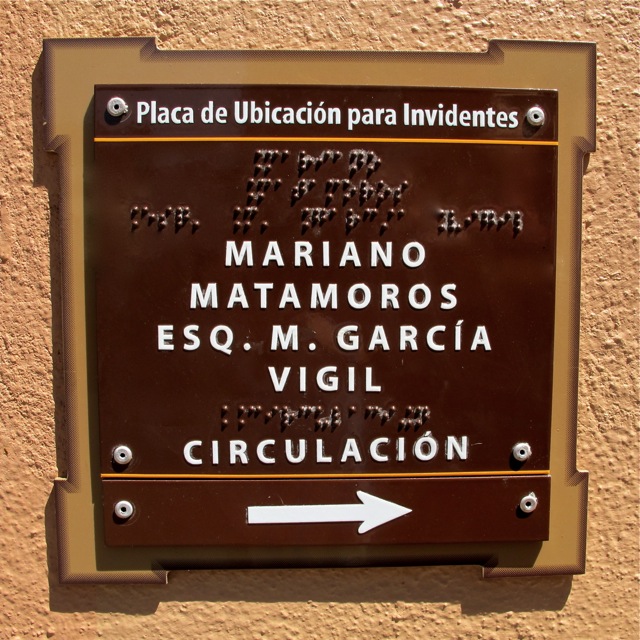
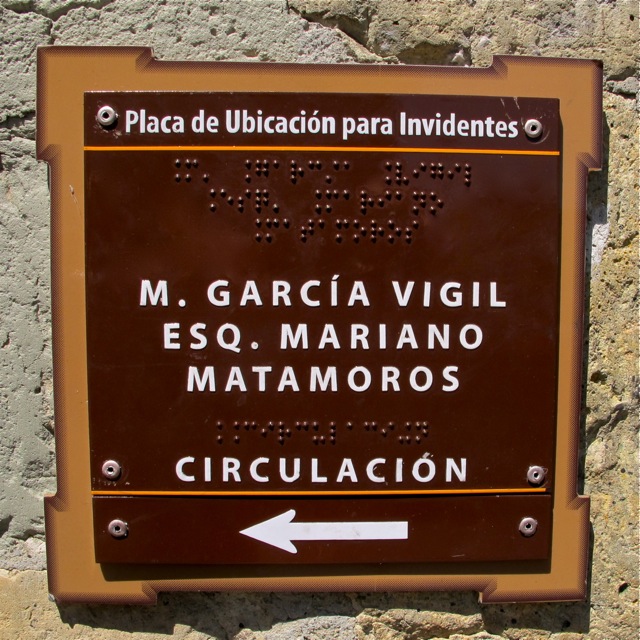
About two months ago, new street signs began appearing in Oaxaca on each side of each street corner.  Eight signs per each 4-way intersection, in Spanish and Braille, are at hand touch and wheelchair eye level, and provide arrows to make it clear if the traffic flows this way…

Mariano Matamoros; esq. M. Garcia Vigil; circulacion -->

… or that.

M. Garcia Vigil; Esq. Mariano Matamoros; Circulacion <--

By the way, Oaxaca has a library for the blind and visually impaired — the Biblioteca Jorge Luis Borges, housed in the Biblioteca Infantil in the Barrio de Xochimilco.  Named after the blind Argentine writer, the library was founded in 1996 by world-renowned Oaxacan artist, Francisco Toledo.  It houses his collection of books in Braille, a permanent workshop teaching Braille, computers with special programs for the blind, and scholarships to outstanding visually impaired students.

Read Full Post »

Today is International Women’s Day, established by V. I. Lenin in 1922, revived by women in the USA in 1968, and recognized by the United Nations in 1975.  Here’s to the beautiful, strong, and all around amazing women of Oaxaca!

This slideshow requires JavaScript.

¡Feliz, Día de la mujer!

The librarian in me can’t help but include a few resources, I put together a few years ago, chronicling the history of International Women’s Day:


Read Full Post »

Samuel Bautista Lazo is one of the smartest, joyous, and Zen-like people I know.

Sam sitting cross-legged in a natural alcove in the mountain

Sam is my young, previously mentioned, Zapotec friend who is getting his Ph.D. in Sustainable Manufacturing at the University of Liverpool.  Sam is from Teotitlán del Valle in Oaxaca, a village watched over by El Picacho, the sacred mountain — whose presence is unmistakable and palpable.

El Picacho

The village is known for its traditional performances of the Danza de la Pluma (about which I’ve posted on numerous occasions) and their skillful and creative weavings with wool.  Like a majority of its Zapotec residents, Sam and his family weave — father, Mario Bautista Martínez; mother, Leonor Lazo González; and brother, Celestino Bautista Lazo.

Sam and his family pose in their yard

The family was featured last year in an article, The Crafts of Oaxaca, posted on the Lark Crafts website.  Like many others, on my first visit in 2007, I couldn’t resist buying a couple of tapetes (rugs), including this one, which now serves as a welcome to all who enter my little casita.

Tapete on floor: geometric patterns in rust, beige, agua

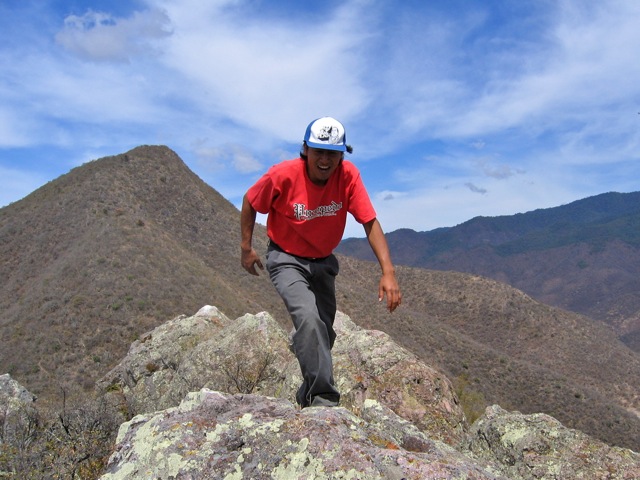
A friend and I returned six months later and had the privilege of climbing to the top of El Picacho with Sam.

Sam on top of El Picacho

And no, I did not join Sam in leaping from one rocky peak to the other!

Looking forward to your return, Sam!

(ps)  Here is a Dixza video of  Sam from 2008, where he discusses the interpretation of the symbols and patterns woven into Zapotec rugs.  You might also want to check out others in his Dixza series from Teotitlán del Valle.

Read Full Post »

Last night I joined a standing-room-only crowd for the book launch of Grandes Maestros del Arte Popular de Oaxaca (Grand Masters of Folk Art of Oaxaca) at the Centro Académico y Cultural San Pablo, in Oaxaca city.  This beautiful 340+ page book was the joint effort of the Fundación Alfredo Harp Helú, Fomento Cultural Banamex, the State of Oaxaca, and CONACULTA (National Council for Culture and the Arts).

Cover of the book

The press was there in full force, as was governor Gabino Cue, benefactor Alfredo Harp Helu, and a number of other movers and shakers on Oaxaca’s cultural scene.  Many of the artisans were also in attendance and several posed for photographs holding their copy of the book at the reception that followed.

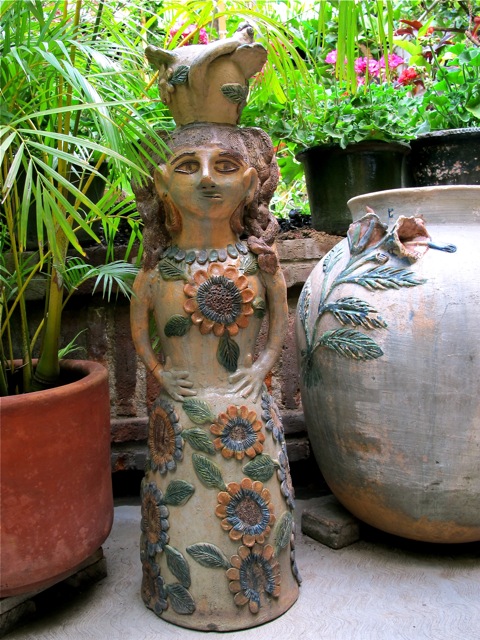
One of the artisans who was not there was the late potter, Dolores Porras from Santa María Atzompa, as Parkinson’s disease had claimed her on November 1, 2010.  Four pages in the book are devoted to this maestra of pottery and her pioneering work with glazes.  Examples of her work can be seen all around Oaxaca, including these scattered in the garden at the hotel, Las Golondrinas.

Vase in the shape of a woman's face and rounded body

Her work has inspired imitation, but as is evident in these pieces, her whimsy, creativity, and sense of proportion would be difficult to match.

Urn with the face of a woman.

I want to thank potter Michael Peed for pointing out these hidden treasures…

Tall vase in the shape of a woman.

following a showing of his loving documentary, Dolores Porras: Artista Artesana de Barro Santa María Atzompa.  (Click here for an excerpt on YouTube.)

DVD front and back covers

And then there is this one, I discovered on my own, the very next day — on a bathroom shelf, no less — at Casa Linda

Vase with image of a woman, with pointy breasts.

Read Full Post »

LA.com just posted a phone interview with Oaxaca’s own, Lila Downs,  where she discusses influences on her musical development, experiences working on the movie Frida, and future projects.  The following is the first of eleven questions asked by Paty Elias, in advance of Lila’s Los Angeles performance on Feb. 25, 2012 promoting her album, “Pecados y Milagros.”

From the interview…

LA.COM::  With such a diverse musical background, why did you decide to focus on Ranchera, style music?

Lila Downs:   I think that I have been very affected by what has been happening in Mexico. There has been a lot of violence, and I started composing a number of songs that were inspired by   retablo, the   votive art forms.

It’s about the notion of having a miracle in your life and giving thanks to the sometimes non-visible saints and elements of faith we have in Mexico. I thought it was very fascinating to somehow find the subjects in the songs and then kind of place them in the same way towards showing and giving thanks for the blessings that we have in our life but then also questioning the interpretation of each of these pieces, which are miracles and sins.

Ranchera is really a genre — it’s a form that is kind of about the profane.

There are Rancheras

Lila Downs (LilaDowns.com)

that are about the celebration of life as well as fertility and perhaps the more Indian elements in our culture.

But I would have to say that the Ranchera is mostly accompanied by tequila or mescal. And I think that’s when we will tell our sins, and that’s why I chose the Rancheras at this point — And of course because its one of the only forms were you can really spill your guts. And I think that’s what we are going through right now. We are in desperate times, and you need something with which you can really express your soul.

For the full interview and a couple of video clips, click HERE.

And for my description and photos from the Nov. 6, 2011 Lila Downs concert at Oaxaca’s Guelaguetza Auditorium, click HERE.

Read Full Post »

Be it looking down from the windows above, strolling through the gardens on a tour, or peeking through openings in the wall on Reforma or Berriozabal on the way to someplace else, Oaxaca’s Ethnobotanical Garden is always a soothing and uplifting sight.

Looking out from window above Ethnobotanical Garden

Check out this informative and enlightening article by Jeff Spurrier discussing the origins and vision of  Oaxaca’s Ethnobotanical Garden — from the Jan/Feb 2012 issue of Garden Design:

Oaxaca’s Ethnobotanical Garden

“I am not a gardener.” Francisco Toledo is sitting in the courtyard of the graphic art institute he founded in downtown Oaxaca City, Mexico, sipping on a glass of agua de jamaica. His fingers are paint-smudged, and he moves stiffly from a sore back. Toledo, 71, is one of Mexico’s best-known living artists; his paintings, sculptures, and textiles are in galleries and museums around the world. At home in Mexico, he is identified with a fierce and outspoken defense of the indigenous arts and culture of the southern state of Oaxaca. He also, as it turns out, helped to create one of the world’s most original public gardens.

“The professionals are the people who live in the country,” he says. “The campesinos and workers — I don’t have the patience.”

Nearly 20 years ago, the Mexican military moved out of a 16th-century Santo Domingo monastery complex it had used as a base for more than 120 years. Mexico’s president gave the exit order after being lobbied by Toledo and other leading artists and intellectuals belonging to Pro-Oax, an advocacy group urging the promotion and protection of art, culture, and the natural environment in Oaxaca. Soon, a great clamor began: The state government wanted the five-acre parcel in the heart of downtown Oaxaca City to create a hotel, convention center, and parking facility. A restoration team brought in by the National Institute of Anthropology and History wanted to establish a European garden in the 17th-century baroque style. Some of Toledo’s fellow artists wanted to use the grounds for workshops and exhibition space.

n 1993, when Toledo knew the army would be leaving, he asked Alejandro de Ávila B., who had family roots in Oaxaca and training in anthropology, biology, and linguistics, what he and other advocates would propose. De Ávila suggested making the space into a botanic garden — or, more precisely, an ethnobotanic garden, one that would “show the interaction of plants and people.”

I highly recommend reading the Full Article.

h/t  Norma and Roberta

Read Full Post »

Apparently, I’m not the only one who has made the journey from Oaxaca to California.  The San Francisco Bay Area has been basking in sun and Oaxacan-blue-skies.  Even though the temps don’t match-up, the coast beckoned…

Wall art on sea wall

And, wall art greeted us in Bolinas.

Wall art of surfer in wetsuit carrying surfboard

Gosh, except for the subject matter, I felt like I was in Oaxaca!

Wall art of whale on seawall

Wait!  Who is that I see?

Wall art of Benito Juárez on seawall

None other than Oaxaca’s favorite son, Benito Juárez.  The subject matter IS the same!!!

Read Full Post »

Mexico’s favourite singer-songwriter dishes on development, gender, indigenous issues, peace and music.  An interview with Lila Downs (in English) from the IFAD social reporting blog:

http://blip.tv/ifad/lila-downs-reverence-hope-change-5672813

By the way, Chris, over at Oaxaca-The Year After has posted more from the recent concert at the Guelaguetza Auditorium, covered in my Sublime sounds and spectacle post.

Read Full Post »

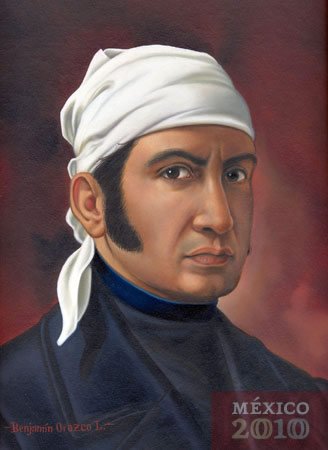
196 years after his execution, Generalísimo José María Morelos y Pavón has returned to Oaxaca.  Filming is underway on the film tentatively titled “Morelos,” chronicling the last three years of the life of one of Mexico’s most revered heroes

José María Morelos y Pavón painting

Costumes hang ready for quick costume changes.

Men's costumes hanging on rolling rack.

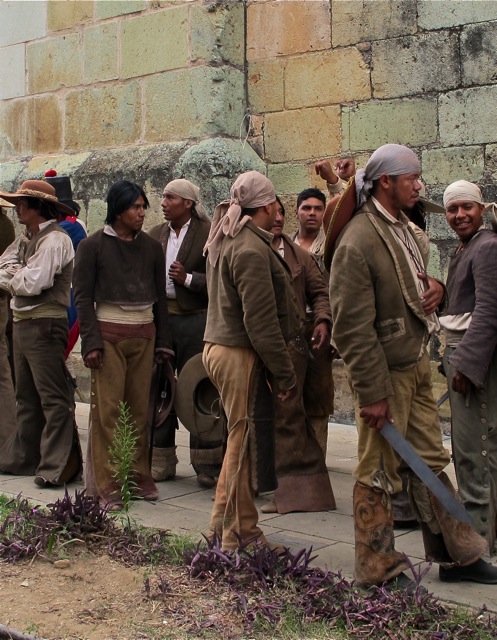
Mexican independence fighter extras await the Spanish language equivalent of ACTION!

Male actors in freedom fighter costumes stand on sidewalk

Serious cameras are ready to film the action.

Large professional film camera

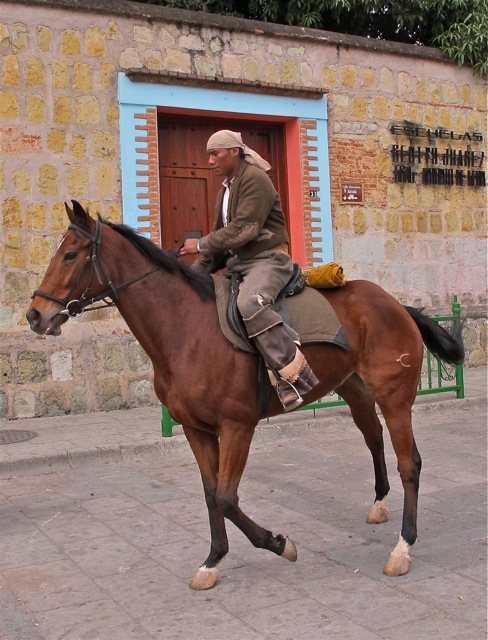
Horses and their riders have taken over the surrounding streets.

Man in freedom fighter costume riding a horse

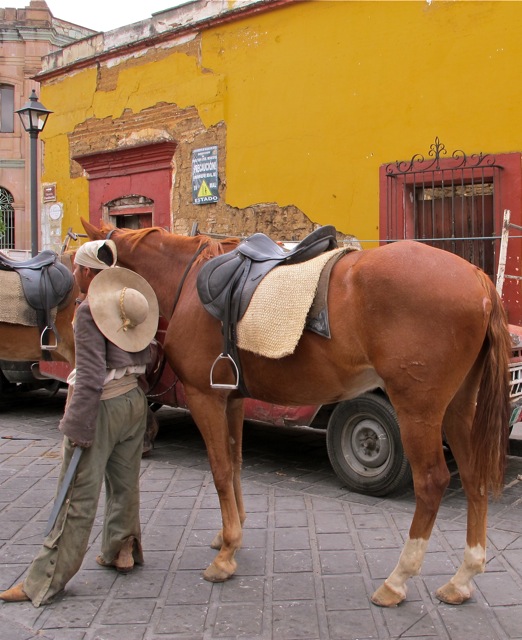
Like all movie sets, it’s, hurry-up and wait!

Independence fighter standing next to horse.

Muy guapo, is all I can say!  The horses… the horses…

Independence fighter walking towards camera, horse in background

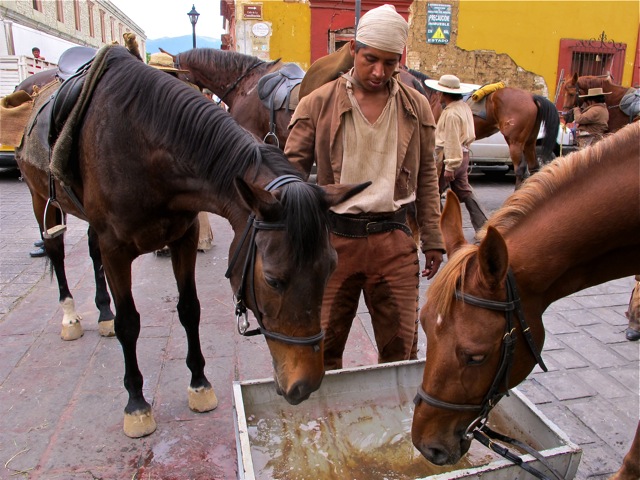
You can lead a horse to water…

Independence fighter in between two horses drinking water from a trough

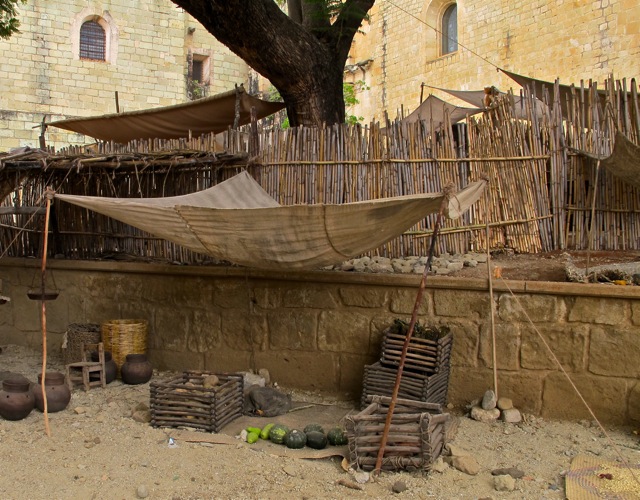
The set designer has taken Constitución back two hundred years…

Camp site

The newly paved cobblestone street and sidewalks have been covered in dirt and buildings and even trees have been aged.

Dirt sidewalk and aged looking buildings and tree.

Though the film covers a time in the life of Morelos that is distinguished more by politics than military action, “dead bodies” line Constitución.

Three "dead" dummies on dirt street

“Morelos” is directed by Antonio Serrano and stars Dagoberto Gama, in the title roll.  Filming is also scheduled to take place in Veracruz, Tlaxcala, Puebla, Hidalgo, Morelia (named for Morelos), and Mexico City.   It is produced by Luis Urquiza and los Estudios Churubusco, with support from Conaculta, Imcine, and the governments of the states.

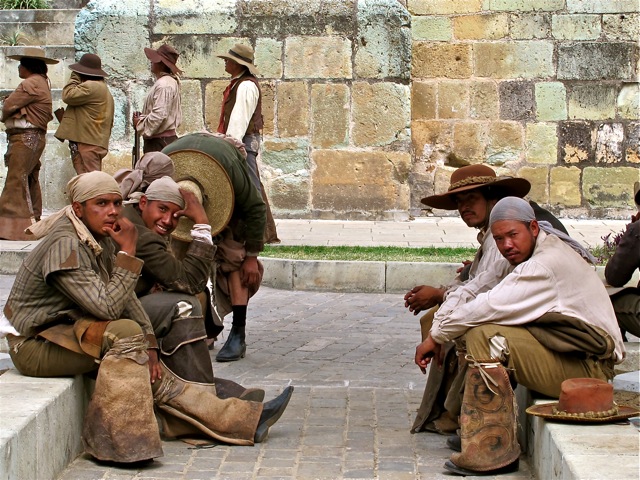
Freedom fighters sitting and waiting

I imagine it’s release will be a major event… can’t wait!

Read Full Post »

What can I say about last night’s Lila Downs concert at the Guelaguetza Auditorium?  It was one of those clear, mild and star-filled Oaxaca evenings.  The glowing auditorium beckoned and encouraged us as we made the steep walk up the street and then stairs to the hillside site, that overlooks the city.

Guelaguetza auditorium glowing with red lights at night

In true, “hey, it’s Mexico” style, we were unsure of the time…  The posters, billboards, and concert’s Facebook page said, 8 PM.  However, our tickets (purchased from TicketMaster… ugh!) said 7 PM.  Needless to say, we were in line by 6:45.  Our, off to the side, front row seats left much to be desired, but once the Afro-Caribbean rhythms of Columbiana, Totó la Momposina and her way hot band began, it didn’t matter.

Totó la Momposina

Although, she initially confused Xalapa with Oaxaca (with the expected laughter and a few catcalls), Totó la Momposina won the crowd over and all were well warmed up for Oaxaca’s favorite daughter.  Lila opened with an offering of mezcal and track number one, “Mezcalito,” from her new CD, Pecados y Milagros (Sins and Miracles).

Lila Downs in white

Totó la Momposina joined her on stage, as on the CD, to sing “Zapata Se Queda,” a tribute to the spirit of Mexican revolutionary hero, Emiliano Zapata.  Other songs followed, a rebozo (shawl) was added, and the lighting changed…

Lila wearing a magenta rebozo with orange/red lighting

Lila then donned a beautiful serape from one of the master weavers of Teotitlán del Valle to sing, “Fallaste corazón.”

Lila Downs wearing a serape.

She dedicated, “Palomo’s Comalito,” to all the women who make tortillas in Mexico.  A knowing smile crossed our faces.  On Wednesday, we had been invited to the home of Emilia and Zacarias Ruiz in Teotitlán del Valle, where we honored the souls of their departed, by savoring Emilia’s delicate tamales and silky smooth and complex mole AND where we were informed by son, Antonio, that Emilia is featured in the music video for “El Palomo del Comalito.” (She’s the woman making tortillas.)

This was my first time seeing Lila Downs live.  I’d listened to last year’s free concert, at the Plaza de la Danza, from my terrace, but it doesn’t compare with seeing her in person…

Lila Downs kneeling, wearing traditional Tehuantepec headdress

I think this was the costume change for her beautiful and haunting rendition of “La Llorona.”  I can’t resist also showing the back of this traditional Isthmus of Tehuantepec headdress, known as a “bidaani quichi.”

Back of the headdress

A sublime and spectacular evening to close a sublime and magical week…  ¡Muchisimas gracias, Oaxaca!

Read Full Post »

« Newer Posts - Older Posts »