Feeds:
Posts
Comments

Archive for the ‘Celebrations’ Category

Decorations have begun going up around town and, at this time of year, La Olla offers the complete dining experience…

Skeleton in pink skirt and feather boa seated on a bench

A warm welcome from the hostess.

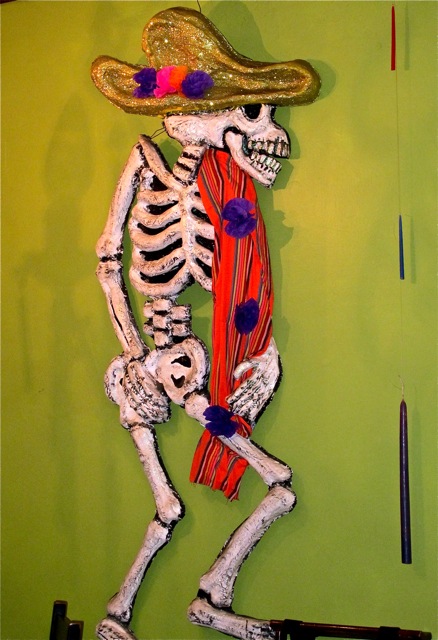
Skeleton with sombrero hanging on wall.

Waiters standing ready to take your order.

Day-glo orange butterfly skeleton hanging in a tree.

And, una mariposa hanging out, ready to wish you “¡buen provecho!”

Read Full Post »

6 AM this morning, I awoke to fireworks and riotously clanging church bells coming from the cathedral, calling my attention to the October 23rd annual fiesta of Señor del Rayo.  Like Guelaguetza, Noche de Rabanós (Night of the Radishes), and Día de la Samaritana (Good Samaritan Day), it is an “only in Oaxaca” celebration.

This image of Christ on the Cross was brought to Oaxaca during the 16th century.  It was placed in the temple of San Juan de Dios, a church which had adobe walls and a straw (or possibly wood) roof.  Legend has it that lightning struck the church and everything was destroyed, save for this statue.  Un milagro!

The statue became known as Señor del Rayo (Lord of Lightning), eventually was moved to his own chapel in the newly built cathedral, and has been much venerated ever since.  However, on October 21, in anticipation of his special day, the statue is moved to the main altar of the cathedral, the cathedral is filled with lilies (the scent “breathtaking”), and the faithful flock to pray before Señor del Rayo.

This slideshow requires JavaScript.

Flowers are daily sprayed with water, to keep them fresh… BUT, as the signs say, please do not uproot and carry them away.

Read Full Post »

Sunday, Oaxaca blogger buddy Chris (Oaxaca-the-year-after) and I returned to Teotitlán del Valle for the Danza de la Pluma.  Another day awash in sights and sounds.  As I discussed in July’s post, Danza de la Pluma, it is a multi-layered ritual reenactment of the Conquest.  And, like the Passion Play in Oberammergau, Germany, the Danza de la Pluma lasts 7-8 hours!

Obviously, the performers occasionally need to take a break…

Subalterno laying down on the plaza

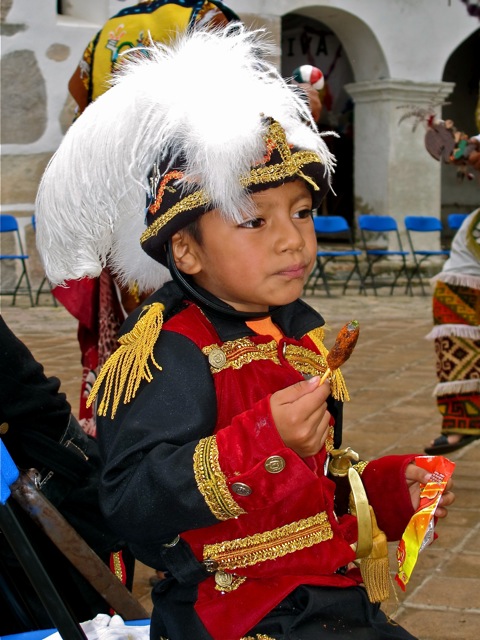
Soldaditos, need nourishment after all that marching around…

Littlest Soldadito munching on a snack

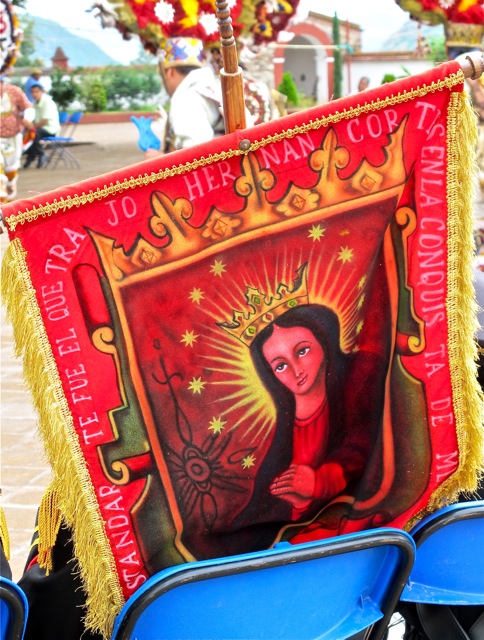
Banners need to chill on a chair…

Banner propped up on a chair

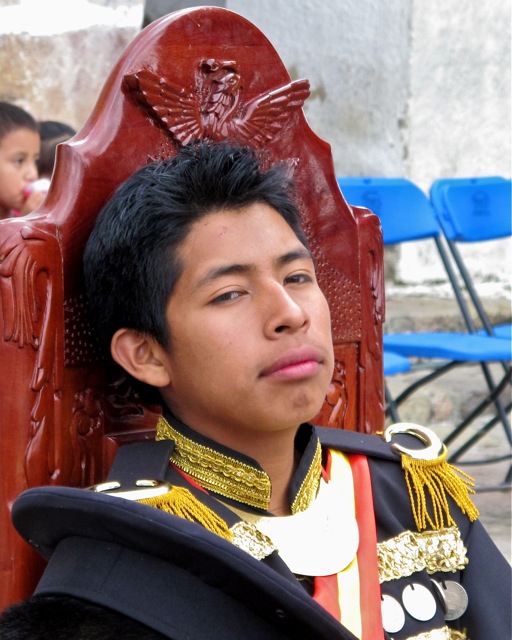
Cortes needs to take a breather from all that conquering…

Cortes resting on his throne.

Danzantes need some male bonding time…

2 Danzantes walking together

Their feathered headdresses need time off for good behavior…

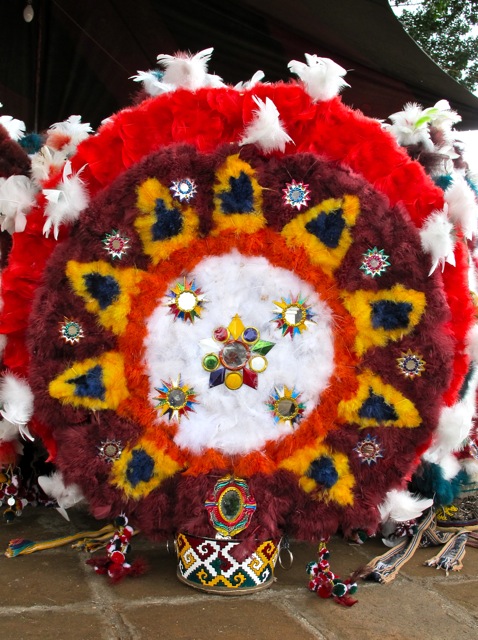
Danzante feathered headdress

Malinche and Doña Marina need to share some giggles…

Malinche and Doña Marina walking and smiling together

And, even tubas need a nap…

Tuba laying on the ground.

Read Full Post »

To borrow from Russian actor and director, Konstantin Stanislavsky, “there are no small parts, only [very] small actors.”  And the children of  Teotitlán del Valle begin learning their lines at a very young age.

They were in full view Friday night as the convite (parade) of unmarried young women and girls opened the multi-day Fiesta de la Virgen del Rosario.

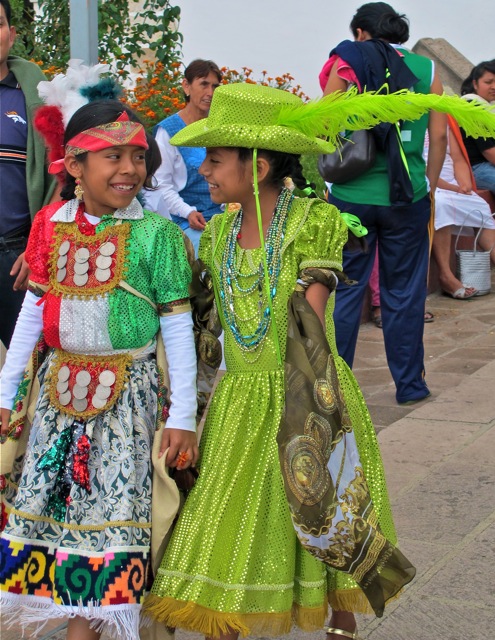
Very young Zapotec girl in traditional dress.

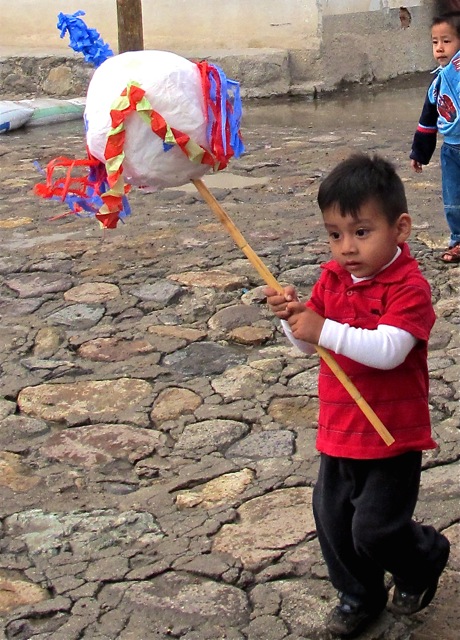
Young boys, carrying marmotas led off the parade, that began at the pueblo’s Sangre de Cristo church.

Very young Zapotec boy carrying a small marmota

They were followed by traditional indigenous drums and a band.

Band with marmota in background

Then the stars of the evening took center stage.  From the oldest to the youngest, all were wearing the traditional red woolen skirt (woven in the village, of course!) and blouses painstakingly and lovingly hand embroidered.

Young Zapotec girl carrying canasta on her head

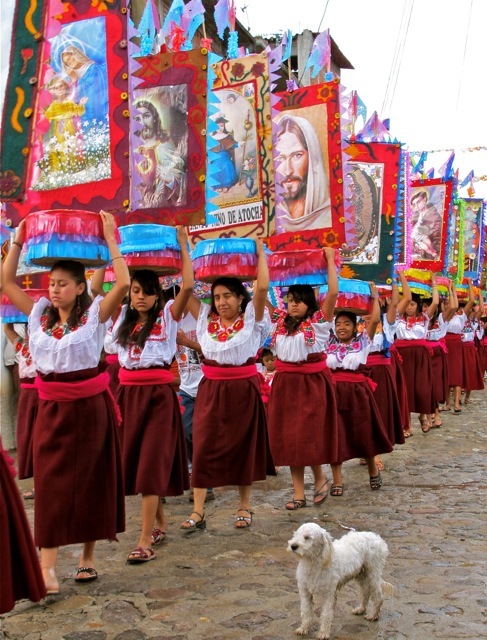
Arms above head, balancing their canastas, they wound their way through the slick (it was drizzling) cobblestone streets of the village for an hour, before eventually returning to the church.

Procession of young Zapotec women carrying canastas on their heads while a little white dog watches

I don’t know how they did it; even the dogs were in awe!

Sunday’s events to follow…

Read Full Post »

Hanging out In Teotitlán del Valle…

Male and female effigies hanging from window grate.

On a rainy day…

Weaver at loom painted on side of building:

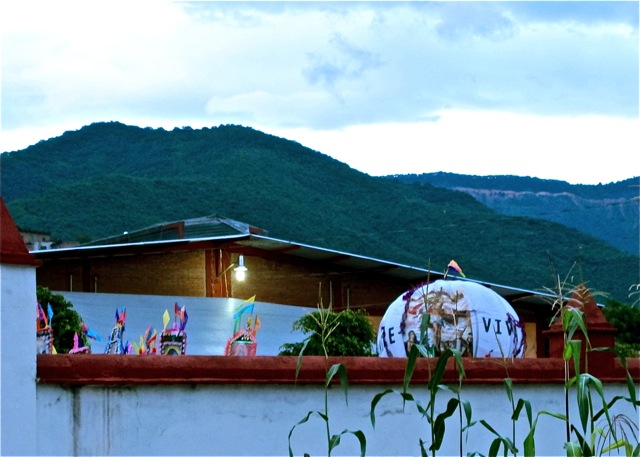
Waiting for a parade to pass me by…

Tops canastas and marmota visible above wall, with mountains in background

Save

Read Full Post »

What a difference 5 days make…

Early Wednesday evening, the unmistakable sounds of a desfile replaced the usual background noise of commute traffic.  Bands (yes, more than one), cheers, and cohetes (all bang, no bling fireworks) got louder and louder.  I had to come down off the rooftop to see what was happening.

The energy, enthusiasm, creativity, and laughter of thousands of young people filled the street, brightened, what had been a gray day, and provided a stark contrast to the serious military pomp of the Independence Day parade only 5 days before.

This slideshow requires JavaScript.

The occasion was the 30th anniversary of the Colegio de Bachilleres del Estado de Oaxaca (COBAO), an academically rigorous and successful high school system in the state.  In thirty years, this public school has grown from a single campus with 400 students to 64 campuses educating 45,000 students.

Students, faculty, alumni, and dignitaries gathered in the Plaza de la Danza for presentations and speeches.  According to Noticias, it was noted that the event coincided with the approval of two amendments to the Mexican constitution making secondary education mandatory, beginning next year.  Naturally, the event concluded with the requisite fireworks display, which I happily enjoyed from the terrace!

(ps)  Alvin Starkman has written an article in English, Oaxaca Public School Education Targets Student Success: COBAO, about a young girl, from a small village and family of potters, who was recently accepted into COBAO.

Read Full Post »

On the morning of September 16, the sidewalks of Trujano, leading to Oaxaca’s Zócalo, were lined with people.  Traffic was blocked on Trujano and many of the side streets, as contingents of soldiers, state police, municipal police, transit police, fire fighters (bomberos), paramedics, schools, and charros gathered to participate in the desfile cívico militar (civic and military parade) marking 201 years of independence from Spain.

This slideshow requires JavaScript.

Like most patriotic parades throughout the world, the military component dominated the civic.  And here, even the school contingents march in military fashion.  The use of Mexico’s military is controversial, not to mention the roles played by the state and municipal police in Oaxaca.  Onlookers clapped for various contingents, but I didn’t catch the subtleties of support, other than the big hand the bomberos received.

This was the other side of the green, white, and red fervor, and I’ve spent a lot of time contemplating what I thought of the parade and what I wanted to say.  However, as a guest in this country, I’m going to let the photographs speak and readers may interpret them as they wish.

Read Full Post »

More color from around town this past week…

This slideshow requires JavaScript.

Read Full Post »

Octavio Paz, writing about the Mexican independence movement in The Labyrinth of Solitude:

The eighteenth century prepared the way for the Independence movement.  In fact, the science and philosophy of the epoch… were necessary intellectual antecedents of the Grito de Dolores.  [p. 118]

…the insurgents vacillated between Independence (Morelos) and modern forms of autonomy (Hidalgo).  The war began as a protest against the abuses of the metropolis and the Spanish bureaucracy, but it was also, and primarily, a protest against the great native landholders.  It was not a rebellion of the local aristocracy against the metropolis but of the people against the former.  Therefore the revolutionaries gave greater importance to certain social reforms than to Independence itself:  Hidalgo proclaimed the abolition of slavery and Morelos broke up the great estates. 

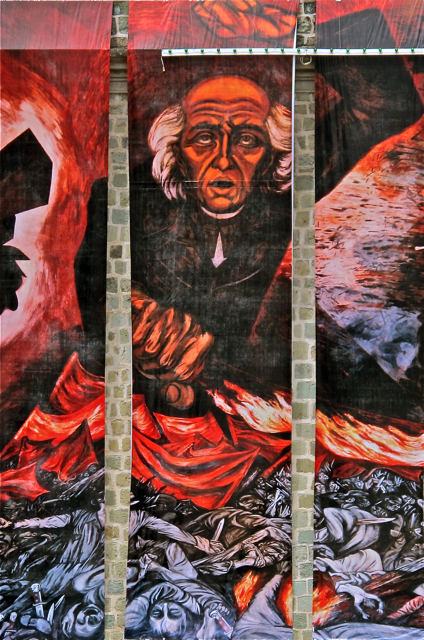
Banner on Oaxaca's Municipal Building; reproduction of mural by José Clemente Orozco of Miguel Hidalgo y Costilla.

The Revolution of Independence was a class war, and its nature cannot be understood correctly unless we recognize the fact that unlike what happened in South America, it was an agrarian revolt in gestation.  This is why the army (with its criollos like Iturbide), the Church and the great landowners supported the Spanish crown… [p. 123]

Paz, Octavio.  The labyrinth of solitude, the other Mexico; Return of the labyrinth of solitude; Mexico and the United States; The philanthropic ogre.  New York:  Grove Press, 1985

Read Full Post »

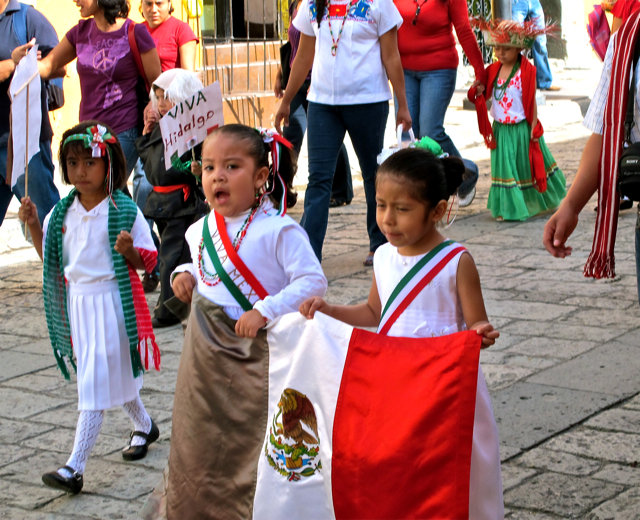
Let the celebrations begin!  This morning, enroute to the library, I ran into a pre-school parade coming down the Alcalá…

Children carrying Mexican flag and Viva Hidalgo sign.

These two were bringing up the rear because they kept pausing for photos, and I couldn’t resist, either!

A little girl holding the hand of an even smaller boy.

Going to the zócalo this afternoon more resembled trying to get to an airport gate, than strolling into a town square.  Security checkpoints, with metal detectors, have been set up at 10 intersections.  According to an article in this morning’s Noticias, security cameras are also in use.

Black clad military with automatic weapons, wearing flak jackets and helmets, at security checkpoint

All is in readiness for tonight’s festivities… another sound and light show projected on the cathedral, fireworks, and the Grito de Dolores from the balcony of the Government Palace.

Government Palace with flags and color portraits of Mexican heroes of Independence.

However, tonight I’ll be eating the traditional Chiles en Nogada,  listening for the bells at 11PM, and then watching the fireworks from my ringside seat on the rooftop.  ¡Viva Mexico!

(ps)  Portrait on the left is of Vicente Guerrero.

Read Full Post »

As I mentioned a few days ago, El Grito and Mexican Independence Day are coming and, besides flags and green, white and red decorations, it also means parades and fuegos artificiales (fireworks).   The latter will, no doubt be grand and, if last year is any indication, the rooftop with have a ringside view.

In anticipation, I thought I’d share a video from the rooftop of the nightly fireworks during July’s Sinfonía de Luz y Sonido throughout this year’s Guelaguetza.

Read Full Post »

El Grito de la Independencia is coming!  Vendors of everything green, white, and red have set up their carts on Oaxaca’s busiest street corners and Mexican flags are flying everywhere.

A little slice from yesterday’s grocery shopping trip around town…

This slideshow requires JavaScript.

Definitely more to come!


Read Full Post »

One priest, countless dogs, several birds, a couple of cats, a few fowl, a pair of fish, one white rabbit, numerous cute kids, parents and grandparents, beautiful young women, tough guys and cool teens, multiple media outlets, and spectators (with cameras and cell phones) congregated at 4 PM today in the plaza outside the Templo de Nuestra Señora de la Merced (Temple of Our Lady of Mercy) for the Bendición de los Animales (Blessing of the Animals).

This slideshow requires JavaScript.

This annual event, held on August 31, celebrates the feast day of San Ramón de Nonato, patron saint of women in labor, persons falsely accused, and keeper of animals.  The gathering was muy tranquilo; a Peaceable Kingdom prevailed and Edward Hicks would have felt right at home.

I must say the priest was quite energetic with the holy water and even the non-believers among us got a good sprinkling and came away feeling blessed!

(ps)  Fellow blogger, Chris, caught the priestly action.

(pps)  Noticias has video… the music is priceless!

Read Full Post »

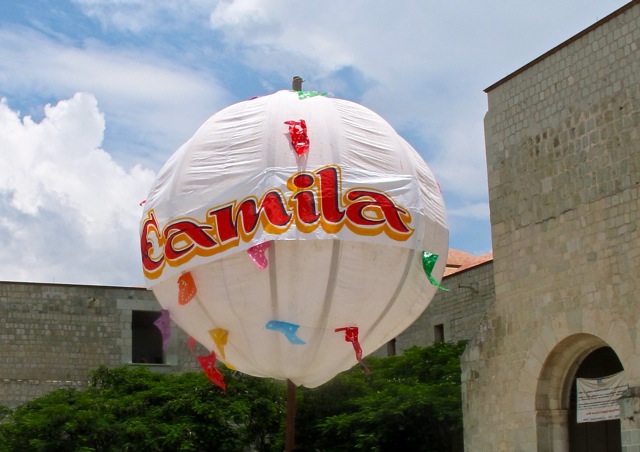
Who is Camila?

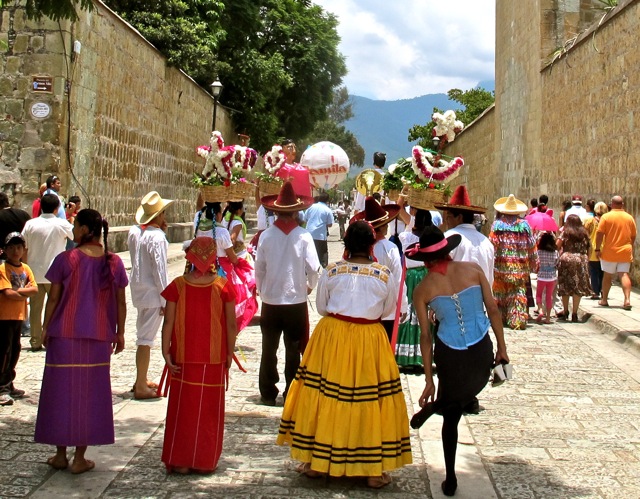
Also on Saturday, I stumbled on yet another parade.   And I wondered, who is Camila?

Giant cloth balloon (una marmota) with Camila written on it

Is this Camila (y amigo)?

Male and female giant puppets (monos)

Whoever she is, she was a good excuse for music, fireworks, dancers, and a parade up Macedonio Alcalá…

Parade up Macedonio Alcalá

and, why it’s a good idea to take one’s camera… even when just going grocery shopping!

Spanish lesson:

  • Giant cloth balloon = Una marmota
  • Giant puppets = Los monos
  • Flower covered head pieces = Las canastas

Read Full Post »

Yesterday, I opted for the smaller and more intimate Guelaguetza in the Villa de Etla, about 12 miles northwest of Oaxaca city.  As far as I could tell, seven of the eight regions of the state of Oaxaca were present; only the Sierra Sur was missing.  FYI:  In the photos below, I purposefully left out the Plume dancers, who represented the Valles Centrales, as you will find plenty of photos of the Danza de la Pluma in my postings from the Fiesta de Preciosa Sangre de Cristo in Teotitlán del Valle.  By the way, Chris at Oaxaca-The Year After posted a terrific Guelaguetza Guide to assist in identifying the regions of Oaxaca.  It’s in Spanish, but even a non-Spanish speaker can learn quite a bit.

On a more serious note… I was reminded today by a Oaxaqueña friend, Guelaguetza in the city of Oaxaca is controversial.  Tickets (available through TicketMaster, I might add) for reserved seating to the official performances on Cerro Fortín at the (newly renovated and hotly disputed) Guelaguetza Auditorium are beyond the reach of most Oaxaqueños, some events are sponsored by Coca Cola, hundreds of thousands of pesos of tax payer monies have been spent on the sound and light show (spectacular, as it is), nightly fireworks, bringing in celebrities, and slick, though often inaccurate, publicity.  All is geared (well, not the inaccuracies) toward tourists; a boon to the restaurants and hotels around the zócalo.  But…

Unfortunately, what is lost is that the Guelaguetza is supposed to be a celebration that brings together the extremely diverse indigenous communities, from the various regions of the state to share their crafts, food, dance.  It wasn’t supposed to be crass commercialism that caters to tourists and well-heeled locals, at the expense of peoples who originated the tradition.  And, my friend asked, along with admiring their costumes and colorful dances, wouldn’t a portion of the pesos be better spent attending to the real and extremely pressing needs of the poverty stricken indigenous communities, especially with regard to infrastructure and education?

However, yesterday in Etla, I caught, perhaps, a glimpse of the original meaning of Guelaguetza.  Admission was free and open to one and all.  Free tamales and beverages (alcoholic and non) were offered to the standing-room only crowd, along with the sombreros, baskets, fans, whisk brooms, tlayudas, and fruit that each of the delegations of dancers tossed to the audience at the end of their performances.  After it was over, fellow blogger Chris and I looked around and realized, we were probably the only gringo and gringa in attendance.  What an honor and privilege!

Read Full Post »

« Newer Posts - Older Posts »