Feeds:
Posts
Comments

Posts Tagged ‘Mexican Independence Day’

As I write, it is late on September 15, and all over Mexico El Grito de Dolores, also known as El Grito de la Independencia (the Shout of Independence), is echoing from government buildings throughout the country, from the Palacio Nacional in Mexico City to Oaxaca’s Palacio de Gobierno to ayuntamientos (city halls) in small towns.

Mexicans!
Long live the heroes that gave us the Fatherland!
Long live Hidalgo!
Long live Morelos!
Long live Josefa Ortiz de Dominguez!
Long live Allende!
Long live Aldama and Matamoros!
Long live National Independence!
Long Live Mexico! Long Live Mexico! Long Live Mexico!

Portraits of the above listed heroes of Mexico’s War of Independence from Spain hang from the Government Palace in Oaxaca, as well as from the Municipal Building facing the Plaza de la Danza.

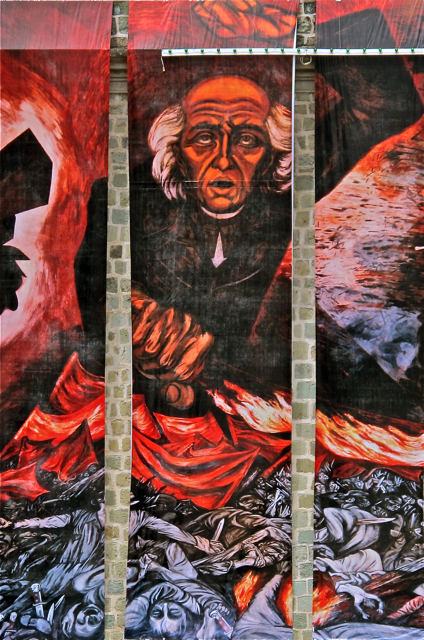
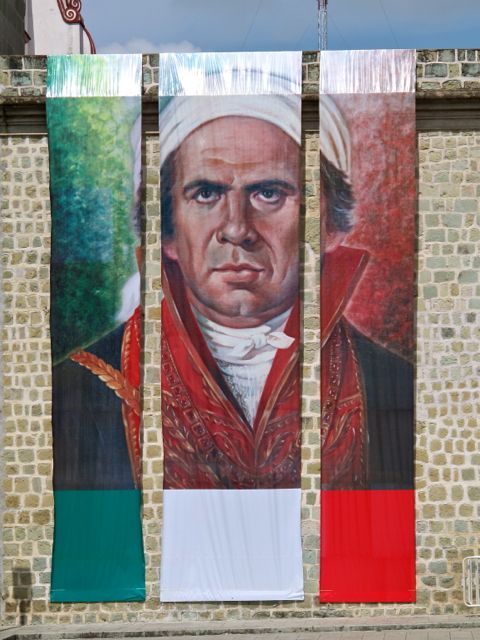
Massive 3-piece banner portrait of Morelos hanging from wall of Oaxaca's Municipal Building

And, this year, José María Morelos y Pavón is honored with a second massive portrait on the outer wall of the Municipal Building.  Last year, it was a reproduction of Orozco’s dramatic painting of Miguel Hidalgo y Costilla.

Read Full Post »

The word "ASK" written on white wall with light green trim on left

Where else have you seen El Grito decorations?

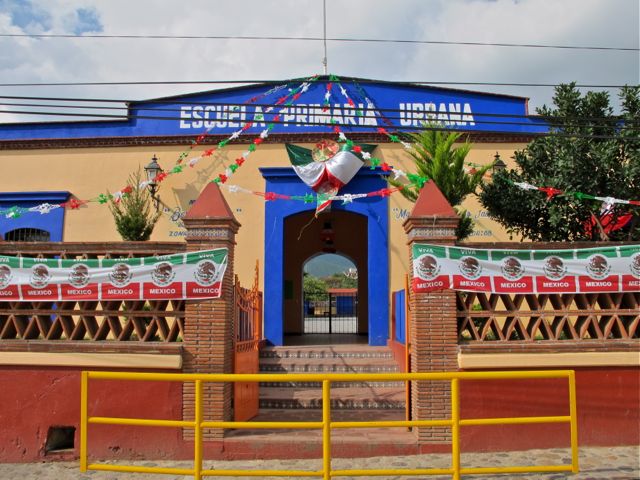
Blue and peach colored school decorated with Mexican flag banners and drapes

Schools, of course!  This one in Teotitlán del Valle.

People standing in front of newsstand decorated with a green, white, and red garland.

And, how about newsstands?  You can’t miss the green, white, and red — it’s everywhere!

Read Full Post »

El Grito is coming, El Grito is coming!!!  Green, white and red is on display all over the city, including clothing stores, as tradition calls for wearing the colors.

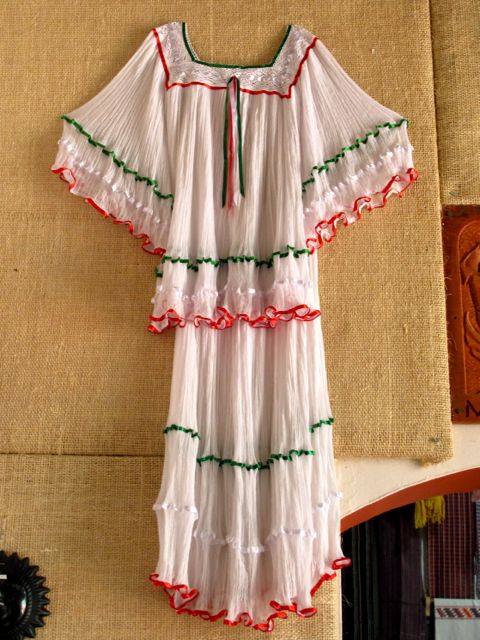
Are you in the market for a traditional look?

White blouse and skirt with green and red trim.

A huipil and rebozo?

Green, white, and red dresses and shawls hanging on wall.

Or, are you leaning toward an updated mix and match style?

Green, white, and red dresses, skirs, blouses, and sash.

Do you need a sweater for going down to the zócalo on the evening of September 15?

Green, white, and red sweaters hanging on display hooks.

By all means, don’t forget to accessorize!

Green purse and red shoes.

On a more serious note:  Despite its current challenges (which are many and serious), Mexicans are extremely proud of being Mexicanos.  And, in my humble opinion, they have every right be!  They can trace their history back to ancient and highly developed civilizations, their national cuisine has been placed on the World Heritage List by UNESCO, and Mexico is considered one of the most geographically and biologically diverse countries in the world.  Plus, when was the last time you heard Mexico had invaded another country?

Read Full Post »

On the morning of September 16, the sidewalks of Trujano, leading to Oaxaca’s Zócalo, were lined with people.  Traffic was blocked on Trujano and many of the side streets, as contingents of soldiers, state police, municipal police, transit police, fire fighters (bomberos), paramedics, schools, and charros gathered to participate in the desfile cívico militar (civic and military parade) marking 201 years of independence from Spain.

This slideshow requires JavaScript.

Like most patriotic parades throughout the world, the military component dominated the civic.  And here, even the school contingents march in military fashion.  The use of Mexico’s military is controversial, not to mention the roles played by the state and municipal police in Oaxaca.  Onlookers clapped for various contingents, but I didn’t catch the subtleties of support, other than the big hand the bomberos received.

This was the other side of the green, white, and red fervor, and I’ve spent a lot of time contemplating what I thought of the parade and what I wanted to say.  However, as a guest in this country, I’m going to let the photographs speak and readers may interpret them as they wish.

Read Full Post »

More color from around town this past week…

This slideshow requires JavaScript.

Read Full Post »

Octavio Paz, writing about the Mexican independence movement in The Labyrinth of Solitude:

The eighteenth century prepared the way for the Independence movement.  In fact, the science and philosophy of the epoch… were necessary intellectual antecedents of the Grito de Dolores.  [p. 118]

…the insurgents vacillated between Independence (Morelos) and modern forms of autonomy (Hidalgo).  The war began as a protest against the abuses of the metropolis and the Spanish bureaucracy, but it was also, and primarily, a protest against the great native landholders.  It was not a rebellion of the local aristocracy against the metropolis but of the people against the former.  Therefore the revolutionaries gave greater importance to certain social reforms than to Independence itself:  Hidalgo proclaimed the abolition of slavery and Morelos broke up the great estates. 

Banner on Oaxaca's Municipal Building; reproduction of mural by José Clemente Orozco of Miguel Hidalgo y Costilla.

The Revolution of Independence was a class war, and its nature cannot be understood correctly unless we recognize the fact that unlike what happened in South America, it was an agrarian revolt in gestation.  This is why the army (with its criollos like Iturbide), the Church and the great landowners supported the Spanish crown… [p. 123]

Paz, Octavio.  The labyrinth of solitude, the other Mexico; Return of the labyrinth of solitude; Mexico and the United States; The philanthropic ogre.  New York:  Grove Press, 1985

Read Full Post »

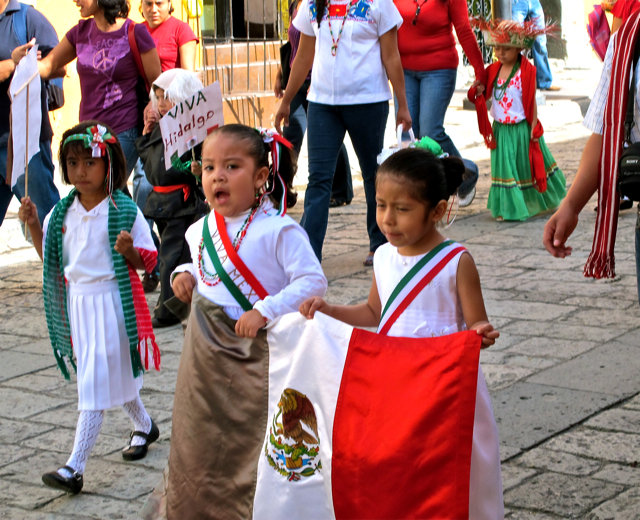
Let the celebrations begin!  This morning, enroute to the library, I ran into a pre-school parade coming down the Alcalá…

Children carrying Mexican flag and Viva Hidalgo sign.

These two were bringing up the rear because they kept pausing for photos, and I couldn’t resist, either!

A little girl holding the hand of an even smaller boy.

Going to the zócalo this afternoon more resembled trying to get to an airport gate, than strolling into a town square.  Security checkpoints, with metal detectors, have been set up at 10 intersections.  According to an article in this morning’s Noticias, security cameras are also in use.

Black clad military with automatic weapons, wearing flak jackets and helmets, at security checkpoint

All is in readiness for tonight’s festivities… another sound and light show projected on the cathedral, fireworks, and the Grito de Dolores from the balcony of the Government Palace.

Government Palace with flags and color portraits of Mexican heroes of Independence.

However, tonight I’ll be eating the traditional Chiles en Nogada,  listening for the bells at 11PM, and then watching the fireworks from my ringside seat on the rooftop.  ¡Viva Mexico!

(ps)  Portrait on the left is of Vicente Guerrero.

Read Full Post »

In Mexico, from small pueblos (villages) to large ciudades (cities), most all have calles (streets) named Morelos and Hidalgo — some, like Oaxaca, have more than one, which can be very confusing when trying to find an address, to say the least!  The names Vicario and Ortiz de Domínguez aren’t nearly so commonplace.

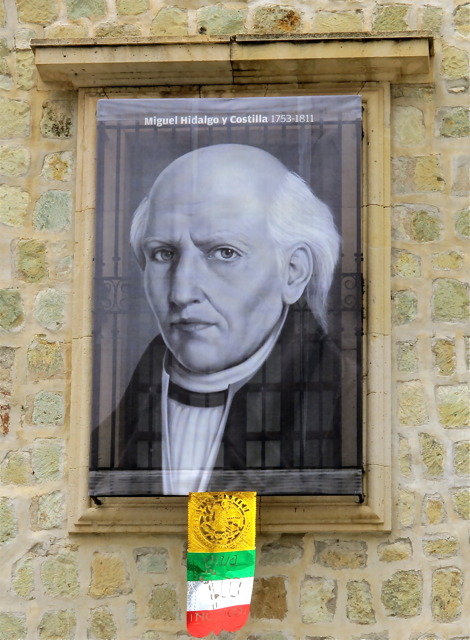
However, two of the women (among countless unsung heroines) who played a major role in the struggle for independence from Spain were Leona Vicario and Josefa Ortiz Domínguez.  In a fitting tribute to their importance to the Independence movement, their giant portraits currently hang on the outside wall of the Municipal Building overlooking the Plaza de la Danza, along with those of Miguel Hidalgo de Costilla and José María Morelos y Pavón.
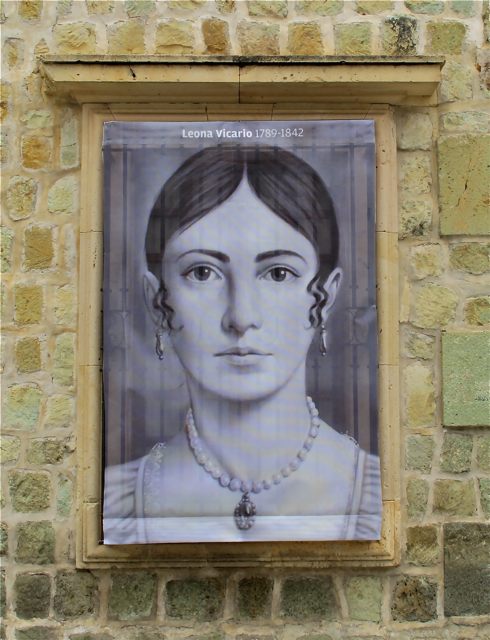
Portrait of Leona Vicario

Leona Vicario, 1789-1842

Leona Vicario provided money and medical support, helped fugitives, and served as a messenger.  After escaping from prison, she helped her husband, Andrés Quintana Roo, plan strategies on the battle field.
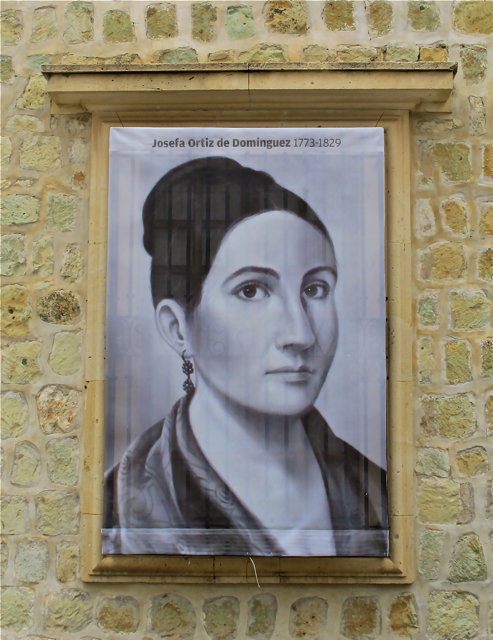
Portrait of Josefa Ortiz de Domínguez

Josefa Ortiz de Domínguez, 1773-1829

Confined to house arrest after a co-conspirator betrayed the upcoming plans for revolt by the Independence movement, Josefa Ortiz de Domínguez was able to smuggle a message out, warning of the betrayal.

Portrait of Miguel Hidalgo y Costilla

Miguel Hidalgo y Costilla, 1753-1811

As a result, in the early morning of September 16, Miguel Hidalgo y Costilla rang the church bells in Dolores, rallying the rebels, and issuing, what has come to be known as Grito de Dolores (Cry of Dolores), the signal to begin the War of Independence from Spain.  It is an event that is recreated all over Mexico at 11 PM on September 15.  (See the link re why it isn’t done in the early morning of September 16.)
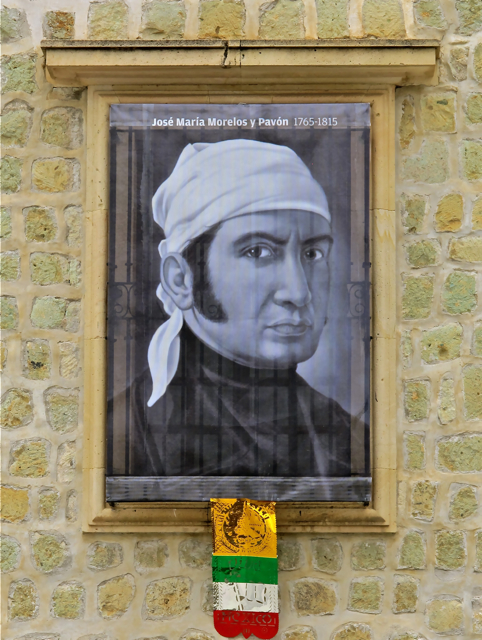
Portrait of José María Morelos y Pavón

José María Morelos y Pavón, 1765-1815

The last portrait on the wall is that of José María Morelos y Pavón, of Afro-mestizo heritage, and, like Hidalgo, also a priest.  He was a capable military commander who assumed leadership of the independence movement after Hidalgo was executed.  For a local connection, on November 25, 1812, in what is thought of as a brilliant victory, Morelos, along with the support of Mariano Matamoros and Miguel Bravo, took the city of Oaxaca.  Fittingly, the streets Morelos and Matamoros run parallel and M. Bravo intersects them just a few blocks from the Municipal Building and the Plaza de la Danza.

(ps)  These portraits are painted directly on fine mesh screen… thus, the window bars showing through.

Read Full Post »
El Grito de la Independencia is coming!  Vendors of everything green, white, and red have set up their carts on Oaxaca’s busiest street corners and Mexican flags are flying everywhere.

A little slice from yesterday’s grocery shopping trip around town…

This slideshow requires JavaScript.

Definitely more to come!


Read Full Post »

« Newer Posts