Feeds:
Posts
Comments

Posts Tagged ‘Fiesta de la Preciosa Sangre de Cristo’

July in the valley of Oaxaca has begun!  There will be festivals of mole, mushrooms, cheeses, and tamales.  And, there will be the costumes, calendas, and music of Guelaguetza in the city and in several of the surrounding villages.  But first…

Subalterno with open arms

Under a dark and threatening sky, the people of Teotitlán del Valle began their week-long Fiesta titular a la Preciosa Sangre de Nuestro Señor Jesucristo (Festival to the Precious Blood of Our Lord Jesus Christ).  Wearing traditional embroidered blouses and wool skirts woven in this Zapotec village known for its weaving, the unmarried young women and girls gathered in front of the church (Templo de la Preciosa Sangre de Cristo) for the convite (procession) that kicks off Teotitlán’s most important fiesta of the year.

Young Zapotec women and girls in front of church

The rain held off and the procession left the confines of the church courtyard.

Marmotas and people leaving entry gate

Marmotas (giant cloth globes), music, and pyrotechnics led the way…

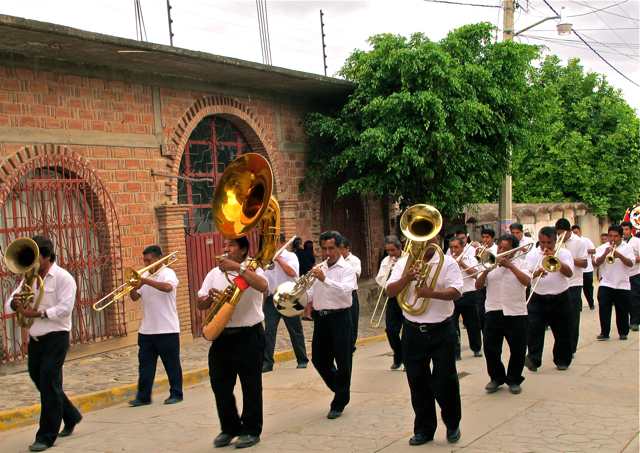
Banda marching down street

along with little boys holding canes of carrizo and poles topped with small marmotas, fluffy sheep, and airplanes (don’t ask me).

Little boy carrying small marmota

And then came the young women and girls, carrying canastas with images of the saints on their heads.  I have to note here, these baskets are REALLY heavy.  I know, because last year one of the gals asked if I’d like to try — I did for all of about five seconds.  They carry them for almost an hour!!!

Young women with carry canastas on their heads

Most of the residents came out to watch at prime viewing locations.  (Teenage boys were especially prominent, but they deserve another blog post.)

Men, women, and children standing on street

Under the watchful eye of El Picacho (the sacred mountain of Teotitlán), the procession wound its way up and down the cobblestone streets…

Procession in mid-ground and mountain in background

and eventually returned to the church courtyard, where it all began.

For more photos, including some of the pyrotechnic guys in action, check out Oaxaca-The Year After.

Read Full Post »

The Danza de la Pluma penachos (headdresses), capes, and leggings are spectacular and unique to Teotitlán del Valle.  The feathered designs on the penachos are more intricate and varied than in other pueblos; and the capes and leggings are hand-woven in this village that is internationally known for its weaving.  However, while the Danza de la Pluma is a crowd-pleaser during the annual July Guelaguetza on Cerro del Fortín in Oaxaca, folkloric groups from other villages are usually chosen to perform it, as Teotitlán’s costumes are not considered “authentic.”

IMG_4828

However, performing for tourists is not why Teotitlán del Valle tells this story through music and dance several times a year.  It is performed on the church plaza, not the municipal plaza, because it is an integral part of the annual major religious celebrations of the village:  Fiesta titular a la Preciosa Sangre de Nuestro Señor Jesucristo in July, Fiesta a la Natividad de la Virgen María in September, Fiesta a el Rosario de la Virgen María in October, and Fiesta a la Virgen de Guadalupe in December.

Penachos from the Fiesta a la Natividad de la Virgen María on Sunday…

Capes from Sunday’s Fiesta a la Natividad de la Virgen María and July’s Preciosa Sangre de Nuestro Señor Jesucristo festival.

Leggings from both festivals…

The various elements of the costumes do not come cheap and dancers must appeal to their extended families to assist in commissioning each of the pieces.  Thus, as annual festivals come and go during a dancer’s 3-year commitment, the costumes may evolve.

With their performances, the dancers honor the rituals of their church and community.  And, with their magnificent costumes, they pay homage to the creativity, talent, and tradition of Teotitlán del Valle’s weavers and feather artists.

Read Full Post »

We returned to Teotitlán del Valle on Tuesday and Wednesday for performances of the Danza de la Pluma, a ritual re-enactment of the battles between the Aztec and Spanish.  According to OaxacaWiki:

The origin of this dance goes back to the spiritual and physical conquest of Mexico by the Spanish – La Guerra de Conquista. The dance originated in the town of Cuilpam de Guerrero where Martin Cortes (son of Cortes) celebrated the first baptism of his child. Martin played the role of his father and the locals played the roles of the conquered indigenous peoples.

The story is told in 41 bailes (dances) and lasts from early afternoon into the night.  Selected years in advance, it is an honor to be a dancer and they perform their roles for 3 years.  This week, during the multi-day fiesta honoring Preciosa Sangre de Nuestro Señor Jesucristo, we saw the first performances by the new cast and they looked great!

Presenting the Cast of Characters

Montezuma

Doña Marina (hat) and Malinche (headdress)

2 Subalternos

16 Danzantes:  Teotiles (2), Capitánes (2), Reyes (4), and Vasallos (8)

They are going to be fun to watch during the next 3 years.   (By the way, the costumes may change from day-to-day, but the cast remains the same.)

Read Full Post »

Monday, we returned to Teotitlán del Valle for the Fiesta titular a la Preciosa Sangre de Nuestro Señor Jesucristo — the pueblo’s most important festival of the year.  While special masses have been celebrated at the Templo de la Preciosa Sangre de Cristo (the village church) since June 30, Monday’s convite (procession) by the unmarried women in the village, kicked off the more public events.

Lovingly decorated canastas (baskets) waited in the church to be reclaimed by their owners, placed on their heads, and carried through the streets.

Crowds gathered in the plaza in front of the church and sidewalks and streets along the route.

And then it began — with solemn drum beats, fireworks, church bells, marmotas (cloth balloons on a pole), and a band.

Little boys (and a few girls) carrying model airplanes (don’t ask me why), paper mache lambs, and turkeys followed.

And then came the neatly organized rows of girls and young women.

For over an hour they wound their way up and down and around the streets of Teotitlán del Valle.  The weather was perfect, no late afternoon thunder showers this year, and it was glorious.

Stay tuned, the festivities continue all week.  And, check out Oaxaca-The Year After this week for blogger buddy Chris’s photos and commentary.

Read Full Post »

I must confess, I’m partial to Teotitlán del Valle and this fiesta.  It was photos from the 2007 celebration that first persuaded me to visit Oaxaca.  However, this is it… I promise… no more photos from the Preciosa Sangre de Nuestro Señor Jesucristo in Teotitlán del Valle until next year!

This slideshow requires JavaScript.

However, if you, like me, can’t get enough… check out Chris’s photos over at Oaxaca-The Year After.

Read Full Post »

A brief slice from the hours and hours of dancing done by the Danzantes de Promesa, in the plaza in front of the church in Teotitlán del Valle, during the multi-day fiesta honoring Preciosa Sangre de Nuestro Señor Jesucristo.

The Danza de la Pluma consists of 41 “bailles” (pieces of music) that, on the surface, reenact the conquest.  Cortes and his troops are played by very young through teenage boys.  They occasionally march around, but mostly stay seated.  The Danzantes representing the Aztec, on the other hand, are young (and not so young!) men and dance at least 70% of the time.  In addition, Moctezuma has some solos and La Malinche and Doña Marina perform several lively dances.

A 20+ piece orchestra accompanies the dancers, playing the proscribed music, including, incongruous to me, waltzes, polkas, and schottisches. According to the Harris article referenced below, at the end of the 19th century the orchestra replaced the original indigenous drum and flute.

The subtext and “hidden” narratives of the danza are multiple and complex and I’m only in the infant stages of understanding.  For now, until my Spanish language skills improve significantly and I can talk with someone who is a member of the community, I will leave it to the two scholarly articles listed at the end of this post to attempt interpretation.

By the way, the day was overcast and windy at times, with gusts threatening those enormous and extremely top-heavy headdresses.

References:

Cohen, Jeffrey.  Danza de la Pluma:  Symbols of submission and separation in a Mexican Fiesta.  Anthropological Quarterly, Jul 93, Vol. 66 Issue 3, p. 149-158.

Harris, Max. The Return of Moctezuma.  The Drama Review, Sp 97, Vol. 41 Issue 1, p. 106, 29 p.

Now that I’ve done some research (alas, after the fact)… I want to see it again!

Read Full Post »

After all the waiting, the calenda (parade) of the Preciosa Sangre de Nuestro Señor Jesucristo began winding its way from the church courtyard down the narrow streets of Teotitlán del Valle and back up to the courtyard.

Arms raised, the unmarried young women of the village carried these bamboo-framed canastas floreadas above their heads for the entire route.

And, naturally there was a band… with the requisite tuba!

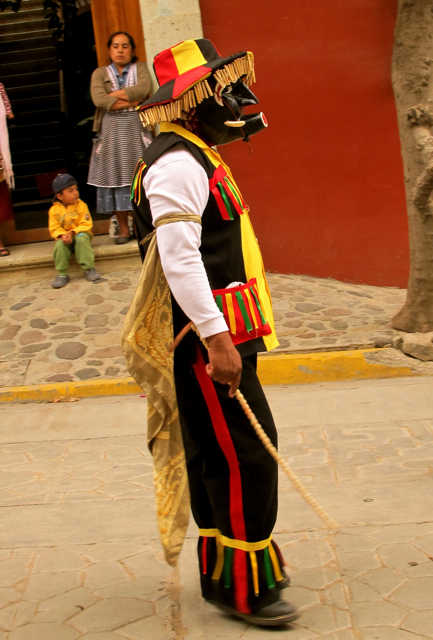
This Subalterno (one of two who keep their eyes on the festivities) kept the procession moving along…

including the young Soldaditos of Hernan Cortes.

They were followed by the Danzantes de Promesa (note the other Subalterno to the far right)…

and bringing up the rear, Moctezuma with the dual personalities of the same woman, La Malinche and Doña Marina.

In this village, known for its weaving, a complex tapestry of religious ritual, historic legend, and tangled mythology has been woven together to celebrate community and identity.

Definitely worth the wait… AND there’s more to come!

Read Full Post »

The participants also did a lot of waiting…

This slideshow requires JavaScript.

How do they remain in such good humor???

Read Full Post »

Waiting is something one does here… and, no matter what the age, it always seems to be done with a Zen-like patience.  Today it was for the traditional calenda of the Preciosa Sangre de Nuestro Señor Jesucristo  in Teotitlán del Valle.

This slideshow requires JavaScript.

More on the fiesta in upcoming posts…

Read Full Post »

« Newer Posts