Feeds:
Posts
Comments

Posts Tagged ‘Danza de la Pluma’

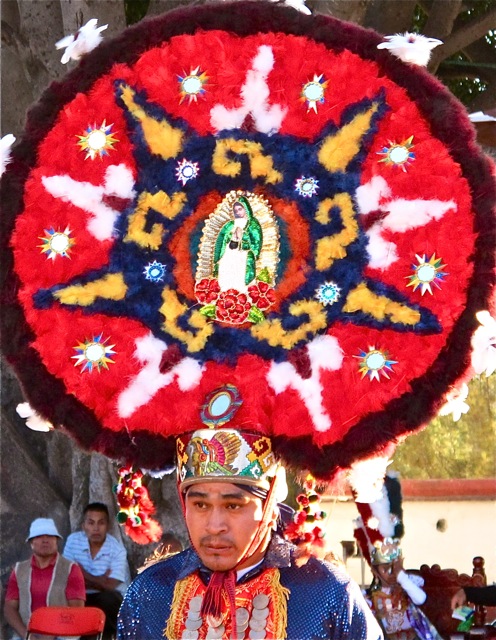
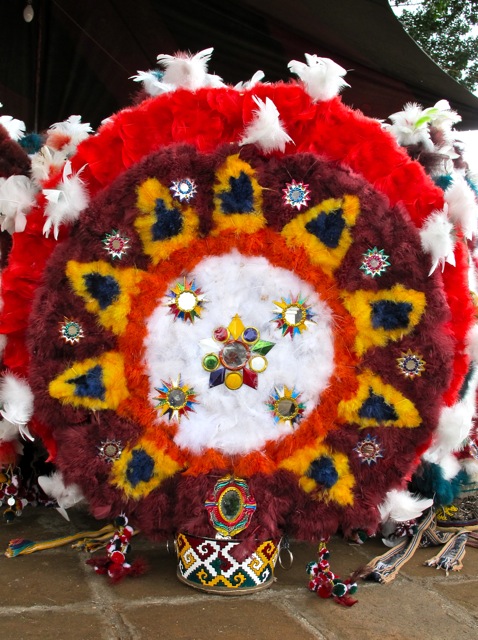
The Danza de la Pluma penachos (headdresses), capes, and leggings are spectacular and unique to Teotitlán del Valle.  The feathered designs on the penachos are more intricate and varied than in other pueblos; and the capes and leggings are hand-woven in this village that is internationally known for its weaving.  However, while the Danza de la Pluma is a crowd-pleaser during the annual July Guelaguetza on Cerro del Fortín in Oaxaca, folkloric groups from other villages are usually chosen to perform it, as Teotitlán’s costumes are not considered “authentic.”

IMG_4828

However, performing for tourists is not why Teotitlán del Valle tells this story through music and dance several times a year.  It is performed on the church plaza, not the municipal plaza, because it is an integral part of the annual major religious celebrations of the village:  Fiesta titular a la Preciosa Sangre de Nuestro Señor Jesucristo in July, Fiesta a la Natividad de la Virgen María in September, Fiesta a el Rosario de la Virgen María in October, and Fiesta a la Virgen de Guadalupe in December.

Penachos from the Fiesta a la Natividad de la Virgen María on Sunday…

Capes from Sunday’s Fiesta a la Natividad de la Virgen María and July’s Preciosa Sangre de Nuestro Señor Jesucristo festival.

Leggings from both festivals…

The various elements of the costumes do not come cheap and dancers must appeal to their extended families to assist in commissioning each of the pieces.  Thus, as annual festivals come and go during a dancer’s 3-year commitment, the costumes may evolve.

With their performances, the dancers honor the rituals of their church and community.  And, with their magnificent costumes, they pay homage to the creativity, talent, and tradition of Teotitlán del Valle’s weavers and feather artists.

Read Full Post »

Yippee, I’m back in Oaxaca!  Last night’s flight was smooth, on-time, and mostly empty.  I have to admit to always getting a goofy grin as the little Embraer comes in over the lights of the city and the smile continues through immigration and baggage claim.  It usually falters and turns to a grimace when I have to hoist my 50 pound suitcase up onto the x-ray conveyor belt.  However, last night the grin returned when I pressed the “to search or not to search” button, got the green light, and was able to proceed directly to the booth to buy my colectivo ticket —  60 pesos for door-to-door service to the historic district ‘hood.  An easy return to home.

Unpacking done, late this morning I walked down to my local mercado to restock the larder with some basics:  2 perfect avocados, 1 pristine white onion, a bunch of unblemished small and sweet bananas, half kilo of quesillo (Oaxacan string cheese), and 6 freshly made tamales (mole, rajas, and verde).  I’d actually asked for 4, but my regular tamale gal threw in 2 extras.  How often does that happen in el norte?   A welcoming return to home.

This afternoon, blogger buddy Chris and I drove out to Teotitlán del Valle for the performance of the Danza de la Pluma.  We stepped up onto the plaza of Templo de la Preciosa Sangre de Cristo and it was like emerging into the middle of a technicolor movie.  We’ve been there countless times, but today we were blown away by the scene.  Mother Nature had conspired to use her enhance wand on the sky, clouds, sun, and costumes.   A spectacular return to home!

The recent trip to California was to sign papers finalizing the sale of the house my grandparent’s built in 1957.  Prior to relocating to Oaxaca, it had been my home for 30 years, where I’d raised my kids and made many wonderful memories.  Needless to say, selling it was an emotionally challenging ordeal and it has engendered a lot of thinking about the notion of “home.”

However, these past 24 hours have reinforced my belief in bumper-sticker wisdom seen many years ago, “When you live in your heart, you are always home.”  It’s good to be home!

Read Full Post »

We returned to Teotitlán del Valle on Tuesday and Wednesday for performances of the Danza de la Pluma, a ritual re-enactment of the battles between the Aztec and Spanish.  According to OaxacaWiki:

The origin of this dance goes back to the spiritual and physical conquest of Mexico by the Spanish – La Guerra de Conquista. The dance originated in the town of Cuilpam de Guerrero where Martin Cortes (son of Cortes) celebrated the first baptism of his child. Martin played the role of his father and the locals played the roles of the conquered indigenous peoples.

The story is told in 41 bailes (dances) and lasts from early afternoon into the night.  Selected years in advance, it is an honor to be a dancer and they perform their roles for 3 years.  This week, during the multi-day fiesta honoring Preciosa Sangre de Nuestro Señor Jesucristo, we saw the first performances by the new cast and they looked great!

Presenting the Cast of Characters

Montezuma

Doña Marina (hat) and Malinche (headdress)

2 Subalternos

16 Danzantes:  Teotiles (2), Capitánes (2), Reyes (4), and Vasallos (8)

They are going to be fun to watch during the next 3 years.   (By the way, the costumes may change from day-to-day, but the cast remains the same.)

Read Full Post »

It’s been a week since the end of Semana Santa and I’m still sorting through photos and videos and reflecting on impressions and feelings.  However, I’m finding that, with too much thinking, the experience slips through the fingers and the magic vanishes.

Thus, I give you the night of Pascuas (Easter) at Carmen Alto…

And then, the hisses, bangs, and brilliant explosions of a castillo…

Flaming castillo

brought Semana Santa to a spectacular close.

Read Full Post »

December seems to be quite a month for the Virgins of Oaxaca.

December 8, I was awakened by cohetes (rockets… all bang, no bling) at 4:45 AM.  They continued sporadically until about an hour later, when wildly clanging church bells heralded a non-stop barrage of more cohetes for several minutes… they eventually faded away, but a banda was heard in the distance.

It was the feast day of the Virgin of Juquila (La Virgen de Juquila), one of Oaxaca’s own.  According to legend, in 1633, when a fire burned the small Chatino village of Amialtepec to the ground, a small statue of the Virgin Mary was rescued amidst the ashes. It was a miracle; she was undamaged, save for her light skin color, which was permanently darkened by the smoke… causing her to look more like the Chatino people, who revered her.

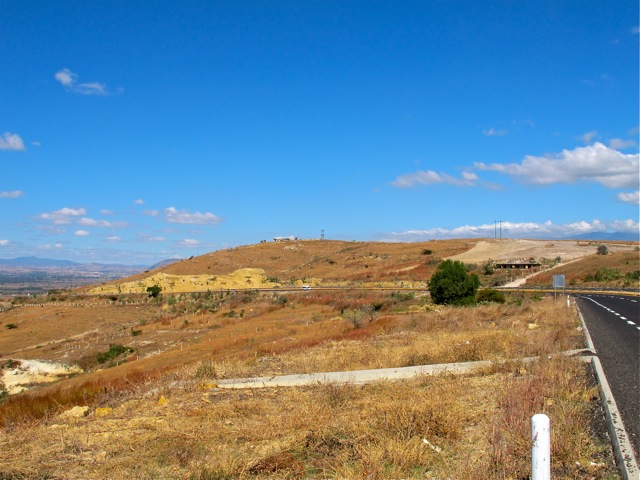
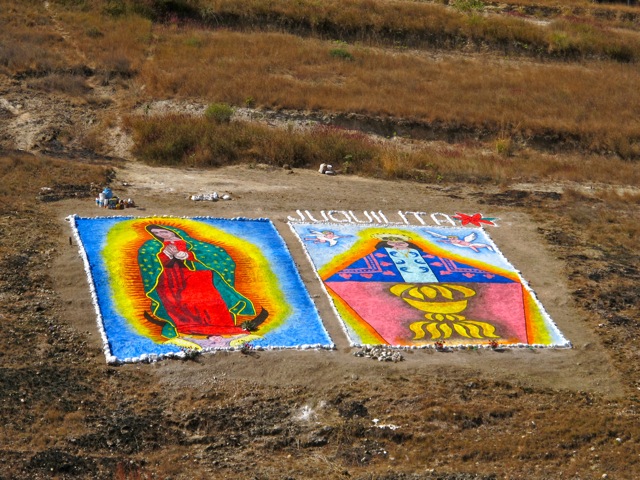
Here she is, in a field alongside La Virgen de Guadalupe, almost at the crest of the new carretera between Oaxaca and San Martín Tilcajete.

Brown fields next to highway at crest of hill

La Virgen de Guadalupe on the left and La Virgen de Juquila on the right.

Sand paintings of the Virgin of Guadalupe and the Virgin of Juquila on a mountainside.

The Virgin of Guadalupe had her day only four days later, on December 12.  La Virgen de Guadalupe is known as the Queen of Mexico and Empress of America, and is the patron saint of México.  Reports estimate that 5.8 million of the faithful made the pilgrimage this year to Basilica of Our Lady of Guadalupe in Mexico City to honor the dark-skinned virgin who appeared to Indian peasant Juan Diego on Dec. 12, 1531 near what is now Mexico City.

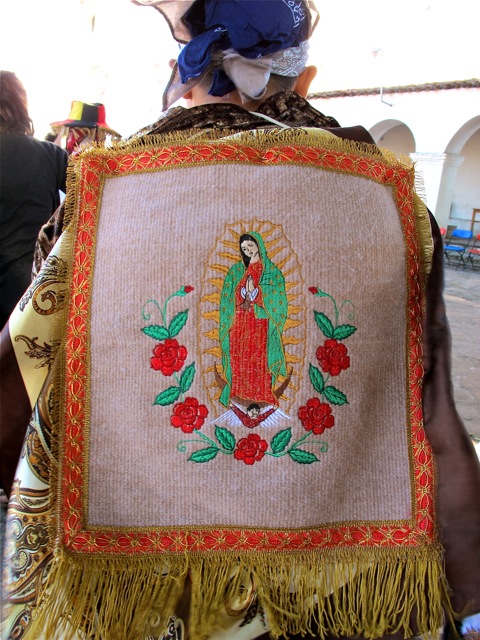
In Oaxaca, worshipers flocked to the Chapel of Guadalupe at the north end of Llano Park and a carnival filled the park for all the little Juan Diegos and girls in period costume to be entertained.  However, I headed out to Teotitlán del Valle to see this Zapotec village honor La Virgen de Guadalupe with their traditional Danza de la Pluma.  Several of the Danzantes (dancers) were wearing capes woven and embroidered especially for this day…

Virgin of Guadalupe embroidered on the back of the cape of a Danzante.

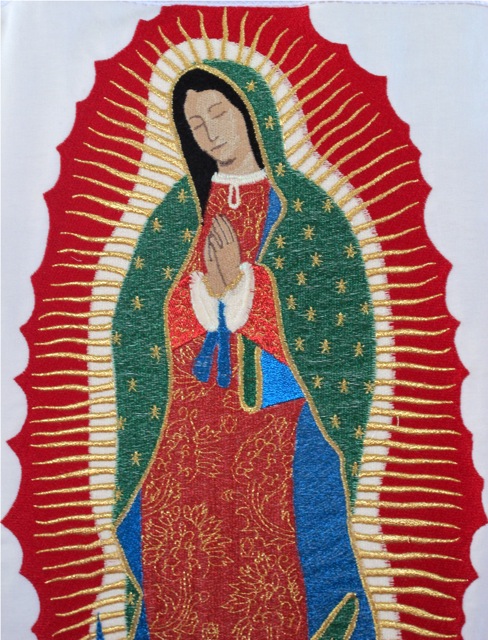
The weaving and embroidery were spectacular!

Closeup of the Virgin of Guadalupe on the back of Moctezuma's cape.

And, at least one of the Danzantes had an image of the Virgin of Guadalupe in the middle of his corona (feathered headdress).

Feathered headdress with image of the Virgin of Guadalupe  in the center.

Malinche and Doña Marina also had similar images on the skirts of their dresses.  To see those and several other photos of the dancers, you should take a look at what Chris has posted at, Oaxaca-The Year After.

Next on the “Virgin” calendar is December 18, the feast day of La Virgen de la Soledad (the Virgin of Solitude), Oaxaca’s patron saint.  Stay tuned…

Read Full Post »

In August 2011, Vive Oaxaca launched a campaign to showcase the best of the state through a series of video shorts.  Two have already been released online:
Esto es Zaachila

http://www.youtube.com/watch?v=cGss60-HeNk&feature=youtu.be

and, Esto es Guelaguetza

I’m looking forward to Monday night’s online release of, Esto es Oaxaca de Juárez.  I guess you know what my Tuesday morning blog post will be!

Read Full Post »

Sunday, Oaxaca blogger buddy Chris (Oaxaca-the-year-after) and I returned to Teotitlán del Valle for the Danza de la Pluma.  Another day awash in sights and sounds.  As I discussed in July’s post, Danza de la Pluma, it is a multi-layered ritual reenactment of the Conquest.  And, like the Passion Play in Oberammergau, Germany, the Danza de la Pluma lasts 7-8 hours!
Obviously, the performers occasionally need to take a break…

Subalterno laying down on the plaza

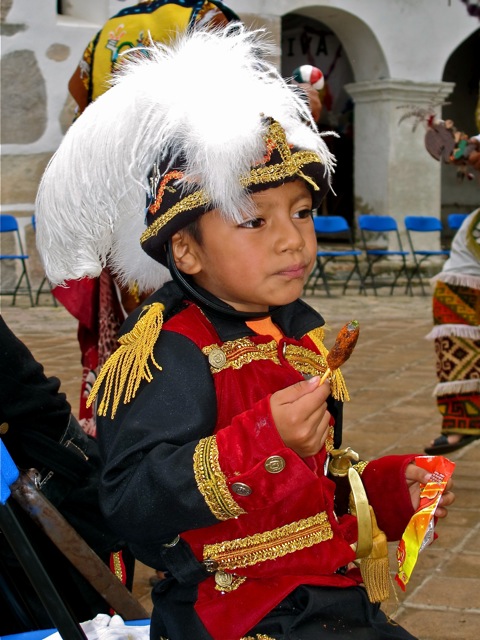
Soldaditos, need nourishment after all that marching around…

Littlest Soldadito munching on a snack

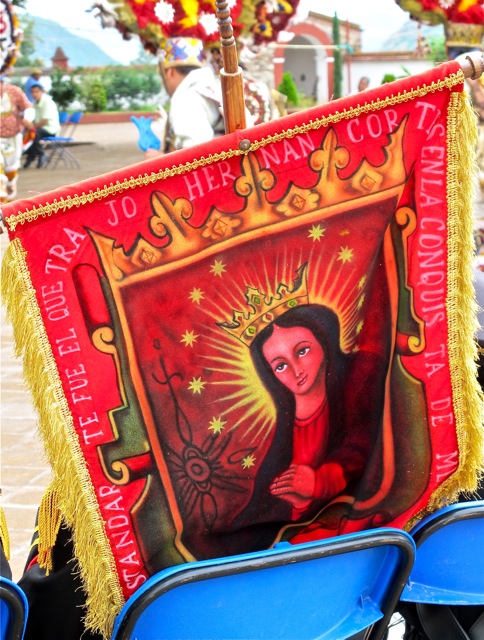
Banners need to chill on a chair…

Banner propped up on a chair

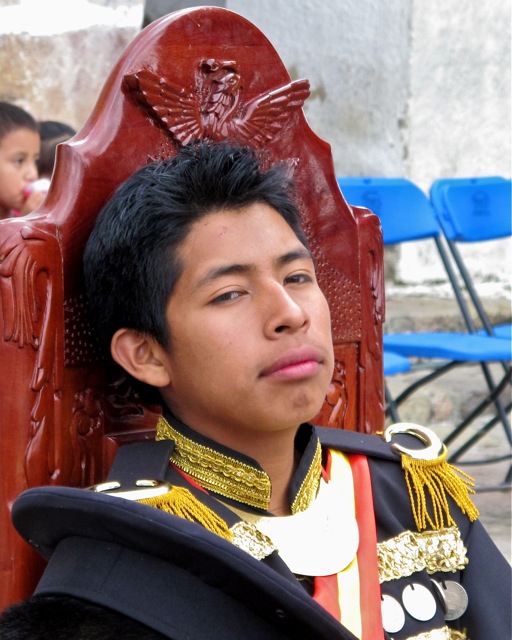
Cortes needs to take a breather from all that conquering…

Cortes resting on his throne.

Danzantes need some male bonding time…

2 Danzantes walking together

Their feathered headdresses need time off for good behavior…

Danzante feathered headdress

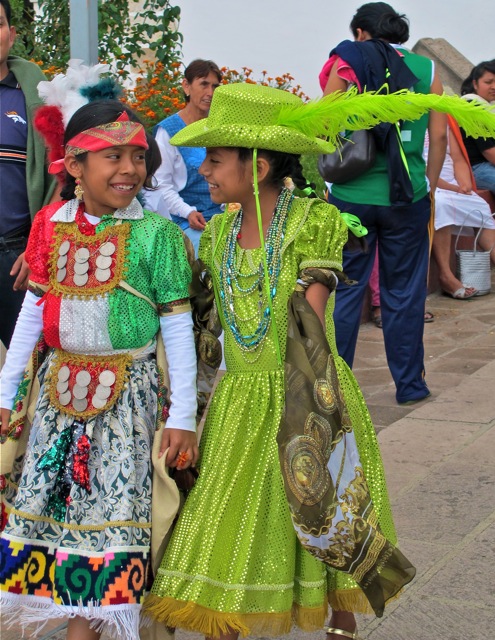
Malinche and Doña Marina need to share some giggles…

Malinche and Doña Marina walking and smiling together

And, even tubas need a nap…

Tuba laying on the ground.

Read Full Post »

I must confess, I’m partial to Teotitlán del Valle and this fiesta.  It was photos from the 2007 celebration that first persuaded me to visit Oaxaca.  However, this is it… I promise… no more photos from the Preciosa Sangre de Nuestro Señor Jesucristo in Teotitlán del Valle until next year!

This slideshow requires JavaScript.

However, if you, like me, can’t get enough… check out Chris’s photos over at Oaxaca-The Year After.

Read Full Post »

A brief slice from the hours and hours of dancing done by the Danzantes de Promesa, in the plaza in front of the church in Teotitlán del Valle, during the multi-day fiesta honoring Preciosa Sangre de Nuestro Señor Jesucristo.

The Danza de la Pluma consists of 41 “bailles” (pieces of music) that, on the surface, reenact the conquest.  Cortes and his troops are played by very young through teenage boys.  They occasionally march around, but mostly stay seated.  The Danzantes representing the Aztec, on the other hand, are young (and not so young!) men and dance at least 70% of the time.  In addition, Moctezuma has some solos and La Malinche and Doña Marina perform several lively dances.

A 20+ piece orchestra accompanies the dancers, playing the proscribed music, including, incongruous to me, waltzes, polkas, and schottisches. According to the Harris article referenced below, at the end of the 19th century the orchestra replaced the original indigenous drum and flute.

The subtext and “hidden” narratives of the danza are multiple and complex and I’m only in the infant stages of understanding.  For now, until my Spanish language skills improve significantly and I can talk with someone who is a member of the community, I will leave it to the two scholarly articles listed at the end of this post to attempt interpretation.

By the way, the day was overcast and windy at times, with gusts threatening those enormous and extremely top-heavy headdresses.

References:

Cohen, Jeffrey.  Danza de la Pluma:  Symbols of submission and separation in a Mexican Fiesta.  Anthropological Quarterly, Jul 93, Vol. 66 Issue 3, p. 149-158.

Harris, Max. The Return of Moctezuma.  The Drama Review, Sp 97, Vol. 41 Issue 1, p. 106, 29 p.

Now that I’ve done some research (alas, after the fact)… I want to see it again!

Read Full Post »

« Newer Posts