Feeds:
Posts
Comments

Interwoven…

After the two days spent in Teotitlán del Valle last week, I’ve been thinking a lot about the following article, written for the Guardian International Development Journalism competition.

Theme: What stops children in rural areas going to school? sponsored by the David Rattray Memorial Trust

Elena Gonzales folds yarn between her fingers. Her tapestry is woven in an intricate pattern of ochre and indigo, with fibre that has been dyed using moss and bark, fruit and flowers. Here in the hills of Oaxaca, in southern Mexico, indigenous Zapotec communities have been weaving rugs for more than two thousand years. Elena spins the loom and the centuries fall away.

Like many Zapotec children growing up in the 1980s, Elena did not attend school. Faced with a primary curriculum that took no account of Zapotec language or culture, her parents decided that she should be educated by her community. She was taught to weave by her grandmother. Self-sufficiency is the historic norm in Oaxaca, but in recent decades as rural life has become increasingly entretejidos – interwoven – with the modern market economy, Zapotec children who have not gone to school are finding themselves on the wrong side of an urban-rural education divide that excludes them from employment and contributes to deepening poverty.  [Read full article]

Multicolor tapete

Tapete purchased in Teotitlán del Valle by a friend. It was woven by Demetrio Bautista Lazo but was started by his young son.

Way back in the very early 1980s, I was captivated by the PBS series, The Flame Trees of Thika, based on the Elspeth Huxley memoir, by the same name, about her early years in Kenya.

African Tulip tree reddish orange blossoms

We had a black and white TV back then and so, if they even showed the “Flame Trees,” they never “registered.

African Tulip tree reddish orange blossoms

However, here I am in Oaxaca, Mexico and I’ve got two African Tulip Trees (aka, Flame of the Forest) hovering over my terrace, bursting with color, providing a modicum of shade, feeding the hummingbirds, and adding to the enchantment of Casita Colibrí.

African Tulip tree reddish orange blossoms

There was something about the sky, the light, and the trees this morning…

I must confess, I’m partial to Teotitlán del Valle and this fiesta.  It was photos from the 2007 celebration that first persuaded me to visit Oaxaca.  However, this is it… I promise… no more photos from the Preciosa Sangre de Nuestro Señor Jesucristo in Teotitlán del Valle until next year!

This slideshow requires JavaScript.

However, if you, like me, can’t get enough… check out Chris’s photos over at Oaxaca-The Year After.

Danza de la Pluma

A brief slice from the hours and hours of dancing done by the Danzantes de Promesa, in the plaza in front of the church in Teotitlán del Valle, during the multi-day fiesta honoring Preciosa Sangre de Nuestro Señor Jesucristo.

The Danza de la Pluma consists of 41 “bailles” (pieces of music) that, on the surface, reenact the conquest.  Cortes and his troops are played by very young through teenage boys.  They occasionally march around, but mostly stay seated.  The Danzantes representing the Aztec, on the other hand, are young (and not so young!) men and dance at least 70% of the time.  In addition, Moctezuma has some solos and La Malinche and Doña Marina perform several lively dances.

A 20+ piece orchestra accompanies the dancers, playing the proscribed music, including, incongruous to me, waltzes, polkas, and schottisches. According to the Harris article referenced below, at the end of the 19th century the orchestra replaced the original indigenous drum and flute.

The subtext and “hidden” narratives of the danza are multiple and complex and I’m only in the infant stages of understanding.  For now, until my Spanish language skills improve significantly and I can talk with someone who is a member of the community, I will leave it to the two scholarly articles listed at the end of this post to attempt interpretation.

By the way, the day was overcast and windy at times, with gusts threatening those enormous and extremely top-heavy headdresses.

References:

Cohen, Jeffrey.  Danza de la Pluma:  Symbols of submission and separation in a Mexican Fiesta.  Anthropological Quarterly, Jul 93, Vol. 66 Issue 3, p. 149-158.

Harris, Max. The Return of Moctezuma.  The Drama Review, Sp 97, Vol. 41 Issue 1, p. 106, 29 p.

Now that I’ve done some research (alas, after the fact)… I want to see it again!

Calenda begins…

After all the waiting, the calenda (parade) of the Preciosa Sangre de Nuestro Señor Jesucristo began winding its way from the church courtyard down the narrow streets of Teotitlán del Valle and back up to the courtyard.

Arms raised, the unmarried young women of the village carried these bamboo-framed canastas floreadas above their heads for the entire route.

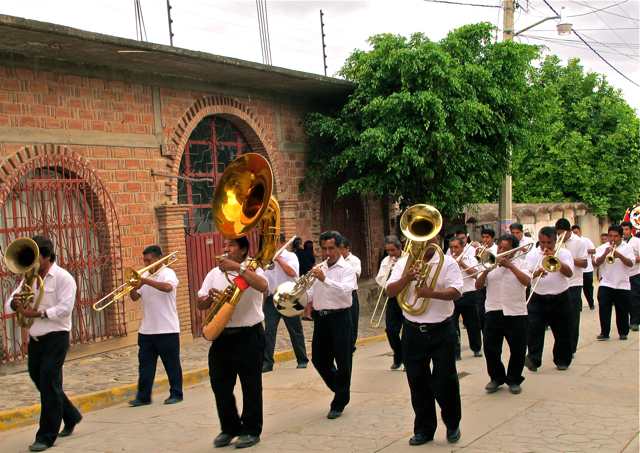
And, naturally there was a band… with the requisite tuba!

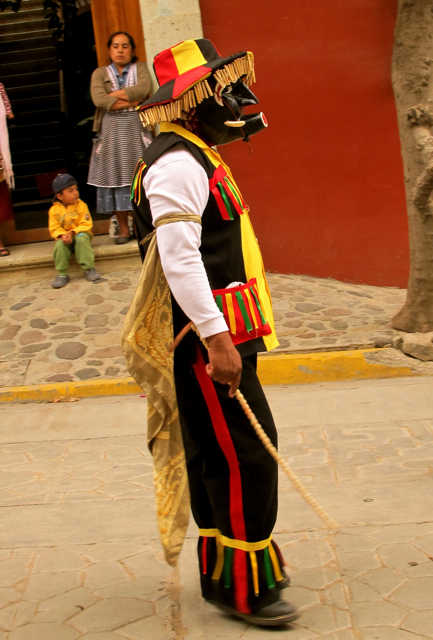
This Subalterno (one of two who keep their eyes on the festivities) kept the procession moving along…

including the young Soldaditos of Hernan Cortes.

They were followed by the Danzantes de Promesa (note the other Subalterno to the far right)…

and bringing up the rear, Moctezuma with the dual personalities of the same woman, La Malinche and Doña Marina.

In this village, known for its weaving, a complex tapestry of religious ritual, historic legend, and tangled mythology has been woven together to celebrate community and identity.

Definitely worth the wait… AND there’s more to come!

Waiting, take 2…

The participants also did a lot of waiting…

This slideshow requires JavaScript.

How do they remain in such good humor???

Waiting…

Waiting is something one does here… and, no matter what the age, it always seems to be done with a Zen-like patience.  Today it was for the traditional calenda of the Preciosa Sangre de Nuestro Señor Jesucristo  in Teotitlán del Valle.

This slideshow requires JavaScript.

More on the fiesta in upcoming posts…

Old and dangerous!

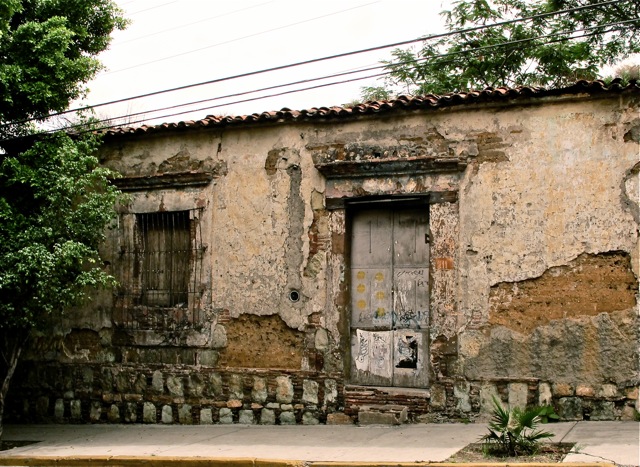
Viejas peligrosas was the headline of an article in yesterday’s Noticias, chronicling the dangerous old buildings in the 484-block historic center of Oaxaca.  According to the article, 23 properties are at high risk of falling, are magnets for trash disposal, and are sources of disease.

Although en español, I encourage even non Spanish speakers to take a look at the revealing slideshow of some of the more egregious, but highly photogenic, properties at the end of the article.

In addition, I’d like to nominate this building:

Front of dilapidated building

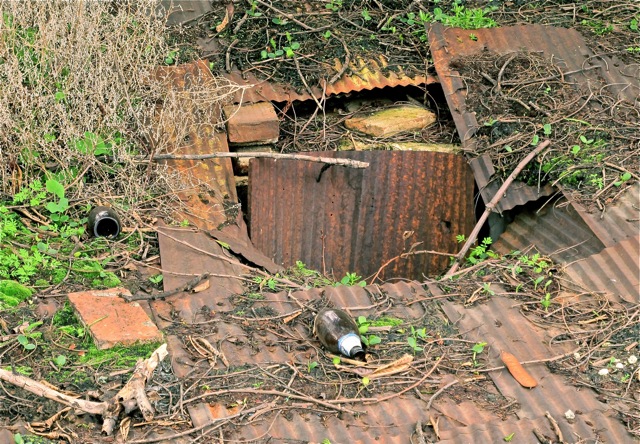
And, what do you think about the roof???

Collapsing tin roof

RIP…

Sadly, the tree mentioned in my last post didn’t fall as a result of wind and rain.   According to newspaper reports, it was slammed into by a Chevy Silverado; the driver apparently had fallen asleep at the wheel.

Sidewalk memorial to Victor D. Diaz Gonzalez

Víctor Damián Díaz González was killed instantly.

After 35 days up in the USA (and yes, I was counting), I’m back in Oaxaca.  The old stove still “decorates” the driveway of my apartment compound, apparently following in the footsteps of the two refrigerators which graced the driveway for almost a year.

Old stove sitting on the side of driveway

However, there are a few changes in the ‘hood.  I arrived home yesterday, to discover a delightful new neighbor moving into one of the apartments below me; the stump of a tree across the street that must have toppled during one of the recent storms;

Tree stump in front of building

and a new canopy atop the Guelaguetza Auditorium.

Sun-shade on the Guelaguetza Auditorium

This is a “take two” attempt at this controversial sunshade; the first tore before it was even finished, causing last year’s Guelaguetza performances to be relocated to the university’s soccer stadium, across the city — making yours truly a very unhappy camper!  With family visiting, it was the first time I had shelled out the big bucks to attend and, not only could we not just walk up the hill to the event, we weren’t able to enjoy the fabulous views of the city and the mountains to the east, that the Guelaguetza Auditorium provides.

FYI:  Over the past week, Chris at Oaxaca-The-Year-After, has been blogging about the controversy.

Thought provoking article from Ed Vulliamy, at the guardian.co.uk:

Ciudad Juarez is all our futures. This is the inevitable war of capitalism gone mad

Mexico’s drug cartels are actually pioneers of the global economy in their business logic and modus operandi

War, as I came to report it, was something fought between people with causes, however crazy or honourable: like between the American and British occupiers of Iraq and the insurgents who opposed them. Then I stumbled across Mexico’s drug war – which has claimed nearly 40,000 lives, mostly civilians – and all the rules changed. This is warfare for the 21st century, and another creature altogether.  [Read full article]

Oaxaca Municipal Police practicing subduing techniques.

Municipal police practicing in the Plaza de la Danza

The Fathers of Oaxaca…

One of the sights on the streets of Oaxaca that always brings a smile is a father holding his young daughter’s hand in one hand and her little pink backpack in the other.  In the absence of a photo of that delightful scene, here are a few other padres y hijos…

This slideshow requires JavaScript.

Back to the future…

Following the example of the 32 autonomous municipalities set up in the Mexican state of Chiapas flowing from the EZLN led uprising in 1994, another Oaxacan community has declared itself independent.

Roadside billboard: Ejido Jotola Adherentes de la otra campaña de la Sexta Declaracion de la Selva Lacandona

Chiapas billboard between San Cristóbal de las Casas and Palenque

The Mex Files provides some background and historical context for the actions taken by the residents of San Francisco Tlapancingo, in the Mixteca Region of the state of Oaxaca.  The posting, Days of future past in Oaxaca, explains:

Oaxaca has always been the most complicated of Mexican states.  Where the rest of us make do with municipalities (roughly equivalent to a U.S. county, and usually doubling as a federal congressional district), the challenge, since Colonial times, has been to impose a centralized governing system on a multi-cultural, multi-linguistic, geographically fragmented political sub-division.  In modern (post-Revolutionary) times, the state has been divided into eight regiones that correspond to various traditional ethnic communities, the regions being further divided into distritos, which have any number of municipios. Complicating the political situation, with the recognition of “usos y costumbres” added to the Federal Constitution in 2001, and to the state constitution, local government and elections may not conform to the standards of the modern state, but follow time-honored practices for better or worse.

Over the past few years, the state has been best known to outsiders for the sometimes violent confrontations between an entrenched PRI state machine and  various opposition groups.  With the electoral success of an opposition coalition in capturing the governor’s office last year, the state’s political troubles seem to have dropped off the radar for most of us, who forget that with the complicated governing structure in Oaxaca, there are still opportunities for  heavy-handed machine politicians to maneuver, on a less noticeable scale.

In San Francisco Tlapancingo, a municipio of about 1250 people in the Silacayoapam distrito of the Mixteca region, the same election that saw the end of the PRI’s 80 year dominance of the state government and put a Convergenia candidate running as the head of the anti-PRI coalition, Gabino Cué Monteagudo, into the Governor’s office, also returned a PRI municipal government.

Claiming Governor Cué did nothing about the alleged fraud in the local election (San Francisco Tlapancingo’s presidente municipal, Pablo Abelardo Vargas Duran enjoying the backing of two powerful PRI deputies [state legislators], as well as having his own armed bodyguards, 200 or so citizens walked into the municipal palace and “went native”.  They simply declared the community would be run by “usos y costumbres”, locking out the elected (and they say fraudulently elected) officers, installing their own, and informing the state elections commission that an assembly of the people would be running the community from now on. 

The new municipal government is rejecting any state interference, including development, in their community, planning to go it alone through self-financing and “tequios” — compulsory communal labor.  Oh, and by the way, that state interference includes the state courts, the state police and the federal army.

This may not be one of those types of events I mentioned in the post below.  Or it may be.   Mexico is not a primarily agrarian society (and hasn’t been in a very long time), so the happenings of an indigenous rural commune may not be all that important.  Nor is  San Francisco Tlapancingo exactly on anyone’s political or cultural radar, and what happens in Oaxaca generally stays in Oaxaca.

What makes it worth noticing is that here, the people are turning to tradition — history — to find a way out of what they see as a failed political and security situation.

***  For an explanation (in Spanish) of “usos y costumbres,” see the document, Usos y Costumbres y Derecho Indígena.


Banned in San Fran…

Chapulines, illegal???  Say it ain’t so, Joe!!!

Woman selling chapulines from two large baskets.

One of the ubiquitous chapulines vendors in a Oaxacan mercado.

Article from yesterday’s San Francisco Chronicle’s Inside Scoop:

La Oaxaquena banned from selling grasshopper tacos and fried tarantula

Posted on 06/08/2011 at 1:29 pm by Paolo Lucchesi in Controversy

A Channel 7 news report last night brought to light an insect crackdown at popular Mission taqueria La Oaxaquena.
In short, the health department said that La Oaxaquena could no longer sell its grasshopper tacos, because the insects — imported from Mexico — don’t come from an FDA-approved source.
Owner Harry Persaud tells Scoop that the ban actually happened about two months ago, and that it also put the kibosh on La Oaxaquena’s fried tarantula tortas.
“The City is worried people will get sick,” he says, pointing out that no one has gotten sick in the two-and-a-half years the exotic treats have been on the menu.
Persaud says it’s not a substantial loss in revenue, though the unique menu items definitely helped lure out-of-state visitors who wouldn’t otherwise head to La Oaxaquena. Also, he’s sent the tacos to different universities who want to do something clever for their biology department dinner or something like that. The City suggested he raise his own grasshoppers, so he’s flirting with that idea.
(But as Jonathan Kauffman points out, you can still get grasshoppers in San Jose.)
So why did the health department crack down now, after over two-plus years of carefree grasshopper and tarantula dining?
Persaud has a simple answer:
“Because we were in the news too much!”
SF won’t let restaurant owner sell grasshopper tacos [ABC]
La Oaxaquena: 2128 Mission Street, between 17th and 18th; (415) 621-5446

Gray gloom continues to hang over the San Francisco Bay Area and I’m dreaming of a beach vacation…

This slideshow requires JavaScript.

Playa San Agustinillo on Oaxaca’s Pacific Coast, October 2009.