Feeds:
Posts
Comments

Archive for the ‘Protests’ Category

It’s a quiet Sunday in the city.  Traffic on the busy street beyond Casita Colibrí’s gates is light; church bells, for reasons mysterious to me, seem more restrained on Sundays; and even the usually chattering birds sound like they are taking a rest from their noisy territorial battles.

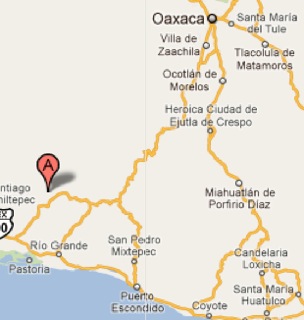
However, yesterday, all was not tranquil in the village of Santa Cruz Tepenixtlahuaca, 165 miles southwest of the city, where villagers, fed up with alleged cattle rustling, rapes, and murders, took matters into their own hands…

Map showing Santa Cruz Tepenixtlahuaca is southwest of Oaxaca city

Mexican villagers attack alleged crooks, killing 6

OAXACA, Mexico (AP) — Dozens of armed villagers surrounded the home of a suspected crime gang in southern Mexico, setting off a gunbattle that killed a child, a woman and four men, authorities said Saturday.

The confrontation took place after a town assembly decided to arm 90 villagers and send them to threaten the group allegedly behind cattle thefts, rapes and murders, Oaxaca state’s public security chief said in a statement.  [Read full article]

From tiny mountain villages in Southern Mexico to the streets of Tel Aviv,  ¡Basta ya! was a cry echoing around the world on Saturday.

Read Full Post »

Currently, the Instituto de Artes Gráficas de Oaxaca is exhibiting the work of Rini Templeton; three rooms of her iconic work.  For those who may not be familiar with the name, there is a good reason…

For 20 years an extraordinary artist-activist named Rini Templeton drew struggles of grassroots people in the United States, Mexico and Central America. She made thousands of drawings, didn’t sign them and gave them away freely, so her name remains unknown while her work is widely known, used and loved.  [Read full biography at RiniArt.org]

As the former director of a labor library and archive, the exhibition kindled so many wonderful memories of this talented, committed, and inspiring woman’s work.

Read Full Post »

Following the example of the 32 autonomous municipalities set up in the Mexican state of Chiapas flowing from the EZLN led uprising in 1994, another Oaxacan community has declared itself independent.

Roadside billboard: Ejido Jotola Adherentes de la otra campaña de la Sexta Declaracion de la Selva Lacandona

Chiapas billboard between San Cristóbal de las Casas and Palenque

The Mex Files provides some background and historical context for the actions taken by the residents of San Francisco Tlapancingo, in the Mixteca Region of the state of Oaxaca.  The posting, Days of future past in Oaxaca, explains:

Oaxaca has always been the most complicated of Mexican states.  Where the rest of us make do with municipalities (roughly equivalent to a U.S. county, and usually doubling as a federal congressional district), the challenge, since Colonial times, has been to impose a centralized governing system on a multi-cultural, multi-linguistic, geographically fragmented political sub-division.  In modern (post-Revolutionary) times, the state has been divided into eight regiones that correspond to various traditional ethnic communities, the regions being further divided into distritos, which have any number of municipios. Complicating the political situation, with the recognition of “usos y costumbres” added to the Federal Constitution in 2001, and to the state constitution, local government and elections may not conform to the standards of the modern state, but follow time-honored practices for better or worse.

Over the past few years, the state has been best known to outsiders for the sometimes violent confrontations between an entrenched PRI state machine and  various opposition groups.  With the electoral success of an opposition coalition in capturing the governor’s office last year, the state’s political troubles seem to have dropped off the radar for most of us, who forget that with the complicated governing structure in Oaxaca, there are still opportunities for  heavy-handed machine politicians to maneuver, on a less noticeable scale.

In San Francisco Tlapancingo, a municipio of about 1250 people in the Silacayoapam distrito of the Mixteca region, the same election that saw the end of the PRI’s 80 year dominance of the state government and put a Convergenia candidate running as the head of the anti-PRI coalition, Gabino Cué Monteagudo, into the Governor’s office, also returned a PRI municipal government.

Claiming Governor Cué did nothing about the alleged fraud in the local election (San Francisco Tlapancingo’s presidente municipal, Pablo Abelardo Vargas Duran enjoying the backing of two powerful PRI deputies [state legislators], as well as having his own armed bodyguards, 200 or so citizens walked into the municipal palace and “went native”.  They simply declared the community would be run by “usos y costumbres”, locking out the elected (and they say fraudulently elected) officers, installing their own, and informing the state elections commission that an assembly of the people would be running the community from now on. 

The new municipal government is rejecting any state interference, including development, in their community, planning to go it alone through self-financing and “tequios” — compulsory communal labor.  Oh, and by the way, that state interference includes the state courts, the state police and the federal army.

This may not be one of those types of events I mentioned in the post below.  Or it may be.   Mexico is not a primarily agrarian society (and hasn’t been in a very long time), so the happenings of an indigenous rural commune may not be all that important.  Nor is  San Francisco Tlapancingo exactly on anyone’s political or cultural radar, and what happens in Oaxaca generally stays in Oaxaca.

What makes it worth noticing is that here, the people are turning to tradition — history — to find a way out of what they see as a failed political and security situation.

***  For an explanation (in Spanish) of “usos y costumbres,” see the document, Usos y Costumbres y Derecho Indígena.

Read Full Post »

Banner - close-up of eyes, nose, and tears running down cheeks.The Marcha del Color de la Sangre (Caravan of the Color of Blood), by the Triqui of San Juan Copala and their supporters, mentioned in my May 23 post, was prevented from entering the village.

Banner:  Face of mother and son and slogan:  Autonomia, justicia, paz, dignidad; Municipio Autónomo de San juan Copala.According to Angry White Kid, a National and International Day of Action in Solidarity with the Autonomous Municipality of San Juan Copala, Oaxaca, Mexico has been called for June 3.

Banner in the style of a huipil with text:  Apoyo al planton de mujeres y niños desplazados de San Juan Copala.

These banners graced the portales of the Government Palace during the encampment.

Banner - Triqui woman with slogan: Justicia y paz con dignidad; Municipio Autónomo San Juan Copala

Beautiful and poignant, I could never pass by without pausing…

Read Full Post »

Propping up fallen trees isn’t the only activity on the Alameda… 3 tents under the Indian Laurel trees on the Alameda

Today, Sección 22 del Sindicato Nacional de Trabajadores de la Educación (the teachers’ union) is beginning an occupation of Oaxaca’s zócalo, Alameda, and several side streets.2 tents under the portales of the Governor's Palace According to a report in the Latin American Herald Tribune, Teachers Call for Strike in Southern Mexican State, the teachers are not demanding wage increases, instead focusing on social issues, including “better uniform allowances for students, computers in all of the state’s elementary schools and electricity in all schools.”  Privatization is also an issue.Green banner with text reading:  ¡No a la privatización de la educación!

This annual activity by the teachers’ union is extremely contentious.  Adding bold-face to the lines above will be my only comment on the subject.

However, the teachers aren’t the only people converging on the zócalo today…Poster: Marcha del Color de la Sangre; 23 de Mayo; Zocalo de Oaxaca a la Ciudad de MexicoThe displaced Triqui, who were driven out of their village of San Juan Copala after several years of political violence, have decided to return home, leading a march/caravan from Oaxaca to Mexico City and finally back to San Juan Copala.Triqui women and baby await the arrival of the march/caravan For more information, see the blog posting by Angry White Kid, The displaced decide to return to our community: Caravan of the Color of Blood and for background on their struggle for autonomy, see Repression, Impunity and Resistance in Oaxaca: One Year After the Copala Caravan Ambush.

Read Full Post »

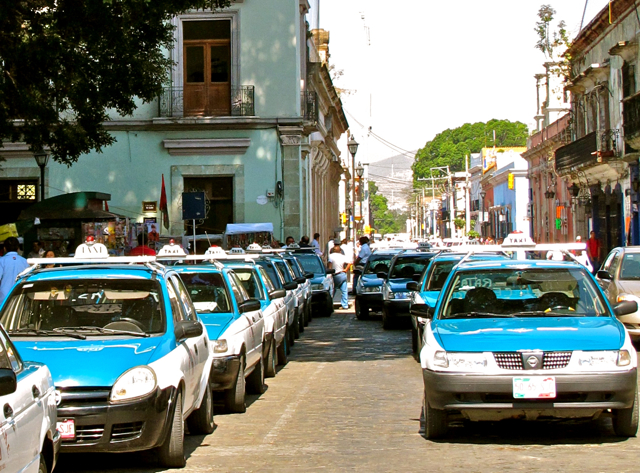
I sure hope no one needs a taxi in el centro today.

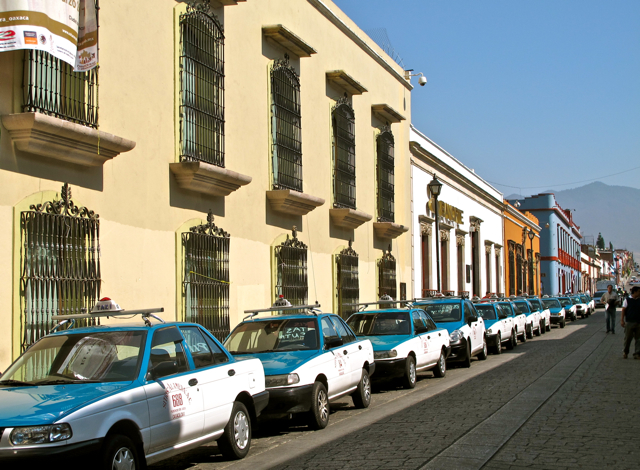
Taxis double-parked on Indenpendencia

Double-parked on Independencia and lined up for blocks on side streets, empty taxis sit…

Taxis line up on side street

A protest against “pirate” taxis.

Fuera taxis piratas del centro

By the way, pink taxis, lavender taxis, and green taxis were lined up on other streets, which would have added more color to this entry.  But, alas, I violated the first rule of photography:  Always carry an extra battery!   I know, my feeble excuse of, I’d only gone out to buy velcro adhesive for my mosquito screen door project, is no excuse.

Read Full Post »

Another reason I love Oaxaca…

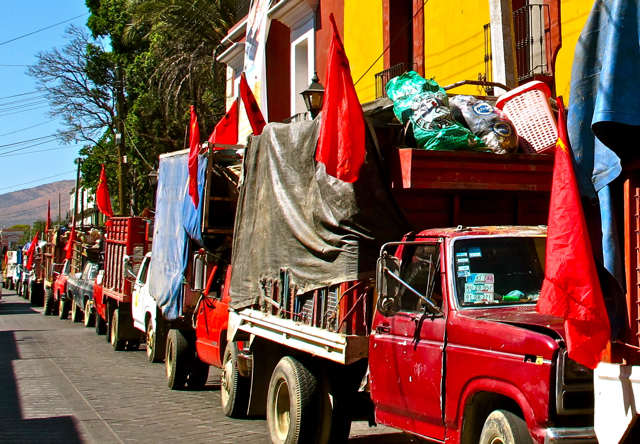
Trash collectors trucks with red flags

Yes, I know street blockades are inconvenient for drivers and I know the trade unions are not immune from the corruption that dominates politics here, but at least workers are not sitting on their hands doing nothing as austerity measures threaten to take away what little they have.

Protest sign with red flags on trash collector's truck.

According to signs posted on various trucks, trash collectors are demanding cancellation of a 300% increase in the cost of using the municipal dump, access to the dump 7 days a week, and the dismissal of the municipal services director.

Last fall massive protests against austerity measures spread across Europe, the Jasmine Revolution in Tunisia earlier this month was sparked by the self-immolation of a young college graduate who couldn’t find a job, and, as I write, hundreds of thousands of students, women, industrial workers, unemployed, and others are marching in Egypt in what is being called “a day of wrath against poverty.”

Workers in the USA should be taking notes…

Read Full Post »

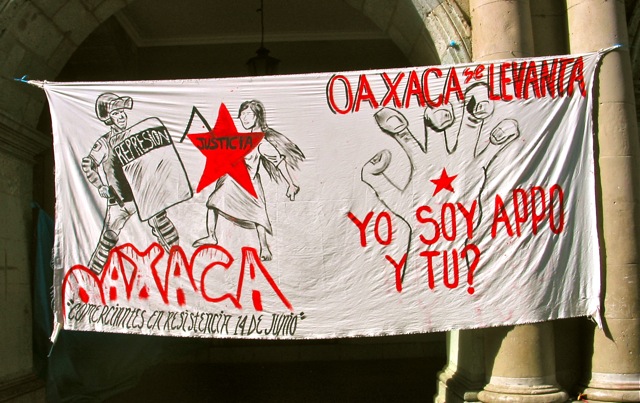
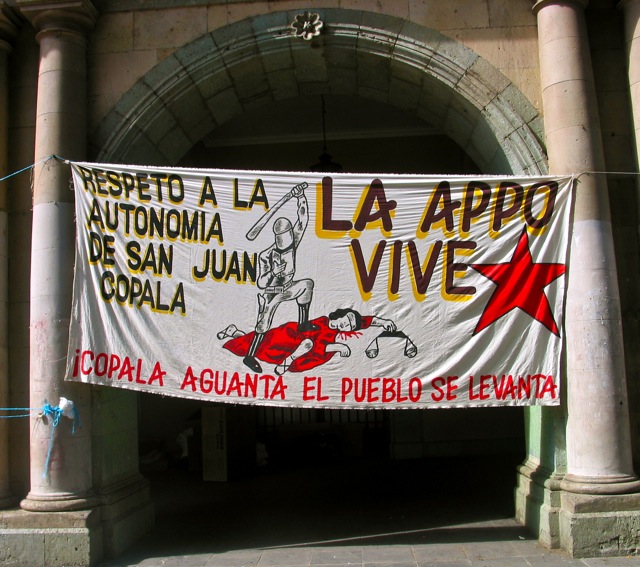
After a delightful but whirlwind (6 days is too short) visit, my stepson and his wife have come and gone; this year’s Guelaguetza festivities are over; life at Casita Colibrí is gradually resuming a more leisurely rhythm; and our current historic rain has gone on hiatus.  A quiet solo Sunday morning walk beckoned, as did the APPO banners, strung along the arches of the Palacio de Gobierno, that I wanted to photograph.

Oaxaca se levanta

The banners are a work of art, but ephemeral — here today, gone tomorrow — and I never seem to have my camera with me when I come across them.
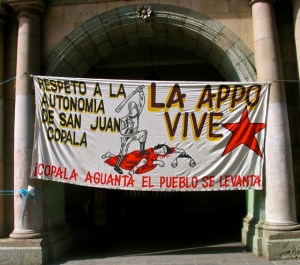
"Respeto a la autonomia de San Juan Copala"

And, more importantly, they are a graphic reminder that behind the vitality, beauty, and quaint cosmetics of “new” cobblestone streets of this UNESCO World Heritage Site facade, class warfare lurks in the shadows.

Oaxaca’s contradictions are mine.  I turn the corner and walk over to puesto 80 at Mercado Juárez to see if they’ve gotten in the chocolate covered coffee beans.  No, maybe tomorrow…  I stop by the temporary pocket market in front of the Jesuit church on the corner and satisfy my sweet tooth by buying a bag of melt-in-your-mouth Merengue Sabor Cafe, instead.

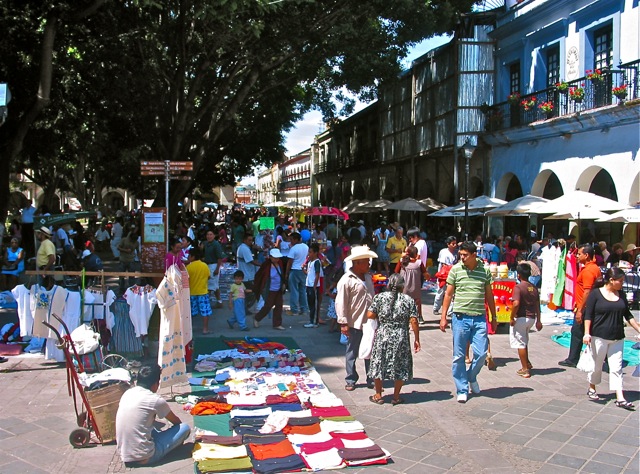
The Zócalo has awakened during my 45 minutes of shopping; young and old strolling arm-in-arm, vendors selling their wares, shoes being shined, outside tables occupied with diners chatting or simple watching the scene before them.

People strolling; vendors selling

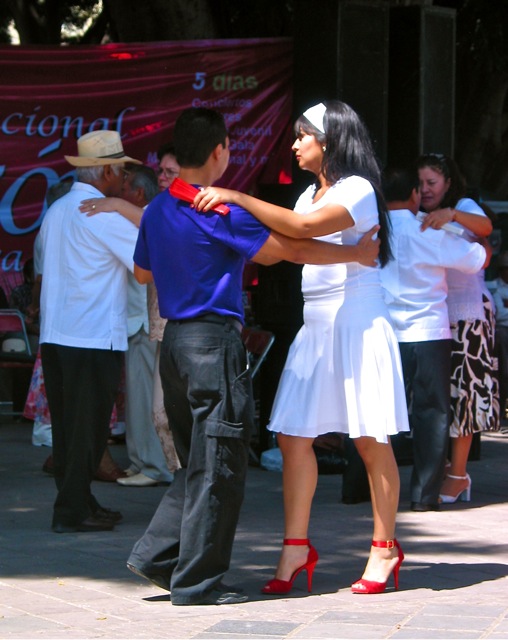
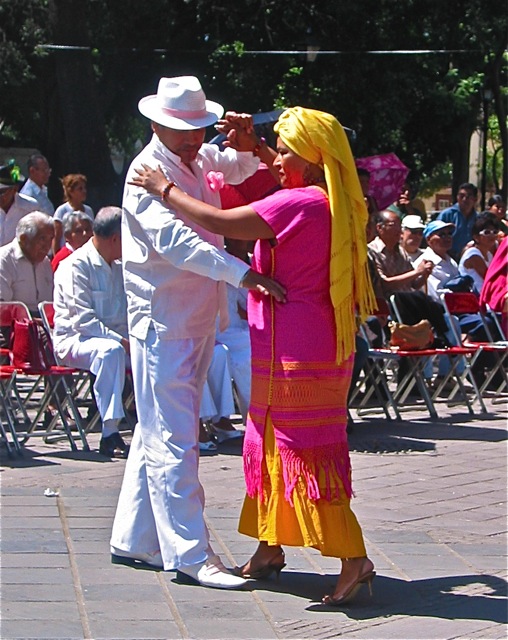
And, there is music — always, there is music — today an orchestra has set up under the laurels for the final day of the Festival Nacional de Danzón.  The dance, with its origins in Cuba, is stately and prescribed, with inexplicable pauses where dancers turn to face the orchestra, women move to the right side of their partners, fan themselves, and then several measures later dancing resumes.

Dancers in traditional Oaxacan dress

I’m captivated by the dancers who are at once, serious and joyful, and by their varied attire — once a costumer, always a costumer!

Dancers - woman in slacks

Most dancers are in the latter third of their life, though there are a few earnest young people.

Young dancers

It’s a prosperous crowd — a dance of the elite — but mesmerizing to watch.
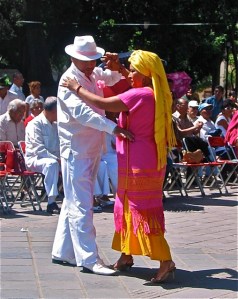
dancers

After an hour of observing this very “civilized” scene under an intense sun, I headed to Independencia, the shady side of the street, and home, only to stop, reel around, and follow the sounds of a calenda coming into the Alameda; band, dancers, fireworks — celebrating Día del Comerciante!

Calinda

I leave feeling conflicted about my three hours on a sunny Sunday.  The lines from the song inspired by the 1912 Lawrence, Massachusetts textile strike come to mind…

As we come marching, marching, unnumbered women dead
Go crying through our singing their ancient cry for bread.
Small art and love and beauty their drudging spirits knew.
Yes, it is bread we fight for — but we fight for roses, too!

Lunch eaten, clouds gather, sky darkens, and Mother Nature reminds us who is in charge.

Read Full Post »
« Newer Posts