On December 18, Oaxaqueños celebrated the feast day of the Queen of Oaxaca, La Santísima Virgen de La Soledad (Virgin of Solitude). There are several minor variations to her story, but there is no doubt that in the State of Oaxaca, she is venerated in a manner similar to the Virgin of Guadalupe and is carried through the streets of the city during many religious celebrations.
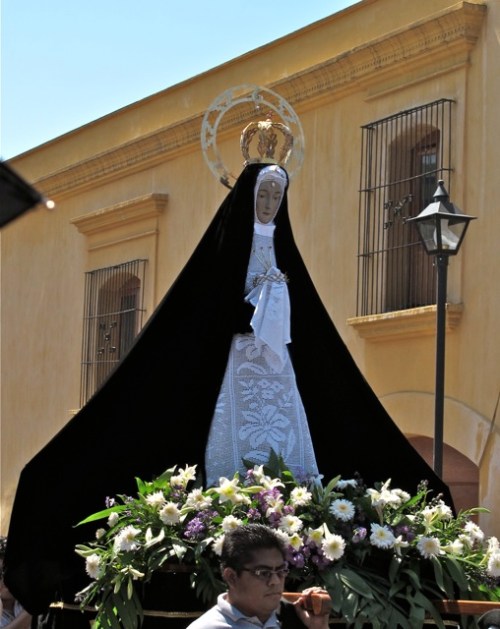
Virgen de La Soledad in her traveling clothes
According to one legend: In 1620 a mule train bound for Guatemala camped outside the city of Oaxaca discovered an extra mule which did not belong to anyone in the group. The mule refused to move and when prodded rolled over and died. When the pack it carried was opened, it was found to contain the statue of the Virgin of Soledad. Taking this as a sign from heaven, the inhabitants built first a shrine, later a church and finally the imposing basilica which stands today on the spot where the statue first appeared.
Another story: a muleteer from Veracruz in route to Guatemala noticed he had one too many mules in his pack upon his arrival in Oaxaca. Outside the San Sebastian hermitage, the mule collapsed under the burden it was carrying. All attempts by the muleteer to get it back on its feet were futile; so to avoid punishment he notified the authorities. When he lifted the load off the mule, it got up and died instantly. The burden was inspected, and they found an image of the Virgin accompanied by Christ on it, along with a sign that said, “The Virgin by the Cross.” Faced with this momentous event, Bishop Bartolome Bohorquez ordered a sanctuary built in honour of the divinity.
Still another legend: a heavily laden burro of mysterious origin appeared outside of town in 1534, fell to the ground, spilling its load next to a rock (still onsite) containing the beautifully carved Virgin (thought to be carved in Guatemala or the Philippines) and a chapel was built on the spot. However, apparently there was an adobe shrine to the Virgin of Solitude atop Cerro Fortín as early as 1532 — and the rock may have even been moved from the mountain in 1617 to the current site (immediately to the right, along the wall as you enter).
She became the patron of not only the city but the entire state, as well as of the mariners who sailed to and from her ports. She wears a purple velvet cape, and her vestments are encrusted with pearls, 600 diamonds, and she wears a 4-lb gold crown.

Virgen de La Soledad her glass enclosed home at the Basilica
She resides in the church dedicated to her, the Basílica de Nuestra Señora de la Soledad. Construction began in 1682, it was designed by Father Fernando Méndez, sanctioned by the Viceroy Tomas Aquino Manrique de la Cerda, and consecrated in 1690 by Bishop Isidro Siraña y Cuenca. The current baroque style facade was built between 1717-1719 and is unusual because it faces east (Photos are best in the AM). It was built with the green cantera and a pinkish stone, used in the facade. If one looks carefully, several ways in which the indigenous masons and carpenters introduced their own “pagan” symbology and pantheon into the wood and stone are in evidence.
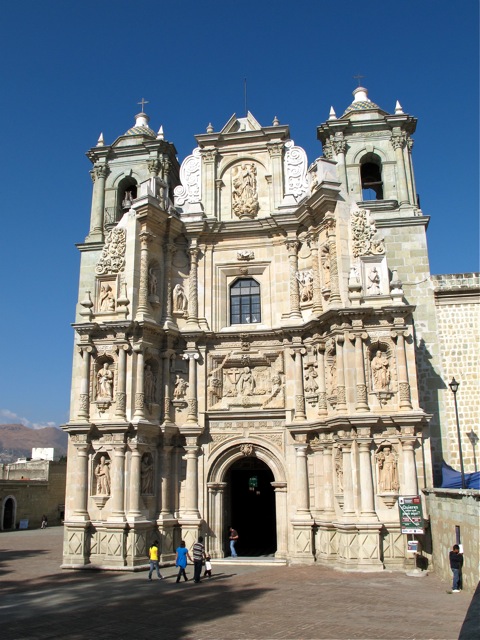
East facing facade
It was intentionally built with low spires and towers, to better withstand earthquakes. The atrial courtyard is enclosed and fitted with two simple access portals, one facing south, and the other east. The latter leads to the Socrates Garden (currently undergoing a major renovation) and the Plaza de la Danza.
References:
Read Full Post »


 Mexican Peso Converter

 View From Casita Colibrí