Feeds:
Posts
Comments

Posts Tagged ‘Teotitlán del Valle’

Sunday, Oaxaca blogger buddy Chris (Oaxaca-the-year-after) and I returned to Teotitlán del Valle for the Danza de la Pluma.  Another day awash in sights and sounds.  As I discussed in July’s post, Danza de la Pluma, it is a multi-layered ritual reenactment of the Conquest.  And, like the Passion Play in Oberammergau, Germany, the Danza de la Pluma lasts 7-8 hours!

Obviously, the performers occasionally need to take a break…

Subalterno laying down on the plaza

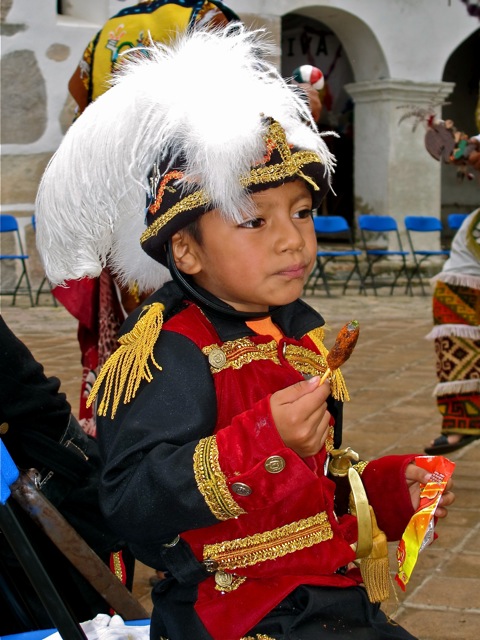
Soldaditos, need nourishment after all that marching around…

Littlest Soldadito munching on a snack

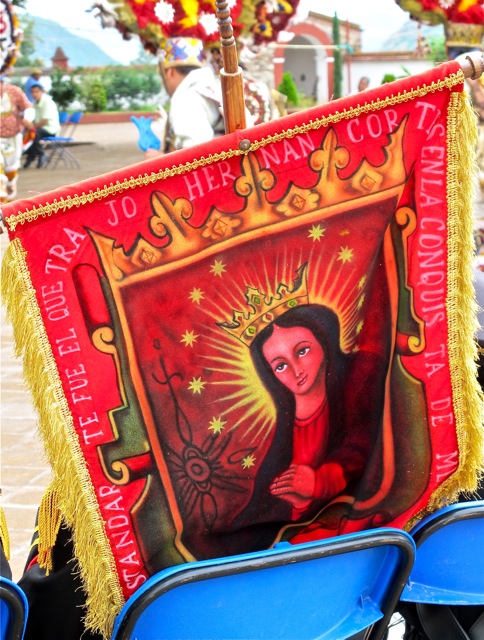
Banners need to chill on a chair…

Banner propped up on a chair

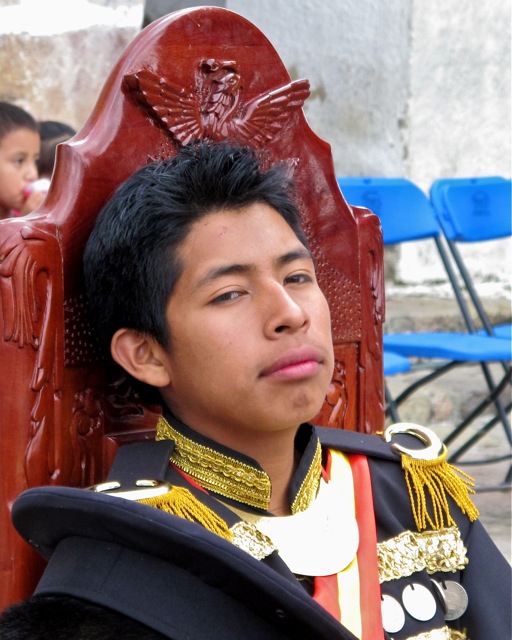
Cortes needs to take a breather from all that conquering…

Cortes resting on his throne.

Danzantes need some male bonding time…

2 Danzantes walking together

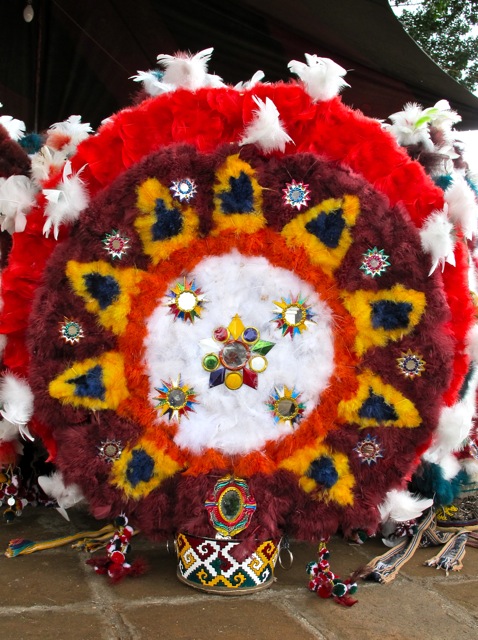
Their feathered headdresses need time off for good behavior…

Danzante feathered headdress

Malinche and Doña Marina need to share some giggles…

Malinche and Doña Marina walking and smiling together

And, even tubas need a nap…

Tuba laying on the ground.

Read Full Post »

To borrow from Russian actor and director, Konstantin Stanislavsky, “there are no small parts, only [very] small actors.”  And the children of  Teotitlán del Valle begin learning their lines at a very young age.

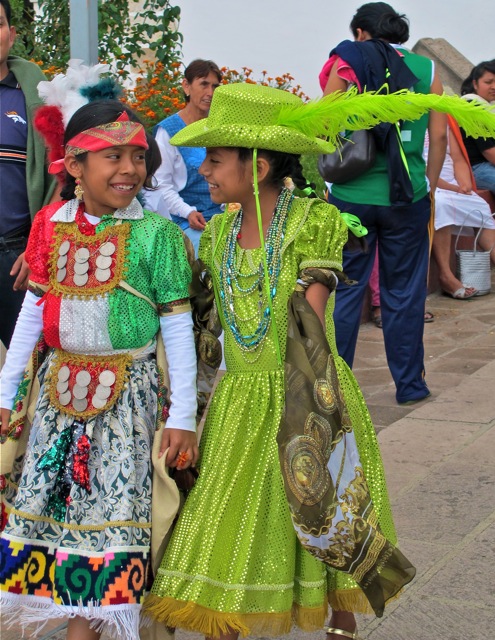
They were in full view Friday night as the convite (parade) of unmarried young women and girls opened the multi-day Fiesta de la Virgen del Rosario.

Very young Zapotec girl in traditional dress.

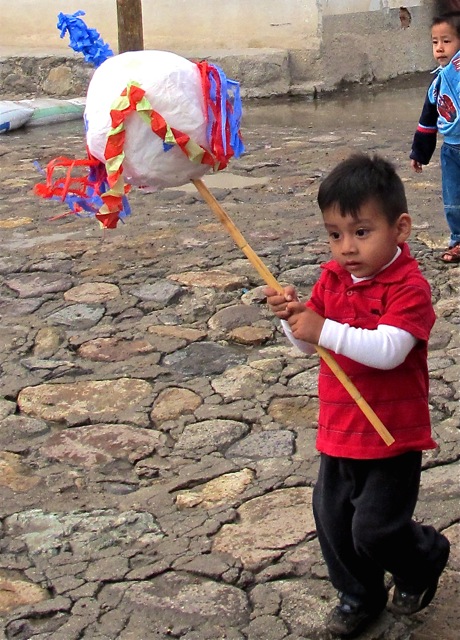
Young boys, carrying marmotas led off the parade, that began at the pueblo’s Sangre de Cristo church.

Very young Zapotec boy carrying a small marmota

They were followed by traditional indigenous drums and a band.

Band with marmota in background

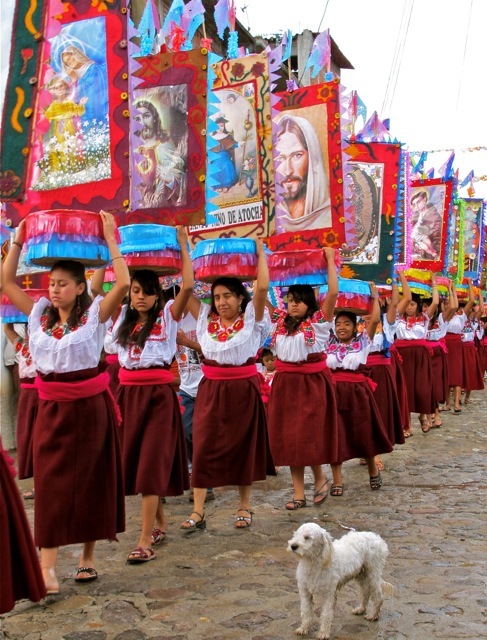
Then the stars of the evening took center stage.  From the oldest to the youngest, all were wearing the traditional red woolen skirt (woven in the village, of course!) and blouses painstakingly and lovingly hand embroidered.

Young Zapotec girl carrying canasta on her head

Arms above head, balancing their canastas, they wound their way through the slick (it was drizzling) cobblestone streets of the village for an hour, before eventually returning to the church.

Procession of young Zapotec women carrying canastas on their heads while a little white dog watches

I don’t know how they did it; even the dogs were in awe!

Sunday’s events to follow…

Read Full Post »

Hanging out In Teotitlán del Valle…

Male and female effigies hanging from window grate.

On a rainy day…

Weaver at loom painted on side of building:

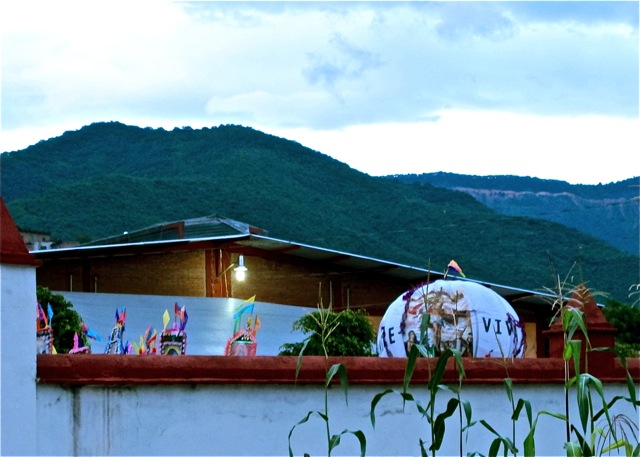
Waiting for a parade to pass me by…

Tops canastas and marmota visible above wall, with mountains in background

Save

Read Full Post »

I must confess, I’m partial to Teotitlán del Valle and this fiesta.  It was photos from the 2007 celebration that first persuaded me to visit Oaxaca.  However, this is it… I promise… no more photos from the Preciosa Sangre de Nuestro Señor Jesucristo in Teotitlán del Valle until next year!

This slideshow requires JavaScript.

However, if you, like me, can’t get enough… check out Chris’s photos over at Oaxaca-The Year After.

Read Full Post »

A brief slice from the hours and hours of dancing done by the Danzantes de Promesa, in the plaza in front of the church in Teotitlán del Valle, during the multi-day fiesta honoring Preciosa Sangre de Nuestro Señor Jesucristo.

The Danza de la Pluma consists of 41 “bailles” (pieces of music) that, on the surface, reenact the conquest.  Cortes and his troops are played by very young through teenage boys.  They occasionally march around, but mostly stay seated.  The Danzantes representing the Aztec, on the other hand, are young (and not so young!) men and dance at least 70% of the time.  In addition, Moctezuma has some solos and La Malinche and Doña Marina perform several lively dances.

A 20+ piece orchestra accompanies the dancers, playing the proscribed music, including, incongruous to me, waltzes, polkas, and schottisches. According to the Harris article referenced below, at the end of the 19th century the orchestra replaced the original indigenous drum and flute.

The subtext and “hidden” narratives of the danza are multiple and complex and I’m only in the infant stages of understanding.  For now, until my Spanish language skills improve significantly and I can talk with someone who is a member of the community, I will leave it to the two scholarly articles listed at the end of this post to attempt interpretation.

By the way, the day was overcast and windy at times, with gusts threatening those enormous and extremely top-heavy headdresses.

References:

Cohen, Jeffrey.  Danza de la Pluma:  Symbols of submission and separation in a Mexican Fiesta.  Anthropological Quarterly, Jul 93, Vol. 66 Issue 3, p. 149-158.

Harris, Max. The Return of Moctezuma.  The Drama Review, Sp 97, Vol. 41 Issue 1, p. 106, 29 p.

Now that I’ve done some research (alas, after the fact)… I want to see it again!

Read Full Post »

After all the waiting, the calenda (parade) of the Preciosa Sangre de Nuestro Señor Jesucristo began winding its way from the church courtyard down the narrow streets of Teotitlán del Valle and back up to the courtyard.

Arms raised, the unmarried young women of the village carried these bamboo-framed canastas floreadas above their heads for the entire route.

And, naturally there was a band… with the requisite tuba!

This Subalterno (one of two who keep their eyes on the festivities) kept the procession moving along…

including the young Soldaditos of Hernan Cortes.

They were followed by the Danzantes de Promesa (note the other Subalterno to the far right)…

and bringing up the rear, Moctezuma with the dual personalities of the same woman, La Malinche and Doña Marina.

In this village, known for its weaving, a complex tapestry of religious ritual, historic legend, and tangled mythology has been woven together to celebrate community and identity.

Definitely worth the wait… AND there’s more to come!

Read Full Post »

The participants also did a lot of waiting…

This slideshow requires JavaScript.

How do they remain in such good humor???

Read Full Post »

Waiting is something one does here… and, no matter what the age, it always seems to be done with a Zen-like patience.  Today it was for the traditional calenda of the Preciosa Sangre de Nuestro Señor Jesucristo  in Teotitlán del Valle.

This slideshow requires JavaScript.

More on the fiesta in upcoming posts…

Read Full Post »

… what you will find around the corner.

Today’s drive up into the mountains and pine forests of Cuajimoloyas and Benito Júarez revealed…

Burned out car on mountain road

a burned out car…

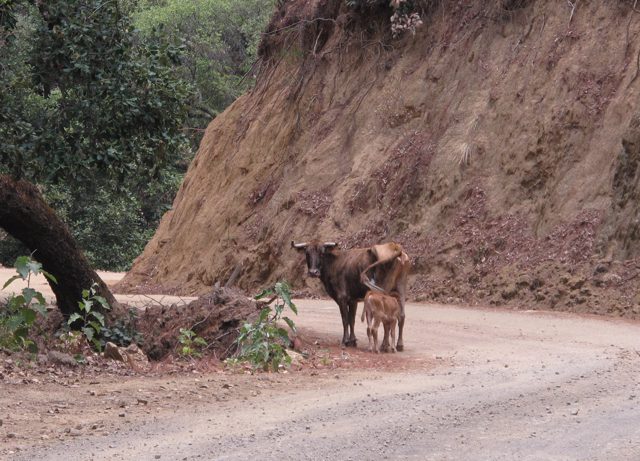
Cow and her calf on the side of mountain road.

a cow and her calf.  And, down the mountain in Teotitlán del Valle…

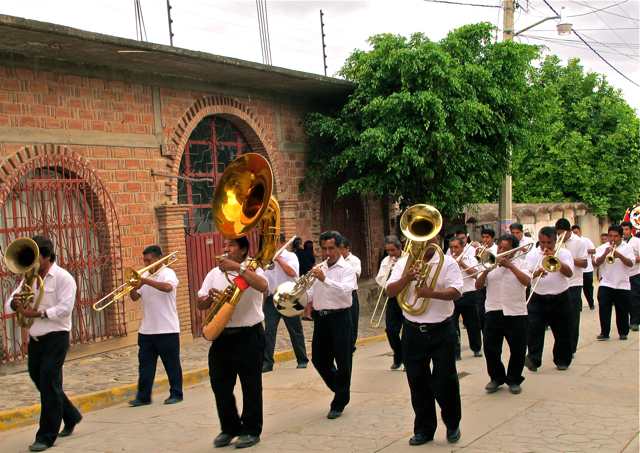
Brass band on a street in Teotitlán del Valle

a brass band leading a wedding parade.

Read Full Post »
« Newer Posts