Feeds:
Posts
Comments

Archive for July, 2011

Way back in the very early 1980s, I was captivated by the PBS series, The Flame Trees of Thika, based on the Elspeth Huxley memoir, by the same name, about her early years in Kenya.

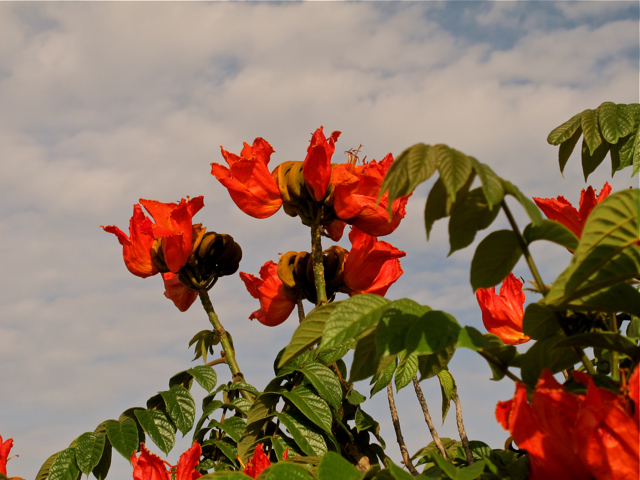
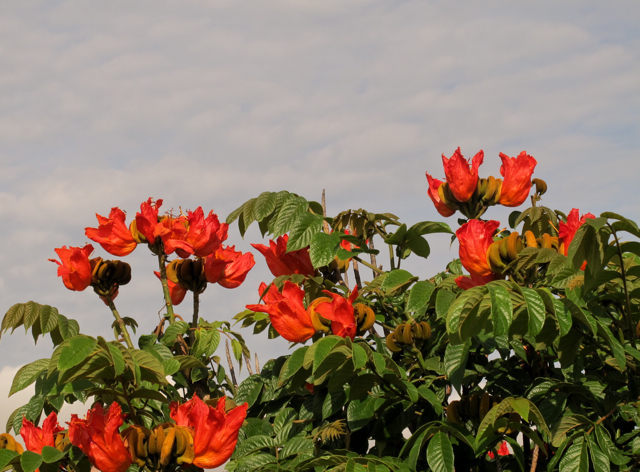
African Tulip tree reddish orange blossoms

We had a black and white TV back then and so, if they even showed the “Flame Trees,” they never “registered.

African Tulip tree reddish orange blossoms

However, here I am in Oaxaca, Mexico and I’ve got two African Tulip Trees (aka, Flame of the Forest) hovering over my terrace, bursting with color, providing a modicum of shade, feeding the hummingbirds, and adding to the enchantment of Casita Colibrí.

African Tulip tree reddish orange blossoms

There was something about the sky, the light, and the trees this morning…

Read Full Post »

I must confess, I’m partial to Teotitlán del Valle and this fiesta.  It was photos from the 2007 celebration that first persuaded me to visit Oaxaca.  However, this is it… I promise… no more photos from the Preciosa Sangre de Nuestro Señor Jesucristo in Teotitlán del Valle until next year!

This slideshow requires JavaScript.

However, if you, like me, can’t get enough… check out Chris’s photos over at Oaxaca-The Year After.

Read Full Post »

A brief slice from the hours and hours of dancing done by the Danzantes de Promesa, in the plaza in front of the church in Teotitlán del Valle, during the multi-day fiesta honoring Preciosa Sangre de Nuestro Señor Jesucristo.

The Danza de la Pluma consists of 41 “bailles” (pieces of music) that, on the surface, reenact the conquest.  Cortes and his troops are played by very young through teenage boys.  They occasionally march around, but mostly stay seated.  The Danzantes representing the Aztec, on the other hand, are young (and not so young!) men and dance at least 70% of the time.  In addition, Moctezuma has some solos and La Malinche and Doña Marina perform several lively dances.

A 20+ piece orchestra accompanies the dancers, playing the proscribed music, including, incongruous to me, waltzes, polkas, and schottisches. According to the Harris article referenced below, at the end of the 19th century the orchestra replaced the original indigenous drum and flute.

The subtext and “hidden” narratives of the danza are multiple and complex and I’m only in the infant stages of understanding.  For now, until my Spanish language skills improve significantly and I can talk with someone who is a member of the community, I will leave it to the two scholarly articles listed at the end of this post to attempt interpretation.

By the way, the day was overcast and windy at times, with gusts threatening those enormous and extremely top-heavy headdresses.

References:

Cohen, Jeffrey.  Danza de la Pluma:  Symbols of submission and separation in a Mexican Fiesta.  Anthropological Quarterly, Jul 93, Vol. 66 Issue 3, p. 149-158.

Harris, Max. The Return of Moctezuma.  The Drama Review, Sp 97, Vol. 41 Issue 1, p. 106, 29 p.

Now that I’ve done some research (alas, after the fact)… I want to see it again!

Read Full Post »
After all the waiting, the calenda (parade) of the Preciosa Sangre de Nuestro Señor Jesucristo began winding its way from the church courtyard down the narrow streets of Teotitlán del Valle and back up to the courtyard.

Arms raised, the unmarried young women of the village carried these bamboo-framed canastas floreadas above their heads for the entire route.

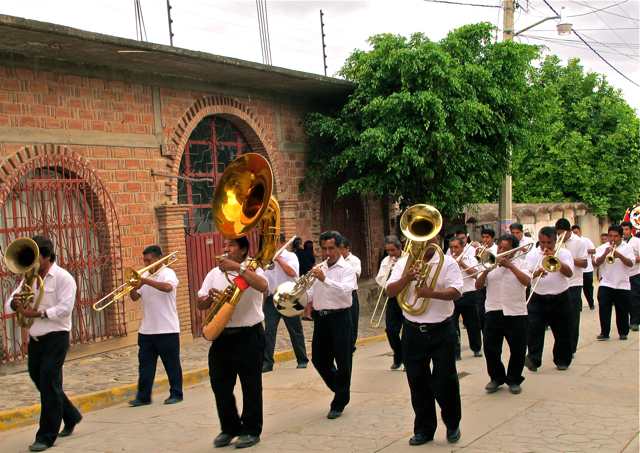
And, naturally there was a band… with the requisite tuba!

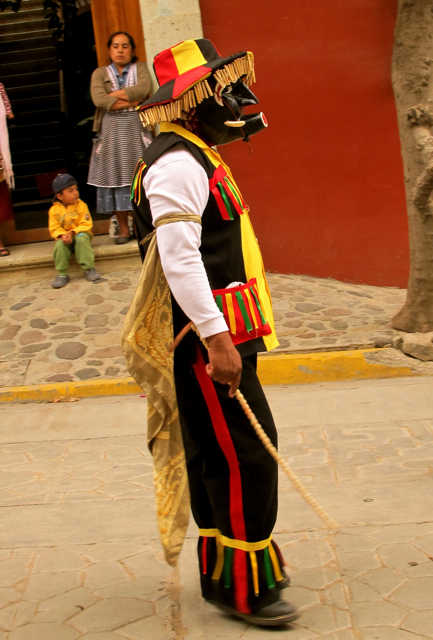
This Subalterno (one of two who keep their eyes on the festivities) kept the procession moving along…

including the young Soldaditos of Hernan Cortes.

They were followed by the Danzantes de Promesa (note the other Subalterno to the far right)…

and bringing up the rear, Moctezuma with the dual personalities of the same woman, La Malinche and Doña Marina.

In this village, known for its weaving, a complex tapestry of religious ritual, historic legend, and tangled mythology has been woven together to celebrate community and identity.

Definitely worth the wait… AND there’s more to come!

Read Full Post »

The participants also did a lot of waiting…

This slideshow requires JavaScript.

How do they remain in such good humor???

Read Full Post »

Waiting is something one does here… and, no matter what the age, it always seems to be done with a Zen-like patience.  Today it was for the traditional calenda of the Preciosa Sangre de Nuestro Señor Jesucristo  in Teotitlán del Valle.

This slideshow requires JavaScript.

More on the fiesta in upcoming posts…

Read Full Post »

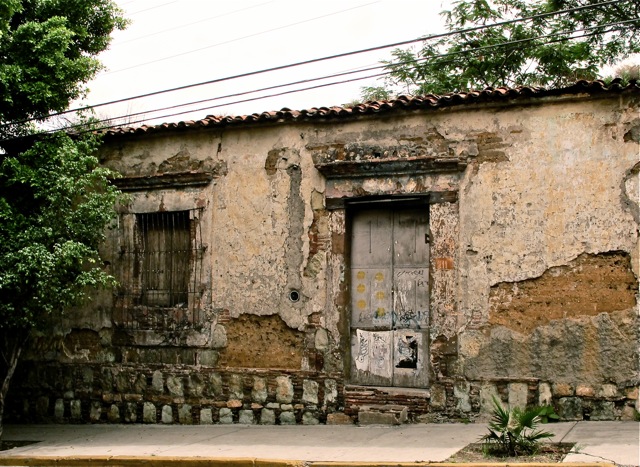
Viejas peligrosas was the headline of an article in yesterday’s Noticias, chronicling the dangerous old buildings in the 484-block historic center of Oaxaca.  According to the article, 23 properties are at high risk of falling, are magnets for trash disposal, and are sources of disease.

Although en español, I encourage even non Spanish speakers to take a look at the revealing slideshow of some of the more egregious, but highly photogenic, properties at the end of the article.

In addition, I’d like to nominate this building:

Front of dilapidated building

And, what do you think about the roof???

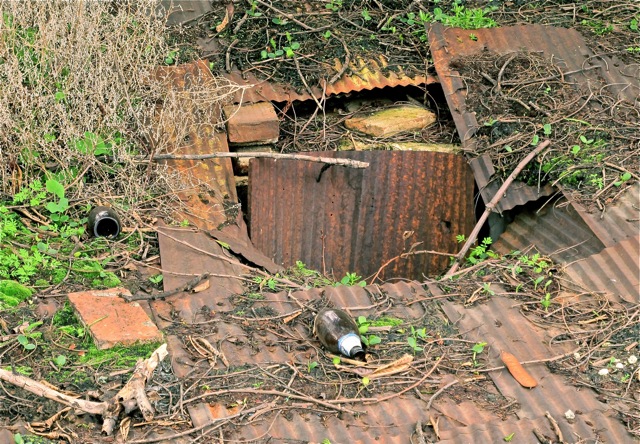
Collapsing tin roof

Read Full Post »

Sadly, the tree mentioned in my last post didn’t fall as a result of wind and rain.   According to newspaper reports, it was slammed into by a Chevy Silverado; the driver apparently had fallen asleep at the wheel.

Sidewalk memorial to Victor D. Diaz Gonzalez

Víctor Damián Díaz González was killed instantly.

Read Full Post »

« Newer Posts