December seems to be quite a month for the Virgins of Oaxaca.
December 8, I was awakened by cohetes (rockets… all bang, no bling) at 4:45 AM. They continued sporadically until about an hour later, when wildly clanging church bells heralded a non-stop barrage of more cohetes for several minutes… they eventually faded away, but a banda was heard in the distance.
It was the feast day of the Virgin of Juquila (La Virgen de Juquila), one of Oaxaca’s own. According to legend, in 1633, when a fire burned the small Chatino village of Amialtepec to the ground, a small statue of the Virgin Mary was rescued amidst the ashes. It was a miracle; she was undamaged, save for her light skin color, which was permanently darkened by the smoke… causing her to look more like the Chatino people, who revered her.
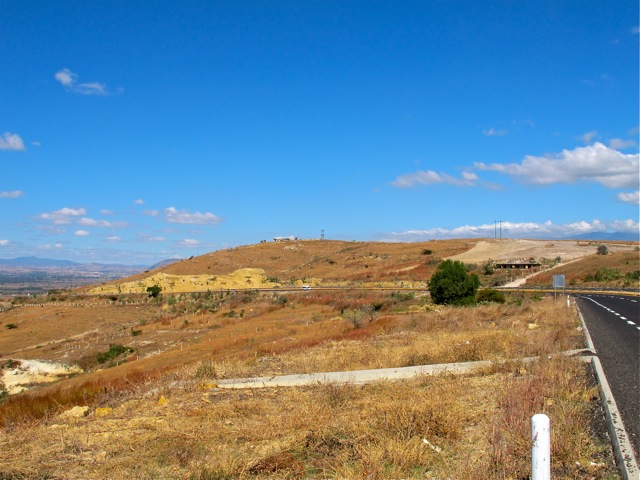
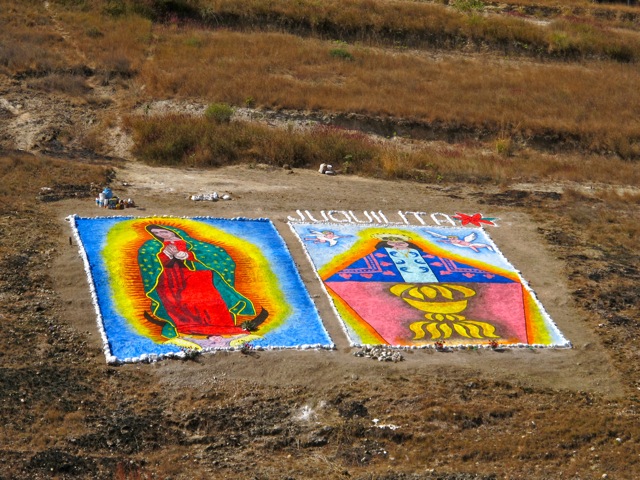
Here she is, in a field alongside La Virgen de Guadalupe, almost at the crest of the new carretera between Oaxaca and San Martín Tilcajete.
La Virgen de Guadalupe on the left and La Virgen de Juquila on the right.
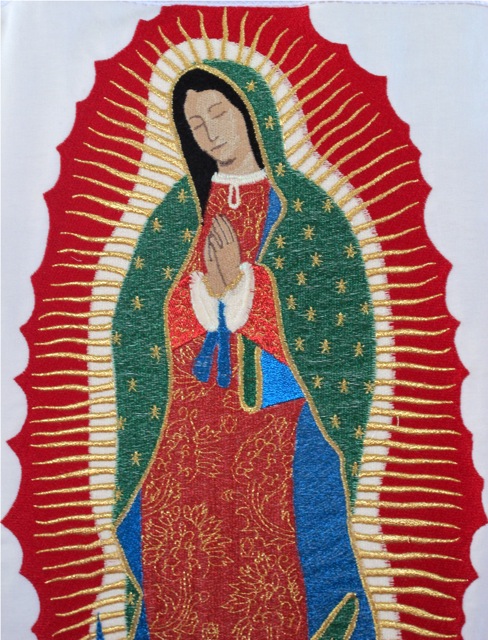
The Virgin of Guadalupe had her day only four days later, on December 12. La Virgen de Guadalupe is known as the Queen of Mexico and Empress of America, and is the patron saint of México. Reports estimate that 5.8 million of the faithful made the pilgrimage this year to Basilica of Our Lady of Guadalupe in Mexico City to honor the dark-skinned virgin who appeared to Indian peasant Juan Diego on Dec. 12, 1531 near what is now Mexico City.
In Oaxaca, worshipers flocked to the Chapel of Guadalupe at the north end of Llano Park and a carnival filled the park for all the little Juan Diegos and girls in period costume to be entertained. However, I headed out to Teotitlán del Valle to see this Zapotec village honor La Virgen de Guadalupe with their traditional Danza de la Pluma. Several of the Danzantes (dancers) were wearing capes woven and embroidered especially for this day…
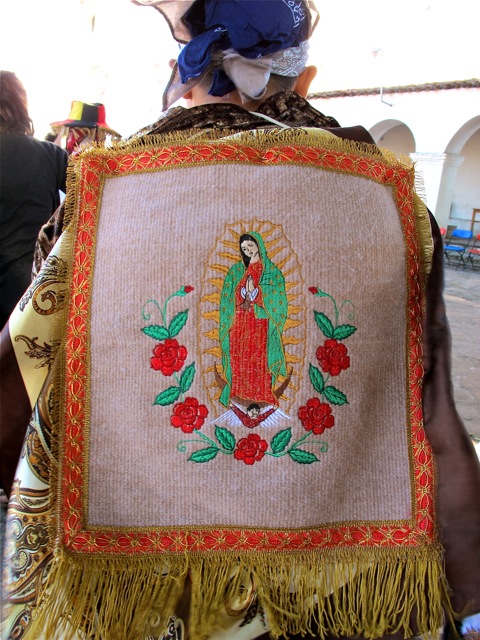
The weaving and embroidery were spectacular!
And, at least one of the Danzantes had an image of the Virgin of Guadalupe in the middle of his corona (feathered headdress).
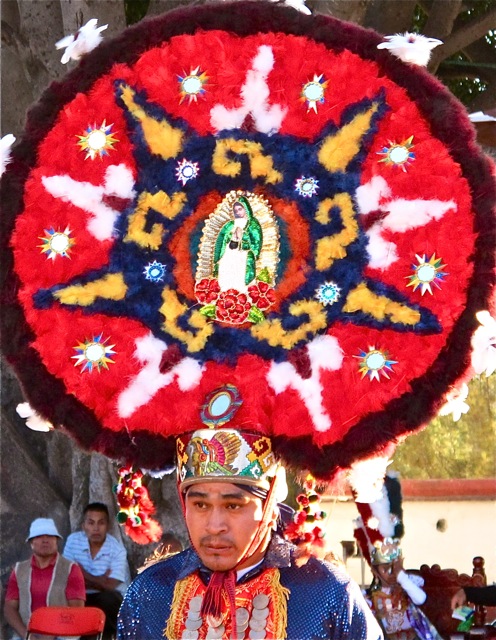
Malinche and Doña Marina also had similar images on the skirts of their dresses. To see those and several other photos of the dancers, you should take a look at what Chris has posted at, Oaxaca-The Year After.
Next on the “Virgin” calendar is December 18, the feast day of La Virgen de la Soledad (the Virgin of Solitude), Oaxaca’s patron saint. Stay tuned…


 Mexican Peso Converter

 View From Casita Colibrí