
Archive for the ‘Holidays’ Category
Feliz Navidad
Posted in Holidays, tagged Christmas, Navidad on December 23, 2010| Leave a Comment »
November, where did you go? Part 1
Posted in Culture, Holidays, Religion, Remembering, tagged Atzompa, celebrations, cemetery, Day of the Dead, Día de los Muertos, Día de Muertos, Mitla, Oaxaca, ofrenda, panteón, ritual, Xoxocotlán on November 27, 2010| 2 Comments »
November has come and now is almost gone. Time accelerated. Where did it go? Retired life… I thought it would slow down… apparently not when one lives in Oaxaca. There’s too much to see and experience!
Los Días de Muertos
The month began with Los Días de Muertos. I signed-up to accompany my extraordinarily energetic Spanish teacher, Laura Olachea, on two “field trips.” About 30 of us (her students and their guests) boarded a bus the night of Oct. 31, bound for the old and new cemeteries of Xoxocotlán. Tens of thousands of tourists (overwhelmingly Mexican) seemed to have descended on this small village, the bus was forced to park 8-10 blocks away on a dirt side street, the sky was pitch black, and there were no street lights. Somehow, we all managed to keep up with our tiny maestra as she lead us through the crush of people and vendors (food, drink, sugar skulls, candles, you name it!) to the old cemetery.
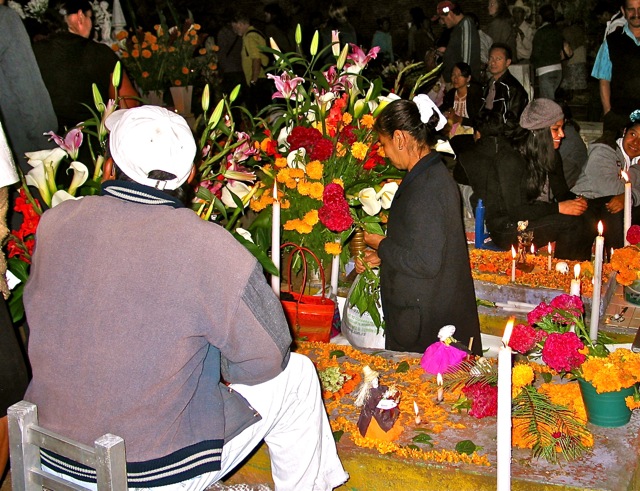
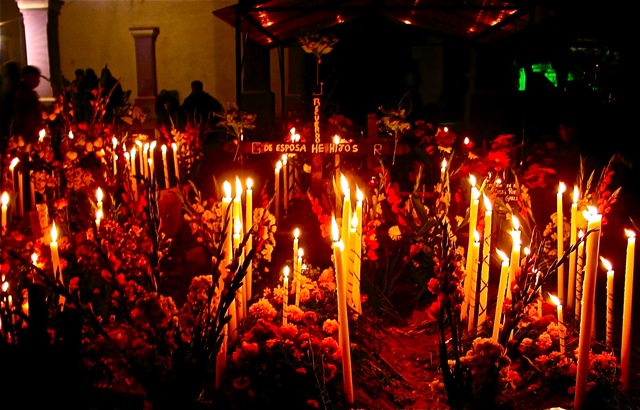
I plunged in. Heeding Laura’s advice to travel in groups of 3-4, I tagged along with a couple, chosen because he was at least 6 feet tall and I figured he would be easy to keep in eye range. The scene was like nothing I’ve ever seen before… a cornucopia of candles, by the thousands, flickering in the darkness; of color from the marigolds, cockscomb, and lilies; and of hundreds of families gathered around lopsided graves, drinking, sitting, laughing, and sharing in a ritual that recognizes that death is part of life. The scene was repeated at the new cemetery, before we stumbled our way back to the bus, which spirited us to the tiny pottery village of Atzompa and its panteón, well after midnight: Stage and dance floor, band playing, couples dancing, flowers, candles glowing in the darkness, families, few tourists, deeply personal, and magical… I felt like an intruder.
Though it was close to 1:30 AM when the bus dropped me off a block and a half from Casita Colibrí, I was up and back on the bus at 10 AM, for the ride to Mitla with Laura and our gang. We had the privilege of being guests of the García family, invited to participate in their Zapotec Day of the Dead traditions. We were welcomed to their home, a traditional family compound, with rooms surrounding an enormous dirt courtyard, with clotheslines holding newly dyed skeins of yarn (this is a family of weavers). Cervesas were offered, and then, in accordance with age-old custom, we followed the recently widowed family matriarch through the dusty streets to the Panteón Municipal. Here, holding the three-legged incense burner, the sweet and seductive smell of the burning copal perfuming the air, Doña Garcia performed a ceremony with words spoken in Zapotec.
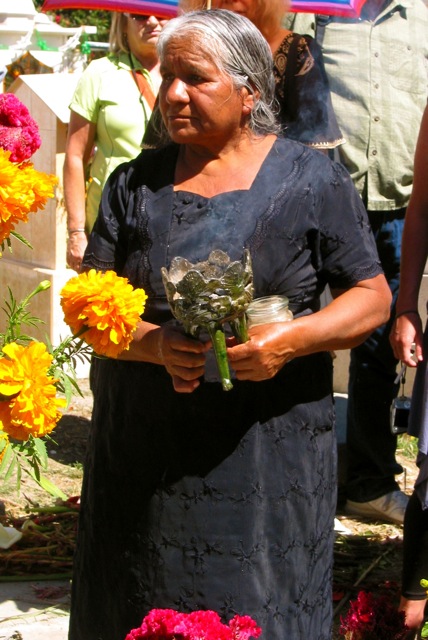
Mezcal and cigarettes were passed around. Joining the others, I drank the Mezcal and deposited my cigarette on the grave of the departed, where it joined several others — smoked and, like mine, un-smoked. With fireworks erupting periodically, we retraced our steps, following Doña Garcia and the smoke of the copal, as she brought the spirit of her late husband, Rutilio Garcia, back home to share the day with his family.
We returned to the lovingly assembled altar set-up by Doña Garcia. It was here, in front of this colorful altar, laden with flowers and food, including the intricately decorated pan de muertos that echoes the designs of the archeological ruins in Mitla, words were spoken in Zapotec and Spanish and tears traveled down many cheeks. Following this extremely moving ceremony, chairs were set up around several long tables where we joined the family in drinking Oaxacan hot chocolate, feasting on pan de muertos and mole negro, served, of course, with tortillas.
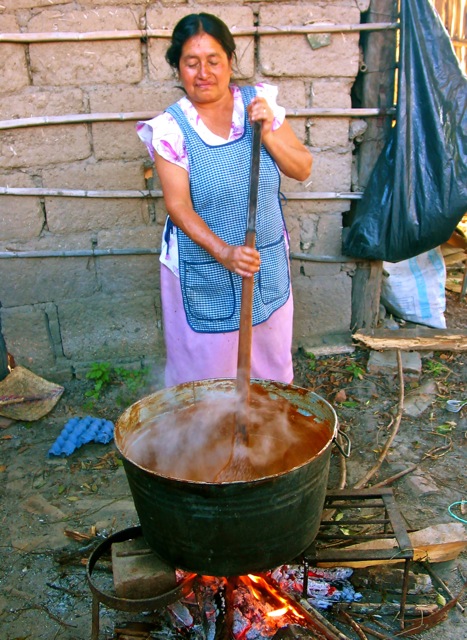
Satiated, it was probably a good thing that we were then led on a walking tour through this City of the Dead, to visit several other altars. Gracious families ushered our group through courtyards. At one, we paused to marvel at a woman, standing over an open fire (on this 80+ degree day), stirring a massive cauldron of mole,
We gathered in modest homes where families “introduced” their departed and proudly explained the significance of items on their altars. Hot, exhausted and deeply moved, a much quieter crowd returned to the García home. We were offered a final shot of mezcal, said our heartfelt thank-yous, and boarded the bus for the trip back to the city.
I returned home in time to watch my San Francisco Giants win their first World Series crown since 1954, when they were the New York Giants. After my initial hurrahs, my head couldn’t help but turn from the TV to my small Day of the Dead altar; where, along with photos of my parents, mother and father-in-law, and departed friends, my eyes settled in the center of the altar, to a photo of my grandparents.
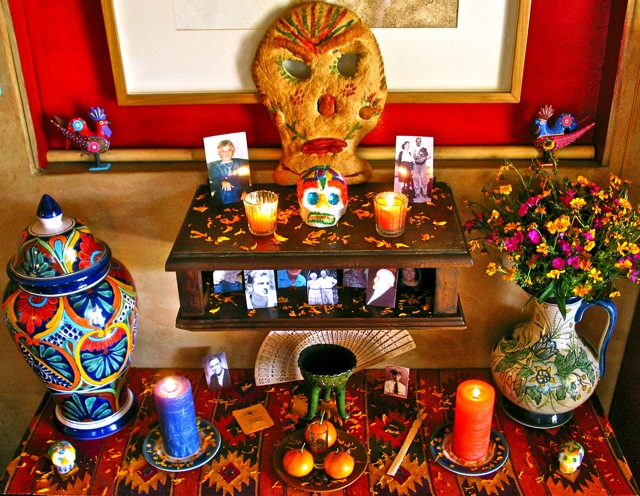
They had moved next door to my childhood home in Mill Valley about the same time the Giants moved to San Francisco, and it was then that Grandpa introduced me to baseball. We listened to Russ Hodges and Lon Simmons call the games and I put up a team photo (Willie Mays, Orlando Cepeda, Juan Marichal, Willie McCovey, Felipe Alou, Stu Miller, Mike McCormick, Jose Pagan, Jimmy Davenport, Hobie Landrith…) on the wall of my bedroom; grandfather and granddaughter cheering, agonizing, and bonding. I took my Giants cap off, walked over, and put it on the altar.
478 and counting…
Posted in History, Holidays, tagged calendas, celebrations, Happy Birthday Oaxaca, history, Mexico, Oaxaca, parades, photos on April 26, 2010| Leave a Comment »
Oaxaca is old! As a cursory glance at Mixtec and Zapotec history and their descendants will tell, this valley has been settled for thousands of years.

However, yesterday the city celebrated its founding as a colonial city, marking the 478 years since Spanish settlers (their bloody way paved by Hernán Cortés and his conquistadores) successfully petitioned the Queen of Spain for a land grant of 1 square league. The colonists had already established their own town on the site of Huaxyacac, renamed it Antequera (after an old Roman city in Spain) and received a Royal Charter from King Charles I of Spain. However, Cortés had successfully gotten the entire Valley of Oaxaca (hundreds of thousands of acres) declared as his own private marquisate and, his greed knowing no bounds, kept trying to evict the colonial townspeople. By obtaining the queen’s charter, this end-run around Cortés insured the rights of the townspeople to the land. Thus, April 25th continues to be celebrated as Oaxaca’s birthday.
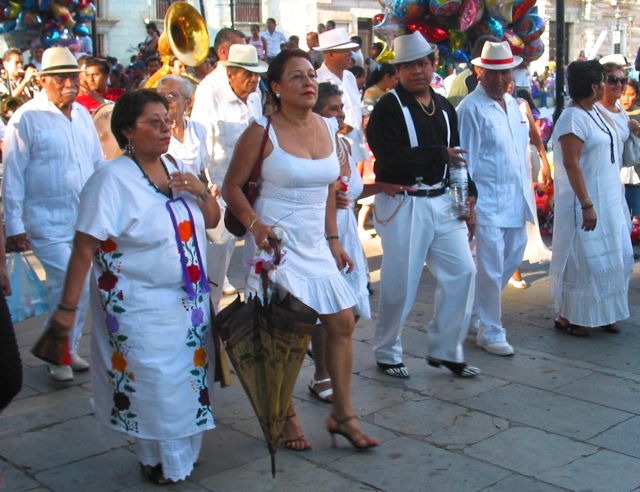
Saturday night I had a ringside seat on my terrace for fuegos artificiales (fireworks) — first emanating from the vicinity of the ex-convento of Santo Domingo (6 blocks to the NE), followed by those sent up into the night sky from La Basílica de Nuestra Señora de la Soledad (AKA: my backyard). Sunday morning, I was awakened at 6:05 to the sounds of Lady Soledad’s bells chiming — more musical than the usual clang-clang-clang — for a full 5 minutes, along with the rat-ta-tat-tat of firecrackers, adding exclamation points!
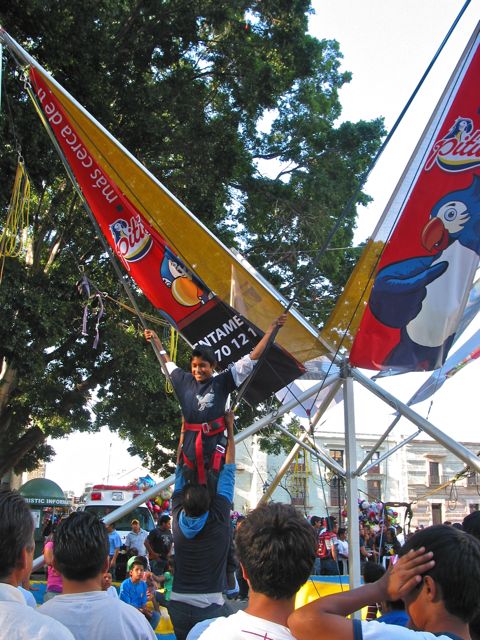
I went down to the Zócalo a little before 6pm — the calenda (parade) hadn’t yet arrived, but the place was teeming with people (mostly all Mexican). Payasos (clowns) were in abundance, but the big hit was a bungee cord contraption suspended above a trampoline. A guy would harness a kid to the cord, jump up and down on the trampoline with his arms around said kid and once momentum was achieved, let go and send the kid sling-shot-like up into the sky. Yikes, the way several of the kids were flaying around, I thought someone was going to break a back.

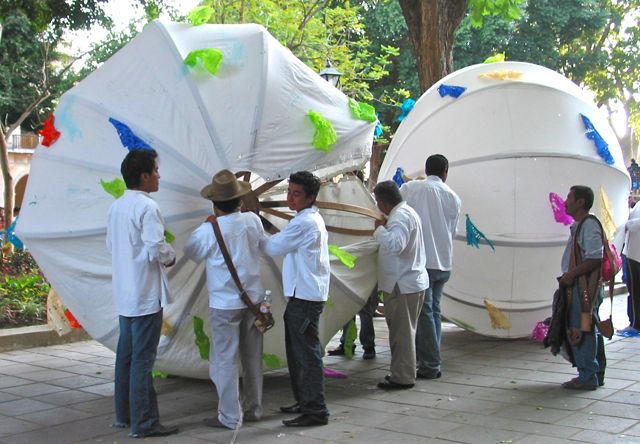
For the 3rd day in a row, temperatures continued to be in the high 90s, unseasonably hot even for Oaxaca so, for the second day in a row, I hit the ice cream shop — this time for a scoop each of peach and banana (in a cup, no cone this time… less messy as it melted) — a great combination! The calenda eventually arrived with all the usual suspects — several brass bands, municipal honchos, dancers in costume, monos (giant puppets — see above photo), etc. Did I mention, it was really hot? There I was, dripping wet, confining myself to the shade of the Zócalo’s 135+ year old towering Indian laurel trees, and eating ice cream when these participants (of all ages, I might add) had walked, played, and danced their way under the blazing sun for 13 blocks from Llano Park!

After 13 blocks, she didn't look any worse for wear!

Guys unmasked.

Feeling the heat... the pause that refreshes!
That's all folks!
Semana Santa — Oaxaca style
Posted in Holidays, tagged Easter, Oaxaca, ritual, Semana Santa, Teachers union on April 8, 2010| Leave a Comment »
Evidence of Semana Santa began days before Palm Sunday; the streets and sidewalk cafés began filling with Mexican and international tourists; street vendors began blanketing the Zócalo, the Alcalá, and any and all gathering places; and the front of the Cathedral was lined with local artisans — the dark faces and strong compact bodies of native craftsmen and women weaving palm fronds into intricate flowers and crucifixes to sell to the faithful (and tourists) for Palm Sunday rituals.

Palm Sunday – I awoke early to the sounds of construction. From my terrace, I could see a giant awning being erected on the Plaza de la Danza next to the Basílica de Nuestra Señora de la Soledad. Following a quick shower and breakfast, I grabbed my camera and woven palm frond and headed over there. Food stalls with hot comals, tables and benches, and a beckoning aroma spilled down the stairs next to the Plaza – squash blossoms, mushrooms, cheese, tortillas, red and green hot sauces — the fixings for empanadas – and I asked myself, “Why did I eat a boring breakfast of cereal?” More artisans weaving and selling palm fronds lined the stairs nearer the Basílica.

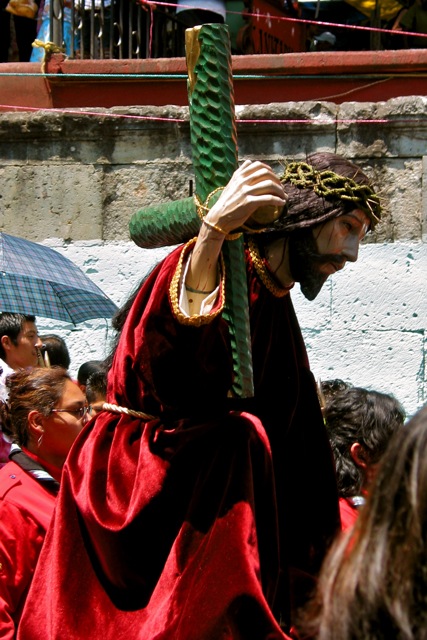
Massive sculptures of Jesús, bent under the weight of the cross he is bearing, and Lady Soledad, in her deep purple mantle, gold crown and halo, were set up outside, as was a small stage. La misa was celebrated outside (to accommodate the enormous crowd, I’m guessing); the youthful choir, accompanied by a guitar, sang folky-sounding songs, cheers were chanted to the cadence of “rah, rah, sis boom bah!” and palm fronds were raised and blessed with holy water. I wandered through the crowd (I’ve noticed a degree of fluidity exists among worshippers here, even inside churches, so I wasn’t the only one roaming around), one of only a handful of gringos in this congregation of 600+ mostly indigenous faithful. I had pretty much no idea what was being said but did offer my right hand when it looked like all were to greet their neighbors — and was greeted with startled but warm smiles and handshakes.

I returned home, but first peeked through the rarely open large red door of the Holy Trinity Anglican Episcopal Church nearby; 15-20 people standing in a circle in a small courtyard. Quite a contrast!
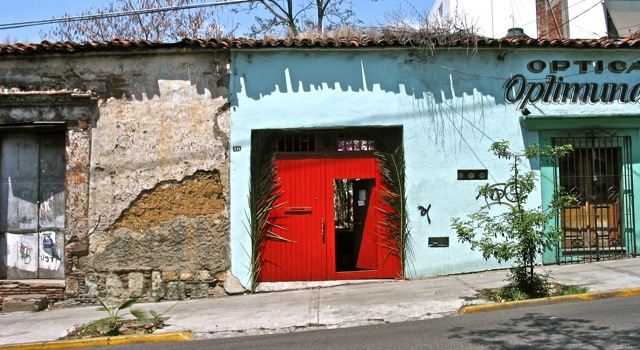
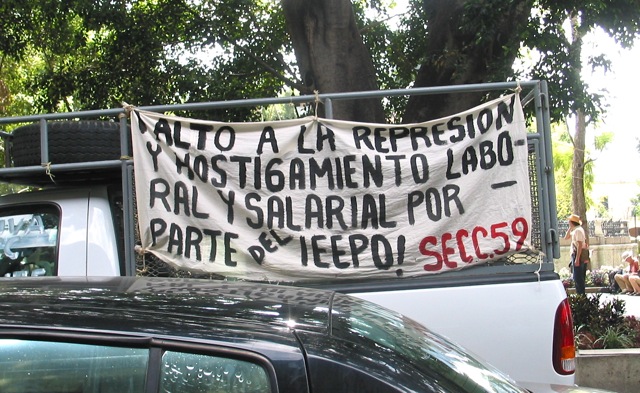
Religious ritual wasn’t the only event of the day; a Secc. 59, teachers’ union car caravan from Juchitán (about 150 from miles away) occupied part of the Zócalo – a peaceful reminder of the ongoing struggle between the teachers’ unions and the government. And, in the evening, sounds of a live (and free!) rock concert blared from the massive stage (I had heard being set up before the crack of dawn) in the Plaza de la Danza. As is routine here, a fireworks display exploded only a few hundred yards above the heads of the concert-goers (and a little above eye level from my terrace, less than 2 blocks away) – all courtesy of one of the opposition political parties – PRD, I think. The color, community, and contrast that is Oaxaca!
Jueves Santo – After a morning spend hand-washing “delicates” and tending to my garden, followed by an afternoon of Spanish lessons and shopping for fruit, veggies, and tortillas, with my portable fan on high (it was in the 90s), I collapsed on my bed for a late afternoon siesta. Unfortunately, that meant missing the 5 pm (give or take) mass and washing of feet apparently at all the churches in the city. However, after a dinner of tacos made with my newly purchased tortillas, aguacate, cilantro, Queso Oaxaca, lechuga, y pollo and washed down with Valle Redondo California Vino Blanco (my new favorite cheap wine), I reluctantly put on long pants (one doesn’t wear shorts in public in the city), grabbed my camera, and emerged from the refuge of Casita Colibrí, unwashed feet and all, to join the people-moving throngs.
Ritual called for visiting 7 churches, though pretty sure I wasn’t going to make it to 7, I figured I’d give it the good old college try. My first stop was San Felipe Neri where, at the entrance, I purchased a bag of Pan Bendito (5 buns for 10 pesos) and the followed the faithful down the aisle toward the altar and out a side door (I didn’t stop to get my Pan Bendito blessed), a traffic pattern that was repeated at the other churches, some with entrance and exit signs tacked on the doors, all in the interest of preventing gridlock that threatened. Clutching my bag of pan, my next stop was at Carmen Abajo, followed by the Cathedral, and Sangre de Cristo.

My plan was to end the evening minutes from my apartment, at the Basílica de La Soledad, where I could reward myself with a “Nieves Oaxaqueñas” (Oaxacan ice cream) of leche quemada (burnt milk) and tuna (not fish! fruit from nopal cactus) at El Jardín de Socrates, next to the church. The Basílica was closed, but some sort of mass was being celebrated in the plaza outside. So my question was, does that count as one of the seven? I pondered this deep theological question as I tried to eat my nieve slowly enough so as not to get the inevitable brain freeze. Last stop was at San José a small church across the Plaza de la Danza from Soledad, and even closer to home.
I’ve come to see Oaxaca as a city of contradictions, and the evening’s ritual was no different — sidewalks jammed with people in a combination of a semi-solemn pilgrimage, street festival, family night at the fair, and date night. A balmy evening; streets teeming with young, old, and everyone in between; loud music blaring from clubs; lively conversations flowing from the open windows of restaurants; every kind of street vendor seemingly doing a booming business; and lots of young April-love canoodling going on!
Viernes Santo – I slept later than usual and slowly went about my morning routine, knowing tonight was THE major event of Semana Santa – the Procesion del Silencio. However, as I was showering, from the open window I heard a slow, solemn drumbeat coming up the street — the unmistakable sound of a somber procession. I rinsed, dried, dressed, brushed my hair, was out the door, and onto Morelos in less than 10 minutes, to see the the backs of the slow moving multitude. Figuring they were headed to the Basílica, I ran down through the Plaza de la Danza and El Jardín de Socrates to the top of the retaining wall beside the stairway leading up from Independencia below, to the church above. Good move!

After about a half an hour, I had a ringside view as the statues of Jesús and Nuestra Señora de la Soledad made their way up the stairs right in front of me.
About 6 PM, I re-emerged from Casita Colibrí and headed up the Alcalá to La Preciosa Sangre de Cristo for the beginning of the Procesion del Silencio. Crowds had already gathered in front of the church, yellow caution tape roped off the street for participants to assemble, and banners were leaning against a nearby building. I joined the tourists (But, hey, I live here!) jockeying for good camera position to snap some pics, then retreated to the curb to sit and wait.


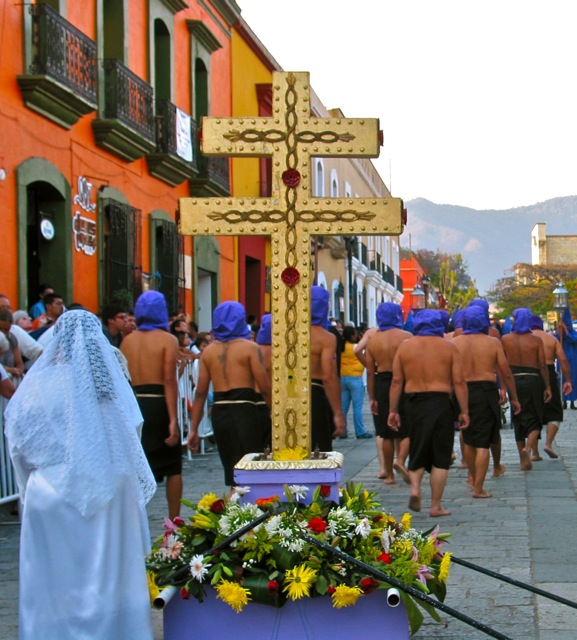
The procession began not long after sunset, but immediately took a left turn – ooops a change in route! The sidewalk populace immediately dispersed and I, pulling out my Spanish teacher’s route instructions (mil gracias!), ran over to 5 de Mayo where, in the darkness, I watched a grim, strangely moving, yet mystifying cortège. Night photos, punctuated by bright white, energy efficient street lights were equally obscure, but Flip video turned out better and I hope, eventually, to edit it into a short video vignette. We shall see…
By Saturday, I was “Semana Santa-ed” out! Perhaps next year I’ll make it to Sabado Santo, the celebration of fire and water. However, though I didn’t leave my rooftop refuge on Domingo de Resurreccion, the sound system of Nuestra Señora de la Soledad afforded me a bedside seat at the morning’s 6 AM outdoor Easter mass — the early hour more egregious because we had “sprung ahead” the previous night! And, no sooner had I finally been lulled back to sleep by the priest’s sonorous sound, than the flinchers (rocket explosions) began and I bolted upright. Bells followed and I gave up on trying to sleep. La misa lasted 2-1/2 hours; a mile high in the Sierra Madre, “He” has risen…
Want to translate this blog?
Where is Oaxaca?

Weather in Oaxaca?
What is the Exchange Rate?
-
Categories
-
Want to read recent posts?
- For the love of murals
- Numbers in my neighborhood
- Focusing on the joy
- ¡Feliz Nochebuena!
- Food glorious food!
- Of marigolds and fruit
- Serenade for the departed
- Beacon to my departed
- No Kings, Oaxaca style!
- Independence Day, Oaxaca style
- La Guelaguetza 2025 – live stream
- There and here
- Happy Birthday Oaxaca de Juárez
- A donkey not a warhorse
- Honoring the artisans
- Blogging in the time of…
- Valentine’s love from Oaxaca
- Taste of my return
- Felices fiestas to all!
- Month of Juquila, Guadalupe & Soledad
Archives
What tags are most used?
art artists Ayotzinapa Barrio de Jalatlaco Basilica de la Soledad Black and white photography cactus California Carnaval Carnival Casita Colibrí celebrations cemetery Christmas convite coronavirus fallout costumes COVID-19 fallout dance dancers Danza de la Pluma danzantes Day of the Dead Día de los Muertos Día de Muertos Easter El Picacho festivals Fiesta de la Preciosa Sangre de Cristo flowers food food festival garden Good Friday graffiti Guelaguetza Holy Week markets mascaras masks mercados Mexican Independence Day Mexico murals music Oaxaca panteón papel picado parade parades photographs photos plants Plaza de la Danza popular travel destinations protests restaurants San Antonino Castillo Velasco San Martín Tilcajete Semana Santa skeletons stencil art street art students Teotitlán del Valle textiles Tlacolula de Matamoros traje travel trees urban art video Viernes Santo Virgen de Guadalupe wall artWant to email me?
-

This work by spixl is licensed under a Creative Commons Attribution-Noncommercial-No Derivative Works 3.0 United States License.

 Mexican Peso Converter
 View From Casita Colibrí