Feeds:
Posts
Comments

Archive for the ‘Archaeology’ Category


Buried treasures continue to be found in Oaxaca.  Mexico’s INAH (National Anthropology and History Institute) reported this week another burial chamber has been uncovered at the nearby Santa María Atzompa archaeological zone.

Current findings in the tomb include this urn, which they date to sometime between 650 CE and 850 CE.

Red urn shaped like a human face.

Photo: Red anthropomorphic urn (EFE/INAH)

Here is an English language article that reports on these latest discoveries from the site.

Mexican Archaeologists Discover Ancient Zapotec Tomb

Published at 10:06 pm EST, August 16, 2012

The tomb of a high-ranking member of Zapotec society was found at a 1,200-year-old funerary complex in the southern Mexican state of Oaxaca, the National Anthropology and History Institute, or INAH, said.

Archaeologist in Zapotec tomb

Photo: Burial and offering (INAH)

The funerary complex, which has three burial chambers, was found about three months ago at the Atzompa archaeological zone, the INAH said.

Archaeologists managed to get into the third pre-Columbian burial chamber, which contained human remains that are likely those of a male, INAH archaeology coordinator Nelly Robles Garcia said.

The remains will be analyzed to determine the age, nutrition and health of the individual, as well as whether there are intentional deformities of a cultural nature.

Archaeologists found a fractured skull belonging to another individual next to the remains, leading them to conclude that it may have been an offering.

A small, black tubular pitcher and pieces of a vessel were also found in the burial chamber.

A red urn with a human face on it and other items were found in the grave, archaeologist Eduardo Garcia said.

The vessel, which is estimated to date back to 650 A.D. to 850 A.D., is 50 centimeters (1.6 feet) tall, archaeologists said.

“We are dealing with a building where the remains of people with a very high status were placed. Who they were and what role they played in Zapotec society is still to be determined based on the findings that are being made and their later analysis,” Robles said.

Archaeologists found the building, which was designed exclusively as a burial site, in late April.

The tombs are located one on top of the other and, unlike previous discoveries, are not underground.

One of the burial chambers is decorated with a mural of a ball game, a theme not found before in Zapotec funerary practices.

Atzompa was a small satellite city of Monte Alban, the main center of the Zapotec state that dominated what today is Oaxaca.

“This discovery changes the perception we had in the sense that it was not as similar to Monte Alban as had been thought but, instead, developed its own architectural expressions, such as in the case of tombs and palaces,” Robles said.

For more on the Santa María Atzompa archaelogical zone, take a look at a January 2012 article I reprinted on an Ancient Zapotec kiln discovered there.  The site is scheduled to open sometime this year.

Read Full Post »

At the top of my Oaxaca Yahoo! Alerts today…

GW professor’s research on ancient ballgame reveals more about early Mesoamerican society

GW anthropology professor Jeffrey Blomster’s research featured in PNAS journal

WASHINGTON—George Washington University Professor Jeffrey P. Blomster’s latest research explores the importance of the ballgame to ancient Mesoamerican societies. Dr. Blomster’s findings show how the discovery of a ballplayer figurine in the Mixteca Alta region of Oaxaca demonstrates the early participation of the region in the iconography and ideology of the game, a point that had not been previously documented by other researchers. Dr. Blomster’s paper, Early evidence of the ballgame in Oaxaca, Mexico, is featured in the latest issue of Proceedings in the National Academy of Sciences (PNAS).

Dr. Blomster, GW associate professor of anthropology, has spent 20 years researching the origin of complex societies in Mesoamerica. The participation of early Mixtec societies in ballgame imagery is a new aspect of his research. For the journal publication, Dr. Blomster worked with undergraduate students Izack Nacheman and Joseph DiVirgilio to create artistic renditions of the figurine artifacts found in Mexico.

While early games used a hard rubber ball, the ballgames Dr. Blomster researches bear little resemblance to today’s Major League Baseball. The games and the costumes or uniforms participants wore were tied to themes of life and death, mortals and underworld deities or symbolizing the sun and the moon. In some instances, the ballcourt itself represented a portal to the underworld.

According to Dr. Blomster, “Because the ballgame is associated with the rise of complex societies, understanding its origins also illuminates the evolution of socio-politically complex societies.”

During the Early Horizon period, or roughly between 1400 BCE (Before the Common Era) and 1700 BCE, there was little evidence of ballgame activity in the way of artifacts in the Oaxaca region of Mexico. Dr. Blomster’s findings of a clay figurine garbed in distinctive ballgame costume, similar to both Olmec figurines and monumental sculptures from the Gulf Coast, indicate such engagement did take place in the area.

“Exploring the origins and spread of the ballgame is central to understanding the development of the Mesoamerican civilization,” he said. “We know there were earlier versions of a ballgame prior to the Early Horizon with both a ballcourt and rubber balls found in coastal Chiapas and the Gulf Coast, but the institutionalized version of the ballgame, a hallmark of Mesoamerican civilizations, developed during the Early Horizon. While there has been some limited evidence about the participation of the nearby Valley of Oaxaca in the ballgame, the Mixteca has largely been written off in terms of involvement in the origins of complex society in ancient Mexico. This discovery reemphasizes how the ancient Mixtecs were active participants in larger Mesoamerican phenomenon.”

###

By the way, there was a lot more to these ballgames than mere athletic competitions — think ritual, conflict resolution, sacrifice.  Below is the ballcourt just up the hill at Monte Alban.

Ballcourt at Monte Albán

The stories it could tell…

Read Full Post »

Hurray for libraries and librarians everywhere!  Just like Oaxaca, you never know what you will find when you turn a corner in a library or archive. And, whether it’s wandering the streets or roaming the aisles, we can’t help but learn a little more about our world and ourselves. We need more occasions for big, goofy smiles. Don’t let your community cut funding to libraries!  –spixl

Photos on Flickr of Códice de Santa Catarina.

marquettehistory's avatarHistorians@Work

Laura Matthew on the secret life of primary sources and the responsibility historians have to them, and to each other, when documenting the past. 

I have been thinking about how documents are lost, then found.

A week or so ago, my friend and colleague Aims McGuiness from the History department at the University of Wisconsin, Milwaukee (UWM) left me a voice mail message. “There’s this mysterious document at the American Geographical Society Library here at UWM,” he said. “It looks colonial-era, and maybe Mexican. The librarians don’t know what it is, or how they got it. Could you come look at it?”

“Ooh, fun!” I emailed him back (yes, that’s a direct quote). “I can always make time for a lost document.”

Little did I know. A few days later, Jovanka Ristic and Kay Guilden at the AGS Library unrolled in front of me a piece of bark paper on…

View original post 1,015 more words

Read Full Post »

News of this discovery was posted on Facebook this morning by Sam, my young Zapotec friend from Teotitlán del Valle, who is currently getting his Ph.D. in Sustainable Manufacturing at the University of Liverpool.  A global village, it is!

By the way, Santa María Atzompa (mentioned below) is where I experienced a Magical and Mystical October 31st.  The article and photo are from today’s, Hispanically Speaking News.

1,300 Year Old Kiln Used by Ancient Zapotecs Discovered in Mexico

Mexican archaeologists have discovered in the southern part of the country a kiln used by the ancient Zapotecs to make ceramics more than 1,300 years ago, the National Anthropology and History Institute, or INAH, said.

Clay pot in ancient kiln

The pre-Columbian kiln was discovered in the Atzompa Archaeological Zone in Oaxaca state, which will be opened to the public this year, INAH said in a communique.

It added that this is one of the best preserved ceramic kilns ever found in the Zapotec area, and noted Oaxaca’s long tradition in making pottery.

According to Wednesday’s communique, the kiln “is a link between the pre-Columbian pottery tradition and the artisanal ceramics currently made in the community of Santa Maria Atzompa, establishing the connection between today’s inhabitants and their ancestors.”

Archaeologist Jaime Vera, head of the excavation, said the kiln “is thought to date back to the first years of the pre-Columbian settlement of the area, in other words, more than 1,300 years ago, which is deduced from the ceramics found with it.”

Another element that allows the kiln to be dated is the depth at which it was found – 2.2 meters (7 feet 2 1/2 inches) – “far below the layer of stucco that covered it, and which corresponds to that era, the archaeologist said, adding that further studies will be made to confirm its antiquity.

It was in the excavation period between March and December 2011 that the kiln was completely uncovered allowing its principal characteristics to be observed: a cylindrical adobe wall and shelves for placing the objects to be fired.

The kiln consists of a cylindrical adobe wall measuring 2.1 meters (6 feet 11 inches) from the surface to the firing shelves arranged in convergent lines toward the center, and a downdraft vent in the lower part approximately 20 centimeters (8 inches) wide,” Vera said.

He said that “while today’s kilns are not identical in dimensions or shelf arrangement, they do perserve certain basic elements and the function as a space for firing ceramics.”

The Atzompa Archaeological Zone, approximately 4 square kilometers (1 1/2 square miles), existed as a small satellite village of the Zapotec city of Monte Alban during the Late Classic period (650 B.C.to 900 B.C.) when the latter’s growing population expanded beyond its boundaries.

The work to provide the Atzompa Archaeological Zone with the necessary infrastructure will continue, since it is one of the pre-Columbian sites that will be opened to the public this year, INAH said.

Read Full Post »

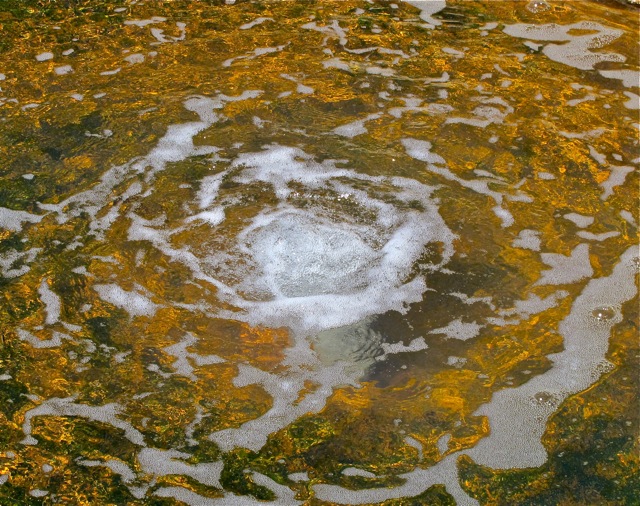
…at Hierve el Agua.  Well, it doesn’t actually boil; cool, mineral rich water burbles up from underground springs,

Water burbling up into a small pool

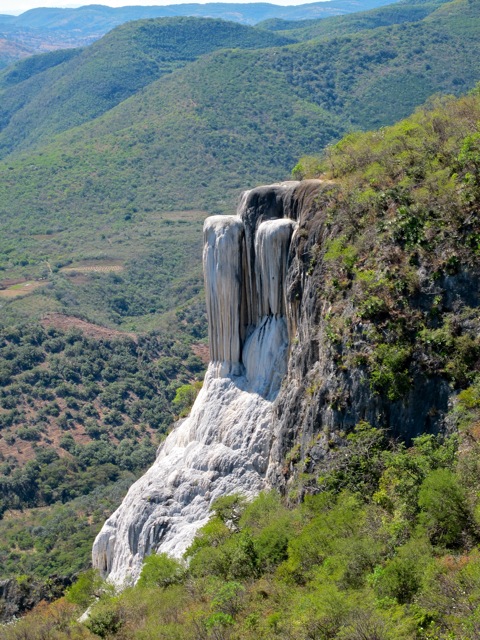
depositing calcium carbonate as it cascades over the two cliffs, forming the Cascada Grande…

Calcium carbonate "waterfall"

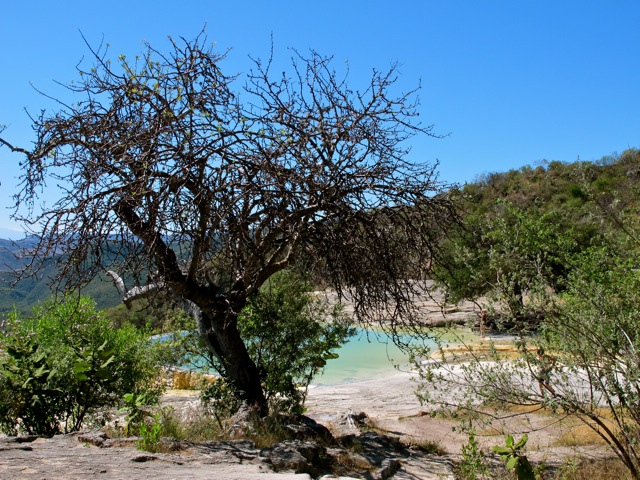
and the Cascada Chica.  To reach the latter, one must bounce along a dirt road that twists, climbs, and descends for at least a half an hour from Mitla, pay a 20 peso admission, park, and then walk a short way down a steep and rocky path to come upon a spectacular sight.

Tree in foreground, with pool and mountains behind.

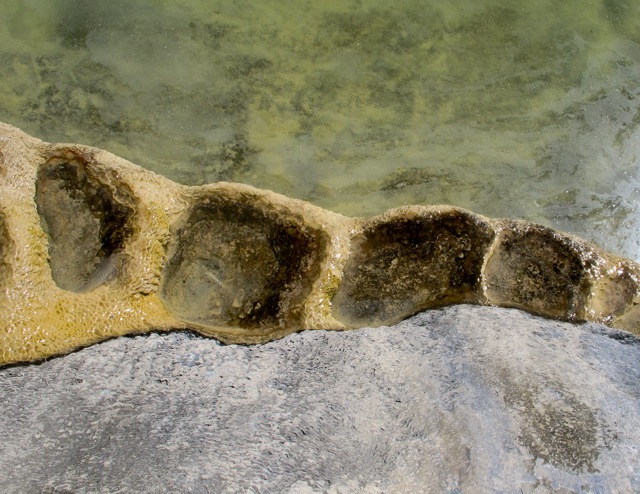
More than 2,500 years ago, a uniquely designed irrigation system was constructed to channel the waters.  (More information:  Ecotourism – Hierve el Agua)

Water and stone pockets

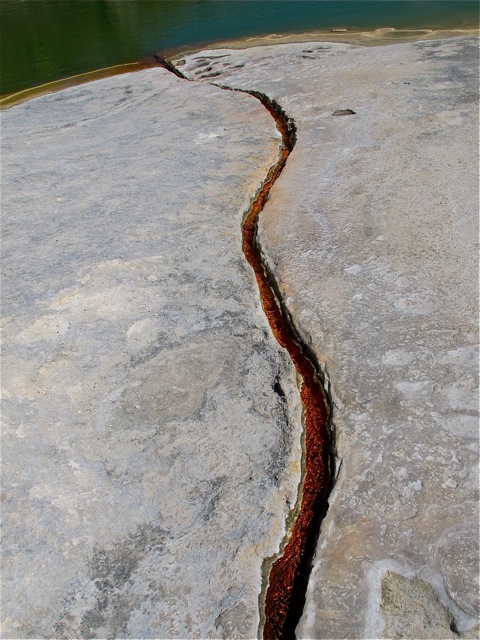
Iron stained troughs bring the mineral rich and supposedly healing water…

Rust-red stained trough

to two artificial, but tranquil pools above the Cascada Chica; peaceful at least on weekdays.  Rumor has it, the weekend scene is much more lively!

Green tinged water in pool on side of cliff.

Yesterday (a Friday), this dramatic take on an infinity pool had us all saying, aaahhh.

Pool dropping off over the cliff, with scenic background of mountains.

(ps)  A word to the wise (from the unwise), bring bug spray… though you may not see them, they (whatever they are) are there!  There are also food and trinket vendors, swimming is allowed, and bathrooms and changing rooms are available.

Read Full Post »

Yesterday’s trip to Zaachila began with the archaeological site, located right above the Church of Nuestra Señora de la Natividad.

View of Church of Nuestra Señora de la Natividad from Zaachila archaeological site

Zaachila, named for the pre-Columbian Zapotec king, Zaachila Yoo, was the last Zapotec capital, following the demise of Monte Alban.  It was eventually conquered by the Mixtecs, who were still there when the Spanish conquistadors appeared on the scene.

Entrance to Zaachila archaeological site

First excavated by archaeologist Roberto Gallegos in 1962, only a small fraction of the site has been uncovered.  However, visitors have access to two small tombs in mound A.

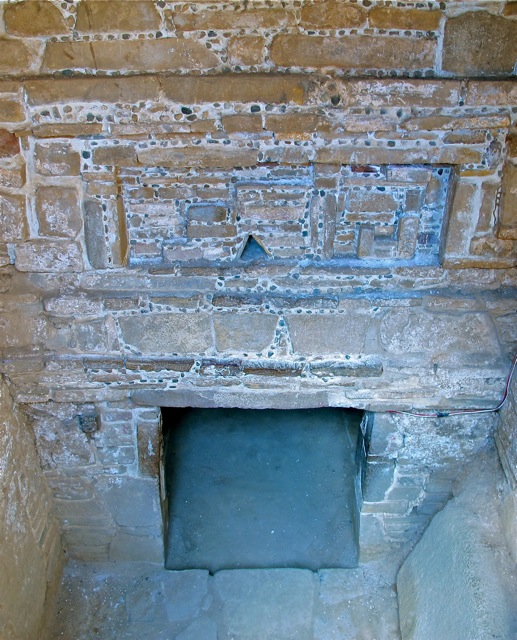
Facade of Tomb 2

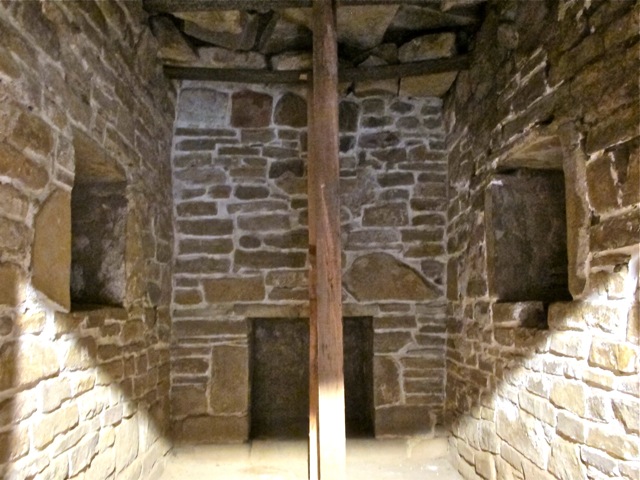
Tomb 2 is the much less decorative of the two, though it apparently once held jewelry and other valuable offerings, many, of which can be found in the Instituto Nacional de Antropología e Historia in Mexico City.

Interior of Tomb 2

According to the brochure available for purchase (10 pesos), Tomb 1 was constructed in the epoch III-A (250-650 CE) and reused in the Post-classic era (950-1521 CE).

Facade of Tomb 1

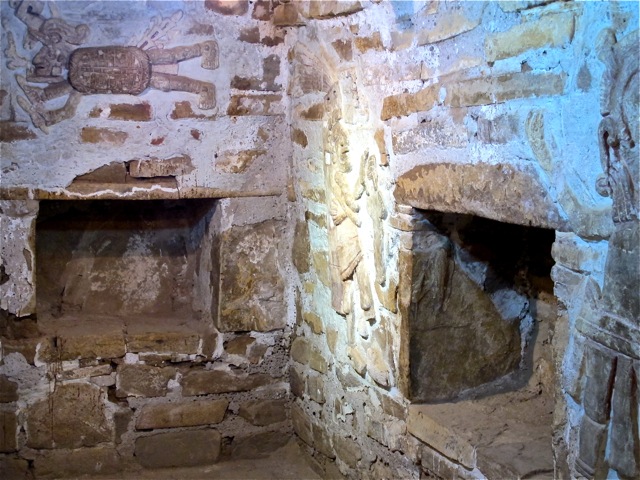
Seven figures adorn the walls of Tomb 1.

Figure of Yahui on far wall of Tomb 1

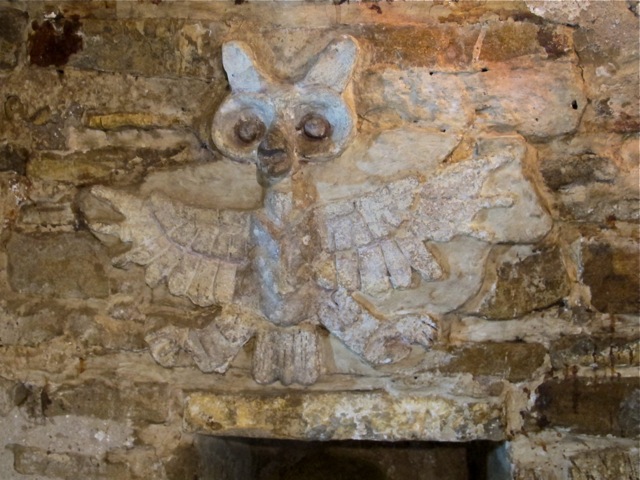
Figure of Búho (owl) on left wall of Tomb 1

Figure of Bújo (owl) on right wall of Tomb 1.

Figure on right wall of Tomb 1

Figure of Bezelao (a supreme god) on left wall of Tomb 1

Figures of 5 Flower and 9 Flower are also depicted but I couldn’t lean far enough over the barrier to photograph them.

The site recently reopened after being closed for several months.  Work continues…

Piles of stones under trees

The site is open Monday through Sunday from 8 AM to 6 PM.  A small museum collects the 31 peso admission fee, displays photos of many of artifacts removed from the site and on display in Mexico City, reproduction of parts of the Codex Zouche-Nuttall (housed in the British Museum), and photographs from other archaeological sites in Oaxaca.

For more information on the Mixtec Group Codices, take a look at the Foundation for the Advancement of Mesoamerican Studies website.

Read Full Post »

« Newer Posts